
What Is A Solana Phone: Models, Specs, And Who It's For


Editorial Note: While we adhere to strict Editorial Integrity, this post may contain references to products from our partners. Here's an explanation for How We Make Money. None of the data and information on this webpage constitutes investment advice according to our Disclaimer.
A Solana phone is an Android-based smartphone developed by Solana Mobile with built-in Web3 functionality. It allows users to store crypto, manage private keys, and use decentralized apps directly from the device. There are two models. The Solana Saga phone launched in 2023 as the first in the lineup. The Solana Seeker phone, originally called Chapter 2 during pre-order, started shipping in 2025 as a more affordable follow-up. Both include hardware-level key protection through Seed Vault and access to the Solana dApp Store.
In the world of crypto and Web3, innovation is no longer limited to software. Solana, one of the fastest and most popular blockchains, has pushed into hardware through its division, Solana Mobile. The result is a dedicated smartphone line designed for secure, direct interaction with digital assets.
The first generation, the Solana Saga phone, showed how a purpose-built Solana crypto phone could bring native Web3 features to a mobile device. The new Solana phone, the Solana Seeker phone, builds on that foundation with a lower price and broader appeal. In this article, you will learn what the Solana phone is, how both models compare, full specifications, airdrops, and who these devices are actually built for.
Risk warning: Cryptocurrency markets are highly volatile, with sharp price swings and regulatory uncertainties. Research indicates that 75-90% of traders face losses. Only invest discretionary funds and consult an experienced financial advisor.
What is a Solana phone?
A Solana phone is an Android-based smartphone with integrated Web3 functionality, developed by Solana Mobile. Devices like the Solana Saga phone and the newer Solana Seeker phone are built to let users store cryptocurrencies, manage private keys, sign transactions, and interact with decentralized applications (dApps) directly, without relying on third-party browser extensions.
The goal of the Solana mobile phone line is to make crypto interaction on a cell phone as simple and secure as sending a message. Instead of treating blockchain as an add-on, these devices embed it at the system level, turning the Solana crypto phone into a direct gateway to Web3.
Brief history of the Solana phone lineup:
Solana Saga (2023). The first official Solana Mobile smartphone, developed in partnership with OSOM Products. It served as an experimental step to collect user feedback and build a foundation for future devices.
Solana Seeker (2025). Originally known as the Solana Chapter 2 phone during its pre-order phase, the Seeker was developed using Saga owner feedback. It launched as a more affordable, mass-market Web3 phone with improved software features and a lower entry price.
Many early references to a Solana phone 2 or Solana Saga phone 2 were pointing to what eventually became the Seeker. There is no separate third model. The Solana mobile phone lineup currently consists of these two devices.
Solana phone models
The Solana phone lineup currently includes two models: the Solana Saga and the Solana Seeker. Each targets a different audience and price point, but both share the same core idea, a mobile phone built for native Web3 interaction on the Solana blockchain.
Solana Saga: the first Web3 smartphone
Solana Saga was the first official smartphone from Solana Mobile, developed in partnership with OSOM Products, a US-based hardware company. The device was designed in the United States and assembled in China.
| Feature | Details |
|---|---|
| Processor | Snapdragon 8+ Gen 1 |
| RAM | 12 GB |
| Storage | 512 GB |
| Display | 6.67" AMOLED, 120 Hz |
| Security | Hardware-integrated Seed Vault |
| Launch price | $1,000 (later reduced to $599) |
| Release date | 2023 |
| Designed by | OSOM Products (US) |
| Assembly | China |
The price of the Solana Saga phone started at $1,000 but dropped to $599 before the device sold out completely. The Saga gained major attention in late 2023 during the BONK token surge. Device owners received airdrops from Solana phones worth more than the original purchase price, turning the Saga from a niche experiment into a talked-about "infrastructure asset."
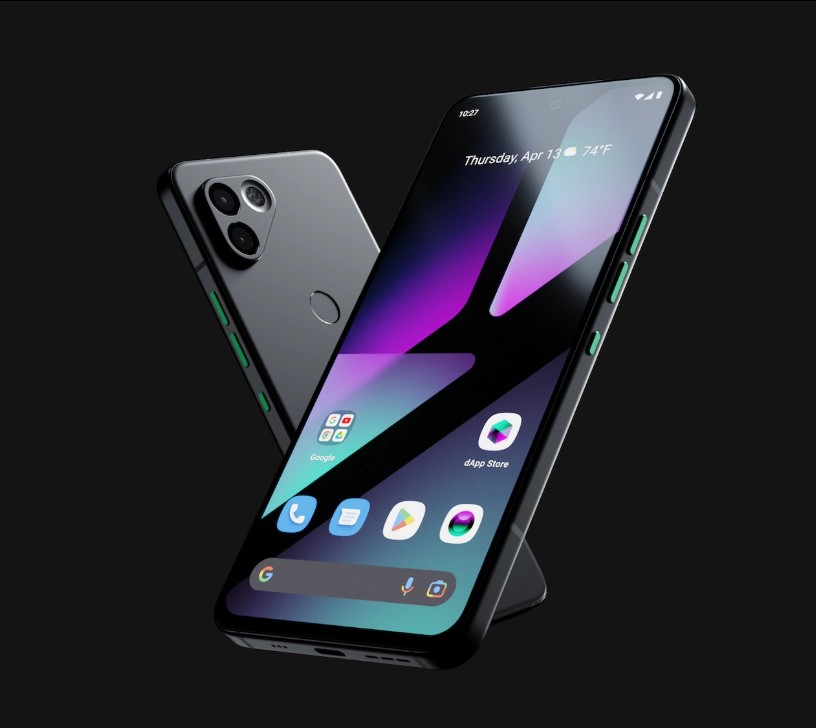
Today, the Solana Saga phone is only available on the secondary market.
Solana Seeker: a more affordable Web3 phone
The Solana Seeker phone represents the next step in the lineup. Originally marketed under the name Chapter 2 during its pre-order phase, the Seeker is positioned as a more accessible and mass-market Web3 smartphone. Pre-orders opened in September 2024, and the device started shipping in 2025.
| Feature | Details |
|---|---|
| Processor | MediaTek Dimensity 7300 |
| RAM | 8 GB |
| Storage | 128 GB |
| Display | 6.36" AMOLED, 120 Hz |
| Battery | 4,500 mAh |
| Operating system | Android 14 |
| Security | Seed Vault with biometric authentication |
| Software | dApp Store 2.0, Genesis Token support |
| Pre-order price | ~$450 |
| Launch price | ~$500 |
| Release date (pre-order) | September 2024 |
| Ship date | 2025 |
The main idea behind the Seeker is broader adoption. While the Saga was experimental and developer-oriented, the price of the Solana Seeker phone is nearly half of the original Saga launch cost, making it a realistic option for everyday crypto users.
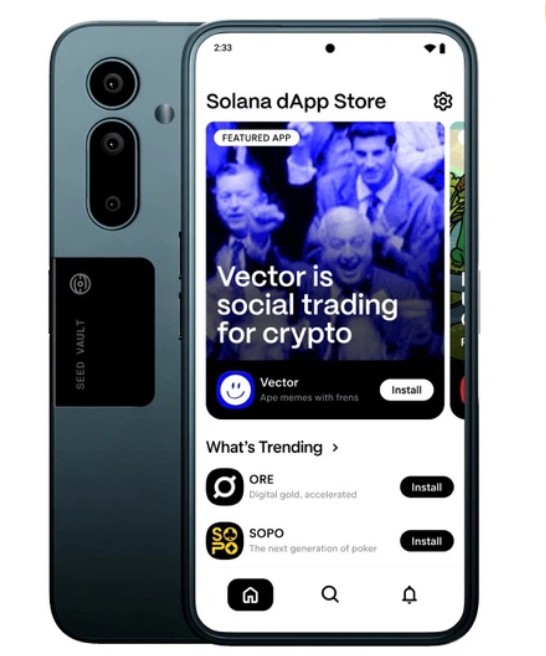
Like the Saga, Seeker owners may receive ecosystem bonuses. Early Solana Seeker phone airdrop campaigns and the Genesis Token have driven strong pre-order demand. However, airdrops are never guaranteed, a point covered later in this article.
Note: Many early references to the ‘Solana phone 2’, ‘Solana 2 phone’, or ‘Solana Saga 2 phone’ were all pointing to what eventually became the Seeker. There is no separate third device in the lineup. The release and ship date of the Solana phone correspond to the Seeker's 2025 launch.
How the Solana phone works
Every Solana phone runs on Android with an added blockchain layer built specifically for Web3 tasks. Users get a familiar experience for calls, messaging, and browsing, combined with system-level crypto management tools. This means the Web3 functionality is not a separate app but part of how the phone operates at its core.
There are four main components that define how the Solana mobile phone works:
Seed Vault. This is the security backbone of every Solana phone. It is a hardware-isolated storage environment for private keys, kept completely separate from the main operating system. When users sign a transaction, they confirm it through biometrics like a fingerprint or face unlock. This design makes it much harder for malicious apps to access keys compared to standard software wallets on a regular smartphone.
Solana dApp Store 2.0. Instead of relying only on the Google Play Store, the Solana phone includes its own curated catalog of decentralized applications. These dApps interact directly with the Solana blockchain and cover areas like DeFi, NFT platforms, and Web3 gaming. The Seeker ships with version 2.0, which has improved navigation and a wider selection than what was available on the Saga.
Native transaction signing. Transactions are signed directly at the system level without the need for browser extensions or third-party tools. This reduces friction for users who interact with decentralized exchanges, staking platforms, or lending protocols on a daily basis.
Genesis Token. Introduced with the Seeker, this token is received during pre-order or after device purchase. It provides access to exclusive programs, ecosystem rewards, and promotions within Solana Mobile. Think of it as a membership pass to early opportunities across the Solana ecosystem.
Who should buy a Solana phone?
The Solana phone is not just another Android device with a crypto wallet pre-installed. It is a tool for active participation in the Web3 ecosystem, with blockchain functionality built into the operating system itself. That said, it is not for everyone. Here is a breakdown of who benefits most from owning one:
NFT collectors and traders. Managing NFTs, participating in mints, and claiming airdrops directly from a mobile phone becomes much simpler. No need to connect to a computer every time.
Web3 developers. Testing dApps within the Solana ecosystem on actual hardware gives a realistic picture of the mobile user experience, something emulators cannot fully replicate.
Active DeFi users. Anyone who regularly interacts with decentralized exchanges, staking platforms, or lending protocols will benefit from fast biometric transaction signing through Seed Vault. The Solana mobile phone reduces the steps between deciding to trade and executing it.
Crypto enthusiasts and early adopters. Those who want to test innovative solutions early and potentially receive ecosystem bonuses, including airdrops from their Solana phone, will find real value in being part of the ecosystem from day one.
Security-focused users. Hardware isolation of private keys makes the device more secure than a regular smartphone running software-only wallets. For users who handle meaningful amounts of crypto on mobile, this is a significant upgrade.
Note: If you do not actively use Web3 services and only interact with cryptocurrency occasionally, a Solana phone may offer more than you need. These devices show their full value only with regular participation in the Solana blockchain ecosystem.
Solana phone vs regular smartphones and alternatives
At first glance, a Solana phone looks like any other Android device. Same touchscreen design, same familiar interface, whether it is the Saga or the Seeker. The real difference is under the surface, in the security architecture and the Web3 layer built directly into the operating system.
On a regular smartphone, interacting with crypto means downloading third-party wallet apps, relying on browser extensions, and trusting software-level key storage. A Solana mobile phone replaces all of that with system-level tools. Private keys stay in hardware-isolated Seed Vault storage, transactions are signed natively, and decentralized apps run through a dedicated dApp Store rather than the standard app marketplace.
But a Solana phone is not the only way to access Web3 on mobile. Here is how it compares to common alternatives.
| Solution | Security level | Convenience | Cost | Best for |
|---|---|---|---|---|
| Solana phone | High (hardware key isolation) | Very convenient for active Web3 | $450 to $500 | Active Solana users |
| Android + Phantom wallet | Medium (software protection) | Convenient | Low (if phone already owned) | Beginners |
| Smartphone + Ledger | Very high | Less convenient (requires connection) | Medium | Long-term investors |
| iPhone + Web3 wallet | Medium | Convenient | Medium to high | General users |
When a Solana phone makes sense. It is justified if you regularly sign transactions, participate in NFT launches, use DeFi protocols, or actively interact with dApps on the Solana network. The built-in security and native Web3 tools save real time and reduce risk for daily users.
When it may not be necessary. You can do without one if you buy SOL occasionally, store crypto long-term without active trading, or do not participate in on-chain activity. In those cases, a regular smartphone paired with a software wallet or a hardware wallet like Ledger will cover your needs at a lower cost.
Key limitations and risks
The Solana phone offers deep Web3 integration, but it is not a universal solution for every crypto user. Before buying, it is important to understand what these devices cannot do and what risks come with using them:
It is not a cold wallet. Seed Vault provides strong protection, but the device is still a mobile phone connected to the internet. It does not replace hardware wallets like Ledger or Trezor for long-term storage of large amounts. Users should treat it as an operational wallet, not a vault.
It is focused on the Solana ecosystem. Although Android allows installing third-party apps, the device architecture is optimized for Solana. If you primarily use Ethereum, BNB Chain, or other networks, the Solana phone will not offer major advantages over a regular smartphone with a multi-chain wallet.
Airdrops are never guaranteed. The BONK airdrop made the Saga famous, but that was a one-time event driven by market conditions. Buying a Solana Seeker phone expecting similar returns is speculative. Airdrops from a Solana phone should be viewed as ecosystem bonuses, not a built-in profit model.
Limited mass adoption. These are niche devices, which affects service availability, secondary market liquidity, and regional distribution. Repairs, accessories, and local support may be harder to find compared to mainstream brands.
User responsibility is higher. Self-custody means there is no customer support to recover lost funds. Key risks include:
loss of access to funds if seed phrases are lost or compromised;
phishing attacks and malicious dApps disguised as legitimate services;
mistakes when signing transactions without carefully reviewing details;
token volatility affecting the value of any received airdrops.
Note: Use biometric transaction signing responsibly. Avoid storing large amounts of funds on the device, and always back up seed phrases in a secure offline location.
How to use a Solana phone effectively
Getting the most out of a Solana phone means using its system-level Web3 tools rather than treating it like a regular smartphone with a wallet app installed. Here are practical tips for both the Saga and the Seeker.
Keep Seed Vault as your primary signing tool. Avoid duplicating private keys in third-party apps. Sign transactions through the system interface to maintain hardware-level isolation.
Separate assets by risk level. Store larger holdings on a cold wallet or a separate address. Use the Solana phone as an operational wallet for daily transactions and dApp interaction.
Test new protocols with small amounts. Web3 projects update frequently and may contain vulnerabilities. Try new dApps with minimal funds before committing more capital.
Review dApp permissions before connecting. Always check what actions an application can perform and what transactions it asks you to sign. Revoking permissions after use adds another layer of safety.
Monitor network conditions. Even on Solana's low-fee network, high activity periods can slow transaction speeds. Plan larger operations around calmer network windows.
For buying, selling, or trading SOL and other tokens, you will also need a reliable crypto exchange. The table below shows platforms with strong security, competitive fees, and mobile app support.
| Coinbase | Kraken | OKX | BTCC | Crypto.com | |
|---|---|---|---|---|---|
|
Min. Deposit, $ |
10 | 10 | 10 | 10 | 1 |
|
Cryptocurrencies available |
400+ | 400+ | 600+ | 399 | 400+ |
|
Spot Taker fee, % |
0.5 | 0.4 | 0.1 | 0.3 | 0.5 |
|
Spot Maker Fee, % |
0.5 | 0.25 | 0.08 | 0.2 | 0.25 |
|
P2P |
Yes | No | Yes | No | Yes |
|
Verification (KYC) |
Yes | Yes | Yes | Yes | Yes |
|
Android |
Yes | Yes | Yes | Yes | Yes |
|
iOS |
Yes | Yes | Yes | Yes | Yes |
|
Open an account |
Go to broker Your capital is at risk. |
Go to broker Your capital is at risk. |
Go to broker Your capital is at risk. |
Go to broker Your capital is at risk.
|
Go to broker Your capital is at risk. |
Best for active daily traders, not passive holders

I have used both devices as working tools, first the Saga, then the Seeker. The real value only clicks when you actively engage with on-chain infrastructure every day. Fast biometric signing saves noticeable time if you frequently interact with DEXs, farming pools, or NFT marketplaces. The Solana mobile experience feels less like a separate crypto app and more like a built-in system function, especially when you use it as an operational wallet for liquidity and quick trade execution rather than long-term storage.
That said, discipline still matters. I never store large sums on the device and distribute core capital across cold storage and multisig solutions. The convenience of seamless transfers and dApp interaction does not remove security responsibilities. And potential airdrops from owning a Solana phone should be treated as ecosystem bonuses, not a reason to buy. If the device fits into your daily trading workflow, it earns its price. If you are only holding SOL long-term, a regular phone with a hardware wallet will serve you just as well.
Conclusion
The Solana phone stands out as a purpose-built tool for active Web3 and crypto users who demand both security and seamless blockchain interaction in their daily routines. Unlike regular smartphones, devices like the Solana Saga and Seeker integrate hardware-level key protection and native support for decentralized apps, making crypto management effortless for NFT enthusiasts and DeFi traders. However, the value of these phones truly shines only for those deeply engaged in the Solana ecosystem, as casual users or long-term holders may find more cost-effective and secure alternatives with traditional hardware wallets. Ultimately, the Solana phone represents a bold step in merging blockchain technology with mobile hardware, empowering those who live and trade on-chain to move at the speed of Web3.
FAQs
How does the Seed Vault on the Solana Seeker phone improve security compared to regular crypto wallets?
Can you use blockchains other than Solana on the Solana Seeker phone?
What is the purpose of the Genesis Token received with the Solana Seeker phone?
What are the main differences between the Solana Saga and Solana Seeker phones?
Editors' Top Picks and Insights






Related Articles
Team that worked on the article
Aleksandra Chaikina has been a contributor to Traders Union since 2021. With over 15 years of experience in copywriting and more than 5 years focused on financial content, she specializes in producing detailed guides, analytics, and comparative reviews across various sectors, including cryptocurrencies, Forex, investment strategies, and financial technologies.
Ciaran Ryan is a veteran financial journalist based in South Africa, where he covers cryptocurrency, mining, stock markets, and governance for Moneyweb. He also hosts the weekly Moneyweb Crypto Podcast.
Chinmay Soni is a financial analyst with more than 5 years of experience in working with stocks, Forex, derivatives, and other assets. As a founder of a boutique research firm and an active researcher, he covers various industries and fields, providing insights backed by statistical data.
CFD is a contract between an investor/trader and seller that demonstrates that the trader will need to pay the price difference between the current value of the asset and its value at the time of contract to the seller.
Trade execution is knowing how to place and close trades at the right price. This is the key to turning your trading plans into real action and has a direct impact on your profits.
Index in trading is the measure of the performance of a group of stocks, which can include the assets and securities in it.
An investor is an individual, who invests money in an asset with the expectation that its value would appreciate in the future. The asset can be anything, including a bond, debenture, mutual fund, equity, gold, silver, exchange-traded funds (ETFs), and real-estate property.
Bitcoin is a decentralized digital cryptocurrency that was created in 2009 by an anonymous individual or group using the pseudonym Satoshi Nakamoto. It operates on a technology called blockchain, which is a distributed ledger that records all transactions across a network of computers.

-
 Afghanistan
-
 Albania
-
 Algeria
-
 Angola
-
 Argentina
-
 Armenia
-
 Australia
-
 Austria
-
 Azerbaijan
-
 Bahamas
-
 Bahrain
-
 Bangladesh
-
 Belarus
-
 Belgium
-
 Bolivia
-
 Botswana
-
 Brazil
-
 Brunei
-
 Bulgaria
-
 Cambodia
-
 Cameroon
-
 Canada
-
 Chile
-
 China
-
 Colombia
-
 Congo
-
 Costa Rica
-
 Cote d'Ivoire
-
 Croatia
-
 Cuba
-
 Cyprus
-
 Czechia
-
 DR Congo
-
 Denmark
-
 Dominican Republic
-
 Ecuador
-
 Egypt
-
 El Salvador
-
 Estonia
-
 Eswatini
-
 Ethiopia
-
 Finland
-
 France
-
 Georgia
-
 Germany
-
 Ghana
-
 Greece
-
 Haiti
-
 Hong Kong
-
 Hungary
-
 India
-
 Indonesia
-
 Iran, Islamic republic
-
 Iraq
-
 Ireland
-
 Israel
-
 Italy
-
 Jamaica
-
 Japan
-
 Jordan
-
 Kazakhstan
-
 Kenya
-
 Korea
-
 Kuwait
-
 Kyrgyzstan
-
 Laos
-
 Latvia
-
 Lebanon
-
 Lesotho
-
 Libya
-
 Lithuania
-
 Luxembourg
-
 Madagascar
-
 Malaysia
-
 Malta
-
 Mauritius
-
 Mexico
-
 Moldova
-
 Mongolia
-
 Montenegro
-
 Morocco
-
 Mozambique
-
 Myanmar
-
 Namibia
-
 Nepal
-
 Netherlands
-
 New Zealand
-
 Nigeria
-
 North Macedonia
-
 Norway
-
 Oman
-
 Pakistan
-
 Palestine
-
 Panama
-
 Papua New Guinea
-
 Paraguay
-
 Peru
-
 Philippines
-
 Poland
-
 Portugal
-
 Puerto Rico
-
 Qatar
-
 Reunion
-
 Romania
-
 Rwanda
-
 Saudi Arabia
-
 Serbia
-
 Singapore
-
 Slovakia
-
 Slovenia
-
 Somalia
-
 South Africa
-
 Spain
-
 Sri Lanka
-
 Sweden
-
 Switzerland
-
 Syria
-
 Taiwan
-
 Tajikistan
-
 Tanzania
-
 Thailand
-
 Trinidad and Tobago
-
 Tunisia
-
 Turkey
-
 UAE
-
 Uganda
-
 Ukraine
-
 United Kingdom
-
United States
-
 Uruguay
-
 Uzbekistan
-
 Venezuela
-
 Vietnam
-
 Yemen
-
 Zambia
-
 Zimbabwe
- Forex
- Crypto












