
Exploring OANDA Islamic Account: Is Trading With OANDA Halal Or Haram?



Editorial Note: While we adhere to strict Editorial Integrity, this post may contain references to products from our partners. Here's an explanation for How We Make Money. None of the data and information on this webpage constitutes investment advice according to our Disclaimer.
OANDA provides a swap-free account option that can be selected during the standard sign-up process. This type of account is designed to accommodate traders who follow Islamic finance principles. Instead of overnight swap charges, traders are charged fixed administrative fees and may face slightly wider spreads. The offering includes around 25 instruments, mainly in Forex and indices, though eligibility depends on the regulatory rules of your region. For traders looking for a platform that aligns with their beliefs, the OANDA Islamic account is an option worth exploring within the broader account setup process.
Offering a swap-free model is only one part of building a Sharia-compliant trading environment. Islamic finance requires the complete removal of interest (riba), speculation (maysir), and uncertainty (gharar) from both the pricing structure and the broker’s revenue model. This means platforms cannot rely on interest-based earnings or allow products that are speculative in nature. A genuinely compliant service must balance religious integrity with the technical needs of active traders. Some brokers only meet the surface-level requirements, while others invest in building a deeper infrastructure that supports Islamic principles at every level. If you're wondering whether OANDA is halal, this overview takes a closer look at how the broker’s Islamic account stands up to these expectations.
Features of OANDA’s Islamic account

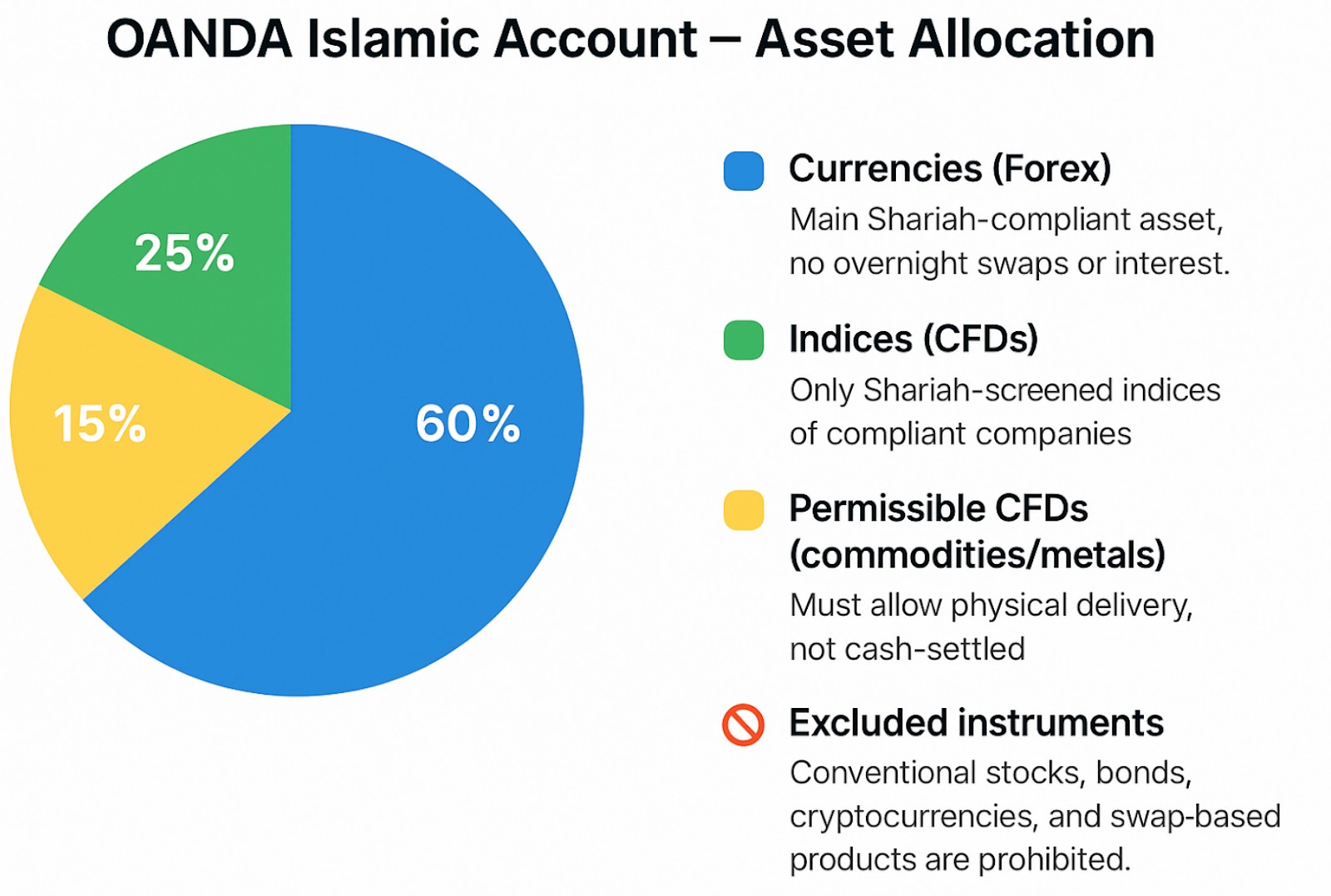
The most notable feature of the OANDA Islamic account’s swap free model is the combination of low entry requirements and transparent pricing. The account provides access to around 25 currency pairs and stock indices, offers spreads starting at 1.6 pips and supports micro‑lot trading. No minimum deposit is required, and leverage can reach up to 1:200. Traders may open positions through MT4, enabling the use of expert advisors (EAs), hedging and scalping strategies. However, this simplicity comes at a cost: once the five‑day grace period has passed, a fixed administrative fee applies per instrument. Since these fees are constant regardless of market conditions, they can erode profits on longer‑term trades. Another limitation is product breadth, there are no individual stocks or commodities beyond gold, nor any Shariah‑compliant ETFs or sukuk. This makes OANDA better suited to short‑term FX strategies rather than diversified long‑term investment, which isn’t really the forte of OANDA’s Islamic investment account.
What replaces swaps: administrative fees and their logic
In conventional trading accounts, swaps (positive or negative) reflect the interest‑rate differential between the two currencies in a pair. Islamic finance forbids earning or paying such interest, so OANDA substitutes swaps with a flat administrative fee. This fee applies only after a trade has been open for more than five calendar days and is predetermined by instrument.
For example, EUR/USD and USD/JPY incur a $7 per lot daily fee beyond day five, while gold (XAU/USD) is charged $6 and major indices like the FTSE 100 or DAX cost $4 per lot. These charges are independent of trade size, leverage or prevailing interest rates. Because the fees are static, traders must treat them as a ticking clock: profitable setups should ideally resolve within five days, and any extension must account for cumulative fees.
| Instrument | Asset type | Typical spread* | Administrative fee after day 5 (per lot/day) | Notes |
|---|---|---|---|---|
| EUR/USD | Major FX pair | 1.6 pips | $7 | High liquidity; grace period first five days |
| USD/JPY | Major FX pair | 1.6 pips | $7 | Yen exposure; strong correlation to U.S. rates |
| GBP/USD | Major FX pair | 1.7 pips | $7 | Volatile; administrative fee significant if held long |
| XAU/USD | Precious metal | 2.2 pips | $6 | Gold behaves differently from fiat pairs |
| FTSE 100 (UK100) | Stock index | ~2.0 pips | $4 | Suitable for short index trades |
| DAX 40 (GER40) | Stock index | ~2.6 pips | $4 | European market proxy |
*Spreads and fees are indicative; actual numbers may vary by market conditions.
How this affects position holding strategies
The five‑day grace period and subsequent flat fee fundamentally change how you manage positions. In a standard account, swaps vary daily and can sometimes be positive; in the OANDA Islamic account, there is no income from holding positions. As soon as the fee period begins, each additional day reduces your net return by a fixed amount. Beginners often overlook this clock and leave positions open during sideways markets, only to find that the administrative cost wipes out their gains. To avoid this, plan trades with a clear exit window (ideally under five days), scale out rather than hold through drawdowns, and avoid keeping hedged or offsetting positions open just to circumvent the fees. When an idea requires a longer horizon, such as multi‑week macro trades, consider alternative halal instruments like Shariah‑compliant ETFs or sukuk that do not charge daily fees.
Core parameters of the OANDA Islamic account
Beginners often confuse swap‑free accounts with free trading. To clarify what you’re actually getting, the table below compares the Islamic and standard account structures. Notice that while spreads on the Islamic account are wider and an administrative fee appears after five days, there is no minimum deposit and you can open an account with minimal documentation.
| Parameter | Islamic (swap‑free) | Standard account |
|---|---|---|
| Swap charges | None; flat fee applies after five days per lot | Daily swap based on interest-rate differential |
| Administrative fee | $4–7 per lot/day from day 6 onward | None |
| Minimum spread (EUR/USD) | 1.6 pips | Around 0.6 pips (floating) |
| Platforms | MetaTrader 4 only | MT4, MT5, Web, Mobile |
| Available instruments | ~25 FX pairs and indices | Over 200 instruments (FX, indices, commodities, metals, crypto) |
| Verification requirement | Optional for balances under $9,000 | Mandatory KYC for all real‑money accounts |
| Scalping/hedging | Allowed (subject to ethical use) | Allowed |
Who can open an Islamic account with OANDA
Opening an OANDA Islamic account requires more than checking a box. Only clients whose accounts are held with OANDA Global Markets (BVI) can elect the swap‑free option during registration. This structure is not available under the U.S., Canadian, U.K. or EU subsidiaries, so residents of those regions cannot open an Islamic account.
The BVI division also has simplified onboarding: deposits below $9,000 do not trigger full identity verification. While this convenience appeals to new traders, it is essential to recognise that BVI licensing does not offer the same investor protections as regulators such as the FCA or CFTC. Before funding an account, beginners should verify the broker’s regulatory entity, read the client agreements carefully, and understand that recourse in the event of a dispute may differ from their home country’s rules.
Country restrictions and client eligibility
Eligibility for the Islamic account hinges on both geography and broker policy. OANDA’s BVI entity offers the swap‑free account in selected countries in Africa, Asia and the Middle East. Clients from the U.S., Canada, the EU and the U.K. are served by separately regulated subsidiaries where Islamic accounts are currently unavailable. Even within eligible regions, OANDA reserves the right to revoke swap‑free status if it detects behaviour that resembles interest arbitrage, for example, holding hedged positions simply to exploit the grace‑period fee structure. The broker may reclassify accounts if it determines that trades are speculative or contravene internal policies. In other words, to maintain halal status, the onus is on the trader to use the account ethically and within the intended trading window. As a precaution, consult local Sharia scholars and review the broker’s terms regularly.
What Islamic investment opportunities does OANDA offer
The Islamic account’s instrument list is intentionally short. You can trade major Forex pairs, such as EUR/USD, GBP/USD, USD/JPY, along with gold and a handful of indices. There are no individual stocks, commodities like oil or copper, or Shariah‑compliant ETFs. For traders accustomed to a broad portfolio, this narrow scope presents concentration risk. To build a balanced Islamic investment portfolio on OANDA, consider combining OANDA’s FX exposure with longer‑term halal products available through other platforms.
For example, Shariah‑compliant ETFs such as Wahed’s FTSE USA Shariah (HLAL) have delivered multi‑year returns similar to mainstream indices, while charging management fees of about 0.5%. By using OANDA for short‑term currency strategies and a robo‑advisory platform for equities, you can diversify across asset classes while remaining within Shariah bounds. Always verify the Shariah certification of each product and ensure it aligns with your personal ethics.
What is prohibited under Islamic principles
The same Shariah principles that prohibit riba also forbid maysir (gambling) and gharar (excessive uncertainty). Riba is forbidden because it creates inequity and encourages exploitation. Maysir is implied in the case of binary options, spread betting and other win‑all/lose‑all games; these are not offered on OANDA’s Islamic platform. Gharar applies to high‑risk derivatives with unclear delivery terms, certain synthetic contracts or leveraged ETFs. OANDA addresses these issues by removing ambiguous products from the Islamic account and by publishing a clear schedule of administrative fees. Nevertheless, you remain responsible for avoiding behaviour that resembles gambling, such as over‑leveraged bets on news events. Always trade based on analysis, not speculation, and avoid the temptation to treat short‑term FX as a quick‑rich scheme.
How to build an Islamic investment portfolio with OANDA
Building a halal portfolio using OANDA requires creativity because of the limited product range. Here’s a targeted approach:
Define your trade horizon. Use the swap‑free account for trades lasting five days or less to avoid administrative fees. If your analysis suggests a longer timeframe, look for Shariah‑compliant ETFs or sukuk outside OANDA.
Focus on liquid pairs. Stick to major currency pairs and indices where spreads are tight. Avoid exotic pairs, which may have wider spreads and lower liquidity.
Integrate external halal investments. Consider balancing FX exposure with halal equities or sukuk held in a separate portfolio. Robo‑advisors and mutual fund providers offer pre‑screened, Shariah‑compliant products that can provide steady long‑term growth.
Use risk management tools. Always apply stop‑loss orders and size positions conservatively. Because you cannot earn swap credits on overnight holdings, any drawdown will compound when administrative fees kick in.
Review scholar opinions. Islamic finance is not monolithic. Some scholars accept administrative fees in lieu of swaps; others may require additional purification. Consult a qualified advisor to ensure your strategy aligns with your personal interpretation of halal investing.
Is OANDA halal according to Islamic finance principles
Based on available information, the OANDA swap‑free account meets the basic requirements of halal trading. It removes interest‑based pricing, eliminates variable rollover charges, and instead uses fixed administrative fees that are disconnected from currency differentials. Investopedia notes that riba is any unjust gain derived from lending money; by refusing to pay or receive interest, OANDA’s model sidesteps this prohibition. However, there are caveats: the broker does not have a formal Shariah certification issued by a recognised Islamic finance board, and the BVI regulatory environment may offer fewer consumer protections than Western regulators. Additionally, the narrow product range limits diversification. For these reasons, many scholars view OANDA as halal “with conditions”, suitable for short‑term currency trades but not for long‑term wealth building without supplemental investments.
Looking beyond OANDA, several brokers provide dedicated swap-free setups with clearer Sharia oversight. The table below compares other Islamic accounts so you can match fees, eligibility, and platform support to your trading style.
| Swap Free | Crypto | Stocks | Currency pairs | Min. deposit, $ | Regulation | TU overall score | Open an account | |
|---|---|---|---|---|---|---|---|---|
| Yes | Yes | Yes | 90 | No | ASIC, FCA, DFSA, BaFin, CMA, SCB, CySec | 9.3 | Go to broker Your capital is at risk.
|
|
| Yes | Yes | Yes | 80 | 100 | CIMA, FCA, FSA (Japan), NFA, IIROC, ASIC, CFTC | 6.51 | Study review | |
| Yes | No | Yes | 57 | 5 | CySEC, FSC (Belize), DFSA, FSCA, FSA (Seychelles), FSC (Mauritius), SCA (United Arab Emirates), CMA (Kenya) | 9.35 | Go to broker Your capital is at risk. |
|
| Yes | Yes | Yes | 90 | 1 | ASIC, VFSC, FSA | 9.25 | Go to broker Your capital is at risk. |
|
| Yes | Yes | Yes | 68 | No | FSC (BVI), ASIC, IIROC, FCA, CFTC, NFA | 6.69 | Go to broker Your capital is at risk. |
Spot hidden costs and confirm halal execution

With an OANDA Islamic account, the real test isn’t just whether swaps are removed but whether the fee structure has been redesigned in a way that doesn’t sneak riba back in. Many brokers claim Shariah compliance but quietly shift the cost of swaps into “financing adjustments” or unusual spread widening. A smart beginner move is to run parallel trades: open the same position on a standard account and the Islamic account at the same time, then compare how the costs evolve after volatile sessions. If the Islamic account consistently drains more through spread expansion or hidden adjustments, then it’s not truly halal even if it carries the Islamic label.
Another overlooked detail is market execution models. OANDA uses both straight-through processing and internal order matching, and beginners need to ask where their trades are being routed. If your orders are primarily matched internally, you might be exposed to elements of speculation that resemble gharar (excessive uncertainty) since you’re effectively betting against the broker. A practical way to test this is by checking execution reports or trade receipts to see if your trades are being filled by external liquidity providers. This deeper layer of due diligence separates a genuinely halal setup from one that is Islamic in name only.
Conclusion
OANDA offers an Islamic account built on a pricing model that excludes interest charges and avoids any link to market-based rates. All instruments are swap-free, and the broker applies a fixed administrative fee that does not depend on holding duration or trade volume. The platform provides access to major markets, though the list of available instruments is narrower, requiring more precise planning. This setup is well-suited for short-term strategies with defined timeframes. For longer holding periods, the cumulative fees increase overall costs, reducing the efficiency of extended positions.
FAQs
Can you trade commodities under an Islamic account?
Yes, if the trade is based on spot pricing with no delays or interest. Alcohol, pork products, and leveraged futures are prohibited.
How can you tell if an instrument is Sharia-compliant when it's not explicitly labeled?
You need to examine the revenue structure: it must not rely on interest, rollover fees, or profit from chance. If income is based solely on price movement, it is generally allowed.
Are algorithmic strategies permitted?
Yes, provided the algorithm avoids any interest-based logic, swap use, or arbitrage on rate differences. Auto-trading is acceptable when all calculations follow transparent and compliant structures.
Are scalping and intraday trading allowed?
Yes, as long as trades don’t involve credit mechanisms, fees are fixed in advance, and position value doesn’t depend on holding time.
Related Articles
Team that worked on the article
Alamin Morshed is a contributor at Traders Union. He specializes in writing articles for businesses that want to improve their Google search rankings to compete with their competition.
Dan Blystone began his trading career in 1998 as an arbitrage clerk on the floor of the Chicago Mercantile Exchange (CME). He later traded bond and Eurex futures at proprietary firms such as Altea Trading, gaining valuable experience in high-frequency trading and risk management.
Chinmay Soni is a financial analyst with more than 5 years of experience in working with stocks, Forex, derivatives, and other assets. As a founder of a boutique research firm and an active researcher, he covers various industries and fields, providing insights backed by statistical data.
-
 Afghanistan
-
 Albania
-
 Algeria
-
 Angola
-
 Argentina
-
 Armenia
-
 Australia
-
 Austria
-
 Azerbaijan
-
 Bahamas
-
 Bahrain
-
 Bangladesh
-
 Belarus
-
 Belgium
-
 Bolivia
-
 Botswana
-
 Brazil
-
 Brunei
-
 Bulgaria
-
 Cambodia
-
 Cameroon
-
 Canada
-
 Chile
Chile
-
 China
China
-
 Colombia
-
 Congo
Congo
-
 Costa Rica
-
 Cote d'Ivoire
-
 Croatia
-
 Cuba
Cuba
-
 Cyprus
-
 Czechia
-
 DR Congo
-
 Denmark
-
 Dominican Republic
-
 Ecuador
-
 Egypt
Egypt
-
 El Salvador
-
 Estonia
-
 Eswatini
-
 Ethiopia
-
 Finland
-
 France
-
 Georgia
-
 Germany
-
 Ghana
Ghana
-
 Greece
-
 Haiti
Haiti
-
 Hong Kong
-
 Hungary
-
 India
India
-
 Indonesia
-
 Iran, Islamic republic
-
 Iraq
Iraq
-
 Ireland
-
 Israel
-
 Italy
Italy
-
 Jamaica
-
 Japan
Japan
-
 Jordan
-
 Kazakhstan
-
 Kenya
Kenya
-
 Korea
Korea
-
 Kuwait
-
 Kyrgyzstan
-
 Laos
Laos
-
 Latvia
-
 Lebanon
-
 Lesotho
-
 Libya
Libya
-
 Lithuania
-
 Luxembourg
-
 Madagascar
-
 Malaysia
-
 Malta
Malta
-
 Mauritius
-
 Mexico
-
 Moldova
-
 Mongolia
-
 Montenegro
-
 Morocco
-
 Mozambique
-
 Myanmar
-
 Namibia
-
 Nepal
Nepal
-
 Netherlands
-
 New Zealand
-
 Nigeria
-
 North Macedonia
-
 Norway
-
 Oman
Oman
-
 Pakistan
-
 Palestine
-
 Panama
-
 Papua New Guinea
-
 Paraguay
-
 Peru
Peru
-
 Philippines
-
 Poland
-
 Portugal
-
 Puerto Rico
-
 Qatar
Qatar
-
 Reunion
-
 Romania
-
 Rwanda
-
 Saudi Arabia
-
 Serbia
-
 Singapore
-
 Slovakia
-
 Slovenia
-
 Somalia
-
 South Africa
-
 Spain
Spain
-
 Sri Lanka
-
 Sweden
-
 Switzerland
-
 Syria
Syria
-
 Taiwan
-
 Tajikistan
-
 Tanzania
-
 Thailand
-
 Trinidad and Tobago
-
 Tunisia
-
 Turkey
-
 UAE
UAE
-
 Uganda
-
 Ukraine
-
 United Kingdom
-
United States
-
 Uruguay
-
 Uzbekistan
-
 Venezuela
-
 Vietnam
-
 Yemen
Yemen
-
 Zambia
-
 Zimbabwe
- Forex
- Crypto











