
Can Silver Reach $1000 Per Ounce?



Editorial Note: While we adhere to strict Editorial Integrity, this post may contain references to products from our partners. Here's an explanation for How We Make Money. None of the data and information on this webpage constitutes investment advice according to our Disclaimer.
Will silver go up to $1000:
Silver occupies a unique position in global markets. It functions both as an industrial input and as a monetary metal, which makes its price sensitive to economic cycles, inflation trends, and shifts in investor confidence. As of early 2026, silver continues to attract trader interest due to steady industrial use and periodic safe-haven demand.
This comprehensive guide breaks down silver’s potential trajectory, offering historic context, structural catalysts, analyst expectations, and data-driven trading strategies. It explores what it would take for silver price to reach 1000 dollars per ounce and how likely it is in today’s economic climate.
Can silver go to $1000 an ounce?
Silver has experienced strong price growth in recent years, driven by both investor demand and expanding industrial use. By the end of 2025, the metal was trading around $82 per ounce (XAG/USD), a level that already places it far above many historical averages. This rise reflects stronger demand from sectors such as renewable energy, electronics, and battery manufacturing, as well as renewed interest in precious metals during periods of economic uncertainty.
However, the question of whether silver could reach $1000 per ounce is far more complex and depends on multiple economic and structural factors.
Near-term expectations
In the short run, silver prices will likely continue reacting to macroeconomic signals such as interest rate policy, inflation expectations, and the strength of the U.S. dollar. Industrial demand should remain supportive, but markets may still experience volatility.
If global financial conditions tighten or investor sentiment shifts toward risk assets, temporary pullbacks in silver prices are possible. Short-term movements therefore tend to reflect broader economic conditions rather than structural supply and demand trends.
| Month | Minimum Price, $ | Average Price, $ | Maximum Price, $ |
|---|---|---|---|
| August 2026 | 47 | 48 | 49 |
| September 2026 | 47 | 49 | 50 |
| October 2026 | 51 | 53 | 54 |
| November 2026 | 57 | 59 | 61 |
| December 2026 | 59 | 61 | 63 |
Long-term perspective for investors
Despite the uncertainty around extreme price targets, silver continues to play an important role in diversified portfolios. Its dual nature – as both an industrial commodity and a monetary metal – makes it sensitive to technological progress as well as global financial trends.
For long-term investors, silver remains relevant as a strategic asset that can benefit from industrial growth, technological expansion, and periods of macroeconomic stress. While price cycles are inevitable, structural demand may continue to support the metal over time.
| Year | Price in the middle of the year | Price at the end of the year |
|---|---|---|
| 2026 | $58 | $87 |
| 2027 | $88 | $83 |
| 2028 | $83 | $81 |
| 2029 | $86 | $83 |
| 2030 | $84 | $84 |
| 2031 | $83 | $83 |
| 2032 | $82 | $85 |
| 2033 | $85 | $93 |
| 2034 | $93 | $90 |
| 2035 | $87 | $91 |
| 2036 | $90 | $91 |
| 2037 | $96 | $96 |
| 2038 | $100 | $130 |
| 2039 | $130 | $130 |
| 2040 | $130 | $130 |
Historical context: silver’s price trajectory
Silver’s price history is defined by sharp rallies that fade quickly, followed by long periods of sideways movement. This pattern is essential context for traders evaluating whether silver will hit $1000 in the future, because it shows how rarely extreme prices have been sustained.
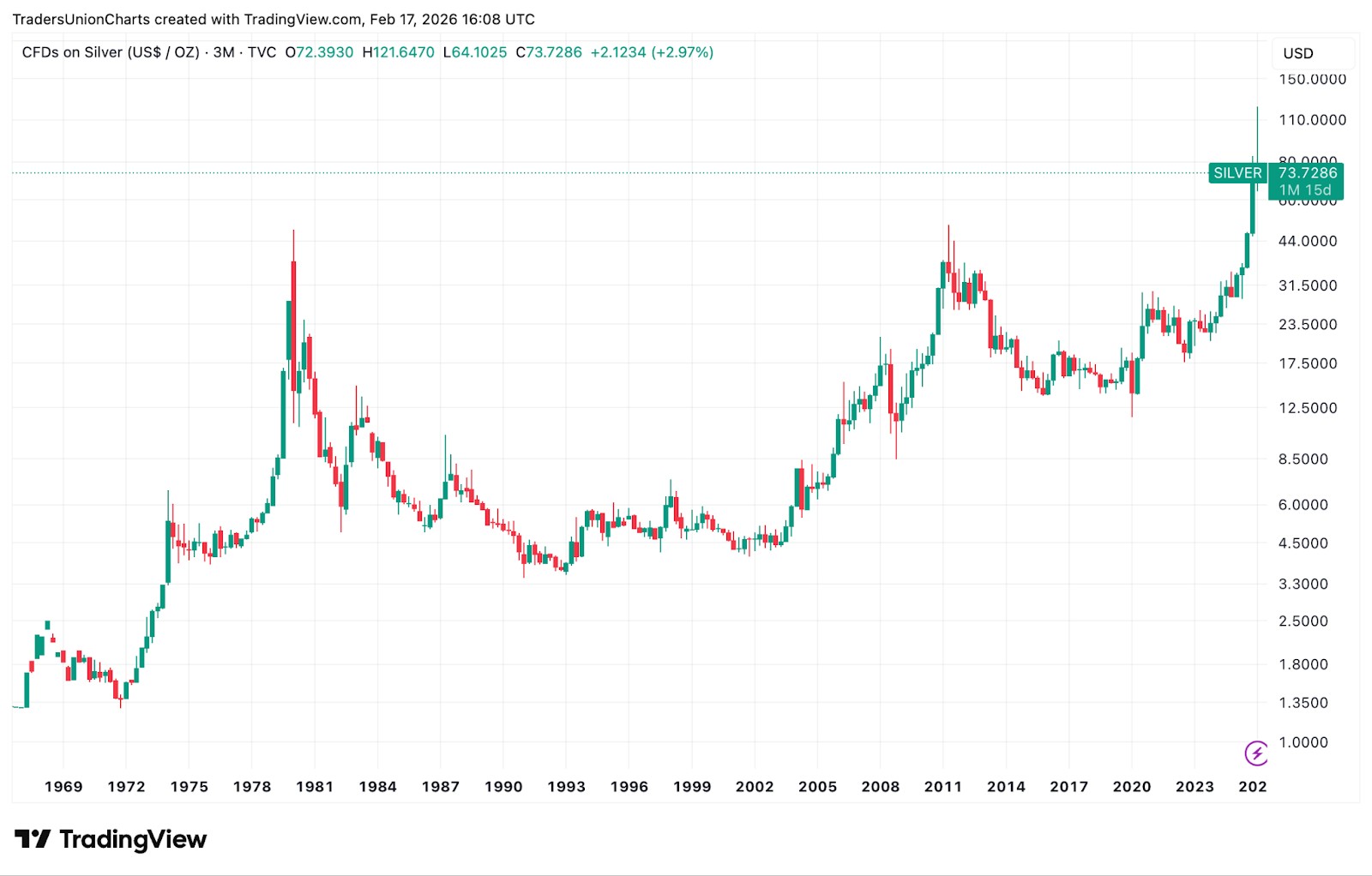
Unlike assets with long-term growth drivers, silver has relied on macro shocks to generate major price moves. Its strongest rallies have consistently occurred during periods of inflation stress, financial instability, or aggressive monetary easing. Once those conditions eased, prices reversed. This historical behavior is central when assessing whether silver could realistically reach 1000 dollars per ounce, or whether such an outcome would require conditions far outside normal market cycles.
The 1980 rally remains the most extreme example. Inflation fears and speculative positioning pushed prices close to $50 per ounce before regulatory changes and tighter liquidity caused a rapid collapse. A similar dynamic appeared in 2011, when post-crisis stimulus and inflation hedging drove heavy investor demand. Prices again failed to hold once real yields stabilized.
Silver also benefited from extraordinary stimulus during the pandemic period and from inflation concerns in the early 2020s. By early 2026, however, the metal still trades well below its inflation-adjusted highs. This matters for traders considering whether silver will ever reach $1000 an ounce, because it highlights how dependent past rallies were on temporary macro stress.
From a historical perspective, the idea that silver could ever reach $1000 an ounce is less about normal supply dynamics and more about systemic disruption.
| Year | Key event | Price peak (USD) |
|---|---|---|
| 1980 | Speculative squeeze by Hunt brothers led to a major spike before a collapse due to regulatory intervention. | 49.45 |
| 2011 | Investors flocked to silver as a hedge against inflation and monetary easing post-2008 financial crisis. | 48.70 |
| 2020 | Massive fiscal stimulus and global liquidity during the COVID-19 pandemic pushed safe-haven demand. | 29.14 |
| 2024 | Global inflation and strong industrial demand from clean energy and EVs supported a moderate price rally. | 29.86 |
For traders weighing if silver could go to $1000, this historical record offers a clear takeaway. Sharp rallies are possible, but every major surge has depended on extraordinary macro stress and has reversed once conditions normalized. Silver reaching 1000 dollars per ounce would therefore imply a structural break from all prior pricing behavior.
Fundamental drivers that could lift silver prices
Silver prices are influenced by two main demand channels: industrial consumption and investment demand. Each of these drivers affects the market differently and plays a distinct role in shaping long-term price dynamics.
Industrial demand
Industrial use provides a stable base of demand for silver. The metal is widely used in electronics, renewable energy technologies, medical devices, and various manufacturing processes. This steady consumption helps support long-term price levels and reduces downside pressure during weaker market periods. However, industrial demand alone has historically produced gradual price increases rather than the extreme rallies implied by projections such as $1000 per ounce.
Supply limitations
Silver supply dynamics can also influence prices, but their impact is often limited. A large share of global silver production comes as a byproduct of mining other metals, including copper, lead, and zinc. Because of this, production levels do not always respond quickly to changes in silver prices. While this structure can tighten supply during periods of strong demand, it is unlikely by itself to drive prices toward extremely high levels without additional market forces.
Investment demand
Historically, major price rallies in silver have been driven primarily by investment inflows rather than industrial growth. When investors increase exposure to precious metals – often during periods of inflation concerns, currency weakness, or financial instability – silver prices can rise rapidly. Without sustained investment demand, however, expectations of silver reaching extremely high price levels remain largely theoretical.
Industrial demand and supply constraints can help support higher average prices and reduce downside risk. However, dramatic price targets such as $1000 per ounce would likely require powerful macroeconomic catalysts and substantial capital inflows into the silver market.
What it would take for $1000 an ounce pricing for silver
Reaching four-digit prices would require conditions far outside normal market cycles and the discussion shifts away from standard supply and demand and toward systemic financial stress.
For silver to reach 1000 dollars an ounce, several extreme forces would need to occur at the same time and persist for years.
Loss of confidence in fiat currencies. Investors would need to move capital out of cash and sovereign debt and into hard assets on a global scale.
Sustained negative real interest rates. Inflation-adjusted returns on cash and bonds would need to remain deeply negative for an extended period.
Explosion in investment demand. Inflows into physical silver and silver-backed products would need to exceed all historical peaks and remain elevated.
Major repricing of gold. Gold would need to trade substantially higher, allowing silver to go to 1000 dollars an ounce without breaking relative valuation logic.
Bullish and bearish scenarios for traders
Silver’s outlook depends less on single catalysts and more on how macro conditions evolve over time. For traders, it is more productive to frame outcomes as scenarios rather than fixating on extreme price targets.
Bullish scenario
Monetary easing intensifies. Central banks suppress real yields for extended periods, supporting renewed interest in hard assets.
Inflation remains persistent. Price pressures erode confidence in fiat currencies and revive narratives around silver as a hedge concept.
Investment demand accelerates. Capital flows into physical silver and exchange-traded products rise consistently, lifting long-term price ranges.
Under this setup, silver could trend higher over multiple cycles. However, even bullish cases focus on sustained appreciation rather than assuming silver to hit 1000 dollars an ounce in the foreseeable future.
Bearish scenario
Monetary policy stays restrictive. Real yields remain positive, reducing the appeal of non-yielding assets.
Economic growth slows. Industrial demand weakens, limiting upside pressure.
Investor interest fades. Capital rotates toward yield-bearing or growth assets.
In this environment, prices tend to remain range-bound or cyclical rather than directional. For traders, the key is alignment. Bullish positioning works best when macro signals and capital flows reinforce each other. Bearish or neutral strategies dominate when liquidity tightens and speculative narratives lose traction.
Practical trader strategies
Extreme price targets attract attention, but trading silver effectively requires separating realistic setups from long-term tail risks. For most traders, the question is not when silver might reach four digits, but how to position across different market regimes.
Strategies for conservative traders
Use silver as a hedge. Allocate modest exposure during periods of rising inflation or declining real yields, without assuming silver will reach the 1000 dollar mark.
Favor low-cost instruments. ETFs and physically backed products reduce complexity while maintaining liquidity.
Manage expectations. Treat price prediction of silver reaching 1000 USD as scenario planning rather than trade signals.
Strategies for active traders
Trade volatility, not targets. Silver’s price swings offer opportunities regardless of whether silver could go to $1000.
Watch investor flows. Sustained inflows into silver-backed products often precede medium-term trends.
Use defined risk. Options and spread strategies allow participation without relying on outcomes where silver would reach 1000 dollars an ounce.
Strategies for long-term positioning
Build gradually. Accumulate exposure during periods of consolidation rather than chasing momentum.
Anchor to macro signals. Real yields, currency trends, and liquidity conditions matter more than speculative price ceilings.
Plan exits early. Even if silver rallies sharply, past cycles show that extreme moves tend to reverse.
For all traders, discipline matters more than prediction. Whether or not silver ever reaches 1000 dollars an ounce, consistent risk management and timing have historically delivered better results than betting on headline numbers.
For traders considering exposure to silver, broker choice also plays a practical role. Access to reliable execution and clear pricing can make a difference when trading a volatile metal like silver. The broker suggestions below provide a starting point for comparing platforms that offer silver trading in your region.
| zForex | Plus500 | OANDA | FOREX.com | IG Markets | |
|---|---|---|---|---|---|
|
Silver |
Yes | Yes | Yes | Yes | Yes |
|
Demo |
Yes | Yes | Yes | Yes | Yes |
|
Min. deposit, $ |
10 | 100 | No | 100 | 1 |
|
Deposit fee, % |
No | No | No | No | No |
|
Withdrawal fee, % |
No | No | No | No | No |
|
Regulation level |
Not regulated | Tier-1 | Tier-1 | Tier-1 | Tier-1 |
|
TU overall score |
8.05 | 7.57 | 6.89 | 6.87 | 6.82 |
|
Open an account |
Go to broker Your capital is at risk.
|
Go to broker 80% of retail CFD accounts lose money. |
Go to broker Your capital is at risk. |
Study review | Study review |
XAG/USD News
Silver stays range-bound above $75 support
Silver price firms above $71 as oil shock revives haven trade

Silver price rebounds above $70 as dip buying tempers yield pressure
Silver price retreats toward $68 as higher yields and oil surge blunt safe-haven bid
Silver price firms near $73 as yields retreat and rebound extends
Silver price steadies near $69 as rebound loses momentum
Discipline beats extreme price targets

I approach extreme silver price targets with caution. In my experience, silver performs best when traders focus on macro structure rather than headline numbers. Periods of strong performance have always aligned with falling real yields, rising monetary risk, and sustained investor inflows, not with isolated supply stories or speculative enthusiasm.
When people fixate on whether silver could eventually reach four-digit levels, they often miss more practical opportunities. I prefer to treat such scenarios as tail risks, not forecasts. My strategy has always been to build exposure gradually during periods of consolidation, avoid excessive leverage, and reduce positions when sentiment becomes crowded. Silver rewards patience and timing far more than bold predictions.
Conclusion
While the allure of silver reaching $1000 an ounce captures the imagination, the article makes clear this scenario is unlikely in the foreseeable future given current macroeconomic indicators and historical price behavior. Even with surges in industrial demand and periodic supply squeezes, silver’s all-time highs have remained a fraction of this level, rarely breaking beyond the $50 mark. The key takeaway is that sustained, transformative shifts—such as a dramatic collapse of fiat currencies or a radical technological breakthrough leading to unprecedented demand—would be required to propel silver anywhere near $1000. For traders, this underscores the importance of tempering expectations with reality: in precious metals, extraordinary price leaps are the exception, not the rule.
FAQs
What macroeconomic events would be necessary for silver to approach $1000 per ounce?
How does silver's role as both an industrial and a monetary metal affect its long-term price outlook?
What historical price patterns should traders consider when evaluating silver’s future potential?
Which trading strategies can help manage risks associated with silver’s high price volatility?
Editors' Top Picks and Insights

Dangerous but indispensable: Why the crypto market needs bridges

Markus Levin: DePIN could power the AI agent economy

Pokémon cards for $2,500: How collectibles became a new form of gambling

The privacy paradox: How the crypto mixer market has changed

Is Bitcoin right for you? Five traits shared by many cryptocurrency holders

Chasing hits: Why investors are losing interest in Netflix
Related Articles
Team that worked on the article
Anton Kharitonov is an active trader and analyst. He employs both short- and long-term trading strategies, primarily based on fundamental factors, supported by technical indicators and intermarket analysis.
Dan Blystone began his trading career in 1998 as an arbitrage clerk on the floor of the Chicago Mercantile Exchange (CME). He later traded bond and Eurex futures at proprietary firms such as Altea Trading, gaining valuable experience in high-frequency trading and risk management.
Chinmay Soni is a financial analyst with more than 5 years of experience in working with stocks, Forex, derivatives, and other assets. As a founder of a boutique research firm and an active researcher, he covers various industries and fields, providing insights backed by statistical data.
Volatility refers to the degree of variation or fluctuation in the price or value of a financial asset, such as stocks, bonds, or cryptocurrencies, over a period of time. Higher volatility indicates that an asset's price is experiencing more significant and rapid price swings, while lower volatility suggests relatively stable and gradual price movements.
Index in trading is the measure of the performance of a group of stocks, which can include the assets and securities in it.
Bitcoin is a decentralized digital cryptocurrency that was created in 2009 by an anonymous individual or group using the pseudonym Satoshi Nakamoto. It operates on a technology called blockchain, which is a distributed ledger that records all transactions across a network of computers.
Cryptocurrency is a type of digital or virtual currency that relies on cryptography for security. Unlike traditional currencies issued by governments (fiat currencies), cryptocurrencies operate on decentralized networks, typically based on blockchain technology.
Ethereum is a decentralized blockchain platform and cryptocurrency that was proposed by Vitalik Buterin in late 2013 and development began in early 2014. It was designed as a versatile platform for creating decentralized applications (DApps) and smart contracts.


-
 Afghanistan
-
 Albania
-
 Algeria
-
 Angola
-
 Argentina
-
 Armenia
-
 Australia
-
 Austria
-
 Azerbaijan
-
 Bahamas
-
 Bahrain
-
 Bangladesh
-
 Belarus
-
 Belgium
-
 Bolivia
-
 Botswana
-
 Brazil
-
 Brunei
-
 Bulgaria
-
 Cambodia
-
 Cameroon
-
 Canada
-
 Chile
Chile
-
 China
China
-
 Colombia
-
 Congo
Congo
-
 Costa Rica
-
 Cote d'Ivoire
-
 Croatia
-
 Cuba
Cuba
-
 Cyprus
-
 Czechia
-
 DR Congo
-
 Denmark
-
 Dominican Republic
-
 Ecuador
-
 Egypt
Egypt
-
 El Salvador
-
 Estonia
-
 Eswatini
-
 Ethiopia
-
 Finland
-
 France
-
 Georgia
-
 Germany
-
 Ghana
Ghana
-
 Greece
-
 Haiti
Haiti
-
 Hong Kong
-
 Hungary
-
 India
India
-
 Indonesia
-
 Iran, Islamic republic
-
 Iraq
Iraq
-
 Ireland
-
 Israel
-
 Italy
Italy
-
 Jamaica
-
 Japan
Japan
-
 Jordan
-
 Kazakhstan
-
 Kenya
Kenya
-
 Korea
Korea
-
 Kuwait
-
 Kyrgyzstan
-
 Laos
Laos
-
 Latvia
-
 Lebanon
-
 Lesotho
-
 Libya
Libya
-
 Lithuania
-
 Luxembourg
-
 Madagascar
-
 Malaysia
-
 Malta
Malta
-
 Mauritius
-
 Mexico
-
 Moldova
-
 Mongolia
-
 Montenegro
-
 Morocco
-
 Mozambique
-
 Myanmar
-
 Namibia
-
 Nepal
Nepal
-
 Netherlands
-
 New Zealand
-
 Nigeria
-
 North Macedonia
-
 Norway
-
 Oman
Oman
-
 Pakistan
-
 Palestine
-
 Panama
-
 Papua New Guinea
-
 Paraguay
-
 Peru
Peru
-
 Philippines
-
 Poland
-
 Portugal
-
 Puerto Rico
-
 Qatar
Qatar
-
 Reunion
-
 Romania
-
 Rwanda
-
 Saudi Arabia
-
 Serbia
-
 Singapore
-
 Slovakia
-
 Slovenia
-
 Somalia
-
 South Africa
-
 Spain
Spain
-
 Sri Lanka
-
 Sweden
-
 Switzerland
-
 Syria
Syria
-
 Taiwan
-
 Tajikistan
-
 Tanzania
-
 Thailand
-
 Trinidad and Tobago
-
 Tunisia
-
 Turkey
-
 UAE
UAE
-
 Uganda
-
 Ukraine
-
 United Kingdom
-
United States
-
 Uruguay
-
 Uzbekistan
-
 Venezuela
-
 Vietnam
-
 Yemen
Yemen
-
 Zambia
-
 Zimbabwe
- Forex
- Crypto











