
FSC | Financial Regulator Of Belize



Editorial Note: While we adhere to strict Editorial Integrity, this post may contain references to products from our partners. Here's an explanation for How We Make Money. None of the data and information on this webpage constitutes investment advice according to our Disclaimer.
The Financial Services Commission of Belize regulates the non-banking sector of that country. The Commission issues licenses to brokerage, investment, and insurance companies, collects and analyzes information about the operation of its licensees, develops the jurisdiction’s financial sector, and assists in organizing effective interaction between all financial market participants.
In many countries, a financial regulator is an independent government body responsible for the licensing and control of legal entities in the banking and non-banking sectors. Regulators perform in-depth inspections of licensees’ financial documentation, organizational structure, risk management system, and foundation documents at the time of registration. They control licensees’ compliance with the local law, counteract fraud, abuse and the usage of insider information, and protect clients’ rights, and control licensees’ fulfillment of their requirements.
The necessity to follow the regulator’s rules, keep operations transparent, possess registered capital required by the regulator, go through yearly audits, observe the account segregation rule, etc
Freedom of licensed brokers to advertise their services
For a trader, a valid license means that a broker is a real company abiding by the law. If a trader’s rights are violated, a regulator can revoke the license in the acquisition of which the broker invested time and money. Therefore, brokers aim to uphold a positive reputation and operate transparently.
This post explores the functions, advantages, and complaint submission procedure, as well as reviews and an expert’s opinion of FSC Belize.
Description and functions of the FSCBelize
The FSC’s predecessor, the International Financial Services Commission of Belize (IFSC), was created in 1999. Prior to its establishment, the banking sector was controlled by the National Bank of Belize. But due to the country’s simplified tax regime, the number of registered companies grew every year. In 1999, the IFSC was entrusted with the supervision of the whole non-banking sector of the jurisdiction. In 2021, the IFSC was transformed into the FSC and given additional responsibilities.
Tasks and purposes of the FSC Belize in the Forex market
Issue licenses and certificates
Keep accounts for the National Bank and government bodies
Inform licensees about forthcoming changes and innovations in the financial field
Assist government bodies in the development of statutory documentation
Analyze yearly financial statements
Consider complaints
The FSC Belize is an offshore regulator that carries out auxiliary functions. It maintains order in the interaction between all participants in the Belizean financial sector and responds to obvious violations of the law. The FSC does not have the power to make key decisions on its own. The ways in which it influences offenders include warnings, small fines, and license revocation. Control of each licensee comes down to the general examination of documents at the time of registration. After that, the FSC only collects brokerage statements.
To obtain an FSC license, a broker has to
Complete registration documents. The registration form of 4-5 sheets can be found on the Commission’s website
Open an account at a Belizean bank and freeze the funds in it. This is an analog of the requirement for minimum registered capital. Deposit for an international license is from $100,000. Deposit for a local license, which does not give brokers the right to provide services in international markets, is from $25,000. The amount can be increased
Provide the founders’ personal information
Provide documented confirmation of the management team’s competence in the financial field
Pay fees. There may be other expenses
Documents review takes 1-3 months. Registration conditions are lenient: executives are not required to be personally present, and opening a physical office in Belize is not needed. Requirements for minimum registered capital are several times lower than European regulators. Brokers also don’t have to disclose their organizational structure, technologies, and risk management system.
Official website
The Commission’s website has a complex, but comprehensible structure. The content is mostly introductory. The FSC Belize website features financial legislation, registration rules, a list of licensed legal entities, news, and much more. The website’s structure is as follows:
Main menu and a downloadable FSC Strategic Plan at the top
 FSCBelize Review — Website sections
Central part with public notices, laws and regulations, and guidelines and procedures
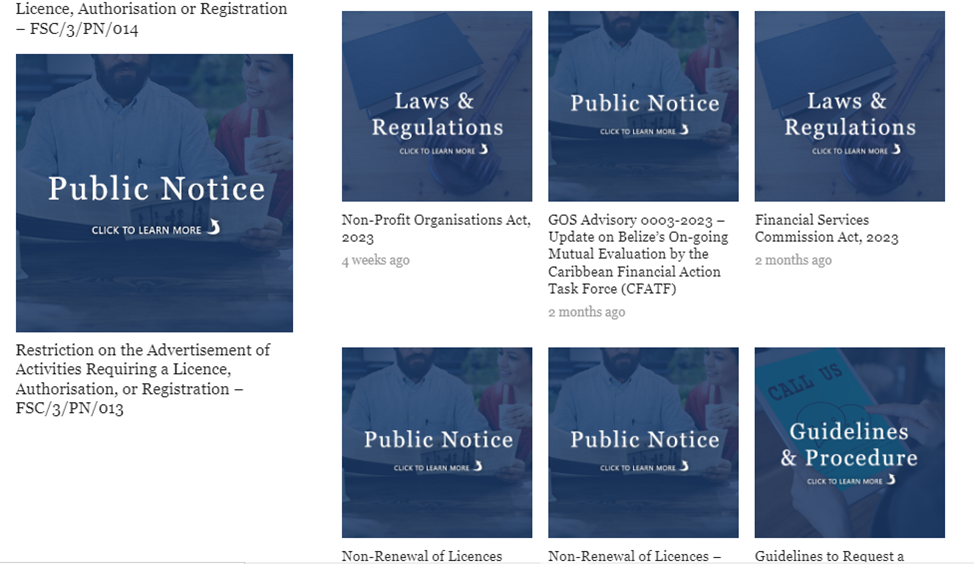 FSCBelize Review — Website sections
The part below features information about government agencies, with which the regulator works closely
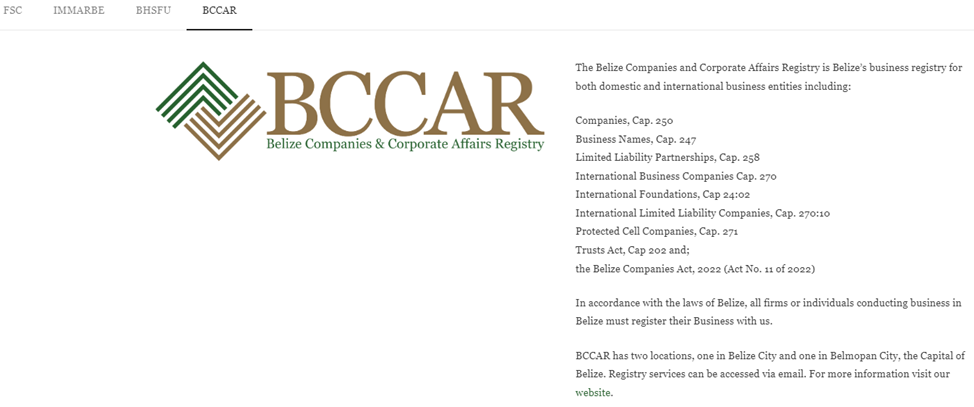 FSCBelize Review — Website sections
Footer contains the regulator’s contact information
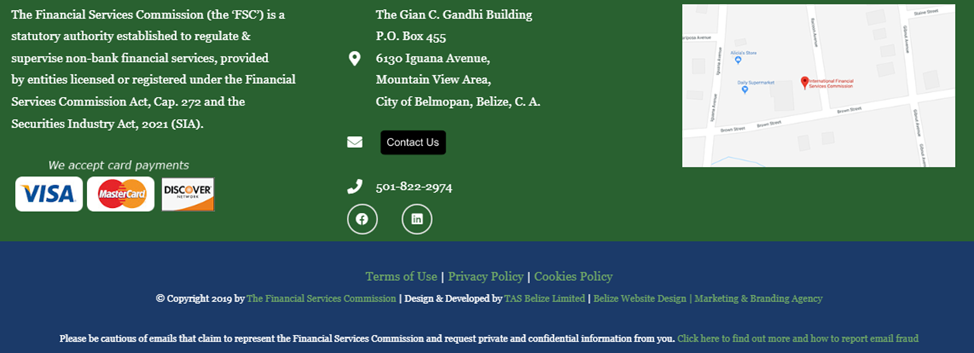 FSCBelize Review — Website sections
International cooperation. Exchange of tax information with other jurisdictions and international agreements within which the Commission’s licensees can operate
Domestic cooperation. Structure of internal government agencies responsible for the regulation of various sectors of Belize’s economy
Career. The Commission’s vacancies
About Us. Information about the Commission’s objectives, mission, and team
Regulatory framework. Legislation, regulations, standards
Licensing. License verification, applying for a license, authorizations, and licensed service providers
Compliance. Supervision, AML/CFT (Anti-Money Laundering and Countering the Financing of Terrorism), on-site examination and off-site surveillance, and scams targeting FSC clients
Enforcement. Enforcement activities, disciplinary proceedings, and complaints
Library. Publications, news and press releases, industry updates, warning notices, guidelines and guidance notes, etc
Some sections are especially important for traders. In Licensing, you can confirm a broker’s license. In Enforcement, you can file a complaint. It is also useful to view the news and warnings regularly. A broker’s license may remain valid, but fines or official warnings issued by the regulator are reasons to be on guard.
How to confirm a broker’s license on the FSCBelize website
The information on the website is well-structured and therefore finding a license is easy.
On the broker’s website, find its license number. It can be in the homepage’s footer, FAQs, or About Us
On the FSC website’s homepage, go to Licensing/License Verification
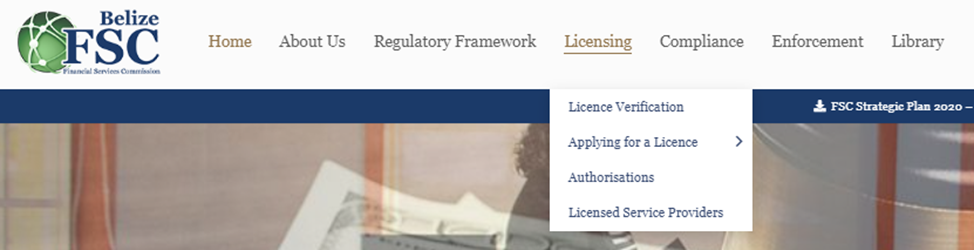 FSC Belize Review — Website sections
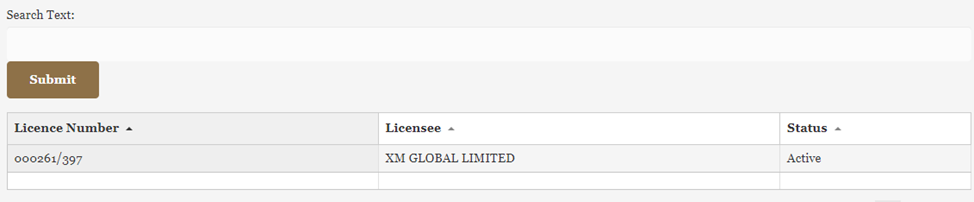
Enter the license number
 FSCBelize Review — Website sections
Unlike the FCA or CySEC, the Belizean regulator only displays whether a license is active or not. Its type, expiry date, and other details can be found out on a separate request.
FSC’s basic requirements for brokers
Hold at least $25,000 or $100,000 in the transaction account. The amount depends on the type of license. This condition is an analog of the requirement for minimum registered capital
Limit cooperation with Belize residents and do not open accounts in the national currency
Go through yearly audits and provide statements
The main requirements come down to freezing a fixed amount in the account and the absence of violations of local laws.
FSC Belize license | Pros and cons
The authority of an FSC Belize license is relatively low. Brokers register in Belize to optimize taxation, and a license is not so much a goal as an additional option for them. In theory, the FSC can cancel a license because of violations, but it’s not an obstacle for brokers. Most of them keep operating in international markets under the laws of separate countries where they provide services.
- Pros
- Cons
- The broker passed an initial examination. Its financial documents and founders’ personal details were reviewed. The executives confirmed their qualifications
- The regulator’s help in a disputed situation. Sometimes, this argument helps to resolve an issue in the trader’s favor
- Superficial control. The regulator collects financial statements but does not require full information disclosure. It is also not necessary to segregate accounts or open a physical office in the jurisdiction. A broker’s existence online is sufficient
- No compensation fund.
Most fraudulent companies exist on the internet only. They don’t have a legal registration, don’t create substantive websites, and often disappear after a trader makes a substantial deposit. Or, they may block the deposit because they know the trader can’t go to any authority. A license testifies that a broker has real founders, a legal address, and professional experience. Such a broker is less likely to resort to fraud as its reputation is more important to it.
An FSC Belize license is of little use to a trader. It is better than nothing, but it has little reassuring effect. At least, a license means that a broker indeed exists legally and its constitutional documents were reviewed by the regulator. But traders’ interests aren’t actually protected. Information about license types is not publicly available, inspection of brokers is informal only, and there are no real examples of how private traders received help.
FSC Belize jurisdiction
The FSC Belize entitles its licensees to operate within and outside its jurisdiction. The Commission grants two license types: international and local. The first type enables brokers to provide services internationally on the condition that they do not contravene the laws of traders’ countries. Obtaining and keeping such a license requires a broker to freeze $100,000 in its account in Belize. The local license type permits providing services in Belize only and requires freezing from $25,000.
Some brokers like to use this loophole. A broker acquires a local license that imposes a lot fewer obligations, but prohibits providing brokerage services outside of Belize. The license number is included on the broker’s website, but to find out the license type, a trader has to submit a separate request to the Commission; this information is not on the FSC website. Therefore, the Commission does not consider complaints by non-residents. In fact, the broker is violating the license acquisition conditions, but the FSC ignores it.
Submission and consideration of complaints
In theory, the regulator considers all complaints regardless of the deposit amount or the number of traders. But practically, there is no confirmation of it. The FSC website does not feature examples where concrete issues were resolved. It is unclear what kind of complaints are considered first and foremost. In trader forums, there are no reviews by those who have applied to the FSC.
Complaint submission procedure:
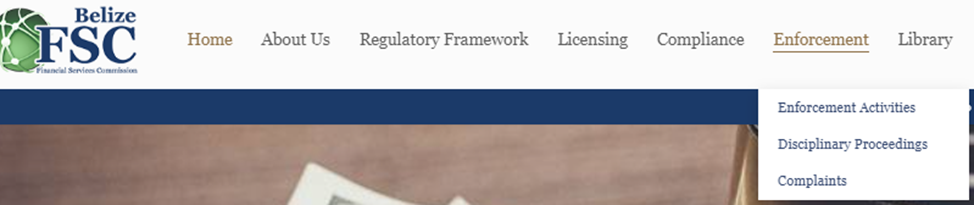
On the FSC website’s homepage, go to Enforcement and select Complaints
 FSCBelize Review — Website sections
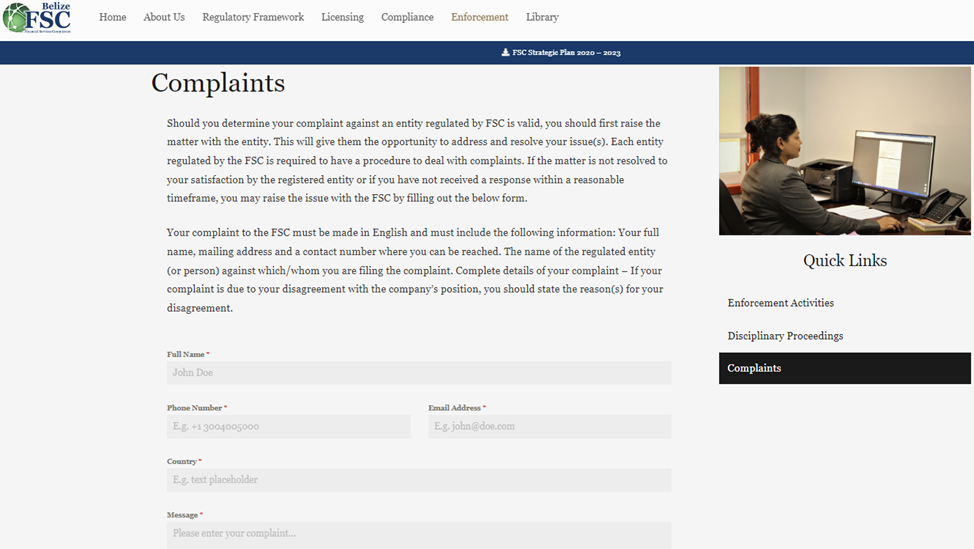
Complete and send a form
 FSCBelize Review — Website sections
Unfortunately, it is unknown whether the regulator will receive and consider your complaint and how long it will take. You cannot attach screenshots to the form. Information that your application received a unique number and was sent does not arrive at the email address you included in your application. This has been confirmed by the author of this review.
Overall:You can send any number of complaints to the FSCBelize using the form on the website, but results are not guaranteed because you won’t be able to prove to the regulator’s support team that you have created an application on the website. For this reason, TU recommends sending a copy of your complaint to the regulator’s email address with a read notification. This way, you will at least be able to see if your message was read and prove that you sent it on a concrete day
FSC-licensed brokers | How to check on a broker
Do you want to save time and always know relevant information about brokers without having to visit dozens of regulators’ websites? On the Traders Union website, you will find a monthly updated Forex brokers rating. Every month, TU’s analysts view regulators’ websites, checking on active licenses and analyzing news about fines or warnings. Every broker may have several licenses, and all information about them is available on TU’s website.
The table below lists vetted FSC-licensed brokers you can directly compare by key criteria — minimum deposit, current license status (including any regulatory actions), investor protection, fees. Sort by what matters to you, narrow candidates quickly and follow up by checking a broker’s licence details and recent regulatory history on the regulator’s website before opening an account.
| Min. deposit, $ | Max. leverage | Standard EUR/USD spread | ECN Spread EUR/USD | Max. Regulation Level | FSC (Belize) | Investor protection | TU overall score | Open an account | |
|---|---|---|---|---|---|---|---|---|---|
| No | 1:500 | Not supported | 0.1 | Tier-3 | Yes | No | 7.95 | Go to broker Your capital is at risk.
|
|
| No | 1:500 | 0.8 | No | Tier-1 | Yes | £85,000 €20,000 | 6.6 | Go to broker Your capital is at risk. |
|
| 10 | 1:2000 | 1.0 | 0.2 | Tier-3 | Yes | €20,000 | 9.15 | Go to broker Your capital is at risk. |
|
| 5 | 1:1000 | 1.0 | 0.2 | Tier-1 | Yes | £85,000 €20,000 | 9.3 | Go to broker Your capital is at risk. |
|
| 15 | 1:1000 | 1.0 | 0.1 | Tier-1 | Yes | €20,000 | 6.29 | Go to broker Your capital is at risk. |
Expert’s assessment
The FSC Belize is an offshore regulator with an average trust level determined by the inactivity of the regulator itself. In theory, the FSC has to strictly control its licensees. But at this point, neither on the internet, nor on the Commission’s website, can you find information about large fines, sanctions, investigations, or the suppression of illegal activities. Although to improve its reputation, the Commission should publish such information transparently.
The Commission’s tasks come down to coordinating the interaction between non-banking sector participants. Practically, the FSC does not take preventative measures. Its mission is to develop the financial sector, simplify communications, and resolve disputes between licensees. Dealing with private individuals’ problems is only theoretically included in that list.
Interestingly, the local legislation forbids brokers with international licenses to provide services to Belize residents. Apparently, the state understands the possible consequences for the national economy.
About the author of this review
Oleg Tkachenko, Author and analyst at TU
Oleg Tkachenko has been TU’s financial analyst and economic observer since 2016. During this time, he has prepared more than 100 reviews of financial companies and analytic articles on technical and fundamental analysis, as well as developed over 10 proprietary trading strategies. Oleg’s motto is to help everyone come all the way from a novice trader to a professional.
Conclusion
In summary, the Financial Services Commission (FSC) of Belize emerges as a pivotal regulator ensuring both broker reliability and trader protection in the region. With stringent requirements for license acquisition and a robust framework for handling complaints, the FSC fosters transparency and trust within the financial sector—demonstrated by its thorough broker vetting process and responsive dispute resolution mechanisms. While some traders may view Belize’s regulatory environment as less rigorous than others like the UK’s FCA, the FSC’s diligent oversight remains essential for upholding industry standards. Ultimately, choosing an FSC-licensed broker ensures that both firms and clients are operating under a system designed to preserve integrity and credibility in the ever-evolving world of financial trading.
FAQs
Can traders from outside Belize submit complaints to the FSC | Financial Regulator Of Belize?
How can you verify the validity of a broker's FSC Belize license?
What obligations must FSC Belize-licensed brokers meet on an ongoing basis?
What are the potential drawbacks of choosing a broker regulated by the FSC Belize?
Editors' Top Picks and Insights

Is Bitcoin right for you? Five traits shared by many cryptocurrency holders

Chasing hits: Why investors are losing interest in Netflix

Tokenized stocks in the spotlight: How do they work and are they worth trading?

Do politicians make the best stock traders?

Crypto test drive: How automakers are exploring digital assets

Lindsey Graham death: U.S. senator’s crypto legacy
Related Articles
Team that worked on the article
Oleg Tkachenko is an economic analyst and risk manager having more than 14 years of experience in working with systemically important banks, investment companies, and analytical platforms. He has been a Traders Union analyst since 2018.
Dr. BJ Johnson is a PhD in English Language and an editor with over 15 years of experience. He earned his degree in English Language in the U.S and the UK.
Mirjan Hipolito is a journalist and news editor at Traders Union. She is an expert crypto writer with five years of experience in the financial markets.
An ECN, or Electronic Communication Network, is a technology that connects traders directly to market participants, facilitating transparent and direct access to financial markets.
Index in trading is the measure of the performance of a group of stocks, which can include the assets and securities in it.
A Forex trading scam refers to any fraudulent or deceptive activity in the foreign exchange (Forex) market, where individuals or entities engage in unethical practices to defraud traders or investors.
Cryptocurrency is a type of digital or virtual currency that relies on cryptography for security. Unlike traditional currencies issued by governments (fiat currencies), cryptocurrencies operate on decentralized networks, typically based on blockchain technology.
Copy trading is an investing tactic where traders replicate the trading strategies of more experienced traders, automatically mirroring their trades in their own accounts to potentially achieve similar results.

-
 Afghanistan
-
 Albania
-
 Algeria
-
 Angola
-
 Argentina
-
 Armenia
-
 Australia
-
 Austria
-
 Azerbaijan
-
 Bahamas
-
 Bahrain
-
 Bangladesh
-
 Belarus
-
 Belgium
-
 Bolivia
-
 Botswana
-
 Brazil
-
 Brunei
-
 Bulgaria
-
 Cambodia
-
 Cameroon
-
 Canada
-
 Chile
Chile
-
 China
China
-
 Colombia
-
 Congo
Congo
-
 Costa Rica
-
 Cote d'Ivoire
-
 Croatia
-
 Cuba
Cuba
-
 Cyprus
-
 Czechia
-
 DR Congo
-
 Denmark
-
 Dominican Republic
-
 Ecuador
-
 Egypt
Egypt
-
 El Salvador
-
 Estonia
-
 Eswatini
-
 Ethiopia
-
 Finland
-
 France
-
 Georgia
-
 Germany
-
 Ghana
Ghana
-
 Greece
-
 Haiti
Haiti
-
 Hong Kong
-
 Hungary
-
 India
India
-
 Indonesia
-
 Iran, Islamic republic
-
 Iraq
Iraq
-
 Ireland
-
 Israel
-
 Italy
Italy
-
 Jamaica
-
 Japan
Japan
-
 Jordan
-
 Kazakhstan
-
 Kenya
Kenya
-
 Korea
Korea
-
 Kuwait
-
 Kyrgyzstan
-
 Laos
Laos
-
 Latvia
-
 Lebanon
-
 Lesotho
-
 Libya
Libya
-
 Lithuania
-
 Luxembourg
-
 Madagascar
-
 Malaysia
-
 Malta
Malta
-
 Mauritius
-
 Mexico
-
 Moldova
-
 Mongolia
-
 Montenegro
-
 Morocco
-
 Mozambique
-
 Myanmar
-
 Namibia
-
 Nepal
Nepal
-
 Netherlands
-
 New Zealand
-
 Nigeria
-
 North Macedonia
-
 Norway
-
 Oman
Oman
-
 Pakistan
-
 Palestine
-
 Panama
-
 Papua New Guinea
-
 Paraguay
-
 Peru
Peru
-
 Philippines
-
 Poland
-
 Portugal
-
 Puerto Rico
-
 Qatar
Qatar
-
 Reunion
-
 Romania
-
 Rwanda
-
 Saudi Arabia
-
 Serbia
-
 Singapore
-
 Slovakia
-
 Slovenia
-
 Somalia
-
 South Africa
-
 Spain
Spain
-
 Sri Lanka
-
 Sweden
-
 Switzerland
-
 Syria
Syria
-
 Taiwan
-
 Tajikistan
-
 Tanzania
-
 Thailand
-
 Trinidad and Tobago
-
 Tunisia
-
 Turkey
-
 UAE
UAE
-
 Uganda
-
 Ukraine
-
 United Kingdom
-
United States
-
 Uruguay
-
 Uzbekistan
-
 Venezuela
-
 Vietnam
-
 Yemen
Yemen
-
 Zambia
-
 Zimbabwe
- Forex
- Crypto











