
Four Strategies To Take Profits From Stocks



Editorial Note: While we adhere to strict Editorial Integrity, this post may contain references to products from our partners. Here's an explanation for How We Make Money. None of the data and information on this webpage constitutes investment advice according to our Disclaimer.
Below are the four strategies to take profits from stocks:
20-25% rule. Consider taking profits when the stock price has risen 20-25% from the purchase price.
Eight-week hold. After an important breakout, the stock price increase can continue for up to 8 weeks.
Trailing stops. Let the market decide for itself when you should close a position. By using a trailing stop, you are not limiting your profit taking potential.
Fundamental analysis. Act Buffett style. Hold shares of successful companies for years. Then, changes in the fundamental background (of both individual companies and the broader market) can trigger profit-taking.
Trading is a journey filled with opportunities and pitfalls. The challenge lies in knowing when to secure your gains and avoid the pitfalls. In the words of IBD founder William J. O'Neil, it's about hopping off the elevator on one of the floors on the way up and not riding it back down. This article addresses a crucial aspect of stock trading—taking profits.
What is the best way to take profits from stocks?
Here are the four strategies to consider:
20-25% Rule. Set a predefined target for your profits. If the stock's value increases by 20-25%, consider using your gains to secure profits and manage risks effectively.
Eight-week hold. Patience can be a virtue. Hold onto the stock for eight weeks, allowing it time to potentially realize its full growth potential. This strategy aligns with the principle of giving the investment ample time to flourish.
Trailing stop. Employ a dynamic approach by setting trailing stops. As the stock price rises, adjust your stop-loss order to lock in profits and protect against potential downturns.
Fundamental analysis. Evaluate the stock's underlying fundamentals, such as earnings, dividends, and market conditions. If the fundamentals support further growth, you might choose to hold onto the stock for a longer period.
These four strategies offer different perspectives on when and how to take profits. Let’s understand them one by one.
20-25% rule
The 20-25% rule is a widely practiced strategy in stock trading. The principle is to sell a substantial portion of your position when a stock reaches a 20-25% profit from your initial purchase price.
This approach aims to secure significant gains, providing a cushion against potential market fluctuations while also allowing for the possibility of further growth. By adhering to this rule, traders strike a balance between capitalizing on profitable opportunities and maintaining flexibility for the stock's potential upward trajectory.
Eight-week hold
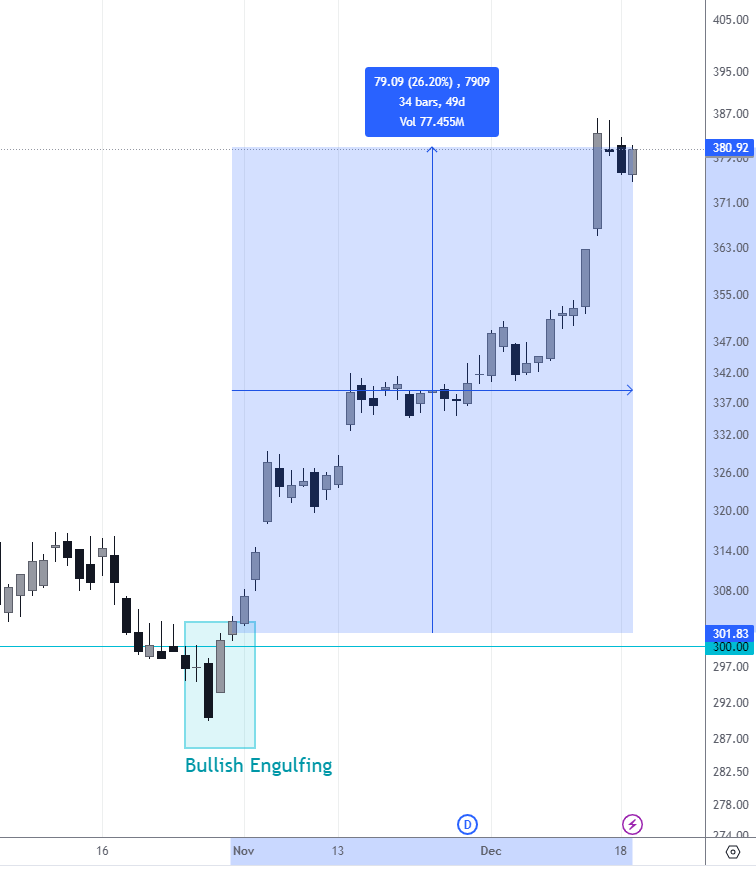
The eight-week hold strategy is grounded in capitalizing on rapid stock surges following a breakout, particularly when the increase is 20% or more within a short timeframe (1-3 weeks).
In such cases, traders are advised to maintain their position for a minimum of eight weeks, allowing the stock to demonstrate its ability to sustain momentum. Given the current scenario where the stock price has broken above $350, refraining from taking profits aligns with this strategy.
Holding for the designated period offers an opportunity to observe if the stock can continue its upward trajectory, potentially maximizing gains over the medium term.
Trailing stops
Implementing trailing stops involves tailoring decisions based on specific parameters, and the determination to take profits hinges on these predefined conditions.
As of now, it appears that the profit-taking trigger has not been activated, suggesting that the current market conditions haven't met the criteria set for realizing gains. Traders employing trailing stops should closely monitor the stock's performance and adjust stop-loss orders accordingly.
For a comprehensive understanding of trailing stops and how to utilize them effectively, consider exploring further insights in this informative article: What is a Trailing Stop Order?.
Fundamental
In fundamental analysis, external factors play a pivotal role in shaping decisions regarding stock positions.
If, for instance, a competitor like Morgan Stanley or Bank of America releases a weak report or if the broader financial sector underperforms relative to other sectors, it could signal a prudent time to consider taking profits.
However, in the present case, the fundamental background for GS Bank appears robust. Given the absence of negative reports from competitors and the overall strength in the financial sector, it is advisable to exercise restraint in taking profits.
Sound fundamentals provide a solid foundation for potential continued growth, reinforcing the rationale for maintaining the position and capitalizing on the enduring strength of the stock.
Profit-taking strategies only work if your broker supports them. Below is a comparison of stock brokers that offer advanced order types, fast execution, and tools essential for locking in profits efficiently.
| eToro USA | Plus500 | eOption | Revolut | Interactive Brokers | Fidelity | Optimus Futures | Wealthsimple | SoFi Invest | |
|---|---|---|---|---|---|---|---|---|---|
|
Foundation year |
2007 | 2008 | 2007 | 2015 | 1978 | 1946 | 2004 | 2014 | 2011 |
|
Account min. |
50 | EUR500 | No | No | No | No | 500 | No | No |
|
Interest rate |
3,75 | No | 8.95% | 0%-4% | 4.83% | 4.97% | No | 1 | 1%-9.5% |
|
Basic stock/ETF fee |
No | $0.006 | $0 | 0.12%-0.25% | 0-0,0035% | No | Not specified | No | No |
|
Min. stock/ETF fee |
No | Not specified | $0 | £1.00/€1.00 | $1,00 | No | Not specified | No | No |
|
Basic futures fee |
Not specified | Not specified | Not specified | No | $0,25 | Varies | $0.25/$0.75 | No | No |
|
Min. futures fee |
Not specified | Not specified | Not specified | No | $0,25 | Varies | $0.05 | No | No |
|
Open an account |
Go to broker Your capital is at risk. |
Go to broker 80% of retail CFD accounts lose money. |
Study review | Study review | Study review | Study review | Study review | Study review | Study review |
Tips for taking profits from stocks
Track stock index. Stay informed about broader market trends by tracking relevant stock indices. Understanding the overall market direction provides valuable context for deciding when to take profits from individual stocks.
Follow the news. Keep a close eye on financial news and developments. News can impact stock prices, and being aware of relevant events helps you make informed decisions about when to capitalize on profits or adjust your positions.
Be aware when everybody is greedy. In the words of Warren Buffett, "Be fearful when others are greedy, and greedy when others are fearful." Recognize market sentiment and exercise caution when excessive greed prevails, as it may indicate an overheated market.
Take profits in stages. Consider a gradual approach to profit-taking by selling a portion of your position. This strategy allows you to secure some gains while maintaining exposure to potential further upside, striking a balance between realizing profits and staying invested.
For more in-depth insights and strategies like fixed take profits, percentage take profits, and trailing take profits by indicators, explore this informative article: Take Profit Strategies.
Each strategy offers a unique perspective on when and how to secure gains, providing traders with awell-rounded toolkit. Drawing inspiration from the wisdom of industry experts and incorporating practical tips such as tracking stock indices and staying abreast of market sentiment, this guide empowers traders to navigate the complex terrain of stock trading with confidence.
Don’t look for a perfect moment to take profits

As a trader with hands-on experience, my main recommendation is simple: don’t look for a perfect moment to take profits – it doesn’t exist. Over the years, I’ve learned that most mistakes are not made on entry, but on exit. If you open a position without a clear plan for how and why you’ll take profits, the market will eventually make that decision for you – usually at the worst possible time.
In practice, I prefer a flexible approach. I often lock in part of the profit earlier to reduce emotional pressure and protect capital, while leaving the rest of the position open to benefit from further upside. Markets can reward patience more than rigid targets. At the same time, I never look at price alone. Broader market conditions, sector strength, and how a stock behaves after strong moves matter just as much. When a rally starts to feel too easy or overly euphoric, that’s usually a warning sign, not a reason to get greedy.
My key advice is to treat profit-taking as a process, not a single decision. Scaling out, staying disciplined, and adapting to changing conditions consistently outperform attempts to sell at the exact top. In the long run, successful traders are not those who catch peaks, but those who protect gains and compound capital steadily.
Conclusion
Mastering the art of taking profits from stocks requires both discipline and strategy. By applying rules like selling after a 20–25% gain, leveraging the eight-week hold for successful breakout stocks, and using trailing stops, investors can lock in gains while minimizing regret and emotional decision-making. Integrating fundamental analysis also helps ensure that exits are grounded in a company’s real performance, as seen when a stock’s fundamentals begin to wane. Ultimately, the most powerful takeaway is that defining and executing a profit-taking plan transforms unpredictable markets into manageable opportunities—because in investing, consistent strategies win over impulsive actions every time.
FAQs
What role does market sentiment play in deciding when to take profits from stocks?
How can tracking stock indices assist in profit-taking decisions?
Are there benefits to taking profits from stocks gradually rather than all at once?
Why is it recommended to treat profit-taking as an ongoing process instead of seeking the perfect exit moment?
Editors' Top Picks and Insights

Bitcoin mining is getting greener, but the debate isn't over

Asia's largest IPO: How CXMT became China's most valuable company

Global fintech in 2026: Three trends that matter

From Jesus Christ to aliens: Polymarket's most absurd prediction markets

Hunting crypto owners: Why criminals have gone offline

BitMEX is shutting down: Why Trump could not save the exchange
Related Articles
Team that worked on the article
Upendra Goswami is a full-time digital content creator, marketer, and active investor. As a creator, he loves writing about online trading, blockchain, cryptocurrency, and stock trading.
Dan Blystone began his trading career in 1998 as an arbitrage clerk on the floor of the Chicago Mercantile Exchange (CME). He later traded bond and Eurex futures at proprietary firms such as Altea Trading, gaining valuable experience in high-frequency trading and risk management.
Chinmay Soni is a financial analyst with more than 5 years of experience in working with stocks, Forex, derivatives, and other assets. As a founder of a boutique research firm and an active researcher, he covers various industries and fields, providing insights backed by statistical data.
CFD is a contract between an investor/trader and seller that demonstrates that the trader will need to pay the price difference between the current value of the asset and its value at the time of contract to the seller.
Bitcoin is a decentralized digital cryptocurrency that was created in 2009 by an anonymous individual or group using the pseudonym Satoshi Nakamoto. It operates on a technology called blockchain, which is a distributed ledger that records all transactions across a network of computers.
A Trailing Stop Order is a type of order that automatically adjusts the stop-loss level as the market price moves in a favorable direction, helping to protect profits.
In the Forex market, a “trend” is the label used to describe the general direction that the prices of currency pairs are moving in, over a specific period of time. Trends are basically the pattern that a currency pair appears to be following and can help traders determine when to enter and exit a trade.
Index in trading is the measure of the performance of a group of stocks, which can include the assets and securities in it.

-
 Afghanistan
-
 Albania
-
 Algeria
-
 Angola
-
 Argentina
-
 Armenia
-
 Australia
-
 Austria
-
 Azerbaijan
-
 Bahamas
-
 Bahrain
-
 Bangladesh
-
 Belarus
-
 Belgium
-
 Bolivia
-
 Botswana
-
 Brazil
-
 Brunei
-
 Bulgaria
-
 Cambodia
-
 Cameroon
-
 Canada
-
 Chile
Chile
-
 China
China
-
 Colombia
-
 Congo
Congo
-
 Costa Rica
-
 Cote d'Ivoire
-
 Croatia
-
 Cuba
Cuba
-
 Cyprus
-
 Czechia
-
 DR Congo
-
 Denmark
-
 Dominican Republic
-
 Ecuador
-
 Egypt
Egypt
-
 El Salvador
-
 Estonia
-
 Eswatini
-
 Ethiopia
-
 Finland
-
 France
-
 Georgia
-
 Germany
-
 Ghana
Ghana
-
 Greece
-
 Haiti
Haiti
-
 Hong Kong
-
 Hungary
-
 India
India
-
 Indonesia
-
 Iran, Islamic republic
-
 Iraq
Iraq
-
 Ireland
-
 Israel
-
 Italy
Italy
-
 Jamaica
-
 Japan
Japan
-
 Jordan
-
 Kazakhstan
-
 Kenya
Kenya
-
 Korea
Korea
-
 Kuwait
-
 Kyrgyzstan
-
 Laos
Laos
-
 Latvia
-
 Lebanon
-
 Lesotho
-
 Libya
Libya
-
 Lithuania
-
 Luxembourg
-
 Madagascar
-
 Malaysia
-
 Malta
Malta
-
 Mauritius
-
 Mexico
-
 Moldova
-
 Mongolia
-
 Montenegro
-
 Morocco
-
 Mozambique
-
 Myanmar
-
 Namibia
-
 Nepal
Nepal
-
 Netherlands
-
 New Zealand
-
 Nigeria
-
 North Macedonia
-
 Norway
-
 Oman
Oman
-
 Pakistan
-
 Palestine
-
 Panama
-
 Papua New Guinea
-
 Paraguay
-
 Peru
Peru
-
 Philippines
-
 Poland
-
 Portugal
-
 Puerto Rico
-
 Qatar
Qatar
-
 Reunion
-
 Romania
-
 Rwanda
-
 Saudi Arabia
-
 Serbia
-
 Singapore
-
 Slovakia
-
 Slovenia
-
 Somalia
-
 South Africa
-
 Spain
Spain
-
 Sri Lanka
-
 Sweden
-
 Switzerland
-
 Syria
Syria
-
 Taiwan
-
 Tajikistan
-
 Tanzania
-
 Thailand
-
 Trinidad and Tobago
-
 Tunisia
-
 Turkey
-
 UAE
UAE
-
 Uganda
-
 Ukraine
-
 United Kingdom
-
United States
-
 Uruguay
-
 Uzbekistan
-
 Venezuela
-
 Vietnam
-
 Yemen
Yemen
-
 Zambia
-
 Zimbabwe
- Forex
- Crypto












