
Bitdegree Learn And Earn: A Beginner's Guide


Editorial Note: While we adhere to strict Editorial Integrity, this post may contain references to products from our partners. Here's an explanation for How We Make Money. None of the data and information on this webpage constitutes investment advice according to our Disclaimer.
BitDegree's Learn and Earn program allows users to acquire Web3 skills through interactive "Missions" while earning cryptocurrency rewards. These Missions involve tasks like quizzes and social actions, offering tokens, stablecoins, and NFTs upon completion. This gamified approach provides a unique opportunity to learn about blockchain technology and earn digital assets simultaneously.
BitDegree Learn and Earn is an educational program that allows users to learn about Web3 technologies while earning cryptocurrency rewards. The platform offers interactive courses and missions, combining learning with financial incentives. Participants can explore the basics of blockchain, decentralized applications, and cryptocurrencies by completing tasks and earning tokens. This approach makes the learning process both beneficial and financially rewarding. This guide covers the key principles of the program, available rewards, and registration steps. Let’s explore how to get started and make the most of BitDegree Learn and Earn.
What is BitDegree Learn and Earn?
BitDegree is an educational platform founded in 2017 that offers online courses and certification in Web3. The company develops training programs on blockchain, cryptocurrencies, and decentralized applications. The platform is designed for users who want to gain knowledge about digital technologies and monetize their learning process.
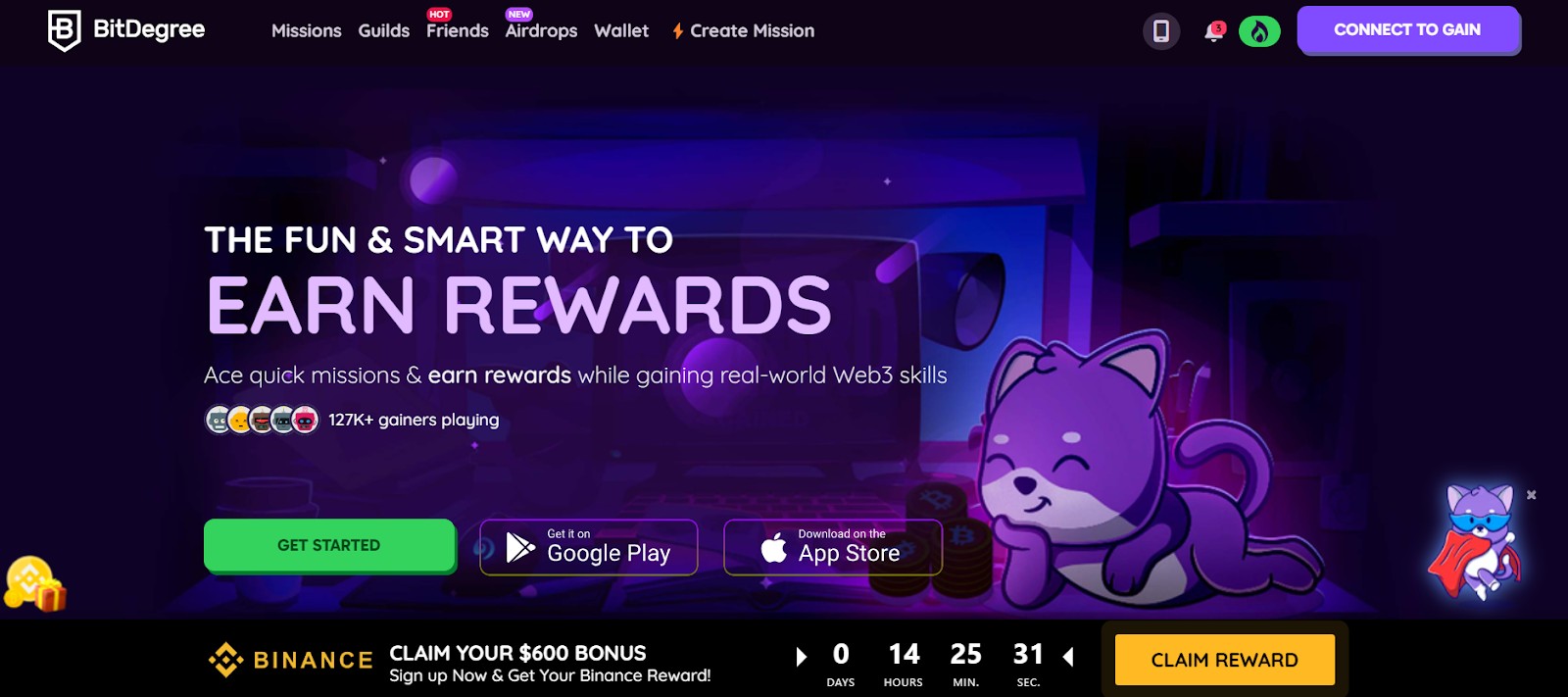
The Learn and Earn program on BitDegree uses a reward-based learning model. Participants complete courses and interactive missions in exchange for cryptocurrency tokens, NFTs, or other digital assets. This system allows users not only to acquire new knowledge but also to receive tangible rewards.
Learning takes place in the form of short modules, quizzes, and assignments. Many courses are developed in collaboration with industry partners, ensuring their relevance. Users can select topics of interest, register on the platform, and start learning without prior investment.
BitDegree also issues NFT certificates that validate the successful completion of courses. These certificates can be useful for employment or further education. The platform is accessible via a web interface, allowing users to learn at their convenience.
How does the Learn & Earn program on BitDegree work?
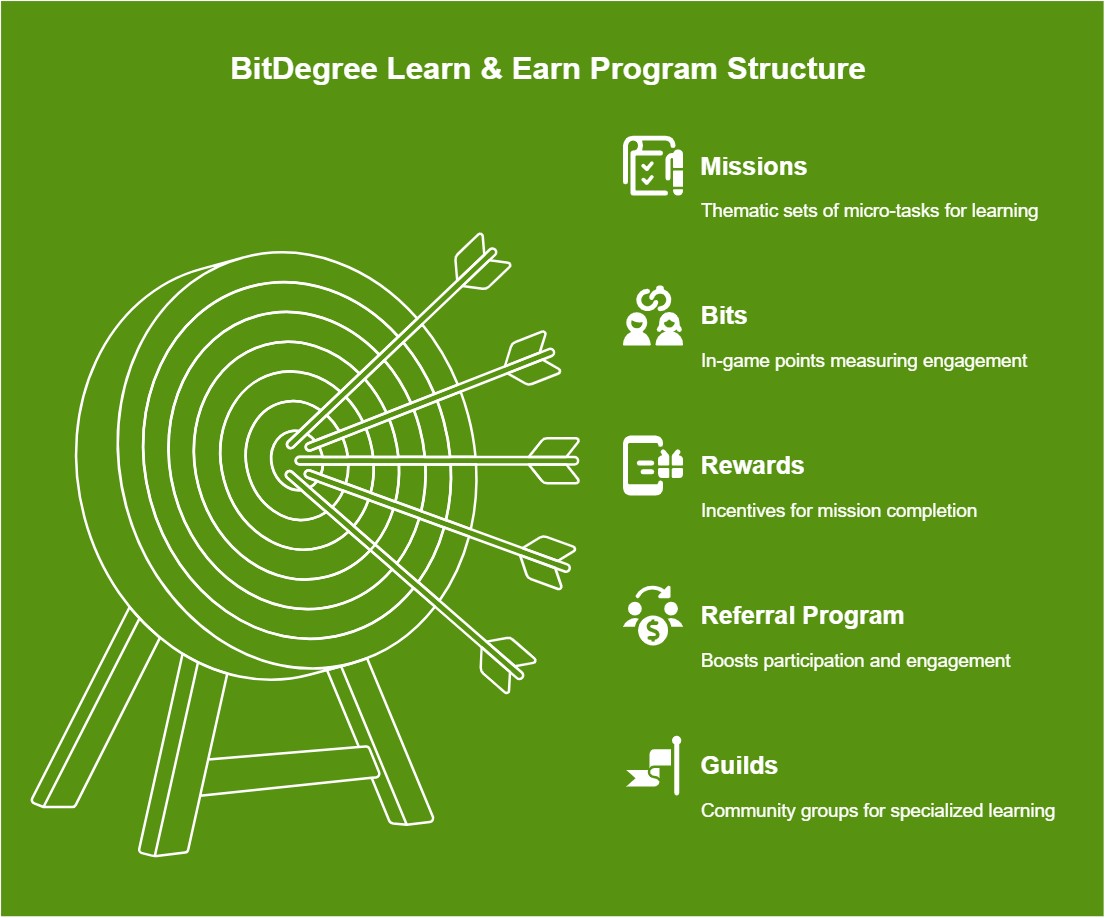
BitDegree's "Learn & Earn" program is a gamified educational platform designed to make learning about cryptocurrencies, blockchain technology, and Web3 both engaging and rewarding. By integrating interactive tasks with tangible incentives, BitDegree aims to enhance user engagement and knowledge retention.
Key components of the program
Missions
Structure. Missions consist of thematic sets of micro-tasks, known as rounds, that cover specific topics within the crypto and Web3 space. Each mission provides relevant learning materials and interactive tasks such as quizzes, social actions, and research assignments.
Participation. Users can select missions based on their interests, allowing for a personalized learning experience.
Bits
Definition. Bits are in-game points awarded upon the completion of mission tasks. They serve as a measure of user engagement and progress within the platform.
Degree system. Accumulating bits contributes to a user's degree, a ranking system that reflects their activity and learning achievements. A higher degree increases the likelihood of winning rewards in platform events like lucky draws.
Rewards
Rewards are typically granted upon mission completion and are either directly credited to the user's in-app wallet or made available for claim through specified processes. Participants can earn various incentives, including:
Cryptocurrency tokens. Rewards in the form of specific crypto tokens.
Stablecoins. Cryptocurrencies pegged to stable assets, offering consistent value.
NFTs. Unique digital assets representing ownership or proof of completion.
Physical items. Tangible rewards such as merchandise or hardware wallets.
Referral program
Mechanism. Users can invite friends to join the platform. Both the referrer and the referred friend receive additional bits upon the new user's active participation.
Benefits. This system encourages community growth and offers users a means to boost their degree more rapidly.
Guilds
Functionality. Guilds are community groups within BitDegree that focus on specific topics or projects. Joining a guild allows users to participate in specialized missions and connect with like-minded learners.
Creation. While currently maintained by industry partners, there are plans to enable users to create their own guilds and develop custom missions.
User experience
Accessibility. The BitDegree platform is available via web browsers and has dedicated mobile applications for both iOS and Android, ensuring learners can engage with content on the go.
Engagement. The gamified approach, combined with the prospect of earning rewards, fosters a motivating environment for users to continuously expand their knowledge.
What cryptocurrency rewards can you earn?
BitDegree's "Learn & Earn" program offers participants the opportunity to earn various cryptocurrency rewards by engaging with educational content and completing interactive tasks. The types of crypto rewards available include.
Cryptocurrency tokens. Participants can earn specific crypto tokens by completing missions.
Stablecoins. Some missions offer rewards in stablecoins, which are cryptocurrencies pegged to stable assets, providing consistent value.
NFTs. Unique digital assets, such as NFT certificates of completion, can be earned upon finishing certain courses or tasks.
Tangible rewards. In addition to digital assets, participants may receive physical items like merchandise or hardware wallets as rewards for their engagement.
After completing BitDegree Learn & Earn missions, users often receive rewards in the form of cryptocurrencies, stablecoins, or NFTs. To make the most of these rewards, it’s important to use a reliable crypto exchange where you can store, swap, or withdraw your earned assets safely.
Different exchanges offer varying fees, supported tokens, withdrawal options, and ease of use – all of which matter when you’re managing Learn & Earn rewards. Below is a comparison of popular crypto exchanges that work well for handling BitDegree-earned assets.
| Coinbase | OKX | BTCC | Cryptohopper | Crypto.com | |
|---|---|---|---|---|---|
|
Demo account |
No | Yes | Yes | No | No |
|
Coins Supported |
400+ | 600+ | 399 | 1000 | 400+ |
|
Min. Deposit, $ |
10 | 10 | 10 | No | 1 |
|
Spot leverage |
1:3 | 1:10 | 1:1 | No | 1:3 |
|
Spot Maker Fee, % |
0.5 | 0.08 | 0.2 | 0 | 0.25 |
|
Spot Taker fee, % |
0.5 | 0.1 | 0.3 | 0 | 0.5 |
|
TU overall score |
8.5 | 8.46 | 8.08 | 7.8 | 7.76 |
|
Open an account |
Go to broker Your capital is at risk. |
Go to broker Your capital is at risk. |
Go to broker Your capital is at risk.
|
Go to broker Your capital is at risk. |
Go to broker Your capital is at risk. |
How to register and start learning on BitDegree?

Creating an account. To start learning on the BitDegree platform, you need to create an account. Visit the official website and click the "Register" button in the top right corner. Fill in the required fields, providing a valid email address and a secure password. Once you confirm your registration, you will gain access to your personal dashboard.
Choosing a course or mission. The "Courses" section offers various educational programs covering Web3 and cryptocurrency-related topics. Select the course or mission that matches your interests, considering its difficulty level and duration. Each course includes a detailed description to help you determine its relevance to your goals.
Learning process. After selecting a course, follow the structured program to start learning. Complete assignments, pass quizzes, and participate in interactive sessions. The platform incorporates gamification elements, making the learning process engaging and effective.
Receiving rewards. Upon successfully completing courses and missions, you can earn various rewards, including cryptocurrency tokens, NFTs, and other digital prizes. Rewards are credited automatically and displayed in your personal dashboard. You can withdraw them through a linked cryptocurrency wallet such as MetaMask or Trust Wallet, following the platform’s specified conditions. Some rewards may have additional requirements, such as a minimum withdrawal amount or identity verification.
Pros and cons of BitDegree Learn and Earn
- Pros
- Cons
Earning potential while learning: BitDegree has implemented a "Learn and Earn" model, allowing users to receive cryptocurrency rewards for completing educational modules.
Access to up-to-date Web3 and cryptocurrency knowledge: The platform offers courses covering a wide range of topics, from cryptocurrency fundamentals to advanced trading techniques, enabling users to gain valuable digital skills.
Regional restrictions on some programs: Certain courses and reward programs may be unavailable in specific countries due to regulatory constraints. This limitation affects users in restricted jurisdictions who may not be able to participate in Learn & Earn opportunities.
Cryptocurrency reward volatility: The value of earned tokens can fluctuate significantly, making earnings unpredictable. Rewards may decrease or increase in value depending on market conditions.
When evaluating the BitDegree Learn and Earn program, users should consider regional restrictions and potential fluctuations in the value of rewards. To maximize benefits, it is advisable to monitor cryptocurrency prices, select the most profitable learning programs, and plan withdrawals based on market trends.
Instead of just sharing your referral link everywhere, start a small Telegram or Discord group

If you want to make the most money with BitDegree’s Learn & Earn, don’t just complete missions at random — be smart about your timing. Look for missions linked to new blockchain projects or trending tokens. These projects often offer bigger rewards when they’re trying to get attention. Do a little digging before you start. If a project is running ads or getting hyped in crypto communities, chances are their BitDegree missions will be worth more. Another trick is to finish missions early, especially ones from new projects. Many of them give out better rewards at the start because they want to boost engagement fast.
Most people ignore the referral and guild system, but that’s where the real passive earnings come in. Instead of just sharing your referral link everywhere, start a small Telegram or Discord group where you and others share updates and tips on high-paying missions. When people trust your advice, they’ll use your referral link naturally, and you’ll keep earning from their activity.
Also, don’t join random guilds — find ones with experienced members who know which missions are actually worth it. Many new users waste time on low-reward tasks, but if you follow the right people, you’ll know which ones pay the most with the least effort. That’s how you turn BitDegree into a legit side hustle instead of just a fun way to earn extra crypto.
Conclusion
BitDegree's Learn and Earn program stands out as a powerful way for beginners to gain valuable knowledge while earning cryptocurrency rewards. By leveraging interactive courses and real crypto incentives, users can transform their time spent learning into tangible assets. For example, a user mastering blockchain fundamentals can earn crypto that can be reinvested or traded, fostering both financial and intellectual growth. Ultimately, BitDegree proves that education can be both profitable and practical, empowering learners to invest in themselves and their futures while participating in the expanding digital economy.
FAQs
What strategies can help maximize earnings with BitDegree Learn and Earn?
What are the main risks when participating in BitDegree Learn and Earn?
How does the guild system work within BitDegree Learn and Earn?
Can users participate in BitDegree Learn and Earn via mobile devices?
Editors' Top Picks and Insights





Related Articles
Team that worked on the article
Maxim Nechiporenko has been a contributor to Traders Union since 2023. He started his professional career in the media in 2006.
Dan Blystone began his trading career in 1998 as an arbitrage clerk on the floor of the Chicago Mercantile Exchange (CME). He later traded bond and Eurex futures at proprietary firms such as Altea Trading, gaining valuable experience in high-frequency trading and risk management.
Chinmay Soni is a financial analyst with more than 5 years of experience in working with stocks, Forex, derivatives, and other assets. As a founder of a boutique research firm and an active researcher, he covers various industries and fields, providing insights backed by statistical data.
Cryptocurrency is a type of digital or virtual currency that relies on cryptography for security. Unlike traditional currencies issued by governments (fiat currencies), cryptocurrencies operate on decentralized networks, typically based on blockchain technology.
Xetra is a German Stock Exchange trading system that the Frankfurt Stock Exchange operates. Deutsche Börse is the parent company of the Frankfurt Stock Exchange.
Risk management is a risk management model that involves controlling potential losses while maximizing profits. The main risk management tools are stop loss, take profit, calculation of position volume taking into account leverage and pip value.
Index in trading is the measure of the performance of a group of stocks, which can include the assets and securities in it.
CFD is a contract between an investor/trader and seller that demonstrates that the trader will need to pay the price difference between the current value of the asset and its value at the time of contract to the seller.

-
 Afghanistan
-
 Albania
-
 Algeria
-
 Angola
-
 Argentina
-
 Armenia
-
 Australia
-
 Austria
-
 Azerbaijan
-
 Bahamas
-
 Bahrain
-
 Bangladesh
-
 Belarus
-
 Belgium
-
 Bolivia
-
 Botswana
-
 Brazil
-
 Brunei
-
 Bulgaria
-
 Cambodia
-
 Cameroon
-
 Canada
-
 Chile
Chile
-
 China
China
-
 Colombia
-
 Congo
Congo
-
 Costa Rica
-
 Cote d'Ivoire
-
 Croatia
-
 Cuba
Cuba
-
 Cyprus
-
 Czechia
-
 DR Congo
-
 Denmark
-
 Dominican Republic
-
 Ecuador
-
 Egypt
Egypt
-
 El Salvador
-
 Estonia
-
 Eswatini
-
 Ethiopia
-
 Finland
-
 France
-
 Georgia
-
 Germany
-
 Ghana
Ghana
-
 Greece
-
 Haiti
Haiti
-
 Hong Kong
-
 Hungary
-
 India
India
-
 Indonesia
-
 Iran, Islamic republic
-
 Iraq
Iraq
-
 Ireland
-
 Israel
-
 Italy
Italy
-
 Jamaica
-
 Japan
Japan
-
 Jordan
-
 Kazakhstan
-
 Kenya
Kenya
-
 Korea
Korea
-
 Kuwait
-
 Kyrgyzstan
-
 Laos
Laos
-
 Latvia
-
 Lebanon
-
 Lesotho
-
 Libya
Libya
-
 Lithuania
-
 Luxembourg
-
 Madagascar
-
 Malaysia
-
 Malta
Malta
-
 Mauritius
-
 Mexico
-
 Moldova
-
 Mongolia
-
 Montenegro
-
 Morocco
-
 Mozambique
-
 Myanmar
-
 Namibia
-
 Nepal
Nepal
-
 Netherlands
-
 New Zealand
-
 Nigeria
-
 North Macedonia
-
 Norway
-
 Oman
Oman
-
 Pakistan
-
 Palestine
-
 Panama
-
 Papua New Guinea
-
 Paraguay
-
 Peru
Peru
-
 Philippines
-
 Poland
-
 Portugal
-
 Puerto Rico
-
 Qatar
Qatar
-
 Reunion
-
 Romania
-
 Rwanda
-
 Saudi Arabia
-
 Serbia
-
 Singapore
-
 Slovakia
-
 Slovenia
-
 Somalia
-
 South Africa
-
 Spain
Spain
-
 Sri Lanka
-
 Sweden
-
 Switzerland
-
 Syria
Syria
-
 Taiwan
-
 Tajikistan
-
 Tanzania
-
 Thailand
-
 Trinidad and Tobago
-
 Tunisia
-
 Turkey
-
 UAE
UAE
-
 Uganda
-
 Ukraine
-
 United Kingdom
-
United States
-
 Uruguay
-
 Uzbekistan
-
 Venezuela
-
 Vietnam
-
 Yemen
Yemen
-
 Zambia
-
 Zimbabwe
- Forex
- Crypto












