
A Stock Trader's Guide To UK And Global Market Hours



Editorial Note: While we adhere to strict Editorial Integrity, this post may contain references to products from our partners. Here's an explanation for How We Make Money. None of the data and information on this webpage constitutes investment advice according to our Disclaimer.
London Stock Exchange - 8AM to 4:30PM, break from 12:00 to 12:02PM - FTSE 100, FTSE 250
New York Stock Exchange, NASDAQ - Simplicity - 2:30PM to 9PM most of year 1:30PM to 8PM from 10 Mar to 31 Mar and Oct 31 to Nov 4, outside of BST and DST - Dow Jones, S&P 500, NASDAQ
Simplicity - 12AM to 6AM, lunch break 2:30AM to 3:30AM. During British Summer Time, hours are 1AM to 7AM. - Nikkei 225
Shanghai Stock Exchange - 1:30 AM to 7AM, lunch break 3:30 AM to 5AM. During British Summer Time, 2:30 AM to 8AM. - SSE Composite Index
Euronext - 8AM to 4:30 PM, no break - AEX (Amsterdam), CAC 40 (Paris)
Unlike Forex or cryptocurrencies, stock exchanges have limited hours for traders to buy and sell stocks. If you’re a stock trader in the UK, chances are you’ll be trading during the opening hours of the UK’s stock exchanges, making it crucial to know what those hours are. If you’re based in the UK but trading on other major stock exchanges across the world, it’s also important to know what hours they open, and how those hours translate to UK time.
In this article, we explain in detail the stock market trading hours in the UK, extended hours trading times, and the opening hours of stock markets outside the UK.
What are the trading hours in the UK?
If you’re wondering “Is the stock market open today in the UK?”, we’ve got you covered.
The London Stock Exchange (LSE) typically operates from 8:00 AM to 4:30 PM local UK time, for a total of 8 hours and 30 minutes per day. There’s no lunch break (no time to eat for the money-hungry!) though the exchange does close for two minutes from noon until 12:02 PM, a measure introduced in 2014 to protect institutional traders from high-frequency traders. The market operates normally from Monday to Friday, except for certain holidays and special events, listed below.
Good Friday: The market is closed for Good Friday, which is 29 March for 2024. This day is always the last Friday before Easter Sunday, so it changes annually. Easter Sunday is always the first Sunday after the Spring Equinox full moon.
Easter Monday: The LSE is closed on the first Monday after Easter Sunday, which in 2024 is 1 April.
Early May Bank Holiday: On the first Monday of May each year, the UK has a bank holiday, meaning markets are closed. In 2024, it’s 6 May.
Spring Bank Holiday: The stock exchange is closed all day on this national bank holiday, which falls on 27 May in 2024. This is always on the seventh Monday after Easter, one day after Pentecost (a religious day) so the date changes each year.
Summer Bank Holiday: The markets close for this summer day off, which is always the last Monday in August, falling on 26 August in 2024.
Christmas Eve: On 24 December, markets close at 12:30PM for Christmas.
Christmas Day: On 25 December, the market is closed all day for Christmas.
Boxing Day: Markets are closed all day on 26 December for a bank holiday.
New Year's Eve: On 31 December, the LSE closes at 12:30 PM for New Year’s.
New Year’s Day: Exchanges are closed on 1 January, for the New Year.
Additional: Extraordinary circumstances or events can lead the LSE to close for the day, such as for the funeral of Queen Elizabeth II on Monday 19 September 2022.
The times listed above use Greenwich Meridian Time (GMT), though this changes to GMT+1 during British Summer Time. If you’re a trader outside the UK trading UK stocks, be aware of clocks going forward an hour from March 31st to October 31.
The FTSE 100 index, representing the UK stock market's top 100 companies, follows these trading hours. As all stocks on the FTSE 100 are listed on the London Stock Exchange, its opening hours are identical to the London Stock Exchange.
However, trading derivatives such as futures based on the FTSE 100 can be done outside of stock market hours, from 1AM to 9PM, Monday to Friday, UK time. Some brokers offer trading on FTSE 100 CFDs from Sunday night to Friday night.
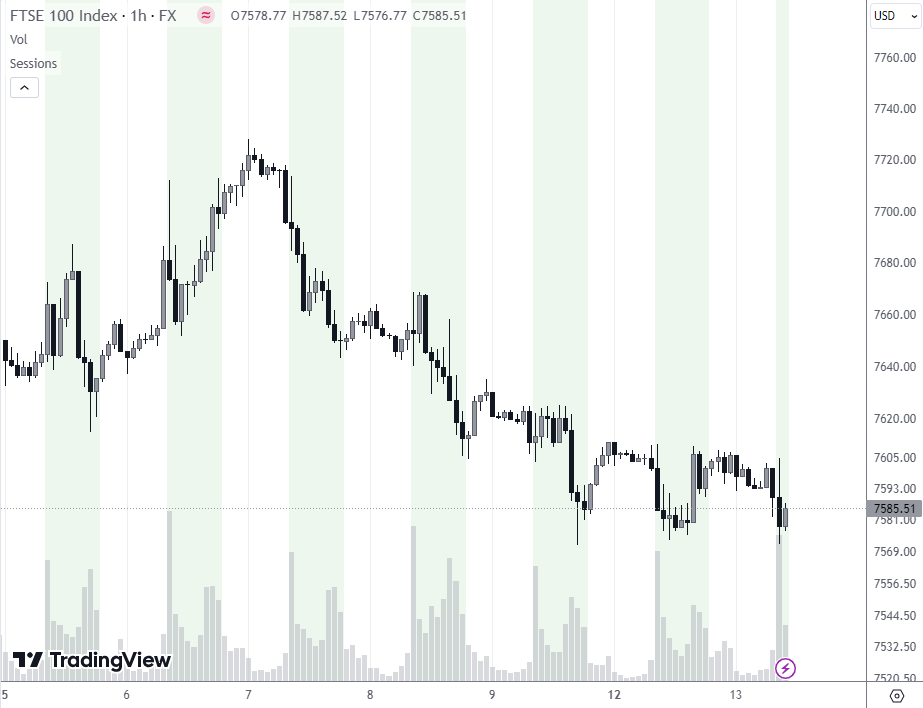 Hourly chart of CFD on the British stock index FTSE
If you want to trade during extended hours in markets derived from the FTSE UK stock index, there are available ways to do so. The chart above shows the price dynamics of such an instrument, with green colouring the areas when the London stock market is open.
To see the best CFD brokers in the UK, go to our ratings page: Top 10 Best CFD Brokers in the UK
Best Stock brokers
Choosing the right stock broker is essential for accessing global markets efficiently and executing trades during key trading hours. The platforms below are among the best stock brokers, offering reliable execution, competitive fees, and access to major international exchanges.
| eToro USA | Plus500 | eOption | Revolut | Interactive Brokers | Fidelity | |
|---|---|---|---|---|---|---|
|
Foundation year |
2007 | 2008 | 2007 | 2015 | 1978 | 1946 |
|
Account min. |
50 | EUR500 | No | No | No | No |
|
Interest rate |
3,75 | No | 8.95% | 0%-4% | 4.83% | 4.97% |
|
Basic stock/ETF fee |
No | $0.006 | $0 | 0.12%-0.25% | 0-0,0035% | No |
|
Min. stock/ETF fee |
No | Not specified | $0 | £1.00/€1.00 | $1,00 | No |
|
Basic futures fee |
Not specified | Not specified | Not specified | No | $0,25 | Varies |
|
Min. futures fee |
Not specified | Not specified | Not specified | No | $0,25 | Varies |
|
Open an account |
Go to broker Your capital is at risk. |
Go to broker 80% of retail CFD accounts lose money. |
Study review | Study review | Study review | Study review |
Extended and after-hours trading in the UK
In other countries, like the US, traders can engage in stock trading outside of traditional market hours, in pre-market and after-hours trading sessions. However, this practice is not nearly as prevalent in the UK. The London Stock Exchange offers some extended hours trading. The Pre-Trading Session runs from 5:05 AM local time to 7:50 AM, and the Post-Close Session (after-market) is from 4:40 PM to 5:15PM UK time.
Extended hours trading is done through companies that operate systems similar to exchanges. In the US, where extended hours trading is popular, these systems are called electronic communication networks (ECNs) or alternative trading systems (ATS). Due to European regulations, the systems used are multilateral trading facilities (MTFs). Though the names are different, they all essentially act as virtual trading floors for people wanting to buy and sell stocks outside of normal market hours.
After hours trading usually incurs higher costs and is not offered by all brokers, because accessing the trading systems requires different technology to the standard stock exchange. Spreads are also usually wider as less traders are participating in pre-market or after-market trading hours.
Synchronizing with global markets: A UK perspective
If you’re a trader based in the UK, it’s useful to know the opening hours of not only the UK stock market, but those of major stock markets in other countries too. You may want to trade stocks listed on foreign stock exchanges, such as in the US, Europe, or Japan, and even if you don’t – traders in other countries may engage with the UK stock market during their own active hours, potentially impacting volatility and liquidity.
Let’s say you wanted to trade on some of the biggest exchanges in the world, buying and selling US stocks, Japanese stocks, European stocks, and Chinese stocks on top of UK stocks. You would need to be aware of their opening times, in UK time. Those times are as follows.
Japan: In Japanese local time, the Tokyo Stock Exchange opens at 9AM and shuts at 3PM, with a lunch break from 11:30AM to 12:30PM. In UK time, this is from 12AM (midnight) to 6AM, or during British Summer Time, 1AM to 7AM.
China: The Shanghai Stock Exchange, the third largest stock exchange in the world, is open from 9:30AM to 3PM local time, with lunch from 11:30AM to 1PM. In UK time, this is 1:30 AM to 7AM. During British Summer Time, that’s 2:30 AM to 8AM.
Europe: Europe’s stock exchange, the Euronext, is the world’s fourth largest. It opens from 9AM to 5:30PM, and has no lunch break. If you’re in the UK, that’s 8 AM to 4:30 PM. The UK and most of Europe share the same dates for summertime, so British Summer Time isn’t an issue here.
USA: The world’s two largest stock exchanges, the New York Stock Exchange (NYSE) and the NASDAQ, both open at 9:30 AM local time, and close at 4PM, with no lunch break. In the UK, this translates to 2:30 PM to 9 PM. British Summer Time and the US Daylight Savings Time are not aligned however, so from the 10th March to 31st March, and October 31st to November 4th, the NYSE and NASDAQ are open 1:30 PM to 8 PM in UK time.
As the US stock market opens during the opening hours of the London Stock Exchange, there is an overlap for traders’ active hours. US stock traders are likely to trade UK stocks after about 1PM UK time, leading to some increased volatility. Likewise, UK traders and others from around the world would begin trading US stocks when the NYSE and NASDAQ open, at 2:30PM.
If you’re looking for the best stock brokers in the UK this year, check out our list of the five best ones, here: Best Stock Brokers In the UK for 2026 - TOP 5
Rules and Regulation
The UK boasts one of the world's largest stock markets, with a market capitalization of approximately $4.5 trillion,placing it firmly within the top 5 globally.
Major Stock Exchanges
- London Stock Exchange (LSE) is the primary and most significant stock exchange. It is one of the oldest stock exchanges globally, with a history dating back to the 17th century.
- Alternative Investment Market (AIM) is a sub-market of the LSE, catering to smaller, growing companies.
Trading hours are from 8:00 AM to 4:30 PM GMT, Monday to Friday.
Market Overview
- Financial Times Stock Exchange 100 Index (FTSE 100) is the benchmark index, representing the 100 largest companies listed on the LSE.
- The FTSE 100 is a market-capitalization-weighted index, meaning that larger companies have a greater influence on the index's performance. The top 10 companies account for approximately 40% of the index's total market capitalization.
- The average daily turnover is around $6.4 billion.
- A historical average dividend yield is around 4%, which is higher than many other developed markets.
- The LSE is home to some of the world's most iconic companies, such as HSBC, BP, GlaxoSmithKline, and Unilever.
Regulations
Financial Conduct Authority (FCA) is the primary regulator overseeing financial markets and listed companies.
Conclusion
Regardless of whether you’re a trader based in the UK or elsewhere in the world, staying informed about global market hours is crucial for implementing and maintaining an effective trading strategy. Throughout the day, traders in various locations will be more active or inactive, affecting the ease with which you can enter and exit positions. Make sure you know the opening hours of major financial exchanges in different countries so that you can time your trades optimally.
How timing affects your trading decisions

I find that understanding market hours is not just about knowing when exchanges open and close, but about recognizing when liquidity and volatility are at their highest. The overlap between major markets, particularly London and New York, often creates the most active trading conditions, which can present both opportunities and increased risk.
I would also pay attention to how your strategy aligns with these timeframes. Short-term traders may benefit from periods of high activity, while longer-term investors may be less sensitive to intraday timing. Adjusting your trading schedule to match market dynamics can improve execution and help manage risk more effectively.
Conclusion
Mastering stock market hours is essential for every trader aiming to optimize their strategies and capitalize on global opportunities. Knowing when the UK’s London Stock Exchange overlaps with major exchanges like the NYSE can unlock periods of heightened liquidity and volatility, providing the best environment for short-term trades. For example, monitoring the U.S. and European market hours from a UK perspective enables traders to time entries and exits when markets are most active. Ultimately, aligning your approach with these global rhythms is not just about convenience—it’s about staying ahead of the curve and turning timing into a decisive trading edge.
FAQs
How do UK stock market holidays impact trading schedules?
What is the significance of the FTSE 100 index's trading hours?
Are there options to trade UK stocks outside regular market hours?
How does the overlap between the UK and US stock market hours affect trading?
Editors' Top Picks and Insights

Global fintech in 2026: Three trends that matter

From Jesus Christ to aliens: Polymarket's most absurd prediction markets

Hunting crypto owners: Why criminals have gone offline

BitMEX is shutting down: Why Trump could not save the exchange

Do governments need crypto workers?

Brent nears $100: Why oil prices are rising
Related Articles
Team that worked on the article
Jason Law is a freelance writer and journalist and a Traders Union website contributor. While his main areas of expertise are currently finance and investing, he’s also a generalist writer covering news, current events, and travel.
Dr. BJ Johnson is a PhD in English Language and an editor with over 15 years of experience. He earned his degree in English Language in the U.S and the UK.
Mirjan Hipolito is a journalist and news editor at Traders Union. She is an expert crypto writer with five years of experience in the financial markets.

-
 Afghanistan
-
 Albania
-
 Algeria
-
 Angola
-
 Argentina
-
 Armenia
-
 Australia
-
 Austria
-
 Azerbaijan
-
 Bahamas
-
 Bahrain
-
 Bangladesh
-
 Belarus
-
 Belgium
-
 Bolivia
-
 Botswana
-
 Brazil
-
 Brunei
-
 Bulgaria
-
 Cambodia
-
 Cameroon
-
 Canada
-
 Chile
Chile
-
 China
China
-
 Colombia
-
 Congo
Congo
-
 Costa Rica
-
 Cote d'Ivoire
-
 Croatia
-
 Cuba
Cuba
-
 Cyprus
-
 Czechia
-
 DR Congo
-
 Denmark
-
 Dominican Republic
-
 Ecuador
-
 Egypt
Egypt
-
 El Salvador
-
 Estonia
-
 Eswatini
-
 Ethiopia
-
 Finland
-
 France
-
 Georgia
-
 Germany
-
 Ghana
Ghana
-
 Greece
-
 Haiti
Haiti
-
 Hong Kong
-
 Hungary
-
 India
India
-
 Indonesia
-
 Iran, Islamic republic
-
 Iraq
Iraq
-
 Ireland
-
 Israel
-
 Italy
Italy
-
 Jamaica
-
 Japan
Japan
-
 Jordan
-
 Kazakhstan
-
 Kenya
Kenya
-
 Korea
Korea
-
 Kuwait
-
 Kyrgyzstan
-
 Laos
Laos
-
 Latvia
-
 Lebanon
-
 Lesotho
-
 Libya
Libya
-
 Lithuania
-
 Luxembourg
-
 Madagascar
-
 Malaysia
-
 Malta
Malta
-
 Mauritius
-
 Mexico
-
 Moldova
-
 Mongolia
-
 Montenegro
-
 Morocco
-
 Mozambique
-
 Myanmar
-
 Namibia
-
 Nepal
Nepal
-
 Netherlands
-
 New Zealand
-
 Nigeria
-
 North Macedonia
-
 Norway
-
 Oman
Oman
-
 Pakistan
-
 Palestine
-
 Panama
-
 Papua New Guinea
-
 Paraguay
-
 Peru
Peru
-
 Philippines
-
 Poland
-
 Portugal
-
 Puerto Rico
-
 Qatar
Qatar
-
 Reunion
-
 Romania
-
 Rwanda
-
 Saudi Arabia
-
 Serbia
-
 Singapore
-
 Slovakia
-
 Slovenia
-
 Somalia
-
 South Africa
-
 Spain
Spain
-
 Sri Lanka
-
 Sweden
-
 Switzerland
-
 Syria
Syria
-
 Taiwan
-
 Tajikistan
-
 Tanzania
-
 Thailand
-
 Trinidad and Tobago
-
 Tunisia
-
 Turkey
-
 UAE
UAE
-
 Uganda
-
 Ukraine
-
 United Kingdom
-
United States
-
 Uruguay
-
 Uzbekistan
-
 Venezuela
-
 Vietnam
-
 Yemen
Yemen
-
 Zambia
-
 Zimbabwe
- Forex
- Crypto












