Understanding Crypto Derivatives And Their Market Impact


Editorial Note: While we adhere to strict Editorial Integrity, this post may contain references to products from our partners. Here's an explanation for How We Make Money. None of the data and information on this webpage constitutes investment advice according to our Disclaimer.
The crypto derivatives market plays a crucial role in shaping price action across digital assets. Instruments like futures, options, and perpetual swaps allow traders to hedge, speculate, and manage risk efficiently. These tools impact liquidity, amplify volatility, and often lead price movements before the spot market reacts. Understanding crypto derivatives is essential for anyone working with Bitcoin, Ethereum, and broader crypto price dynamics. As institutional adoption grows, derivatives continue to drive market depth and direction.
The crypto derivatives market is not just a side feature of trading. It is the engine where real price shifts often begin, driven by high-leverage strategies, perpetual contracts, and institutional positioning. This space was shaped by traders long before regulations caught up, and it continues to lead spot market movements. Watching only spot prices means reacting late to what derivatives already set in motion. In this article, we explore how futures, options, perpetual swaps, leverage, liquidations, and hedging strategies influence crypto price dynamics.
Risk warning: Cryptocurrency markets are highly volatile, with sharp price swings and regulatory uncertainties. Research indicates that 75-90% of traders face losses. Only invest discretionary funds and consult an experienced financial advisor.
Understanding crypto derivatives

Crypto derivatives have become one of the fastest-growing segments in the digital asset space. As more investors look for ways to hedge, speculate, or manage risk, derivatives tied to cryptocurrencies like Bitcoin and Ethereum have gained traction. Whether you are a seasoned trader or just learning about the crypto market, understanding what these products are and how they evolved can give you deeper insight into how modern crypto markets work.
What are crypto derivatives?
Crypto derivatives are financial contracts that derive their value from a cryptocurrency instead of a traditional asset like a stock or commodity.
Common types of crypto derivatives:
Futures contracts. Futures are agreements to buy or sell a cryptocurrency at a predetermined price on a specific date. They are widely used for hedging or speculation and are settled upon expiration. This contract type is commonly listed on regulated exchanges and often favored for its clear structure and liquidity.
Options. Options provide the right, but not the obligation, to buy (call) or sell (put) a cryptocurrency at a set price before a certain date. They allow traders to manage exposure with more flexibility, capping potential losses to the premium paid while offering the opportunity for significant gains.
Perpetual swaps. Also known as perpetual futures, these contracts do not have an expiration date. They remain active as long as funding payments are maintained between long and short positions. These are the most actively traded derivative instruments in crypto and offer high liquidity and leverage, though they require careful risk management due to frequent price swings.
Why traders use them
Leverage. Derivatives allow traders to control larger positions with a fraction of the capital, magnifying both profits and losses.
Speculation. Traders can bet on upward or downward price movements without owning the asset, enabling more agile strategies.
Hedging. Investors use derivatives to protect spot holdings against downside risks by opening offsetting positions.
Flexibility. Perpetual contracts offer uninterrupted exposure to market trends without the need to roll over positions.
Why it matters
Crypto derivatives bring more tools to the market, similar to traditional finance.
They help professionalize trading and attract institutional participation.
But they also increase complexity and potential risk, especially for beginners.
Evolution of the crypto derivatives market
The crypto derivatives market has evolved from a loosely structured trading environment into one of the most influential sectors in the digital asset ecosystem. Below is a timeline of key phases and developments that shaped this transformation.
| Period | Phase | Key Highlights |
|---|---|---|
| 2011–2016 | Early Experiments | Platforms like ICBIT and BitMEX launched early BTC futures and perpetual swaps. |
| 2017 | Regulated Futures | CME & CBOE introduced the first U.S.-regulated Bitcoin futures; institutions entered. |
| 2019–2021 | Exchange-Led Growth | Binance, Bybit, FTX expanded offerings; perps became retail favorites. |
| 2022–2024 | Regulatory Tightening | Global regulators cracked down on high leverage and enforced stricter oversight. |
| 2025 | Institutional Integration | Major players like Coinbase and Nasdaq joined the space with compliant products. |
The market has matured, drawing interest from hedge funds, asset managers, and even banks. Better infrastructure and regulation are helping make crypto derivatives safer and more accessible. But past failures like FTX remind investors of the risks tied to poor oversight and leverage misuse.
Types of crypto derivatives
Crypto derivatives come in several forms, each with its own rules, uses, and risks. Whether you're trading to hedge risk, gain leverage, or speculate on price movements, knowing the differences between the main types, futures, options, and perpetual swaps, can help you choose the right tool for your strategy.
Futures contracts
A futures contract is an agreement to buy or sell a specific cryptocurrency at a fixed price on a set future date. Both the buyer and seller agree on the price today, but the trade is settled later. Futures are often used by traders who want to speculate or hedge against price movements. They can be cash-settled or physically settled, depending on the exchange.
- Pros
- Cons
Allows traders to profit from both rising and falling markets.
Offers leverage, meaning traders can control large positions with a small amount of capital.
Widely used by both retail and institutional investors.
Losses can exceed the initial investment if the market moves sharply.
Requires close monitoring and margin maintenance to avoid liquidation.
Highly sensitive to volatility.
Options contracts
An options contract gives the trader the right, but not the obligation, to buy or sell a cryptocurrency at a certain price before a specific date.
Two main types
Call options give the right to buy.
Put options give the right to sell.
- Pros
- Cons
Useful for managing risk while keeping upside potential.
Often used in combination with other trades to build strategies like straddles or spreads.
Limited downside. losses are usually confined to the upfront premium paid.
Requires a solid understanding of price behavior and time decay.
Premiums can be expensive during high volatility.
More complex than futures for beginners.
Perpetual swaps
Perpetual swaps are a unique type of futures contract that do not have an expiry date.
What makes them different
Traders can hold positions indefinitely, as long as they meet margin requirements.
A funding rate is used to balance long and short positions. Depending on the rate, traders may either pay or receive periodic fees.
- Pros
- Cons
Easy to use for short-term or high-frequency trading.
High liquidity on major exchanges.
Mimics spot trading while offering leverage.
Price swings can lead to quick liquidation if not carefully managed.
Funding rates can eat into profits over time.
Often misused by inexperienced traders chasing quick gains.
Impact of leverage on market volatility
Leverage is a double-edged sword in crypto trading. It allows traders to amplify potential profits, but it also increases the risk of large losses. When many participants use borrowed funds to trade, even small price movements can trigger sharp market reactions. This often results in heightened volatility, as liquidations and rapid position shifts cascade through the system.
Leverage amplifies the impact of even the smallest price changes, making modest moves in the market feel far more dramatic. At its core, leverage allows traders to borrow capital in order to control a larger position than their own funds would permit. For instance, using 10x leverage means that a 1% shift in asset price translates into a 10% gain – or loss – for the trader.
This magnified exposure doesn’t just affect individuals. When many participants use leverage, markets as a whole become more reactive. Even minor headlines or small order imbalances can trigger large price swings. This heightened sensitivity introduces more short-term volatility, especially in thin or less liquid markets. In such environments, just a few aggressive trades can distort prices significantly, even in the absence of meaningful news.
Ultimately, leverage increases both opportunity and risk, which is why it plays such a central role in market dynamics and trader psychology.
Liquidations and their effect on market dynamics
Liquidations are what happens when leveraged trades go too far in the wrong direction, and they hit hard. If a trade goes against you and your margin runs out, the exchange will automatically close your position. This prevents further losses but can hit your portfolio fast and without warning. When lots of traders are leveraged the same way, a small price dip can turn into a wave of forced exits.
How it shakes up the market
Liquidations force traders to sell or buy at the worst possible time, driving prices further in the same direction.
This creates what traders call a "long squeeze" or "short squeeze", where price swings become unusually sharp and intense.
Often, once these forced trades are done, the market bounces back just as quickly.
Why it matters
These sudden drops and recoveries make the market feel unpredictable.
Even smart trades can get wiped out if risk is not managed properly.
Knowing how liquidations work helps you stay one step ahead during wild market swings.
Hedging strategies using crypto derivatives
You do not need to be a hedge fund to hedge your risk. Many traders use these everyday tools to stay protected.
Using futures to hedge
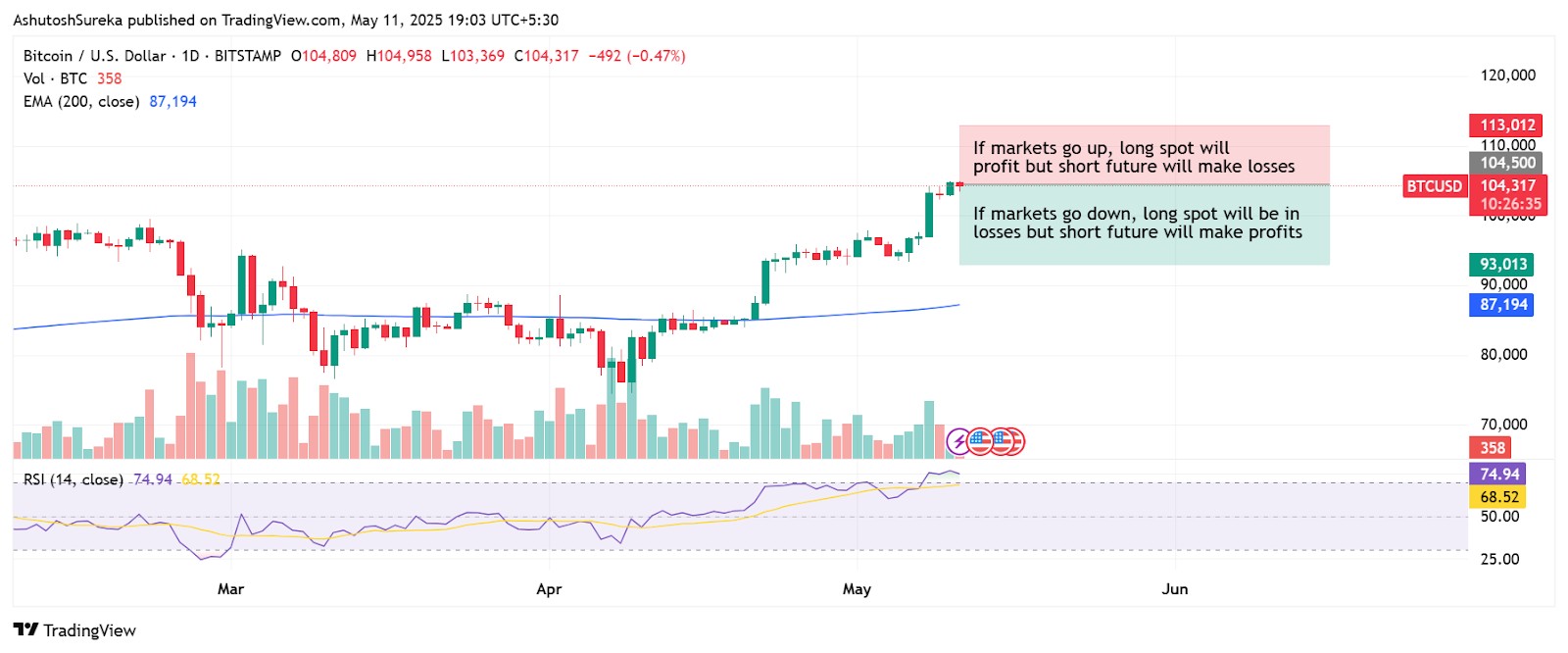
Short futures while holding crypto to protect against price drops.
Lets you stay invested for the long haul while protecting short-term downside.
Using options
Buy put options as a backup plan if the market falls.
Combine puts and calls to lock in a price range (a strategy called a collar).
Sell covered calls to earn extra income on crypto you are already holding.
Advanced hedging with delta strategies
Adjust your position as the market moves to stay balanced.
Mostly used by pros and institutions.
Good for reducing risk without giving up your long position.
Risks and considerations for traders
Crypto derivatives can offer opportunities to grow your portfolio, but they can just as quickly lead to significant losses. High leverage and wild price swings mean big gains and big losses often happen on the same day. If you are not prepared, the market will teach you the hard way. That is why understanding the risks and protecting yourself is more important than trying to time the perfect trade.
Market risks associated with derivatives
Derivatives are not for the faint of heart, especially in crypto.
What makes them risky
Leverage can hurt fast. Even a small move against you can wipe out your position if you are overexposed.
Crypto moves quickly. Prices can swing 10 percent or more in a single day, which puts pressure on leveraged trades.
Not all markets are deep. Thin trading volume in some altcoins can lead to bad fills and bigger losses.
Exchange issues are real. Using the wrong platform could mean frozen accounts, surprise liquidations, lost funds.
Why it matters
Without proper controls, one bad trade can wipe out your account.
Fast markets leave little time to fix mistakes.
Choosing a reliable platform is as important as choosing a good setup.
Importance of risk management practices
Great traders are not just good at making money, they are great at keeping it:
Always use stop-losses. Decide upfront how much you are willing to lose and stick to it.
Don’t overuse leverage. Just because it is there does not mean you need it. Most smart traders stay well under 10x.
Spread your risk. Never bet everything on one trade, one coin, or one moment.
Keep most funds safe. Only trade with what you are okay losing. The rest belongs in a secure wallet.
Review what works and what doesn’t. The best traders learn from every trade, good or bad.
Risk management gives you the power to keep trading, even after a bad day. It keeps emotions in check so you don’t make panic decisions. Long-term success is not just about profit, it is about staying in the game.
| Foundation year | Futures | Options | Coins Supported | Futures Taker Fee, % | Futures Maker Fee, % | Tier-1 regulation | TU overall score | Open an account | |
|---|---|---|---|---|---|---|---|---|---|
| 2017 | Yes | Yes | 600+ | 0.05 | 0.02 | No | 8.46 | Go to broker Your capital is at risk. |
|
| 2017 | Yes | Yes | No | Variable | Variable | No | 3.59 | Study review | |
| 2022 | Yes | Yes | 415 | 0.05 | 0.02 | Yes | 2.64 | Study review | |
| 2018 | Yes | Yes | 750+ | 0.055 | 0.02 | Yes | 9.2 | Go to broker Your capital is at risk.
|
|
| 2017 | Yes | Yes | 1000+ | 0.06 | 0.02 | No | 8.48 | Go to broker Your capital is at risk. |
Misjudged size and crowded trades lead to fast losses

A common trap for new traders in crypto derivatives is thinking more leverage means more control. What it really means is that you are on the clock. Losses show up in no time. If you are using futures or perpetuals and you misjudge your size even slightly the market will remind you fast. And if you are just following someone else's high-risk move without knowing how wild the swings can get you are not trading. You are betting on fast forward.
Something else beginners rarely notice is that funding rates are not just random numbers. They are signs of stress. When a funding rate shoots up it does not only mean people are feeling bullish. It often means too many are crammed on the same side of the trade. That is when big players start looking to flip the script. If you learn to treat funding like a warning system not just a fee meter you will spot setups that lure people in right before the big move up or crash. This market favors people who ask better questions, not just faster ones.
Conclusion
The crypto derivatives market is not a side show. It is the core engine of momentum in digital assets. If you are ignoring it you are missing how risk actually builds and how price is really discovered. It is not just about leverage or advanced tools. It is about reading pressure before it bursts. For any trader who wants to survive in this space knowing where the traps form is just as important as spotting the next breakout. In crypto derivatives the real edge is not in speed. It is in awareness.
FAQs
How do funding rates influence perpetual swap positions?
Funding rates are periodic payments between long and short traders in perpetual swaps, designed to keep prices close to the spot market. Positive rates favor shorts, while negative rates favor longs, influencing position costs and trader behavior.
How do basis trading strategies apply to crypto markets?
Basis trading in crypto involves exploiting the price difference between spot and futures markets. Traders buy the underlying asset and sell the futures contract to lock in a spread, especially when futures trade at a premium.
How does implied volatility affect options pricing in crypto markets?
Implied volatility reflects market expectations of future price movement and directly impacts option premiums. Higher implied volatility increases the value of both calls and puts, making options more expensive during uncertain or volatile periods.
What are the tax implications of trading crypto derivatives?
Crypto derivative gains are typically taxed as capital gains or ordinary income depending on holding period and jurisdiction. Some countries also require detailed reporting of each trade, and losses may be deductible under specific conditions.
Editors' Top Picks and Insights






Related Articles
Team that worked on the article
Anton Kharitonov is an active trader and analyst. He employs both short- and long-term trading strategies, primarily based on fundamental factors, supported by technical indicators and intermarket analysis.
Andreas Kristo Saragih is a seasoned equity research analyst with over a decade of experience across both buy-side and sell-side roles, focused on the Indonesian capital market. He has extensive sector coverage, including banking, consumer goods, retail, real estate, healthcare, transportation, poultry, cement, pharmaceuticals, construction, and infrastructure.
Chinmay Soni is a financial analyst with more than 5 years of experience in working with stocks, Forex, derivatives, and other assets. As a founder of a boutique research firm and an active researcher, he covers various industries and fields, providing insights backed by statistical data.
A short squeeze is a situation in which short sellers are forced to close their positions at a loss, which leads to a sharp rise in the price of an asset.
A futures contract is a standardized financial agreement between two parties to buy or sell an underlying asset, such as a commodity, currency, or financial instrument, at a predetermined price on a specified future date. Futures contracts are commonly used in financial markets to hedge against price fluctuations, speculate on future price movements, or gain exposure to various assets.
CFD is a contract between an investor/trader and seller that demonstrates that the trader will need to pay the price difference between the current value of the asset and its value at the time of contract to the seller.
Cryptocurrency is a type of digital or virtual currency that relies on cryptography for security. Unlike traditional currencies issued by governments (fiat currencies), cryptocurrencies operate on decentralized networks, typically based on blockchain technology.
Risk management is a risk management model that involves controlling potential losses while maximizing profits. The main risk management tools are stop loss, take profit, calculation of position volume taking into account leverage and pip value.

-
 Afghanistan
-
 Albania
-
 Algeria
-
 Angola
-
 Argentina
-
 Armenia
-
 Australia
-
 Austria
-
 Azerbaijan
-
 Bahamas
-
 Bahrain
-
 Bangladesh
-
 Belarus
-
 Belgium
-
 Bolivia
-
 Botswana
-
 Brazil
-
 Brunei
-
 Bulgaria
-
 Cambodia
-
 Cameroon
-
 Canada
-
 Chile
Chile
-
 China
China
-
 Colombia
-
 Congo
Congo
-
 Costa Rica
-
 Cote d'Ivoire
-
 Croatia
-
 Cuba
Cuba
-
 Cyprus
-
 Czechia
-
 DR Congo
-
 Denmark
-
 Dominican Republic
-
 Ecuador
-
 Egypt
Egypt
-
 El Salvador
-
 Estonia
-
 Eswatini
-
 Ethiopia
-
 Finland
-
 France
-
 Georgia
-
 Germany
-
 Ghana
Ghana
-
 Greece
-
 Haiti
Haiti
-
 Hong Kong
-
 Hungary
-
 India
India
-
 Indonesia
-
 Iran, Islamic republic
-
 Iraq
Iraq
-
 Ireland
-
 Israel
-
 Italy
Italy
-
 Jamaica
-
 Japan
Japan
-
 Jordan
-
 Kazakhstan
-
 Kenya
Kenya
-
 Korea
Korea
-
 Kuwait
-
 Kyrgyzstan
-
 Laos
Laos
-
 Latvia
-
 Lebanon
-
 Lesotho
-
 Libya
Libya
-
 Lithuania
-
 Luxembourg
-
 Madagascar
-
 Malaysia
-
 Malta
Malta
-
 Mauritius
-
 Mexico
-
 Moldova
-
 Mongolia
-
 Montenegro
-
 Morocco
-
 Mozambique
-
 Myanmar
-
 Namibia
-
 Nepal
Nepal
-
 Netherlands
-
 New Zealand
-
 Nigeria
-
 North Macedonia
-
 Norway
-
 Oman
Oman
-
 Pakistan
-
 Palestine
-
 Panama
-
 Papua New Guinea
-
 Paraguay
-
 Peru
Peru
-
 Philippines
-
 Poland
-
 Portugal
-
 Puerto Rico
-
 Qatar
Qatar
-
 Reunion
-
 Romania
-
 Rwanda
-
 Saudi Arabia
-
 Serbia
-
 Singapore
-
 Slovakia
-
 Slovenia
-
 Somalia
-
 South Africa
-
 Spain
Spain
-
 Sri Lanka
-
 Sweden
-
 Switzerland
-
 Syria
Syria
-
 Taiwan
-
 Tajikistan
-
 Tanzania
-
 Thailand
-
 Trinidad and Tobago
-
 Tunisia
-
 Turkey
-
 UAE
UAE
-
 Uganda
-
 Ukraine
-
 United Kingdom
-
United States
-
 Uruguay
-
 Uzbekistan
-
 Venezuela
-
 Vietnam
-
 Yemen
Yemen
-
 Zambia
-
 Zimbabwe
- Forex
- Crypto