
FTX Repayment: Everything You Need To Know About FTX Payouts And Refunds


Editorial Note: While we adhere to strict Editorial Integrity, this post may contain references to products from our partners. Here's an explanation for How We Make Money. None of the data and information on this webpage constitutes investment advice according to our Disclaimer.
FTX repayment has begun, with $18 billion allocated for payouts. Creditors with claims up to $50,000, known as the "Convenience Class," are the first to receive payments. This group makes up about 98% of all creditors.
The collapse of FTX in November 2022 disrupted the cryptocurrency market, leaving thousands of customers and investors unable to access their funds. After months of legal proceedings and asset recovery, the exchange has started repaying creditors, providing much-needed relief to affected users.
This guide outlines the FTX repayment schedule, how the refund process works, and whether customers will recover their full balances. It also examines the impact of these repayments on the broader crypto market and provides insights on how to manage recovered funds wisely.
FTX repayment plan overview
FTX's bankruptcy proceedings have recovered approximately $18 billion in assets to be distributed among creditors. This amount includes cash, cryptocurrencies, and other liquid assets seized or reclaimed through legal actions. However, due to FTX's large liabilities, not all customers may receive a full refund.

Key dates and milestones
The FTX repayment schedule follows a phased approach, with different levels of claimants receiving payments at different times:
February 18, 2025: Creditors with claims up to $50,000, known as the "Convenience Class," are the first to receive payments. This group makes up about 98% of all creditors. Payments are expected to be completed within 1 to 3 business days. On February 18, the company paid $800 million to 162,000 accounts.

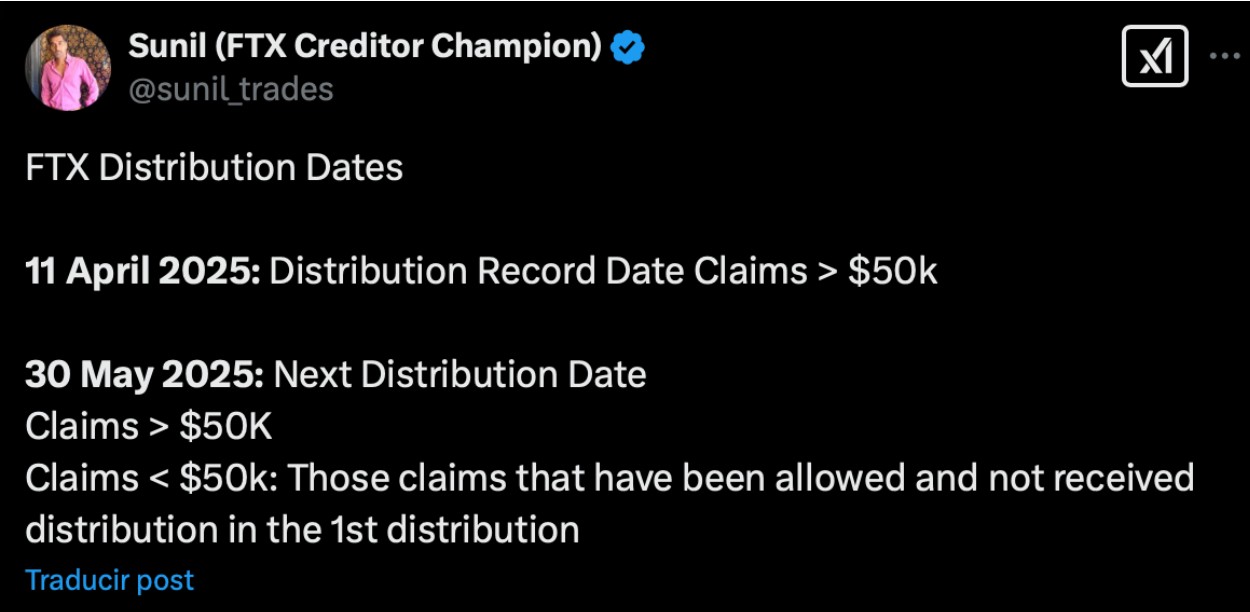
April 11, 2025: Mid-range creditors (claims above $50,000) must verify their claims and select a distribution agent to qualify for the next phase.
May 30, 2025: Payments start for mid-range creditors who have completed verification by the April 11 deadline.
Mid-to-late 2025: High-value claimants and institutional creditors will receive their funds, with exact dates to be announced later.
Distribution details
Interest rate: creditors will receive 100% of their claim value plus an additional 9% interest, calculated from November 11, 2022, until the payment date.
Distribution partners: FTX has partnered with BitGo and Kraken to process the repayments, ensuring secure and efficient transactions.
Eligibility requirements: creditors must complete Know Your Customer (KYC) verification and submit the necessary tax forms to receive their funds. Those who miss initial deadlines may still qualify for later distributions.
Asset recovery and distribution
FTX's recovery efforts have amassed between $14.5 billion and $16.3 billion to distribute to its customers and creditors. The company plans to distribute approximately $16 billion, starting with an initial payout estimated between $6.5 billion and $7.5 billion.
This initiative is a significant step in addressing the losses incurred by FTX's creditors following its bankruptcy filing.
FTX creditor compensation model
The FTX creditor compensation model has sparked controversy, particularly regarding its valuation approach. Under the current plan, assets that remained on the exchange since November 11, 2022, have been accruing 9% annual interest, resulting in 98% of creditors receiving 119% of their original claims. While this may seem favorable at first glance, the payout calculations are based on asset prices from 2022, rather than their current market value.
This valuation discrepancy is a major point of contention. Since November 2022, Bitcoin has surged by approximately 370%, and many other cryptocurrencies have also experienced significant price fluctuations. As a result, while creditors are technically receiving more than their original claims in nominal terms, the compensation fails to reflect the true present-day value of their crypto holdings. Many affected users argue that they are losing out on substantial gains, as their payouts do not account for the substantial market appreciation of their digital assets.
This issue has led to frustration among investors who had expected a more equitable distribution method — one that considers the market's recovery and the actual value of their holdings at the time of repayment. Some legal and financial experts suggest that the fixed-price compensation model benefits the estate and its administrators more than the affected creditors, potentially setting a precedent for future crypto bankruptcy cases.
FTX payouts: how the repayment works
FTX repayment has begun, with $18 billion set aside for creditors. Small claims under $50K may receive up to 90% by February 2025, while larger creditors will see phased distributions later. The FTX repayment schedule prioritizes smaller claimants first, followed by mid-to-large account holders. Payments will be processed via bank transfers and crypto wallets based on verified claims.

Phase 1: Repayments for small creditors
The first group of FTX customers to receive payments includes those with claims of less than $50,000. This group will receive a higher percentage of their lost funds, with some potentially getting up to 90% of their initial holdings back.
Phase 2: Repayments for large creditors
For those with larger claims, FTX refunds may take longer. The final payout amount depends on asset recovery efforts, legal fees, and court decisions.

How to claim your FTX refund
If you're a former FTX Crypto customer, here’s how you can process your refund:
Check your eligibility. Log into the FTX claims portal to verify your status.
Submit documentation. Provide KYC details, account history, and any supporting documents.
Wait for confirmation. The processing time may vary depending on the complexity of your claim.
Receive your payment. Onboard with BitGo or Kraken.
Once FTX creditors receive their payouts, the next question is how to manage the recovered funds. Some users may choose to hold assets securely, others may convert them to fiat, while many will look to reinvest in the crypto market. In all cases, access to a reliable cryptocurrency exchange is essential. The table below compares popular crypto exchanges commonly used for trading, storage, and reinvestment of digital assets.
| OKX | Coinbase | Crypto.com | Cryptohopper | BTCC | |
|---|---|---|---|---|---|
|
Demo account |
Yes | No | No | No | Yes |
|
Coins Supported |
600+ | 400+ | 400+ | 1000 | 399 |
|
Min. Deposit, $ |
10 | 10 | 1 | No | 10 |
|
Spot leverage |
1:10 | 1:3 | 1:3 | No | 1:1 |
|
Spot Maker Fee, % |
0.08 | 0.5 | 0.25 | 0 | 0.2 |
|
Spot Taker fee, % |
0.1 | 0.5 | 0.5 | 0 | 0.3 |
|
TU overall score |
8.48 | 7.84 | 7.8 | 7.76 | 7.6 |
|
Open an account |
Go to broker Your capital is at risk. |
Go to broker Your capital is at risk. |
Go to broker Your capital is at risk. |
Go to broker Your capital is at risk. |
Go to broker Your capital is at risk.
|
Will FTX customers fully recoup their money?
The biggest question among affected users is whether FTX customers will fully recoup their funds. While small creditors may receive nearly full compensation, larger creditors could see partial refunds ranging from 30% to 80%, depending on ongoing legal proceedings.
Factors affecting full recovery
Legal settlements. The amount paid out depends on the success of lawsuits and asset recovery efforts.
FTX’s remaining liabilities. Some funds may be prioritized for legal fees and operational costs.
Market conditions. The value of crypto assets recovered can fluctuate.
How FTX repayment 2025 can affect the market?
The FTX repayment schedule is expected to influence the broader cryptocurrency market.
Immediate market reactions
The commencement of FTX's repayment plan involved disbursing approximately $1.2 billion to creditors with claims under $50,000. Contrary to expectations that this influx of funds would bolster the market, major cryptocurrencies experienced notable declines. Bitcoin, for instance, saw a drop of about 1.1% following the announcement, indicating that recipients might be liquidating their refunded assets, thereby increasing selling pressure.

Liquidity injection and potential for altcoin season
Analysts had anticipated that the return of funds to FTX's creditors could inject significant liquidity into the crypto ecosystem, potentially sparking an altcoin season. With an estimated total repayment of up to $16 billion, including substantial amounts in stablecoins, there was speculation that these funds would be reinvested into various crypto assets. However, the initial market response has been subdued, suggesting that broader market conditions and investor confidence play crucial roles in asset performance.
Regulatory implications
The FTX collapse and subsequent repayment plan have drawn attention to the regulatory frameworks governing cryptocurrency exchanges and asset recovery in bankruptcy scenarios. The process has highlighted the complexities of valuing and distributing digital assets, underscoring the necessity for clear regulations to protect investors and maintain market stability.
Long-term market sentiment
While the immediate effects of the repayments have introduced volatility, the long-term impact on market sentiment remains uncertain. Successful execution of the repayment plan could restore some confidence among investors, demonstrating a degree of resilience and accountability within the crypto industry. Conversely, if the process encounters significant challenges or if a substantial portion of the refunded capital exits the crypto markets, it could lead to prolonged bearish trends.
FTX News

From Bitget to Bybit: 5 biggest crypto exchange hacks

Sam Bankman-Fried asks U.S. Supreme Court to review conviction

U.S. sold Anthropic shares seized from former FTX executives in 2025

FTX announces $900 million distribution to creditors in fifth payout round

U.S. Senate backs resolution opposing clemency for FTX founder Sam Bankman-Fried

Michelle Bond campaign finance case advances in U.S. over alleged FTX-funded House run
FTX payouts may inject liquidity into the market

FTX’s repayment plan marks a major event in the crypto market, but traders must approach it strategically. While FTX payouts may inject liquidity into the market, the impact on asset prices will depend on how recipients react. Some users will cash out immediately, while others may reinvest into Bitcoin, Ethereum, or altcoins. This creates both opportunities and risks for active traders.
If you’re receiving an FTX refund, consider how to deploy these funds wisely. Short-term volatility is likely as payouts roll out, but long-term positioning requires a more disciplined approach. Rather than rushing into speculative assets, look for established projects with real-world utility. Diversifying into layer-1 blockchains, DeFi protocols, and AI-driven trading platforms can provide stability while still capturing growth potential.
For those trading in anticipation of FTX repayment effects, monitoring liquidity flows, investor sentiment, and on-chain activity will be crucial. Don’t chase momentum blindly — identify undervalued assets that stand to benefit from market shifts rather than purely speculative plays. The market is watching FTX news, but successful traders move ahead of trends, not behind them.
Conclusion
With $18 billion earmarked for distribution, the FTX repayment plan launching in 2026 marks a pivotal moment for those affected by the collapse. Notably, smaller creditors with claims under $50,000 stand to benefit most, with anticipated recoveries of up to 90%, showcasing a strong commitment to alleviating the impact on individuals and small businesses. Larger claimants will need to wait longer, reflecting a structured, phased approach to restitution. Ultimately, this process underscores the critical importance of clear eligibility and timely action—those who remain informed and proactive could reclaim much of what was lost.
FAQs
How are FTX repayment amounts determined for different creditors?
What steps should creditors take to ensure successful receipt of FTX payouts?
What are the main controversies surrounding the FTX creditor compensation model?
How might the timing of FTX repayments impact cryptocurrency market movements?
Editors' Top Picks and Insights






Related Articles
Team that worked on the article
Andrey Mastykin is an experienced author, editor, and content strategist who has been with Traders Union since 2020. As an editor, he is meticulous about fact-checking and ensuring the accuracy of all information published on the Traders Union platform.
Dan Blystone began his trading career in 1998 as an arbitrage clerk on the floor of the Chicago Mercantile Exchange (CME). He later traded bond and Eurex futures at proprietary firms such as Altea Trading, gaining valuable experience in high-frequency trading and risk management.
Chinmay Soni is a financial analyst with more than 5 years of experience in working with stocks, Forex, derivatives, and other assets. As a founder of a boutique research firm and an active researcher, he covers various industries and fields, providing insights backed by statistical data.
An investor is an individual, who invests money in an asset with the expectation that its value would appreciate in the future. The asset can be anything, including a bond, debenture, mutual fund, equity, gold, silver, exchange-traded funds (ETFs), and real-estate property.
Forex leverage is a tool enabling traders to control larger positions with a relatively small amount of capital, amplifying potential profits and losses based on the chosen leverage ratio.
Yield refers to the earnings or income derived from an investment. It mirrors the returns generated by owning assets such as stocks, bonds, or other financial instruments.
Volatility refers to the degree of variation or fluctuation in the price or value of a financial asset, such as stocks, bonds, or cryptocurrencies, over a period of time. Higher volatility indicates that an asset's price is experiencing more significant and rapid price swings, while lower volatility suggests relatively stable and gradual price movements.
CFD is a contract between an investor/trader and seller that demonstrates that the trader will need to pay the price difference between the current value of the asset and its value at the time of contract to the seller.

-
 Afghanistan
-
 Albania
-
 Algeria
-
 Angola
-
 Argentina
-
 Armenia
-
 Australia
-
 Austria
-
 Azerbaijan
-
 Bahamas
-
 Bahrain
-
 Bangladesh
-
 Belarus
-
 Belgium
-
 Bolivia
-
 Botswana
-
 Brazil
-
 Brunei
-
 Bulgaria
-
 Cambodia
-
 Cameroon
-
 Canada
-
 Chile
Chile
-
 China
China
-
 Colombia
-
 Congo
Congo
-
 Costa Rica
-
 Cote d'Ivoire
-
 Croatia
-
 Cuba
Cuba
-
 Cyprus
-
 Czechia
-
 DR Congo
-
 Denmark
-
 Dominican Republic
-
 Ecuador
-
 Egypt
Egypt
-
 El Salvador
-
 Estonia
-
 Eswatini
-
 Ethiopia
-
 Finland
-
 France
-
 Georgia
-
 Germany
-
 Ghana
Ghana
-
 Greece
-
 Haiti
Haiti
-
 Hong Kong
-
 Hungary
-
 India
India
-
 Indonesia
-
 Iran, Islamic republic
-
 Iraq
Iraq
-
 Ireland
-
 Israel
-
 Italy
Italy
-
 Jamaica
-
 Japan
Japan
-
 Jordan
-
 Kazakhstan
-
 Kenya
Kenya
-
 Korea
Korea
-
 Kuwait
-
 Kyrgyzstan
-
 Laos
Laos
-
 Latvia
-
 Lebanon
-
 Lesotho
-
 Libya
Libya
-
 Lithuania
-
 Luxembourg
-
 Madagascar
-
 Malaysia
-
 Malta
Malta
-
 Mauritius
-
 Mexico
-
 Moldova
-
 Mongolia
-
 Montenegro
-
 Morocco
-
 Mozambique
-
 Myanmar
-
 Namibia
-
 Nepal
Nepal
-
 Netherlands
-
 New Zealand
-
 Nigeria
-
 North Macedonia
-
 Norway
-
 Oman
Oman
-
 Pakistan
-
 Palestine
-
 Panama
-
 Papua New Guinea
-
 Paraguay
-
 Peru
Peru
-
 Philippines
-
 Poland
-
 Portugal
-
 Puerto Rico
-
 Qatar
Qatar
-
 Reunion
-
 Romania
-
 Rwanda
-
 Saudi Arabia
-
 Serbia
-
 Singapore
-
 Slovakia
-
 Slovenia
-
 Somalia
-
 South Africa
-
 Spain
Spain
-
 Sri Lanka
-
 Sweden
-
 Switzerland
-
 Syria
Syria
-
 Taiwan
-
 Tajikistan
-
 Tanzania
-
 Thailand
-
 Trinidad and Tobago
-
 Tunisia
-
 Turkey
-
 UAE
UAE
-
 Uganda
-
 Ukraine
-
 United Kingdom
-
United States
-
 Uruguay
-
 Uzbekistan
-
 Venezuela
-
 Vietnam
-
 Yemen
Yemen
-
 Zambia
-
 Zimbabwe
- Forex
- Crypto












