
Why Do Retail Investors Keep Their Money in Cash? | TU Research


Editorial Note: While we adhere to strict Editorial Integrity, this post may contain references to products from our partners. Here's an explanation for How We Make Money. None of the data and information on this webpage constitutes investment advice according to our Disclaimer.
TU Research analysis based on a sample of 1,520 retail investors suggests that cash remains a significant part of investment portfolios, with 41% holding at least 20% of their investable assets in cash. Market uncertainty is the leading reason for holding cash at 29%, while 24% prioritize financial security. Although 43% reserve some cash to buy investments at lower prices, only 26% would invest a significant amount after a 10% stock-market decline, compared with 35% who would wait for further losses or avoid investing. Just 32% correctly identify the long-term trade-off between cash stability and investment growth.
Cash remains an important part of retail investment portfolios, offering liquidity, financial security, and protection against unexpected expenses. However, keeping substantial amounts of money outside financial markets can also mean missing long-term investment opportunities. For retail investors, the challenge is determining when holding cash is a sensible financial decision and when it becomes a costly form of market timing.
Recent institutional research from Vanguard, BlackRock, and FINRA highlights the complex relationship between financial confidence, risk perception, and investment participation. While cash provides stability and flexibility, uncertainty about market conditions, fear of losses, and difficulties making investment decisions can discourage investors from putting their money to work.
This raises a broader question about retail investor behavior: do investors maintain cash reserves primarily to protect their financial security, or are they waiting for market opportunities that may never arrive? Understanding the motivations behind cash holdings can help explain how investors balance liquidity needs, market risks, and long-term financial goals.
The research aims to answer key questions:
How much of their investable assets do retail investors keep in cash?
What prevents investors from putting more money into financial markets?
Would a 10% market correction actually encourage them to invest?
Do investors understand the opportunity cost of holding cash?
What would persuade investors to reduce their cash holdings?
Findings
The research framework identifies several potential patterns:
Cash remains a substantial portfolio allocation. The distribution places 41% of investors in cash-allocation categories of 20% or more, including 17% with allocations of at least 40%.
Market uncertainty is the leading individual reason for holding cash. It accounts for 29% of responses, compared with 24% for emergency savings and financial security.
Many investors are waiting for lower prices. 43% reserve at least some cash for future investment opportunities, although only 17% describe this as a substantial portion of their cash holdings.
Waiting for a market dip does not guarantee buying one. Only 26% would invest a significant amount following a hypothetical 10% stock-market decline, while 35% would either wait for further losses or avoid investing because of increased risk.
Fear of losses is the largest individual barrier. It accounts for 28% of responses, followed by insufficient emergency savings at 22%.
Knowledge of cash opportunity costs is limited in the scenario. Only 32% select the answer recognizing both the stability of cash and the potential long-term growth advantage of diversified investments.
Financial planning could be more influential than market timing. A clearer investment plan is the most frequently selected reason to reduce cash holdings at 25%, slightly ahead of a significant market decline at 23%.

Risk warning: All investments carry risk, including potential capital loss. Economic fluctuations and market changes affect returns, and 40-50% of investors underperform benchmarks. Diversification helps but does not eliminate risks. Invest wisely and consult professional financial advisors.
Institutional validation
Institutional research suggests that cash holdings reflect a combination of liquidity needs, perceived market risk, financial confidence and expectations about future returns.
BlackRock examined the barriers separating saving from investing in its December 2025 report, Bridging the Gap: From Saving to Investing. The company found that 62% of UK adults, approximately 34 million people, were not investing. The report also identified misunderstandings about access to invested money. Among regular cash savers, 36% believed investments could be accessed only with penalties or fees, while 18% believed money was locked away for a fixed period. Another 21% did not know which statement about accessing invested money was correct.
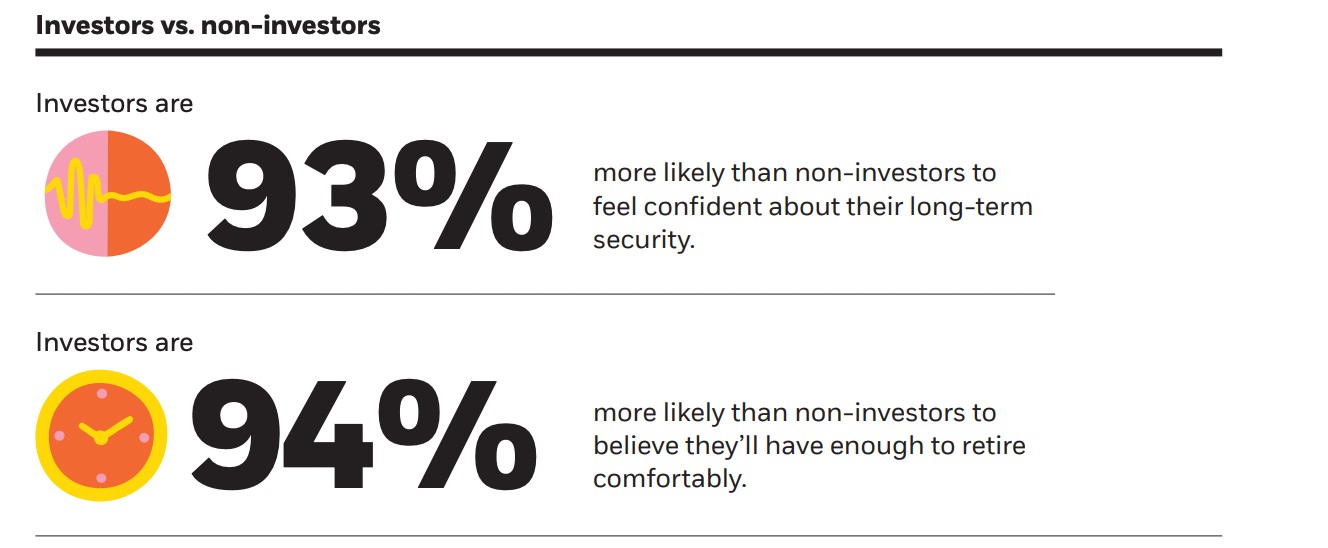
These findings suggest that cash preference is not necessarily driven by expectations of better market prices. For some consumers, the perceived accessibility of savings may be more important than the potential return from investments.
Vanguard examined the financial cost of delaying investment in Cost Averaging: Invest Now or Temporarily Hold Your Cash?, published in 2023. Using historical market data, the researchers found that lump-sum investing outperformed cost averaging 68% of the time. Cost averaging outperformed remaining in cash in 69% of the periods examined, while immediate lump-sum investment outperformed cash in 70%. The comparison used rolling one-year outcomes and historical MSCI World Index returns from 1976 to 2022.
The results indicate that delaying investment can carry a measurable opportunity cost. However, Vanguard also recognizes that investors who are particularly sensitive to losses may prefer gradual investment because it reduces the risk of investing all available capital immediately before a market decline.
The FINRA Investor Education Foundation offers a broader perspective on investor confidence and financial capability. Its 2024 National Financial Capability Study includes information on investment ownership, risk tolerance, investment knowledge and financial decision-making. The study also examines emergency savings, an important factor when evaluating whether cash holdings represent excessive caution or necessary financial protection.
The central question is therefore not simply whether investors hold too much cash, but whether their cash allocations reflect deliberate financial planning or uncertainty about when to invest.
Theoretical research
The preference for cash among retail investors can be understood through liquidity preference and loss aversion. Investors may choose to keep money in cash not only because they need immediate access to funds, but also because uncertainty about future market conditions makes potential investment losses appear more significant than possible gains.
Kahneman and Tversky examined this mechanism in Prospect Theory: An Analysis of Decision under Risk. Their research demonstrated that individuals evaluate potential gains and losses relative to a reference point and often respond more strongly to losses than to equivalent gains. This helps explain why investors may prefer the perceived stability of cash even when diversified investments offer higher expected long-term returns.
This behavior can also encourage market-timing decisions. Investors may hold cash while waiting for lower asset prices, believing that a future market correction will provide a safer entry point. However, when prices decline, heightened uncertainty can reinforce the fear of further losses rather than encourage immediate investment.
This creates a tension between financial security and opportunity cost. Cash provides liquidity and reduces exposure to short-term market volatility, but remaining outside financial markets for extended periods can limit potential returns. Investors who wait for ideal conditions may therefore face a different risk: missing periods of market growth while trying to avoid temporary losses.
The key factor may not be the amount of cash investors hold, but the reasoning behind that allocation. Cash reserved for emergencies serves a different purpose from money held indefinitely in anticipation of lower prices. This provides the theoretical basis for examining whether retail investors maintain cash primarily for financial protection or because uncertainty and loss aversion discourage them from investing.
Survey data
To examine how cash holdings influence retail investment decisions, the research framework covers portfolio allocation, liquidity needs, market timing, financial confidence and willingness to invest during market declines.
Methodology
The study is designed around a structured online questionnaire using the CAWI methodology.
Sample composition: 1,520 retail investors.
Coverage: North America, Europe, Asia, Latin America, Africa and the Middle East.
Age: 18–60 years old.
Participation criteria: Individuals who currently invest or trade financial assets.
Research scope: Cash and cash equivalents, including savings accounts, money-market funds and uninvested brokerage balances. Money required for routine monthly expenses is excluded.
Research team
The study was conducted by our experts:
Anastasiia Chabaniuk (Author, TU research) – research design and interpretation.
Chinmay Soni (Fact-checker) – data validation and statistical verification.
Ciaran Ryan (Editor-in-Chief) – editorial and methodological supervision.
TU research team (Andrey Mastykin, Oleg Tkachenko) – data collection and analysis.
How much cash do retail investors keep in their portfolios?
The first question examines the proportion of investable financial assets allocated to cash and cash equivalents.
| Cash allocation | Share |
|---|---|
| Less than 5% | 24% |
| 5–9% | 16% |
| 10–19% | 19% |
| 20–39% | 24% |
| 40% or more | 17% |
Insight: The distribution places 41% of investors in cash-allocation categories of at least 20%, while 17% hold 40% or more. This suggests that cash can represent a significant component of retail portfolios rather than merely a small operational balance. However, high cash allocations are not necessarily inappropriate when investors have substantial short-term liquidity needs.
Why do investors maintain substantial cash reserves?
Respondents were asked to identify the main reason for keeping money in cash rather than investing it.
| Reason | Share |
|---|---|
| Uncertainty about financial markets | 29% |
| Emergency savings and financial security | 24% |
| Waiting for better investment prices | 18% |
| Attractive interest rates on cash | 11% |
| Planned major expenses | 9% |
| Lack of confidence in investment decisions | 6% |
| Other / unsure | 3% |
Insight: Market uncertainty is the largest individual reason for holding cash at 29%, but emergency savings and planned expenses together account for 33%. The distinction suggests that cash holdings cannot be explained by market pessimism alone. For many investors, liquidity serves a practical financial purpose, while others deliberately delay investing because of uncertainty about asset prices.
How long are investors willing to keep money outside the market?
Respondents were asked how long they would be prepared to keep money intended for investment in cash while waiting for more favorable market conditions.
Expected waiting period before investing:
Less than one month – 12%;
1–3 months – 21%;
3–6 months – 23%;
6–12 months – 18%;
More than one year – 11%;
No defined timeframe / unsure – 15%.

Insight: Nearly three in ten investors, 29%, would be prepared to wait at least six months before investing, while another 15% have no defined timeframe. This creates the possibility that a temporary defensive allocation becomes an indefinite investment strategy. Vanguard's historical research indicates that delayed investment can reduce returns when financial markets outperform cash during the waiting period.
What prevents investors from investing more of their cash?
Respondents were asked to identify the most important obstacle preventing them from allocating additional cash to financial assets.
| Barrier | Share |
|---|---|
| Fear of losing money | 28% |
| Insufficient emergency savings | 22% |
| Uncertainty about market valuations | 18% |
| Uncertain personal income or expenses | 12% |
| Difficulty choosing investments | 9% |
| Cash returns currently seem sufficient | 7% |
| Other / unsure | 4% |
Insight: Fear of losses is the leading individual barrier at 28%, but financial security concerns are also important. Insufficient emergency savings and uncertainty about personal finances together account for 34%. The results suggest that reluctance to invest may reflect both psychological risk aversion and genuine financial constraints.
Are investors holding cash to buy the next market dip?
Respondents were asked whether they currently maintain cash reserves specifically to purchase financial assets if prices decline.
Cash reserved for future buying opportunities:
Yes, a substantial part of my cash – 17%;
Yes, a smaller part of my cash – 26%;
No, cash is mainly held for other purposes – 49%;
Not sure – 8%.

Insight: A combined 43% reserve at least some cash for future buying opportunities. However, only 17% say this represents a substantial part of their holdings. This suggests that market timing may influence cash allocation without necessarily being the primary reason investors maintain liquidity.
Would investors actually buy after a 10% market decline?
Respondents were presented with a scenario in which a broad stock-market index declined by 10% over a short period, while their personal financial circumstances remained unchanged.
They were asked how they would respond using money currently available for investment.
| Response | Share |
|---|---|
| Invest a significant share of available cash | 26% |
| Invest a small amount gradually | 31% |
| Keep cash and wait for a larger decline | 21% |
| Avoid investing because risks have increased | 14% |
| Not sure | 8% |
Insight: Only 26% would invest a significant amount after a 10% decline, while 35% would either wait for a larger correction or avoid investing because of increased uncertainty. Another 31% would invest gradually. The results illustrate how investors who want lower prices may become more cautious when those prices are accompanied by market volatility.
Do investors understand the opportunity cost of holding cash?
Respondents were presented with a hypothetical comparison between holding cash and investing over ten years.
Cash was assumed to earn 3% annually, while a diversified investment portfolio was assumed to earn an average of 6% annually. These assumptions were used to test understanding of risk and potential returns, not to forecast actual performance.
| Response | Share |
|---|---|
| Cash offers stability but potentially lower long-term growth | 32% |
| Cash is always preferable because it avoids market losses | 19% |
| Cash and investments should deliver similar results | 18% |
| The investment portfolio is guaranteed to outperform | 16% |
| Not sure | 15% |
Insight: Only 32% identify the answer that correctly recognizes both the relative stability of cash and the potential growth advantage of diversified investments under the stated assumptions. The remaining responses reflect either misunderstanding of investment risk, unrealistic return expectations or uncertainty. The distinction matters because cash may reduce short-term volatility without necessarily preserving long-term purchasing power.
What would persuade investors to reduce their cash holdings?
Finally, respondents were asked which single factor would be most likely to encourage them to invest a larger share of their available cash.
Main triggers for reducing cash allocations:
A clearer personal investment plan – 25%;
A significant decline in asset prices – 23%;
Greater financial security or emergency savings – 19%;
Lower interest rates on cash savings – 13%;
Better understanding of investment products – 10%;
Advice from a trusted financial professional – 6%;
Nothing / unsure – 4%.

Insight: A clearer investment plan is the most frequently selected trigger at 25%, slightly ahead of a significant market decline at 23%. Another 19% would consider investing more after improving their financial security. This suggests that reducing cash holdings may depend as much on financial planning and confidence as on market conditions. Only 13% identify lower savings rates as their primary trigger.
PDF version of the TU research
Download the full PDF version of the TU research to access additional analysis, detailed survey data, and extended findings from our analytical team. The report includes complete methodology, charts, and behavioral insights referenced throughout the study.
Practical implications for retail investors
Cash can provide valuable financial stability, but maintaining large balances without a defined purpose may also limit long-term investment opportunities. Investors should distinguish between money required for liquidity and capital intended for financial growth.
Separate emergency savings from investment capital. Money needed for unexpected expenses or short-term obligations should not be treated the same as funds intended for long-term investing.
Define the purpose of cash holdings. Determine whether cash is held for financial security, planned purchases, portfolio risk management or future investment opportunities.
Avoid waiting indefinitely for ideal market conditions. Investors who intend to buy after a correction should establish clear investment rules rather than relying on an undefined expectation of lower prices.
Consider the opportunity cost of remaining in cash.. Compare expected returns after inflation, taxes and fees with suitable investment alternatives.
Evaluate cash instruments carefully. Savings accounts, money-market funds and brokerage cash balances differ in yield, liquidity, deposit protection and investment risk.
Match cash allocations to investment horizons. Short-term financial goals may require more stable assets, while longer horizons can provide greater capacity to tolerate market fluctuations.
Consider gradual investing when appropriate. A predefined investment schedule may help investors who are uncomfortable investing a large amount immediately, although it does not eliminate market risk.
Review cash allocations regularly. A defensive position established during an earlier period of uncertainty may no longer match current financial circumstances or investment objectives.
Since the research scenario indicates that 43% of investors reserve at least some cash for future buying opportunities, access to financial markets and transaction costs may influence how effectively investors can act on their plans. The following table compares stock brokers by account requirements, trading costs and available instruments.
| eToro USA | SpeedTrader | Plus500 | TradeZero International | eOption | Revolut | |
|---|---|---|---|---|---|---|
|
Account min. |
50 | 2,500 | 500 | 500 | No | No |
|
Min. stock/ETF fee |
No | $0 | Not specified | $0.99 | $0 | £1.00/€1.00 |
|
Basic stock/ETF fee |
No | $0.0025/$0,0009 | $0.006 | $0,005 | $0 | 0.12%-0.25% |
|
Basic futures fee |
Not specified | Not specified | Not specified | Not specified | Not specified | No |
|
Min. futures fee |
Not specified | Not specified | Not specified | Not specified | Not specified | No |
|
Metals |
No | No | No | No | No | Yes |
|
Forex |
No | No | No | No | No | Yes |
|
Crypto |
Yes | No | No | No | No | Yes |
|
Stocks |
Yes | Yes | Yes | Yes | Yes | Yes |
|
Open an account |
Go to broker Your capital is at risk. |
Go to broker |
Go to broker 81% of retail CFD accounts lose money. |
Go to broker Your capital is at risk. |
Study review | Study review |
Data sources and methodology
BlackRock (2025). Bridging the Gap: From Saving to Investing.
BlackRock. Investor Insights & Trends in the UK.
Vanguard (2023). Finlay, M., and Zorn, J. Cost Averaging: Invest Now or Temporarily Hold Your Cash?
FINRA Investor Education Foundation (2025). Investors in the United States: Results from the National Financial Capability Study.
FINRA Investor Education Foundation (2024). National Financial Capability Study.
OECD (2023). OECD/INFE 2023 International Survey of Adult Financial Literacy.
Kahneman, D., and Tversky, A. (1979). Prospect Theory: An Analysis of Decision under Risk. Econometrica, 47(2), 263–291.
IdSurvey. CAWI Methodology.
Previous volumes in this series
Conclusion
The core takeaway from this research is that retail investors’ preference for holding substantial cash reserves is driven more by uncertainty, risk aversion, and lack of clear financial planning than by disciplined market timing. While 41% allocate at least 20% of their portfolios to cash, this often reflects fears of losses and a desire for financial security rather than an active plan to buy when prices dip. For instance, although nearly half express an intention to invest following a market decline, only 26% would actually invest a significant amount after a 10% correction. Ultimately, the most effective path to reducing excessive cash holdings is a well-defined investment strategy that balances the comfort of liquidity with the growth potential of long-term investing.
FAQs
How do retail investors distinguish between cash for emergencies and cash for investing?
What psychological factors influence retail investors to keep higher cash allocations?
How does holding substantial cash impact long-term investment outcomes?
What factors could prompt retail investors to allocate less to cash and more to investments?
Editors' Top Picks and Insights






Related Articles
Team that worked on the article
Anastasiia has 17 years of experience in finance and content marketing. She believes that the support of information and expert opinion is very important for the success of investors and new traders.
Ciaran Ryan is a veteran financial journalist based in South Africa, where he covers cryptocurrency, mining, stock markets, and governance for Moneyweb. He also hosts the weekly Moneyweb Crypto Podcast.
Chinmay Soni is a financial analyst with more than 5 years of experience in working with stocks, Forex, derivatives, and other assets. As a founder of a boutique research firm and an active researcher, he covers various industries and fields, providing insights backed by statistical data.

-
 Afghanistan
-
 Albania
-
 Algeria
-
 Angola
-
 Argentina
-
 Armenia
-
 Australia
-
 Austria
-
 Azerbaijan
-
 Bahamas
-
 Bahrain
-
 Bangladesh
-
 Belarus
-
 Belgium
-
 Bolivia
-
 Botswana
-
 Brazil
-
 Brunei
-
 Bulgaria
-
 Cambodia
-
 Cameroon
-
 Canada
-
 Chile
-
 China
-
 Colombia
-
 Congo
-
 Costa Rica
-
 Cote d'Ivoire
-
 Croatia
-
 Cuba
-
 Cyprus
-
 Czechia
-
 DR Congo
-
 Denmark
-
 Dominican Republic
-
 Ecuador
-
 Egypt
-
 El Salvador
-
 Estonia
-
 Eswatini
-
 Ethiopia
-
 Finland
-
 France
-
 Georgia
-
 Germany
-
 Ghana
-
 Greece
-
 Haiti
-
 Hong Kong
-
 Hungary
-
 India
-
 Indonesia
-
 Iran, Islamic republic
-
 Iraq
-
 Ireland
-
 Israel
-
 Italy
-
 Jamaica
-
 Japan
-
 Jordan
-
 Kazakhstan
-
 Kenya
-
 Korea
-
 Kuwait
-
 Kyrgyzstan
-
 Laos
-
 Latvia
-
 Lebanon
-
 Lesotho
-
 Libya
-
 Lithuania
-
 Luxembourg
-
 Madagascar
-
 Malaysia
-
 Malta
-
 Mauritius
-
 Mexico
-
 Moldova
-
 Mongolia
-
 Montenegro
-
 Morocco
-
 Mozambique
-
 Myanmar
-
 Namibia
-
 Nepal
-
 Netherlands
-
 New Zealand
-
 Nigeria
-
 North Macedonia
-
 Norway
-
 Oman
-
 Pakistan
-
 Palestine
-
 Panama
-
 Papua New Guinea
-
 Paraguay
-
 Peru
-
 Philippines
-
 Poland
-
 Portugal
-
 Puerto Rico
-
 Qatar
-
 Reunion
-
 Romania
-
 Rwanda
-
 Saudi Arabia
-
 Serbia
-
 Singapore
-
 Slovakia
-
 Slovenia
-
 Somalia
-
 South Africa
-
 Spain
-
 Sri Lanka
-
 Sweden
-
 Switzerland
-
 Syria
-
 Taiwan
-
 Tajikistan
-
 Tanzania
-
 Thailand
-
 Trinidad and Tobago
-
 Tunisia
-
 Turkey
-
 UAE
-
 Uganda
-
 Ukraine
-
 United Kingdom
-
United States
-
 Uruguay
-
 Uzbekistan
-
 Venezuela
-
 Vietnam
-
 Yemen
-
 Zambia
-
 Zimbabwe
- Forex
- Crypto












