
Is Manifold Worth It? An Honest Manifold Review


Editorial Note: While we adhere to strict Editorial Integrity, this post may contain references to products from our partners. Here's an explanation for How We Make Money. None of the data and information on this webpage constitutes investment advice according to our Disclaimer.
Manifold is a social prediction market platform where users forecast real-world events using a virtual currency called mana (Ṁ). Market prices represent estimated probabilities, while mana cannot be directly converted into cash. New users receive Ṁ1,000 for free, and eligible users can separately enter Prize Drawings for USDC prizes.
Prediction markets do not have to involve real-money trading. Manifold uses play-money markets where users forecast events ranging from politics and AI to sports, business and science. Unlike Polymarket, it focuses more on crowdsourced forecasting, community-created markets and social interaction. However, probabilities can still be wrong, liquidity varies, and users should understand each market’s resolution rules before trading.
Risk warning: All investments carry risk, including potential capital loss. Economic fluctuations and market changes affect returns, and 40-50% of investors underperform benchmarks. Diversification helps but does not eliminate risks. Invest wisely and consult professional financial advisors.
What is Manifold?
Manifold is a social prediction market where people trade on the outcomes of future events. Unlike conventional brokers, users are not buying stocks, currencies or cryptocurrencies. Instead, they buy shares linked to possible outcomes.
The platform's internal currency is mana (Ṁ). Mana is play money and does not have a direct cash redemption value. New accounts currently receive Ṁ1,000 free, making it possible to start predicting without depositing money.
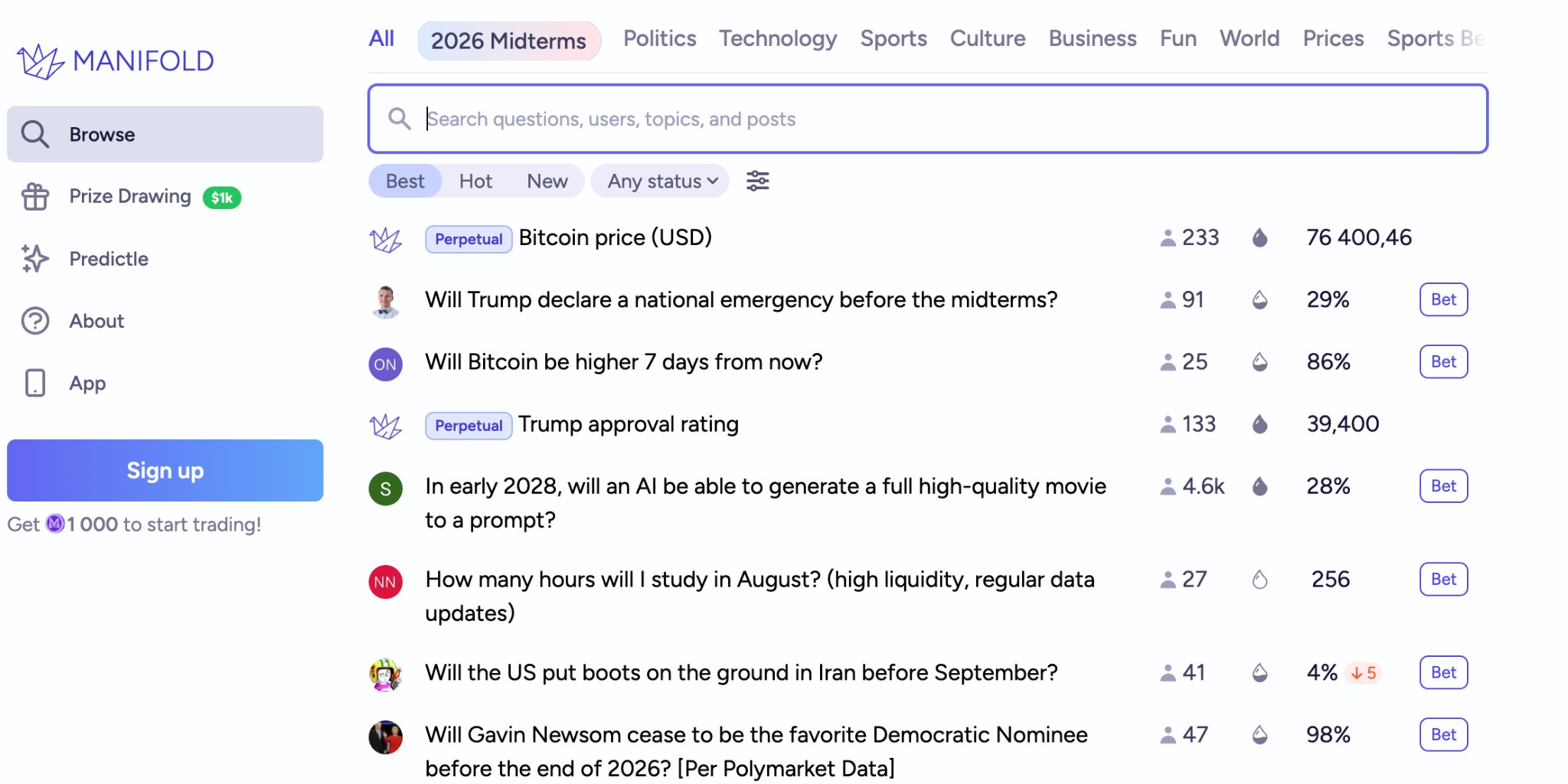
A market showing a 65% probability essentially means that participants have traded the market to a price implying approximately a 65% chance of that outcome.
If you believe the real probability is substantially higher, you can buy YES shares. If you believe it is lower, you can take the opposite position. When other participants trade, the market probability changes.
- Pros
- Cons
free to start, with new users receiving Ṁ1,000;
no need to risk real money on ordinary prediction markets;
users can create their own markets;
extremely broad range of topics;
probabilities update dynamically as participants trade;
supports binary, multiple-choice and numeric markets;
limit orders are available;
social features encourage discussion and information sharing;
official API is available;
eligible users can separately participate in drawings for real USDC prizes.
mana itself cannot be redeemed for cash;
liquidity varies substantially between markets;
small markets can be easier for individual traders to move;
market creators generally determine resolutions;
poorly written resolution criteria can create disputes;
losing predictions can reduce your mana balance;
prize drawings are restricted in some jurisdictions;
real-money prizes require additional eligibility requirements and a crypto wallet.
One of Manifold's biggest distinctions is that any user can create a prediction market. This produces questions that would rarely appear on a conventional betting or financial platform, including niche technology forecasts, research questions, personal goals and community-specific events.
| Feature | What it does |
|---|---|
| Prediction markets | Lets users trade forecasts about future events. |
| Mana | Play-money currency used for predictions and other platform activities. |
| User-created markets | Community members can create their own forecasting questions. |
| Binary markets | Trade YES or NO outcomes. |
| Multiple Choice | Forecast several possible outcomes. |
| Numeric markets | Predict a numerical result within a defined range. |
| Polls | Collect opinions without conventional prediction trading. |
| Bounty Questions | Offer mana rewards for useful answers. |
| Limit orders | Specify the probability at which you are willing to trade. |
| Liquidity | Users can subsidize markets to make larger trades easier. |
| Social features | Comments and discussions let traders explain forecasts and share evidence. |
| Loans | Eligible users can borrow mana against unresolved positions. |
| API | Developers can programmatically access Manifold data and build tools. |
| Prize Drawings | Eligible users can enter separate drawings for real USDC prizes. |
Is Manifold worth it?
Manifold is worth considering primarily as a forecasting and probability-training platform, rather than as a conventional investment service. It is especially useful for people who want to practice thinking in probabilities. Instead of saying that an event "will" or "will not" happen, traders have to consider whether the current probability is too high or too low.
Suppose a market trades at 40%, while your research suggests the event has a 60% probability. The relevant question is not simply whether the event will happen. The question is whether buying at the market's current implied probability offers enough expected value.
Because the normal currency is not redeemable for cash, beginners can practice this type of reasoning without exposing real capital to every forecast. The trade-off is obvious: successful forecasting primarily earns more mana and platform status rather than directly generating cash returns. Users looking specifically for real-money event trading may therefore find Manifold less suitable than a regulated real-money prediction exchange available in their jurisdiction.
What can I predict on Manifold?
One of Manifold's strongest features is the breadth of its markets. Because users can create questions themselves, the platform is not limited to a predefined list of financial or political contracts.
Common areas include:
Politics: elections, government decisions, political appointments and policy developments.
Technology: artificial intelligence, product launches, software, technology companies and industry developments.
Sports: match outcomes, tournaments and sports-related events.
Business and economics: company performance, economic developments, stocks and cryptocurrencies.
Science and research: research outcomes, scientific claims and questions about the usefulness or credibility of studies.
Current events: major news stories, legal outcomes and other measurable developments.
AI: AI capabilities, model releases, AI safety and longer-term technology forecasts.
Culture and entertainment: television, movies, celebrities, online culture and entertainment events.
Personal markets: users can even create markets about their own goals or future decisions.
Project management: teams can use markets to estimate whether projects will succeed or whether particular features should be developed.
This user-generated model is one of Manifold's most important advantages. A highly specialized question may attract only a small number of traders, but it can still become a functioning prediction market.
Types of Manifold markets
Manifold supports several different formats:
Yes/No markets. These are standard binary prediction markets. Traders can take YES or NO positions, while the displayed percentage represents the current market-implied probability.
Multiple Choice markets. These questions have several possible answers. Depending on the configuration, probabilities can be mutually exclusive and add to 100%, or individual answers can behave independently.
Numeric markets. Numeric markets are designed for forecasts where the answer is a number rather than a binary outcome. Examples might include forecasting an election margin, an economic indicator or a future price.
Polls. Manifold also supports polls. These collect opinions without requiring conventional prediction trading and can use single-choice, multi-select or ranked-choice formats.
Bounty Questions. A user can offer mana as a reward for high-quality answers. This expands Manifold beyond pure forecasting and turns part of the platform into an incentive-based question-and-answer community.
How Manifold works
1. Find a market
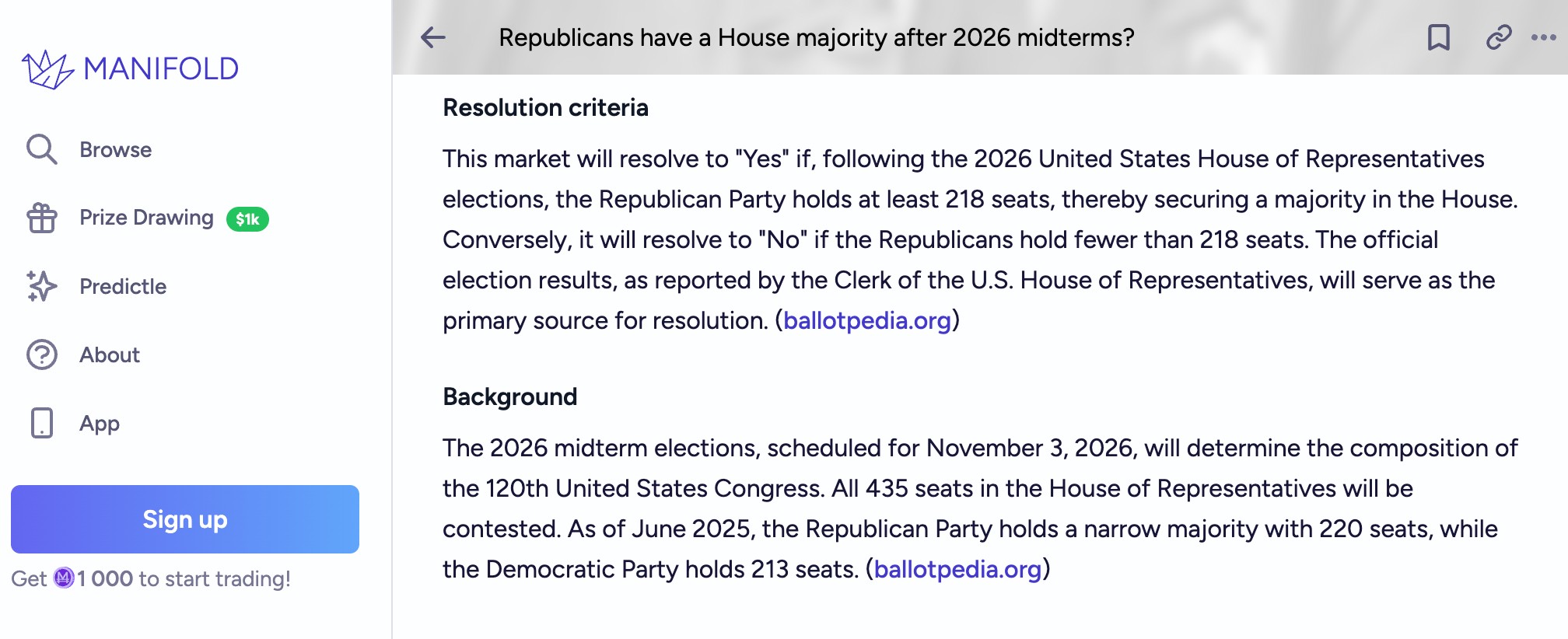
Browse Manifold or search for a topic you understand well. Before trading, read both the question and its resolution criteria.
2. Estimate the probability yourself
Do not automatically accept the displayed percentage as correct. If Manifold shows 30% but your own research suggests 50%, the YES side may appear undervalued. Conversely, if you estimate only a 10% chance, the NO side may offer the more attractive position.
3. Buy shares
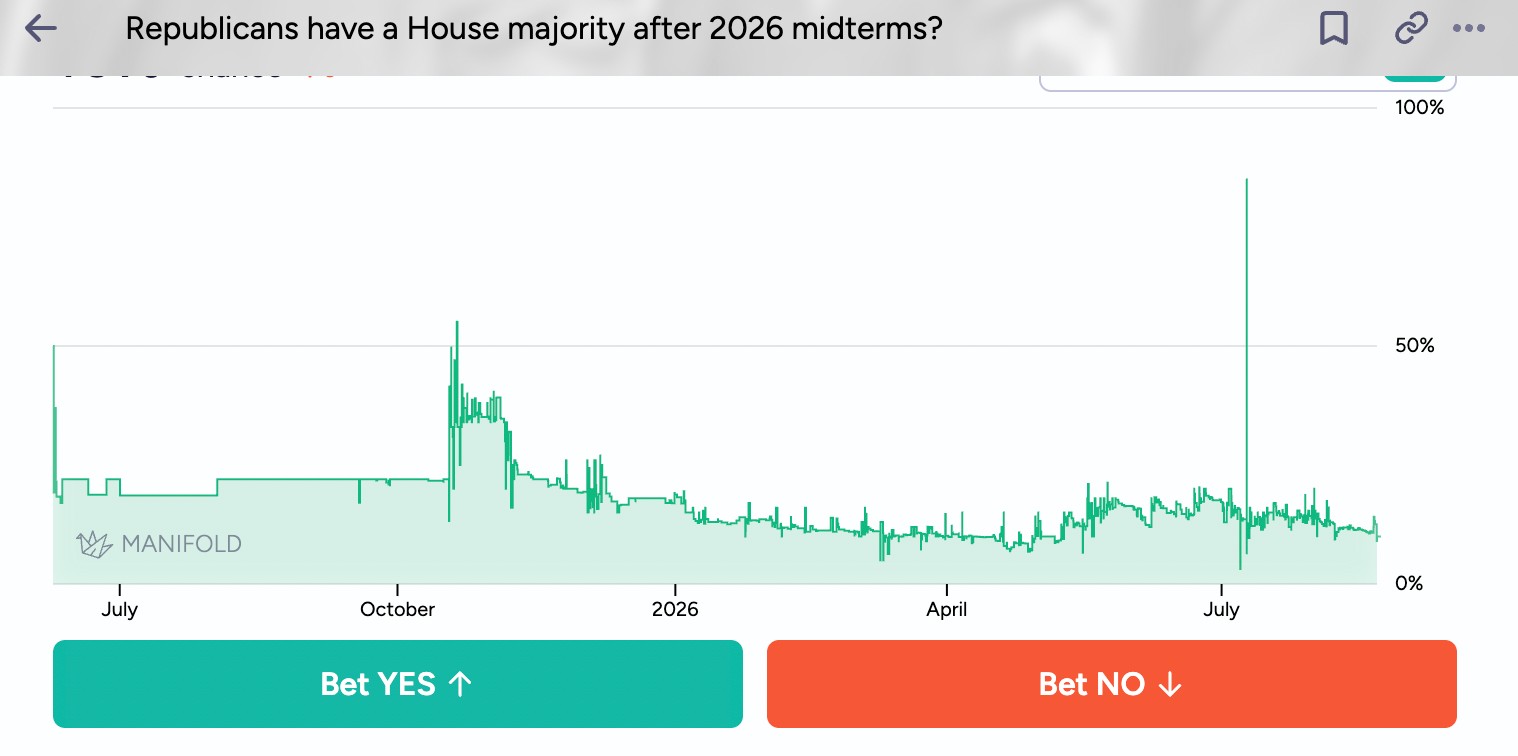
When you make a prediction, you spend mana to purchase shares in an outcome. The share price depends on the probability. Higher-probability outcomes cost more because they are more likely to pay out.
Each correct share is worth Ṁ1 when the market resolves. For example, owning 300 YES shares produces a Ṁ300 payout if the final resolution is YES and no payout from those shares if it resolves NO.
4. Sell before resolution
You do not always have to wait until the final result. If the probability moves in your favor, the value of your shares can rise. You can sell the position and realize a mana profit before resolution. This creates a trading dynamic similar to financial markets: traders can attempt to buy low and sell high as information changes.
5. Market resolution
Unlike some centralized prediction exchanges, Manifold gives substantial responsibility to market creators. The person who creates a market normally resolves it once the predefined conditions have been met. Manifold recommends setting clear resolution criteria in advance, and moderators can intervene in exceptional circumstances.
Manifold fees & costs
The economics of Manifold differ from real-money prediction exchanges because normal markets operate with mana. The most important cost for a typical trader is therefore the mana committed to a prediction. If your forecast is wrong, you can lose the mana used for the position.
Creating and subsidizing markets can also require mana. The initial creation cost contributes liquidity, while users can voluntarily provide additional liquidity. Mana itself can be obtained without paying money. New users receive Ṁ1,000, while additional mana can be earned through successful predictions and platform activities.
Manifold's current FAQ lists several ways to earn mana, including:
trading profits;
prediction streaks;
sharing markets;
creating markets;
referrals;
verification and other quests.
Users can use Manifold without purchasing mana, although additional mana is also available for purchase.
Can you win real money on Manifold?
This point requires an important distinction. Mana cannot itself be directly converted into cash. However, Manifold currently runs separate Prize Drawings where eligible participants can win real prizes.
The drawings are opt-in and are not the same thing as ordinary Manifold prediction markets.
Eligible active users with at least Ṁ1,000 invested across markets can claim a free entry. Additional entries can be obtained by spending mana.
Manifold uses a bonding-curve system for those additional entries: later entries progressively require more mana. This is intended to prevent a participant from cheaply buying a dominant share of entries immediately before a drawing closes.
Every individual entry has the same chance of being selected regardless of whether it was obtained for free or through mana. Winners are selected using a process based on a Bitcoin block hash, which provides an externally verifiable source of randomness. Prizes are paid in USDC, so winners need a compatible cryptocurrency wallet.
| Feature | Details |
|---|---|
| Prize currency | USDC |
| Purchase required | No |
| Free entry | Available to eligible users |
| Minimum activity | At least Ṁ1,000 invested across markets |
| Minimum age | 18 |
| Additional entries | Available by spending mana |
| Selection | Bitcoin-block-hash-based random process |
| Wallet required to receive prize | Yes |
| Geographic restrictions | Yes |
Is Manifold legal and safe?
Because Manifold's core prediction markets use play money, the platform has a very different structure from conventional real-money betting exchanges. Mana cannot be directly redeemed for cash, and users can participate in ordinary prediction markets without purchasing it. Prize Drawings involve real USDC prizes and therefore have separate eligibility requirements and geographic restrictions.
At the time of this review, Manifold states that entrants must:
be at least 18;
have at least Ṁ1,000 invested across markets;
use only one account per person;
be located in an eligible jurisdiction;
not be a Manifold employee or otherwise excluded under the rules.
Some US states, Ontario in Canada and multiple countries are excluded from Prize Drawings because of local legal requirements. Restricted users can generally continue using ordinary Manifold features even though they cannot participate in the drawings.
How to create a Manifold account
Step 1: Open Manifold
Go to the official Manifold website or use its app. Always verify the website before entering credentials, particularly if you arrived through an external link.
Step 2: Sign up
Manifold is designed to make onboarding relatively simple. New users can sign in and start predicting without depositing funds. The platform supports sign-in options including existing Google or Apple accounts.
Step 3: Receive your starting mana
New users currently receive Ṁ1,000. Because mana is play money, you can immediately explore markets without depositing real money.
Step 4: Find a market
Browse categories or use search to find a topic where you have relevant knowledge. Before making your first prediction, read the market description and resolution rules carefully.
Step 5: Make a small first prediction
Choose the outcome you think is incorrectly priced and enter the amount of mana you want to commit. Review the expected payout and how much the order will change the displayed probability before confirming it. Your position can later be sold, or you can hold it until the market resolves.
How to create your own market
Market creation is one of Manifold's defining features.
Users can create binary, multiple-choice and numeric markets, as well as polls and bounty questions. A good market should have clear resolution criteria.
For example, a weak question would be:
"Will AI become much better next year?"
The terms "much better" and even "next year" could generate disagreement. A better market defines a measurable event, deadline and source of evidence. Creators should also specify an appropriate close date, provide useful background information and add the market to relevant topics so interested traders can find it. Creators can contribute additional liquidity or place limit orders to make the market more attractive to participants.
Manifold vs Polymarket
Manifold and Polymarket both use prediction markets to turn beliefs about future events into probabilities, but their underlying models are substantially different.
| Feature | Manifold | Polymarket |
|---|---|---|
| Core model | Social prediction market | Event trading / prediction market |
| Main trading currency | Mana (play money) | USDC-based real-value positions |
| Starting funds | Ṁ1,000 free | Funding generally required to trade |
| Cash value of normal trading currency | No | Yes |
| User-created markets | Major part of platform | More controlled market listing |
| Market resolution | Usually market creator, with moderation | Defined resolution process/oracle infrastructure |
| Market types | Binary, multiple choice, numeric, polls, bounties | Primarily event outcome contracts |
| Social/community focus | High | More trading-focused |
| Real prizes | Separate USDC Prize Drawings | Winning trading positions have monetary value |
| Best suited for | Forecasting practice, communities and niche questions | Real-money probability trading where available |
Use Manifold to improve your probability estimates, not simply to collect mana

The most useful way to approach Manifold is as a training environment for probabilistic thinking. Before looking at the market percentage, I would first try to form an independent estimate. If a market shows 65%, ask yourself what probability you would assign based on the available evidence and why. If your estimate is 67%, there may be little reason to trade. If your estimate is 85%, the difference is much more meaningful.
This distinction is important because successful prediction-market trading is not about being right on every question. A person who repeatedly buys 80%-likely outcomes at prices implying 95% probabilities can make poor trades even if most of those events eventually happen.
For beginners, Manifold provides an unusually accessible environment for learning this lesson because ordinary predictions do not require real-money stakes. I would start with markets in subjects where you already have knowledge, keep position sizes modest relative to your mana balance, and record why you made each prediction. When the market resolves, compare the result not only with your prediction but also with your original reasoning.
Conclusion
Manifold stands out as a unique social prediction market platform that provides an accessible environment for learning and practicing probabilistic thinking without risking real money. By allowing users to create and trade on a wide variety of market topics, from AI breakthroughs to political outcomes, it encourages thoughtful analysis and community engagement. While mana cannot be redeemed for cash, the platform's rich features and occasional USDC prize drawings offer additional motivation for participation. Ultimately, Manifold is best seen as a powerful tool for sharpening forecasting skills, reminding users that real insight comes from questioning market probabilities and refining one's own predictions over time.
FAQs
How does liquidity affect trading outcomes on Manifold?
What role do resolution criteria play in Manifold markets?
Can users participate in Manifold markets without any financial investment?
In what ways do Manifold’s social features enhance the forecasting experience?
Editors' Top Picks and Insights




Related Articles
Team that worked on the article
Aleksandra Chaikina has been a contributor to Traders Union since 2021. With over 15 years of experience in copywriting and more than 5 years focused on financial content, she specializes in producing detailed guides, analytics, and comparative reviews across various sectors, including cryptocurrencies, Forex, investment strategies, and financial technologies.
Ciaran Ryan is a veteran financial journalist based in South Africa, where he covers cryptocurrency, mining, stock markets, and governance for Moneyweb. He also hosts the weekly Moneyweb Crypto Podcast.
Chinmay Soni is a financial analyst with more than 5 years of experience in working with stocks, Forex, derivatives, and other assets. As a founder of a boutique research firm and an active researcher, he covers various industries and fields, providing insights backed by statistical data.
A limit order is a type of order used in trading where an investor specifies a particular price at which they want to buy or sell a financial asset. The order will only be executed if the market price reaches or exceeds the specified limit price, ensuring that the trader gets the desired price or better when the trade is executed.
An investor is an individual, who invests money in an asset with the expectation that its value would appreciate in the future. The asset can be anything, including a bond, debenture, mutual fund, equity, gold, silver, exchange-traded funds (ETFs), and real-estate property.
CFD is a contract between an investor/trader and seller that demonstrates that the trader will need to pay the price difference between the current value of the asset and its value at the time of contract to the seller.
Yield refers to the earnings or income derived from an investment. It mirrors the returns generated by owning assets such as stocks, bonds, or other financial instruments.
Index in trading is the measure of the performance of a group of stocks, which can include the assets and securities in it.

-
 Afghanistan
-
 Albania
-
 Algeria
-
 Angola
-
 Argentina
-
 Armenia
-
 Australia
-
 Austria
-
 Azerbaijan
-
 Bahamas
-
 Bahrain
-
 Bangladesh
-
 Belarus
-
 Belgium
-
 Bolivia
-
 Botswana
-
 Brazil
-
 Brunei
-
 Bulgaria
-
 Cambodia
-
 Cameroon
-
 Canada
-
 Chile
-
 China
-
 Colombia
-
 Congo
-
 Costa Rica
-
 Cote d'Ivoire
-
 Croatia
-
 Cuba
-
 Cyprus
-
 Czechia
-
 DR Congo
-
 Denmark
-
 Dominican Republic
-
 Ecuador
-
 Egypt
-
 El Salvador
-
 Estonia
-
 Eswatini
-
 Ethiopia
-
 Finland
-
 France
-
 Georgia
-
 Germany
-
 Ghana
-
 Greece
-
 Haiti
-
 Hong Kong
-
 Hungary
-
 India
-
 Indonesia
-
 Iran, Islamic republic
-
 Iraq
-
 Ireland
-
 Israel
-
 Italy
-
 Jamaica
-
 Japan
-
 Jordan
-
 Kazakhstan
-
 Kenya
-
 Korea
-
 Kuwait
-
 Kyrgyzstan
-
 Laos
-
 Latvia
-
 Lebanon
-
 Lesotho
-
 Libya
-
 Lithuania
-
 Luxembourg
-
 Madagascar
-
 Malaysia
-
 Malta
-
 Mauritius
-
 Mexico
-
 Moldova
-
 Mongolia
-
 Montenegro
-
 Morocco
-
 Mozambique
-
 Myanmar
-
 Namibia
-
 Nepal
-
 Netherlands
-
 New Zealand
-
 Nigeria
-
 North Macedonia
-
 Norway
-
 Oman
-
 Pakistan
-
 Palestine
-
 Panama
-
 Papua New Guinea
-
 Paraguay
-
 Peru
-
 Philippines
-
 Poland
-
 Portugal
-
 Puerto Rico
-
 Qatar
-
 Reunion
-
 Romania
-
 Rwanda
-
 Saudi Arabia
-
 Serbia
-
 Singapore
-
 Slovakia
-
 Slovenia
-
 Somalia
-
 South Africa
-
 Spain
-
 Sri Lanka
-
 Sweden
-
 Switzerland
-
 Syria
-
 Taiwan
-
 Tajikistan
-
 Tanzania
-
 Thailand
-
 Trinidad and Tobago
-
 Tunisia
-
 Turkey
-
 UAE
-
 Uganda
-
 Ukraine
-
 United Kingdom
-
United States
-
 Uruguay
-
 Uzbekistan
-
 Venezuela
-
 Vietnam
-
 Yemen
-
 Zambia
-
 Zimbabwe
- Forex
- Crypto












