
Prediction Markets: The Basics


Editorial Note: While we adhere to strict Editorial Integrity, this post may contain references to products from our partners. Here's an explanation for How We Make Money. None of the data and information on this webpage constitutes investment advice according to our Disclaimer.
Prediction markets transform future expectations into tradable prices. Instead of just asking if a candidate will win, if inflation will drop, or if a company will reach a target, these markets let people back their views with real money. The market price shifts in real time, reflecting the crowd’s estimate of an event’s probability. Prediction markets can cover economic indicators, interest rates, weather, corporate milestones, tech, sports, and other measurable outcomes. They’re used for speculation, forecasting, research, and sometimes to hedge real-world risks.
This guide gives a hands-on overview of prediction markets: how contracts work, what drives their prices, how they differ from traditional betting, their pros and cons, and what to know about regulation and taxes.
Risk warning: All investments carry risk, including potential capital loss. Economic fluctuations and market changes affect returns, and 40-50% of investors underperform benchmarks. Diversification helps but does not eliminate risks. Invest wisely and consult professional financial advisors.
What are prediction markets?
A prediction market is a platform where people trade contracts whose value depends on the outcome of a future event. Instead of buying company shares, a participant might buy a contract based on a question like:
Will inflation top 3% next month?
Will a specific candidate win an election?
Will the Federal Reserve cut rates at its next meeting?
Will a city get more than a set amount of snowfall?
Will a sports team win the championship?
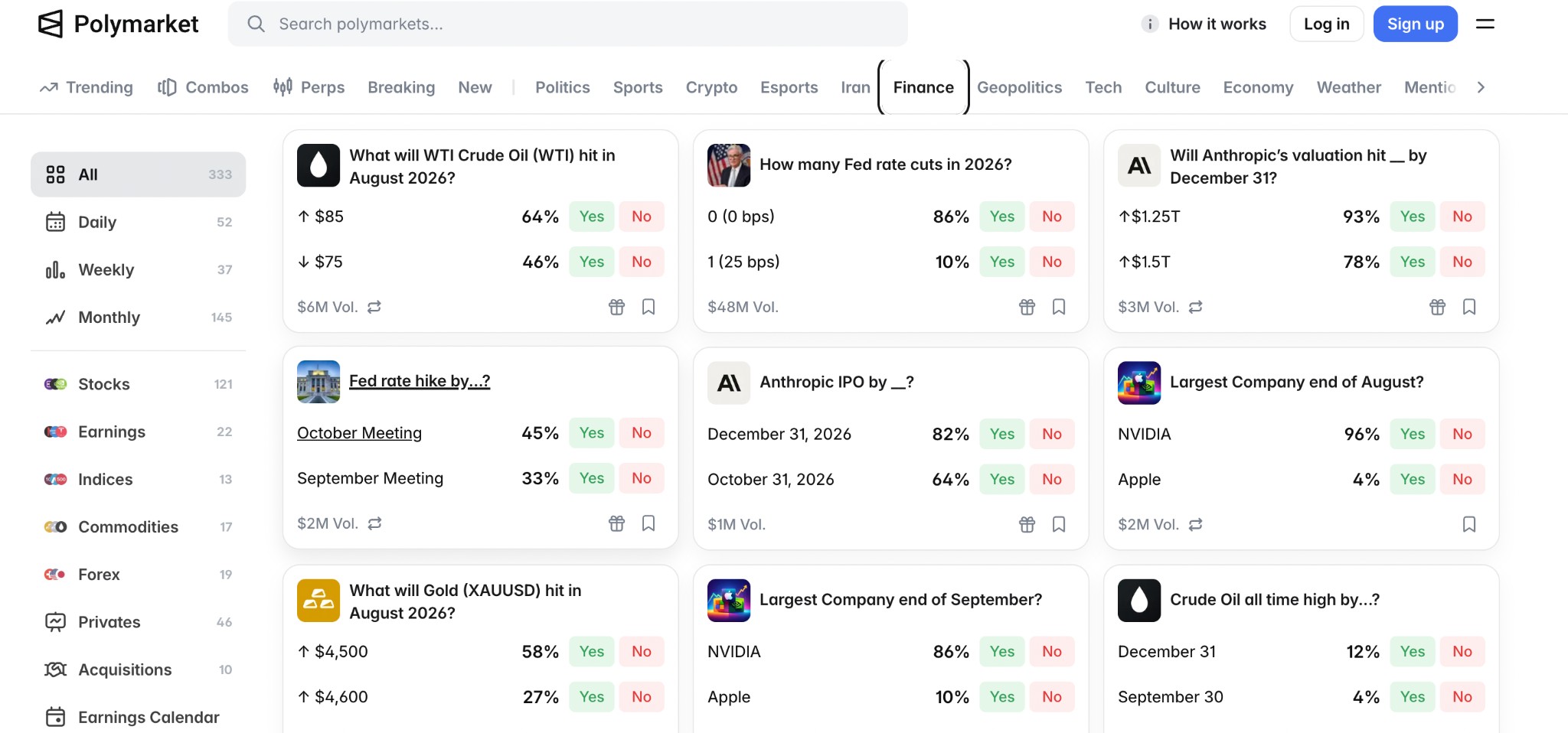
Many prediction markets use binary YES/NO contracts. A winning contract typically settles at $1, while a losing contract settles at $0.
In the United States, the CFTC defines event contracts as derivatives whose payoff depends on a specified event, occurrence, or value. Regulated prediction-market contracts may be structured as swaps and can serve both speculative and hedging purposes.
The key point is that prediction markets do not actually know the future. They generate a market-based estimate based on what participants currently believe and how strongly they are willing to financially support those beliefs.
How do prediction markets work?
To understand how prediction markets work, imagine a market asking: “Will Event X happen before December 31?” There are two possible outcomes: YES and NO. Suppose a YES contract is trading at $0.65. In a simple binary market where the winning contract pays $1, that price can roughly be interpreted as the market assigning a 65% probability to the event.
If new information makes the event seem more likely, traders may be willing to pay more for YES contracts. The price might increase from $0.65 to $0.75.
If negative information emerges, demand may shift toward NO and the YES price could drop to $0.45.
Market prices therefore change as participants respond to:
news;
economic releases;
polls and surveys;
expert analysis;
proprietary research;
public announcements;
new data;
other traders' behavior.
The market continuously aggregates these views into a price. Importantly, a price of $0.65 does not mean that an event has an objectively proven 65% probability of occurring. It means that the market is currently pricing the contract at a level broadly consistent with a 65% implied probability. Liquidity, sentiment, transaction costs, market structure, and behavioral biases can all influence that price.
Prediction markets, forecast markets, and prediction marketing
Several related terms can be confusing:
Forecast markets generally refer to markets designed to aggregate forecasts about future outcomes. In practice, the term often overlaps with prediction markets.
Prediction marketing, on the other hand, is different. In marketing, prediction or predictive marketing usually refers to using customer data, statistical models, or machine learning to anticipate customer behavior and optimize campaigns.
Prediction markets instead use market mechanisms and trading to estimate the likelihood of future events.

The concepts can overlap – for instance, a company might run an internal market to forecast product demand – but they should not be considered synonymous.
Prediction market example: How a trade works
A straightforward prediction market example demonstrates how prices, probabilities, and payouts are linked. Suppose a market poses the question: “Will the central bank cut interest rates at its next meeting?” The contract has two possible outcomes – YES or NO – and a winning contract pays out $1.
Assume a YES contract is currently priced at $0.40. This price indicates that the market is assigning about a 40% probability to a rate cut. You believe the true probability is higher, so you purchase 100 YES contracts for $40.
| Outcome | What happens | Result |
|---|---|---|
| Rate cut occurs | YES contracts pay out $1 each | $100 payout; $60 profit |
| No rate cut | YES contracts pay out $0 | $40 loss |
| YES price rises to $0.70 before the decision | You sell 100 contracts at $0.70 | $70 received; $30 profit |
The third outcome highlights a key feature of many prediction markets: you may not have to wait for the event to be resolved. If new economic data increases the likelihood of a rate cut, demand for YES contracts could drive the price from $0.40 to $0.70. If the market lets you exit your position, you could sell at the higher price and secure a $30 gain before the central bank announces its decision.
In other words, prediction market traders can potentially profit in two ways: by holding a correct position until settlement, or by trading on changes in the market's implied probability before the event occurs. Fees, spreads, liquidity, and taxes can influence the actual outcome.
Prediction markets vs. Betting markets
Both prediction markets and betting markets allow participants to stake money on uncertain future events, but they operate differently.
| Feature | Prediction Markets | Betting Markets |
|---|---|---|
| Who sets the price? | Buyers and sellers through supply and demand | Usually the bookmaker |
| How is probability shown? | Contract price often represents implied probability | Probability is reflected in betting odds |
| Can prices change? | Yes, as participants trade and new information appears | Yes, bookmakers can adjust odds |
| Can you exit early? | Often possible by selling the contract before settlement | Depends on whether the bookmaker offers cash-out |
| Operator's role | Typically facilitates the market between participants | Sets odds and accepts bets |
| Main purpose | Trading or forecasting event probabilities | Betting on an outcome |
How do betting markets work?
In a traditional sportsbook, the bookmaker estimates the probability of each outcome, converts those estimates into odds, and adds a margin – often called the vig or overround. Bettors then choose whether to accept the offered odds.
Prediction markets use a different price-discovery mechanism. For example, if a YES contract trades at $0.60, the market is roughly implying a 60% probability of that event occurring. If new information changes participants' expectations, buying and selling can move the price to $0.70, $0.40, or another level.
The key difference is therefore who determines the price: betting odds are generally set by a bookmaker, while prediction-market prices typically emerge from trading between market participants. This is also why prediction markets can function as forecasting tools – the changing price reflects the market's collective expectations.
What can prediction markets be used for?
Prediction markets can cover any event that can be defined clearly enough to resolve according to predetermined rules.
Common categories include:
Politics. Election outcomes, vote shares, appointments and legislative events have historically attracted substantial attention.
Economics. Markets can track inflation, employment data, GDP, interest-rate decisions and other macroeconomic indicators.
Business and technology. Participants may forecast product launches, corporate milestones, regulatory approvals, acquisitions or technology developments.
Weather and climate. Contracts can be linked to rainfall, snowfall, temperatures, hurricanes and other measurable conditions.
Sports and entertainment. Some platforms offer event contracts related to games, championships, awards and entertainment outcomes, although the regulatory treatment of these products can be particularly jurisdiction-dependent.
Hedging. Prediction markets can potentially help users offset specific event risks.
Pros and cons
- Pros
- Cons
Information aggregation: combines forecasts from participants with different knowledge and perspectives.
Real-time updates: prices can react quickly to news and new data.
Clear probabilities: market prices provide an easy-to-understand estimate of expected outcomes.
Financial incentives: participants have a reason to research events before trading.
Hedging potential: some contracts can help offset risks related to specific events.
Risk of loss: a contract can settle at zero, resulting in a total loss of the amount invested.
Low liquidity: thin markets may have wide spreads and make positions difficult to exit.
Market bias: sentiment, herd behavior, or large traders can distort probabilities.
Resolution risk: unclear contract wording can create uncertainty about how an outcome will be settled.
Regulatory uncertainty: rules and availability differ by jurisdiction and may change over time.
How to invest in prediction markets
Technically, trading prediction markets is usually more precise than “investing ”: you purchase contracts linked to specific outcomes rather than ownership in an asset or company. Here’s how the process generally works:
Step 1: Check availability and regulations
Ensure prediction markets are legally accessible in your jurisdiction and review any eligibility requirements.
Step 2: Choose a suitable platform
Select a regulated or otherwise properly authorized prediction market platform available in your area, and review its fees, markets, and trading rules.
Step 3: Choose a market and read the rules
Identify an event you understand and check exactly what counts as YES or NO, when the contract expires, and how the outcome will be determined.
Step 4: Estimate the probability
Research the event independently instead of relying solely on the market price. Compare your probability estimate with the contract’s implied probability.
Step 5: Calculate risk and potential return
Before opening a position, determine your maximum possible loss and potential payout, factoring in fees and spreads.
Step 6: Buy YES or NO contracts
Take the position that matches your forecast. For example, if YES costs $0.40 but your research indicates a 60% probability, you might consider the contract undervalued.
Step 7: Monitor and exit the position
Track new information that could affect the probability. Depending on the market, you can sell before settlement or hold the contract until the final outcome. The objective is not just to predict what will happen, but to find situations where your evidence-based probability estimate significantly differs from the probability reflected in the market price.
Best prediction market tools
Prediction market tools include dedicated forecasting platforms as well as services for market research, analysis, and trade tracking. Here are nine options for different stages of the process.
1. Polymarket – Best for real-money prediction markets

Polymarket is a prediction market platform where users can trade on the outcomes of real-world events across politics, economics, technology, sports, and other categories. Market prices reflect participants’ changing expectations, making the platform useful for comparing market-implied probabilities with your own forecasts. Availability, trading access, and applicable rules depend on the user’s jurisdiction.
2. Plus500 – Best for event-based trading
Plus500 offers prediction-market products to eligible U.S. customers alongside other trading services. It is most relevant for traders interested in real-money event contracts, subject to local availability and eligibility.
3. TradingView – Best for market research

TradingView provides charts, market data, and economic tools that can help research events underlying prediction contracts, such as interest-rate decisions, inflation releases, and financial-market outcomes.
4. Market Chameleon – Best for options research

Market Chameleon focuses on options and market research. It can provide additional context when prediction-market outcomes are connected to earnings, volatility, stocks, or other financial events.
5. TrendSpider – Best for technical analysis
TrendSpider offers technical-analysis and market-research tools. It can complement prediction markets when traders want to analyze price trends and other market signals related to an event.
6. Tickeron – Best for data-driven analysis

Tickeron provides analytical tools for traditional financial markets. It can help traders examine market conditions and test assumptions before comparing their own forecasts with prediction-market probabilities.
7. TraderSync – Best for trade review

TraderSync is a trading journal for recording and reviewing decisions. Prediction-market traders can use it to track entries, outcomes, probability estimates, and recurring mistakes.
8. Trademetria – Best for performance tracking

Trademetria helps traders track performance and analyze past trades. It can be useful for evaluating whether a prediction-market strategy remains effective over a larger sample of decisions.
9. TraderVue – Best for trading journaling

TraderVue provides trade-journaling and review tools that can help compare initial forecasts with actual results and identify patterns in trading decisions.
10. Manifold Markets – Best for exploring prediction markets

Manifold Markets lets users explore prediction markets covering politics, economics, technology, sports, and other events. Its play-money model makes it particularly useful for learning how prediction markets work and observing how probabilities change over time.
How are prediction markets taxed?
Prediction market profits may be taxable, but there is no universal rule. Treatment depends on the country, platform, contract structure, and whether the activity is classified as gambling, investing, derivatives trading, or a business.
| Country | How prediction market profits may be treated |
|---|---|
| United States | Profits are generally reportable, but the exact classification remains unsettled. Possible treatments include gambling income, ordinary income, or certain financial-contract rules. If wagering rules apply, from 2026 deductible wagering losses are limited to 90% of losses, subject to additional limitations. |
| United Kingdom | Casual gambling winnings are generally tax-free for individuals. However, prediction contracts classified as financial instruments or business activity may be treated differently. |
| Canada | There is currently no specific CRA guidance for prediction markets. Depending on the circumstances, gains could potentially be a non-taxable windfall, capital gain, or fully taxable business income. |
| Australia | Recreational gambling winnings are generally not taxable, but prediction markets do not have a simple universal classification. Professional or business-like activity and crypto-based transactions may receive different treatment. |
The key issue is how the contract and your activity are classified, not simply which prediction market you use. Keep records of trades, settlements, fees, gains, and losses, and check current local rules before filing.
Focus on probability, not prediction

My personal recommendation is to treat prediction markets as a test of your ability to price uncertainty, not simply to guess an outcome. Before opening a position, I would write down my own probability estimate and the specific evidence that could prove it wrong. This creates discipline: if you cannot explain why your estimate differs from the market’s, you probably do not have a meaningful edge.
I would also start with very small positions and keep a record of forecasts, including cases where the trade was profitable for the wrong reasons. Over time, the most useful metric is not the number of winning predictions, but calibration – whether events you estimate at 70%, for example, actually occur roughly seven times out of ten. A trader who learns to measure and correct their own forecasting bias has a much stronger foundation than someone who simply follows headlines or market sentiment.
Finally, I would be especially cautious with markets where the settlement criteria leave room for interpretation. A good forecast can still become a bad trade if the contract wording is ambiguous. For me, a clearly defined resolution source and settlement condition are prerequisites, not formalities.
Conclusion
Prediction markets offer a sophisticated way to aggregate collective wisdom and quantify the likelihood of future events by allowing participants to put real money behind their beliefs. Unlike traditional betting, these markets reflect shifting probabilities as news and analysis shape the price of outcome-based contracts, making them valuable forecasting tools for everything from elections to economic decisions. However, the power of prediction markets lies not just in guessing outcomes but in disciplined probability estimation and clear understanding of contract rules, as illustrated by traders who profit by identifying mismatches between their research and the market’s implied odds. Ultimately, success in prediction markets depends on treating them as a test of your ability to evaluate uncertainty rather than a game of luck, with disciplined tracking and calibration offering the strongest edge.
FAQs
What factors can influence the accuracy of prediction market prices?
Are there any limitations to using prediction markets for forecasting?
How do participants manage risks when trading on prediction markets?
What is the difference between prediction markets and predictive analytics?
Editors' Top Picks and Insights






Related Articles
Team that worked on the article
Aleksandra Chaikina has been a contributor to Traders Union since 2021. With over 15 years of experience in copywriting and more than 5 years focused on financial content, she specializes in producing detailed guides, analytics, and comparative reviews across various sectors, including cryptocurrencies, Forex, investment strategies, and financial technologies.
Ciaran Ryan is a veteran financial journalist based in South Africa, where he covers cryptocurrency, mining, stock markets, and governance for Moneyweb. He also hosts the weekly Moneyweb Crypto Podcast.
Chinmay Soni is a financial analyst with more than 5 years of experience in working with stocks, Forex, derivatives, and other assets. As a founder of a boutique research firm and an active researcher, he covers various industries and fields, providing insights backed by statistical data.
Ethereum is a decentralized blockchain platform and cryptocurrency that was proposed by Vitalik Buterin in late 2013 and development began in early 2014. It was designed as a versatile platform for creating decentralized applications (DApps) and smart contracts.
Index in trading is the measure of the performance of a group of stocks, which can include the assets and securities in it.
CFD is a contract between an investor/trader and seller that demonstrates that the trader will need to pay the price difference between the current value of the asset and its value at the time of contract to the seller.
Insider trading is the illegal practice of buying or selling a company's securities (such as stocks or bonds) based on non-public, material, and confidential information about the company. This information is typically known only to insiders, such as company executives, employees, or individuals with close connections to the company, and it gives them an unfair advantage in the financial markets.
Bitcoin is a decentralized digital cryptocurrency that was created in 2009 by an anonymous individual or group using the pseudonym Satoshi Nakamoto. It operates on a technology called blockchain, which is a distributed ledger that records all transactions across a network of computers.

-
 Afghanistan
-
 Albania
-
 Algeria
-
 Angola
-
 Argentina
-
 Armenia
-
 Australia
-
 Austria
-
 Azerbaijan
-
 Bahamas
-
 Bahrain
-
 Bangladesh
-
 Belarus
-
 Belgium
-
 Bolivia
-
 Botswana
-
 Brazil
-
 Brunei
-
 Bulgaria
-
 Cambodia
-
 Cameroon
-
 Canada
-
 Chile
-
 China
-
 Colombia
-
 Congo
-
 Costa Rica
-
 Cote d'Ivoire
-
 Croatia
-
 Cuba
-
 Cyprus
-
 Czechia
-
 DR Congo
-
 Denmark
-
 Dominican Republic
-
 Ecuador
-
 Egypt
-
 El Salvador
-
 Estonia
-
 Eswatini
-
 Ethiopia
-
 Finland
-
 France
-
 Georgia
-
 Germany
-
 Ghana
-
 Greece
-
 Haiti
-
 Hong Kong
-
 Hungary
-
 India
-
 Indonesia
-
 Iran, Islamic republic
-
 Iraq
-
 Ireland
-
 Israel
-
 Italy
-
 Jamaica
-
 Japan
-
 Jordan
-
 Kazakhstan
-
 Kenya
-
 Korea
-
 Kuwait
-
 Kyrgyzstan
-
 Laos
-
 Latvia
-
 Lebanon
-
 Lesotho
-
 Libya
-
 Lithuania
-
 Luxembourg
-
 Madagascar
-
 Malaysia
-
 Malta
-
 Mauritius
-
 Mexico
-
 Moldova
-
 Mongolia
-
 Montenegro
-
 Morocco
-
 Mozambique
-
 Myanmar
-
 Namibia
-
 Nepal
-
 Netherlands
-
 New Zealand
-
 Nigeria
-
 North Macedonia
-
 Norway
-
 Oman
-
 Pakistan
-
 Palestine
-
 Panama
-
 Papua New Guinea
-
 Paraguay
-
 Peru
-
 Philippines
-
 Poland
-
 Portugal
-
 Puerto Rico
-
 Qatar
-
 Reunion
-
 Romania
-
 Rwanda
-
 Saudi Arabia
-
 Serbia
-
 Singapore
-
 Slovakia
-
 Slovenia
-
 Somalia
-
 South Africa
-
 Spain
-
 Sri Lanka
-
 Sweden
-
 Switzerland
-
 Syria
-
 Taiwan
-
 Tajikistan
-
 Tanzania
-
 Thailand
-
 Trinidad and Tobago
-
 Tunisia
-
 Turkey
-
 UAE
-
 Uganda
-
 Ukraine
-
 United Kingdom
-
United States
-
 Uruguay
-
 Uzbekistan
-
 Venezuela
-
 Vietnam
-
 Yemen
-
 Zambia
-
 Zimbabwe
- Forex
- Crypto












