
Prediction Markets Allow Insider Trading To Run Rampant



Editorial Note: While we adhere to strict Editorial Integrity, this post may contain references to products from our partners. Here's an explanation for How We Make Money. None of the data and information on this webpage constitutes investment advice according to our Disclaimer.
Prediction markets deliberately allow insider trading because informed bets help reveal hidden information and produce more accurate forecasts. Supporters argue that insiders improve market odds by risking capital on real outcomes, making these platforms better predictors than polls or media. Critics warn this can reduce fairness and liquidity, but proponents see insider participation as central to how prediction markets surface truth.
Insider trading has drawn sharp criticism in traditional financial markets for giving those with privileged access to information an edge over everyday investors. Executives or employees often hold details unavailable to the public, allowing them to buy or sell stocks ahead of major announcements.
However, prediction markets flip these concerns on their head, welcoming insider bets to sharpen odds on outcomes ranging from stock prices to sporting events to elections. Proponents of prediction markets argue that such trades reveal hidden truths, improving overall forecasts and democratizing access to information. For instance, a trader recently pocketed over $400,000 by wagering on Venezuelan President Nicolás Maduro's capture shortly before U.S. forces acted, with bets placed when odds sat at slim chances. And in December, another trader netted $1 million in a day by perfectly predicting Google's top Year in Search terms, suggesting access to unreleased data.
While critics of the increased popularity of prediction markets claim this sort of insider trading should not be allowed to flourish, proponents of platforms like Kalshi and Polymarket see that traditionally-dissuaded activity as the entire point that opens up a large number of new potential use cases of these markets.
Why prediction markets want insiders to trade
Despite the common criticism that prediction markets are nothing more than gambling, those who have been working on this area of finance for a long time see a bigger picture, with these markets positioning themselves as trusted indicators of truth superior to traditional journalism. To this point, Polymarket allied with Dow Jones to feed probabilities into The Wall Street Journal and Barron's. Kalshi also has its own media partnerships with the likes of CNN and CNBC.
Prediction markets’ ability to provide truthful odds on specific outcomes hinges on informed participants risking sufficient capital, which echoes the efficient market hypothesis where prices reflect all available knowledge. And there have been plenty of examples of these markets outperforming traditional media and effectively breaking news before it happens.
Polymarket accurately pegged Donald Trump's 2024 U.S. presidential win prior to any traditional media outlet, even outperforming polls aggregated by sites like FiveThirtyEight. The insider trading accusations around Maduro’s capture and the biggest Google searches of 2025, among many others, also point to this reality.
While more reliable information sounds good on paper (especially in the age of rampant fake news on social media), critics fear unchecked insider activity erodes fairness elsewhere. In sports betting, which can be viewed as a specific category of prediction markets, legalization has sparked numerous scandals. For example, Cleveland Guardians pitchers Emmanuel Clase and Luis Ortiz face charges for tipping pitches to bettors, enabling fraudulent wagers worth hundreds of thousands. These sorts of prop bets focused on player stats rather than game outcomes have proven to be particularly problematic for protecting the integrity and reputation of various sports leagues.
Whether in sports or traditional financial markets, the idea with blocking insider trading is to promote trust in the system overall. For the stock market, this promotes further investment from outsiders, as investors are given assurances that insiders will not be able to use inside information to trade against outsiders.
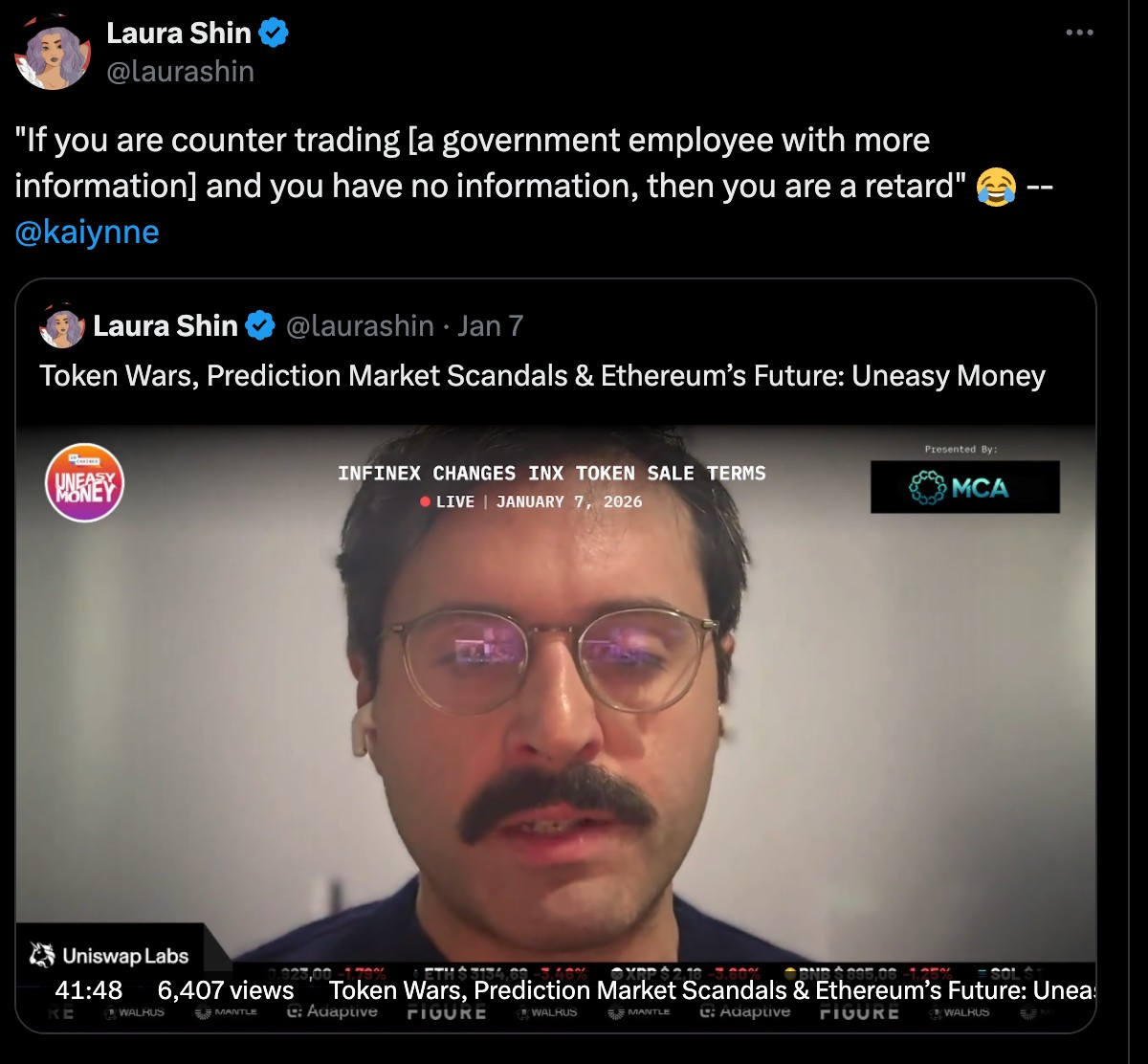
That said, non-insiders provide essential liquidity to insiders by taking opposing sides in prediction markets, effectively paying to surface previously unknown information. In the Maduro case, "no" bettors effectively funded the insider's payout, broadcasting the probability of the event taking place via shifting odds.
Of course, this theoretical method of revealing hidden information only works if those who have the insider information are offered enough liquidity to make trades. The unwise nature of uninformed traders betting against those in the know really drives home the point that those taking the opposite sides of bets from insiders are almost paying a bounty for that information more than anything else. The allowance of rampant insider trading can help bring new info to light, but it also may limit available liquidity on these platforms if people simply decide it doesn’t make sense to trade against insiders.
Before discussing potential regulatory outcomes and future scenarios, it’s useful to understand how today’s prediction markets and brokers differ in practice. The table below provides a snapshot of the current landscape.
| zForex | Plus500 | OANDA | Trading.com USA | FOREX.com | |
|---|---|---|---|---|---|
|
Min. deposit, $ |
10 | 100 | No | 50 | 100 |
|
Tradable assets |
80 | 2800 | 129 | 69 | 5500 |
|
Standard EUR/USD spread |
0.3 | 0.7 | 0.3 | 1.1 | 1.0 |
|
Max. leverage |
1:1000 | 1:300 | 1:200 | 1:50 | 1:50 |
|
Max. Regulation Level |
Not regulated | Tier-1 | Tier-1 | Tier-1 | Tier-1 |
|
TU overall score |
7.95 | 7.57 | 6.89 | 6.16 | 6.87 |
|
Open an account |
Go to broker Your capital is at risk.
|
Go to broker 80% of retail CFD accounts lose money. |
Go to broker Your capital is at risk. |
Go to broker Your capital is at risk. |
Study review |
What will be the side effects of this new paradigm?
The current legal status of prediction markets in the U.S. stems from Kalshi's 2024 court victory over the CFTC, which had blocked event contracts as gambling; a D.C. district judge ruled otherwise, enabling U.S. operations without federal bans on insider trades.
Still, broader implications remain untested, with potential scandals, such as bets on a particular stock crashing right before an earnings report is released, inviting scrutiny. There has already been plenty of backlash in terms of the potential negative effects these markets could have on the sporting world. The heavy regulation that follows some sort of theoretical trading scandal could dull the utility of prediction markets by excluding insiders. House Representative Ritchie Torres has already introduced a bill to ban various government employees and officials from participating in prediction markets in response to the trades made around the Maduro operation.
That said, Kalshi already has restrictions in place regarding trades that come anywhere close to violating existing laws around insider trading of publicly-traded securities.
Decentralized, crypto-based prediction markets like the Ethereum-based Augur were once viewed as the only way these sorts of markets could exist, but the regulatory environment around these markets has dramatically improved over the past decade. That said, blockchain-based alternatives are ready to provide a platform for traders in a situation where there’s a regulatory clampdown. However, they would likely suffer from lower volumes due to technical complexity and effectively operating in a black market. Centralized platforms dominate for now, and regulatory allowance and clarity will be a major factor in the development of prediction markets more generally, as they rely on sufficient liquidity to provide useful data to the public.
Overall, legalized insider trading could yield sharper global insights, cutting through social media noise and effectively making cheap talk much more expensive by putting prediction market odds directly next to claims made on the internet. Indeed, this ability for prediction markets to bring truth to light is why the earliest project that combined crypto and prediction markets was originally known as Truthcoin.
Supporters of prediction markets see transformative power associated with them: markets could align incentives for crowdfunding for public goods, offer dynamic insurance, or even enable futarchy, economist Robin Hanson's system where elected leaders set welfare goals and prediction markets vote on policies by betting on outcomes.
Only time will tell if any of these more transformative concepts associated with prediction markets will be tested in the real world at any point, as a regulatory clampdown could easily stall progress for the industry in the coming years.
Prediction markets are best read as information signals, not arenas to outsmart insiders

From my own experience observing and using prediction markets, I see them less as a threat to fairness and more as a tool for extracting reality from noise. My recommendation to readers is simple: don’t approach these markets as places to “beat insiders,” but as information signals to be interpreted. When informed participants are willing to risk capital, odds tend to adjust faster than headlines or social media narratives ever could.
At the same time, I would caution against overexposure. Prediction markets work best as a complement to traditional analysis, not a replacement for it. For policymakers and platforms, the priority should be transparency and clear boundaries, not blanket bans. If structured correctly, these markets can reward truth over speculation – but only for participants who understand that the real value lies in reading the odds, not blindly trading against them.
Conclusion
Ultimately, the vitality of prediction markets hinges on the unique advantage provided by insider information, which sharpens accuracy and drives liquidity. By allowing those closest to events to trade, platforms like Kalshi and Polymarket transform these insights into powerful forecasting tools, as seen in political election and corporate earnings markets. While risks of manipulation and unfair advantage exist, embracing insider knowledge often yields more truthful consensus probabilities. In a world where information is currency, prediction markets that welcome informed traders redefine how society gauges future outcomes, reminding us that transparency and wisdom are often two sides of the same coin.
FAQs
How do prediction markets differ from traditional financial markets regarding insider information?
What risks do prediction markets pose to the integrity of areas like sports or elections?
How might widespread use of prediction markets affect public perception of news and information?
What role does transparency play in maintaining the usefulness of prediction markets?
Editors' Top Picks and Insights

The crypto IPO problem: How high-profile listings became investor traps
U.S. Bitcoin reserve: Trump’s unrealized crypto promise
Aiming for leadership: Payment giants prepare a new stablecoin
Proof of Reserves: the new standard for cryptocurrency exchanges

Three trends that could reshape the crypto market over the next decade

Trump financial disclosure: How the president's crypto income became a U.S. ethics issue
Related Articles
Team that worked on the article
Kyle began exploring Bitcoin in 2013, when public interest in cryptocurrencies was just beginning to grow. At first, it was more of a hobby.
Dan Blystone began his trading career in 1998 as an arbitrage clerk on the floor of the Chicago Mercantile Exchange (CME). He later traded bond and Eurex futures at proprietary firms such as Altea Trading, gaining valuable experience in high-frequency trading and risk management.
Chinmay Soni is a financial analyst with more than 5 years of experience in working with stocks, Forex, derivatives, and other assets. As a founder of a boutique research firm and an active researcher, he covers various industries and fields, providing insights backed by statistical data.
Risk management is a risk management model that involves controlling potential losses while maximizing profits. The main risk management tools are stop loss, take profit, calculation of position volume taking into account leverage and pip value.
Cryptocurrency is a type of digital or virtual currency that relies on cryptography for security. Unlike traditional currencies issued by governments (fiat currencies), cryptocurrencies operate on decentralized networks, typically based on blockchain technology.
CFD is a contract between an investor/trader and seller that demonstrates that the trader will need to pay the price difference between the current value of the asset and its value at the time of contract to the seller.
Bitcoin is a decentralized digital cryptocurrency that was created in 2009 by an anonymous individual or group using the pseudonym Satoshi Nakamoto. It operates on a technology called blockchain, which is a distributed ledger that records all transactions across a network of computers.
The CFTC protects the public from fraud, manipulation, and abusive practices related to the sale of commodity and financial futures and options, and to fosters open, competitive, and financially sound futures and option markets.

-
 Afghanistan
-
 Albania
-
 Algeria
-
 Angola
-
 Argentina
-
 Armenia
-
 Australia
-
 Austria
-
 Azerbaijan
-
 Bahamas
-
 Bahrain
-
 Bangladesh
-
 Belarus
-
 Belgium
-
 Bolivia
-
 Botswana
-
 Brazil
-
 Brunei
-
 Bulgaria
-
 Cambodia
-
 Cameroon
-
 Canada
-
 Chile
Chile
-
 China
China
-
 Colombia
-
 Congo
Congo
-
 Costa Rica
-
 Cote d'Ivoire
-
 Croatia
-
 Cuba
Cuba
-
 Cyprus
-
 Czechia
-
 DR Congo
-
 Denmark
-
 Dominican Republic
-
 Ecuador
-
 Egypt
Egypt
-
 El Salvador
-
 Estonia
-
 Eswatini
-
 Ethiopia
-
 Finland
-
 France
-
 Georgia
-
 Germany
-
 Ghana
Ghana
-
 Greece
-
 Haiti
Haiti
-
 Hong Kong
-
 Hungary
-
 India
India
-
 Indonesia
-
 Iran, Islamic republic
-
 Iraq
Iraq
-
 Ireland
-
 Israel
-
 Italy
Italy
-
 Jamaica
-
 Japan
Japan
-
 Jordan
-
 Kazakhstan
-
 Kenya
Kenya
-
 Korea
Korea
-
 Kuwait
-
 Kyrgyzstan
-
 Laos
Laos
-
 Latvia
-
 Lebanon
-
 Lesotho
-
 Libya
Libya
-
 Lithuania
-
 Luxembourg
-
 Madagascar
-
 Malaysia
-
 Malta
Malta
-
 Mauritius
-
 Mexico
-
 Moldova
-
 Mongolia
-
 Montenegro
-
 Morocco
-
 Mozambique
-
 Myanmar
-
 Namibia
-
 Nepal
Nepal
-
 Netherlands
-
 New Zealand
-
 Nigeria
-
 North Macedonia
-
 Norway
-
 Oman
Oman
-
 Pakistan
-
 Palestine
-
 Panama
-
 Papua New Guinea
-
 Paraguay
-
 Peru
Peru
-
 Philippines
-
 Poland
-
 Portugal
-
 Puerto Rico
-
 Qatar
Qatar
-
 Reunion
-
 Romania
-
 Rwanda
-
 Saudi Arabia
-
 Serbia
-
 Singapore
-
 Slovakia
-
 Slovenia
-
 Somalia
-
 South Africa
-
 Spain
Spain
-
 Sri Lanka
-
 Sweden
-
 Switzerland
-
 Syria
Syria
-
 Taiwan
-
 Tajikistan
-
 Tanzania
-
 Thailand
-
 Trinidad and Tobago
-
 Tunisia
-
 Turkey
-
 UAE
UAE
-
 Uganda
-
 Ukraine
-
 United Kingdom
-
United States
-
 Uruguay
-
 Uzbekistan
-
 Venezuela
-
 Vietnam
-
 Yemen
Yemen
-
 Zambia
-
 Zimbabwe
- Forex
- Crypto











