
Is Polymarket Worth It? An Honest Polymarket Review


Editorial Note: While we adhere to strict Editorial Integrity, this post may contain references to products from our partners. Here's an explanation for How We Make Money. None of the data and information on this webpage constitutes investment advice according to our Disclaimer.
Polymarket is a prediction market platform where users buy and sell shares based on the outcomes of real-world events, including politics, sports, crypto, finance, technology and geopolitics. Share prices represent the market's implied probability: for example, a $0.70 price suggests roughly a 70% chance of that outcome occurring, while a winning share pays $1 when the market resolves. Polymarket can be worth using for traders who can identify mispriced probabilities, as it offers thousands of markets, real-time odds, peer-to-peer trading and the ability to sell positions before resolution. However, returns are never guaranteed, losing shares settle at $0, and access is restricted in some jurisdictions.
Prediction markets have moved rapidly into the mainstream, and Polymarket is one of the platforms driving that growth. It gives traders a way to put their forecasts to the test by taking positions on elections, sports, crypto, economic releases, geopolitical events and other real-world outcomes.
But popularity and a wide choice of markets do not necessarily make a platform worth using. In this Polymarket review, we look beyond the headlines to assess its trading conditions, fees, available markets, usability, safety and key limitations. We also compare Polymarket with Kalshi and explain where the platform performs well – and where traders should be cautious before putting money at risk.
Risk warning: All investments carry risk, including potential capital loss. Economic fluctuations and market changes affect returns, and 40-50% of investors underperform benchmarks. Diversification helps but does not eliminate risks. Invest wisely and consult professional financial advisors.
What is Polymarket?

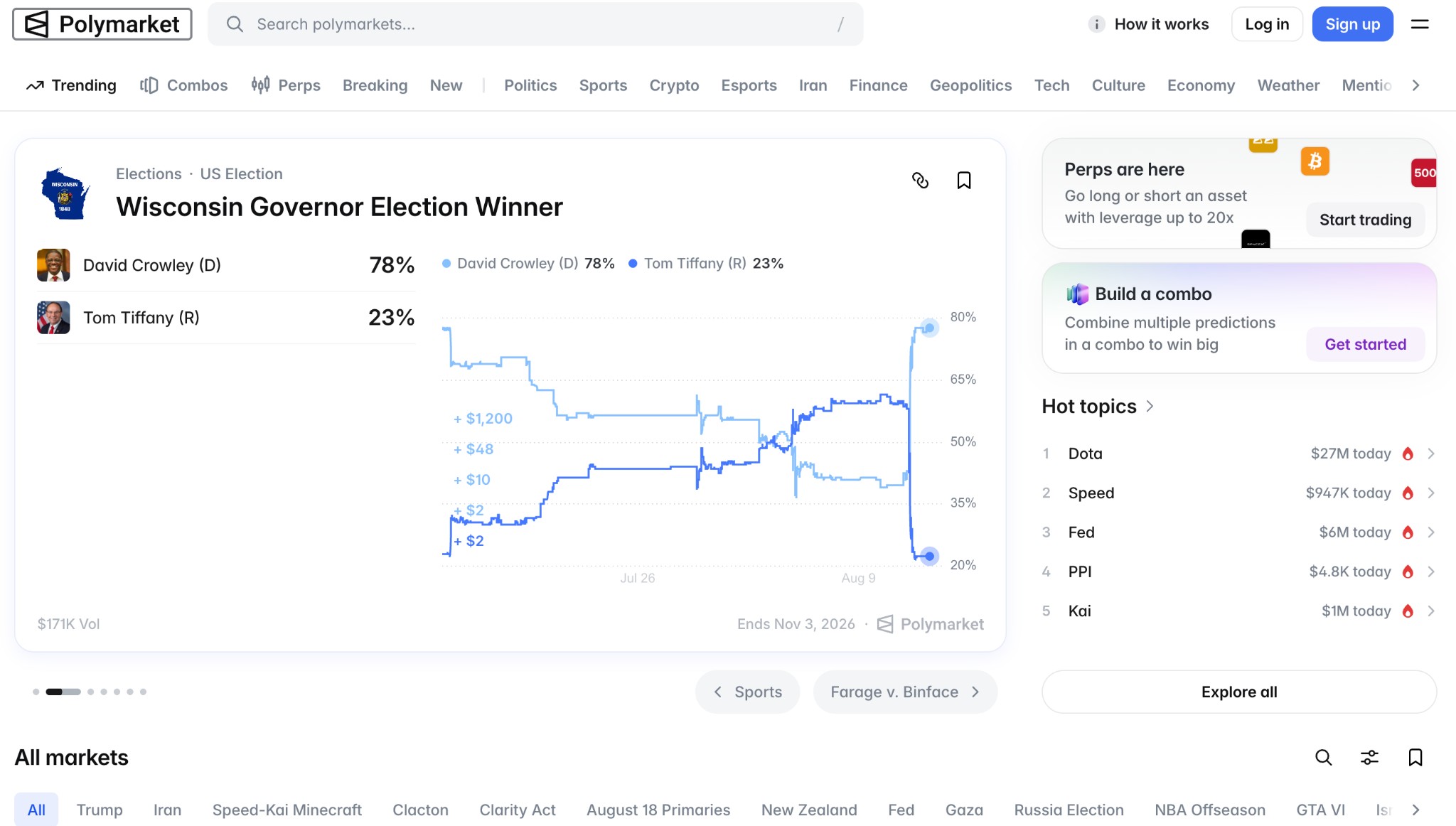
Polymarket is a prediction market platform where users trade on the outcomes of future real-world events, including politics, sports, cryptocurrency, economics, technology and entertainment. Instead of buying traditional assets, traders buy shares representing possible outcomes. These shares are priced between $0 and $1, with the price reflecting the market's estimated probability. For example, a YES share trading at $0.70 implies roughly a 70% probability that the event will occur.
Prices are determined by supply and demand between market participants rather than being set by Polymarket. If an outcome proves correct, each winning share is worth $1 at resolution, while losing shares become worthless.
- Pros
- Cons
wide range of prediction markets across politics, sports, crypto, finance and other real-world events;
market-driven prices that reflect changing expectations in real time;
ability to sell positions before resolution when sufficient liquidity is available;
order-book trading with limit and market orders;
mo maker fees, with rebates available on eligible markets;
multiple account and funding options.
losing shares can settle at $0, resulting in a full loss of the amount committed to the position;
liquidity can vary significantly between markets;
taker fees apply to certain market categories and vary by contract price;
international users may need to manage crypto wallets and USDC;
availability and regulatory requirements vary by jurisdiction;
market resolution rules require careful review before trading.
Traders can also sell their positions before an event is resolved, allowing them to take profits or limit losses as market expectations change. This peer-to-peer structure makes Polymarket operate more like an exchange than a traditional sportsbook.

Key features and tools of Polymarket
Polymarket differs significantly from a conventional broker or charting platform. Its main functionality revolves around event contracts and probability trading.
| Feature | What it does |
|---|---|
| Prediction markets | Trade on the outcomes of real-world events across politics, sports, crypto, economics and more. |
| Outcome shares | Buy and sell outcome shares, typically priced between $0 and $1, reflecting market-implied probabilities. |
| Live market pricing | Prices update with trading activity and available bids and asks in the order book. |
| Order book trading | Trade directly against other market participants rather than fixed bookmaker odds. |
| Limit & market orders | Set your preferred execution price or trade immediately against available liquidity. |
| Early exits | Sell an open position before the event resolves, provided there is sufficient liquidity. |
| Market rules | Every market defines its resolution source, end date and treatment of edge cases. |
| Blockchain settlement | Trades and settlement use Polymarket’s blockchain-based infrastructure on Polygon. |
| UMA resolution | Outcomes are proposed and can be disputed through UMA’s Optimistic Oracle process. |
| API access | APIs and SDKs provide access to markets, prices, order books, positions and trading tools. |
Is Polymarket worth it?
Polymarket is worth considering if you want to trade your view on real-world events rather than traditional assets. Its main appeal is the combination of market-driven probabilities, a broad selection of event markets and the flexibility to exit a position before resolution when sufficient liquidity is available.
The platform is particularly relevant for traders who can form their own probability estimates and identify situations where market pricing may be inaccurate. In that context, Polymarket is less about simply predicting whether something will happen and more about deciding whether the current price offers enough value to justify the risk.
However, it will not suit everyone. Liquidity can vary between markets, trading costs depend on the contract and order type, and a losing position can ultimately settle at zero. International users also need to consider crypto-related funding and geographic restrictions.
Overall, Polymarket is best suited to informed, probability-focused traders who are comfortable with event-driven risk. Beginners can also use it, but starting with small positions and clearly understanding the market’s resolution rules before trading is a more sensible approach.
What can I trade on Polymarket?
Polymarket offers prediction markets on a much broader range of subjects than traditional financial trading platforms. Instead of buying stocks, currencies or cryptocurrencies directly, you trade shares tied to the outcome of real-world events. The platform currently covers politics, elections, sports, crypto, esports, finance, geopolitics, technology, culture, economics, weather and other topics.
Some of the main types of markets available on Polymarket include:
Politics and elections: Trade on election winners, political races, government decisions, legislation and other political developments. For example, the platform currently lists markets for the 2026 US midterms as well as individual US and UK elections.
Sports and esports: Polymarket covers traditional sports as well as esports, with markets linked to individual games, tournaments and competition outcomes. Current listings include markets for major sports alongside esports such as Dota 2 and League of Legends.
Crypto: Users can trade predictions related to Bitcoin and other cryptocurrencies, including whether prices will rise or fall over specific periods, potential price targets and developments within the crypto industry.
Finance: Markets cover stocks, major indices, commodities such as gold and silver, corporate earnings and other financial events. The Finance section also includes questions linked to specific price levels and daily market movements.
Economics: Traders can take positions on interest-rate decisions, inflation, macroeconomic indicators and other economic developments. Polymarket currently organizes this area into topics such as macro indicators, global rates and inflation.
Geopolitics and world events: Markets can focus on international conflicts, diplomatic negotiations and other major global developments. Polymarket currently charges no maker or taker trading fees on geopolitical markets.
Technology: Users can trade on developments involving AI, technology companies, product releases and other major tech-industry events.
Culture and entertainment: Polymarket also lists markets related to movies, awards, pop culture and other entertainment events.
Weather: Prediction markets can cover measurable weather outcomes, including temperatures and other weather-related events.
Mention markets: These markets let users trade on whether a particular person, company, topic or phrase will be mentioned in a defined event or context. Polymarket lists Mentions as a separate market category.
How Polymarket works
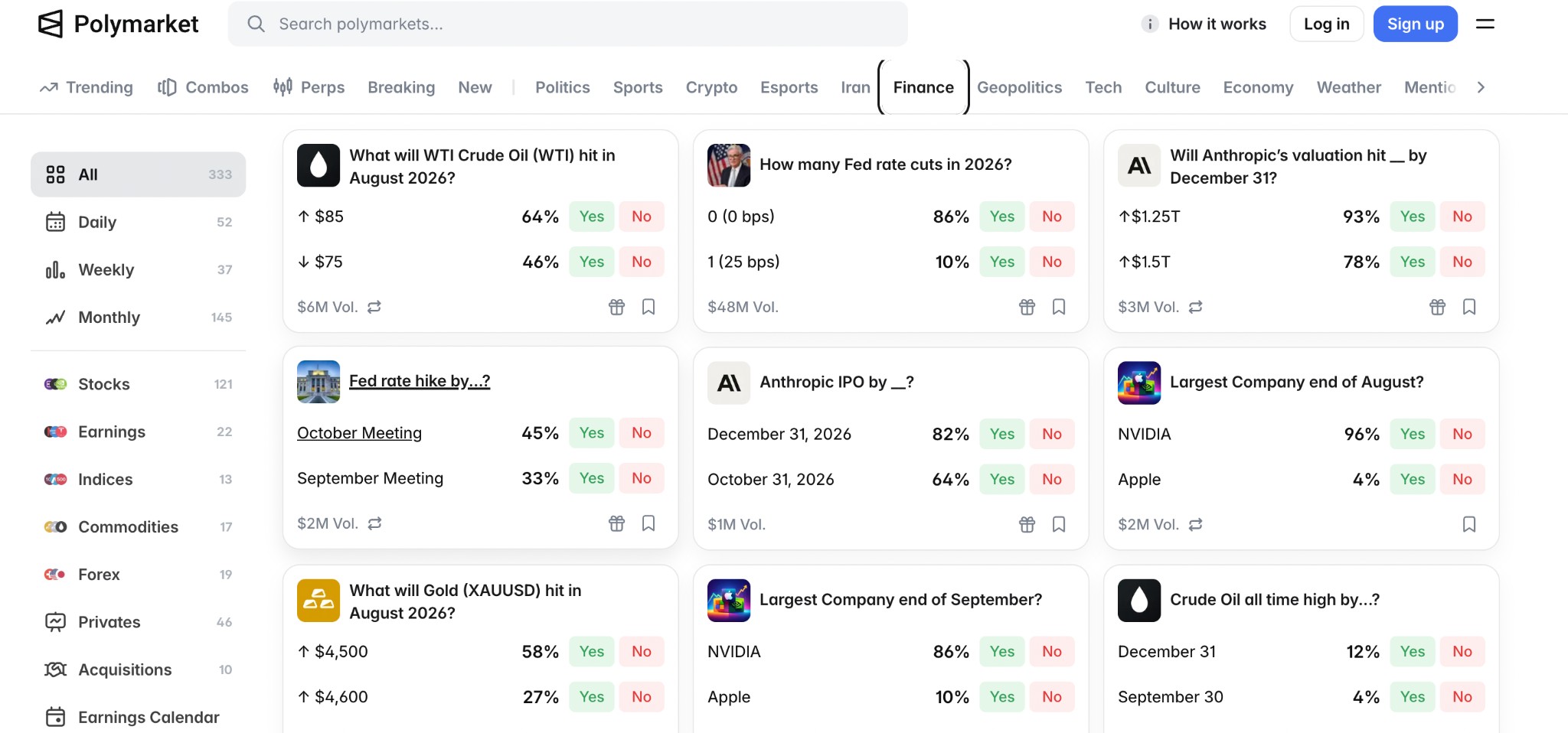
1. Pick a Polymarket
Buy ‘Yes’ or ‘No’ shares depending on your prediction. Odds shift in real time as other traders get in on the action.
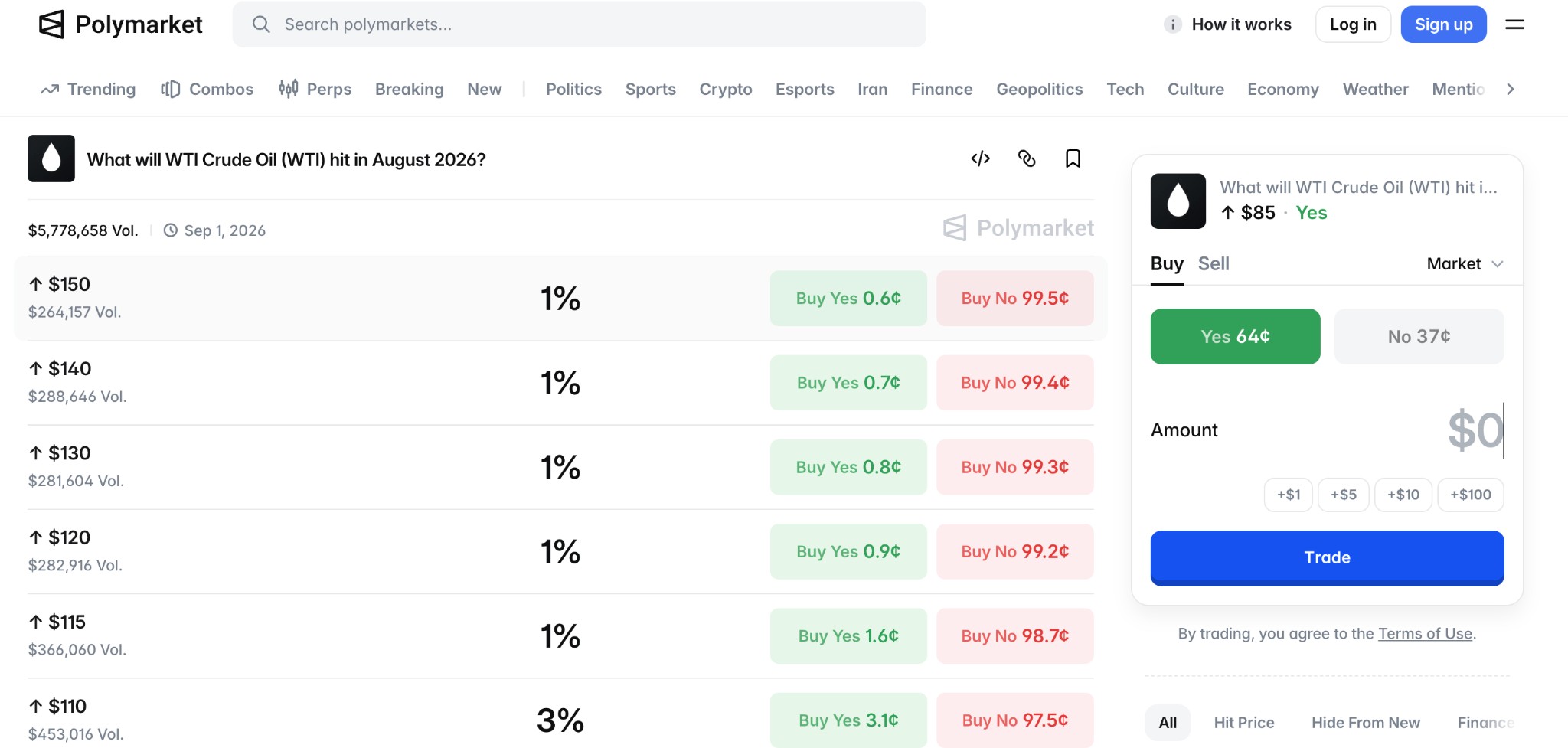
2. Place a trade
Fund your account with crypto, debit card, or bank transfer – then you're ready to trade.
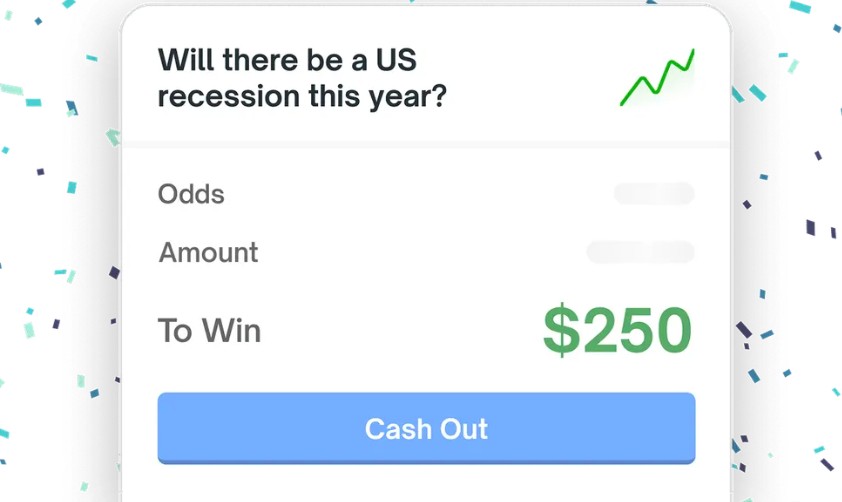
3. Redeem
Sell your 'Yes' or 'No' shares at any time, or wait until the market ends to redeem winning shares for $1 each.
Polymarket fees & Trading costs
Polymarket uses a dynamic fee model, so trading costs depend on the type of market, the share price and whether your order adds or removes liquidity. Not every market carries a trading fee: fees currently apply to selected categories, while geopolitical and world-event markets are fee-free.
International Polymarket trading fees
Polymarket charges trading fees to takers – traders whose orders immediately match existing liquidity. Makers pay no platform trading fee because their limit orders add liquidity to the order book. Eligible makers can also receive daily USDC rebates funded by a portion of collected taker fees.
Taker fees are calculated dynamically. Costs are highest when shares trade around $0.50, where the outcome is effectively priced as a 50/50 probability, and decline as the price moves toward $0 or $1. This means a trade at $0.30 generates the same dollar fee as an equivalent trade at $0.70.
| Market category | Taker fee rate | Maker fee |
|---|---|---|
| Crypto | 0.07 | $0 |
| Finance / Politics / Tech / Mentions | 0.04 | $0 |
| Economics / Culture / Weather / Other | 0.05 | $0 |
| Geopolitics & World Events | 0 | $0 |
For example, 100 crypto shares purchased at $0.50 carry a $1.75 taker fee under the current schedule. The same 100-share trade costs progressively less as the contract price moves away from $0.50. Fees are rounded to five decimal places, and amounts below 0.00001 USDC round to zero.
Maker rebates
While makers do not pay platform trading fees, they may also qualify for the Maker Rebates Program. Rebates are funded by a portion of taker fees and distributed according to the liquidity a maker actually provides and that other traders execute against.
Payments are calculated daily and credited in USDC, with a minimum accumulated rebate of $1 USDC required before payout. Rebate rates vary by market category and may change over time, so they should not be treated as a guaranteed fixed return for placing limit orders.
Taker rebates
Takers may also recover a portion of their trading fees through Polymarket’s tiered Taker Rebate Program. Unlike maker rebates, which reward users for providing liquidity, taker rebates return part of the fees paid when an order immediately matches existing liquidity. The amount a trader can receive depends on the applicable rebate tier and trading activity, so users should check Polymarket’s current fee terms for the latest eligibility requirements and rebate rates.
Deposit and withdrawal fees
Polymarket itself currently charges no fee for depositing or withdrawing USDC. However, this does not necessarily make transfers completely free. Third-party services such as Coinbase or MoonPay may charge their own fees when users buy, transfer or convert funds.
Since third-party costs can affect the total cost of funding Polymarket, it may be useful to compare crypto exchanges before purchasing or transferring digital assets. The table below highlights several popular options and their key features.
| Spot Maker Fee, % | Spot Taker fee, % | P2P Maker Fee, % | P2P Taker Fee, % | Deposit fee | Withdrawal fee | Min. Deposit, $ | Coins Supported | Open an account | |
|---|---|---|---|---|---|---|---|---|---|
| 0.08 | 0.1 | 0 | 0 | No | 0.0004 BTC 2.6 USDT | 10 | 600+ | Go to broker Your capital is at risk. |
|
| 0.5 | 0.5 | 0 - 0.40 | 0.05 - 0.60 | No | Fixed fee - 25 USD PayPal - 1.5% USDC - 10 USD | 10 | 400+ | Go to broker Your capital is at risk. |
|
| 0.25 | 0.5 | 0,10 - 0,16 | 0,16 - 0,20 | No | 0.0005 BTC | 1 | 400+ | Go to broker Your capital is at risk. |
|
| 0 | 0 | No | No | No | No | No | 1000 | Go to broker Your capital is at risk. |
|
| 0.2 | 0.3 | Not supported | Not supported | No | 0.0004 BTC 0.005 ETH 6%. if there was no futures trading | 10 | 399 | Go to broker Your capital is at risk.
|
|
| 0.25 | 0.4 | Not supported | Not supported | No | 0.0005 BTC | 10 | 400+ | Go to broker Your capital is at risk. |
|
| 0 | 0 | No | No | No | No | No | 1817 | Go to broker Your capital is at risk. |
Is Polymarket legal and safe?
This is one of the most important areas where users need to distinguish between different Polymarket services.
Polymarket states that it operates globally through separate legal entities. Polymarket US is operated by QCX LLC d/b/a Polymarket US, which is a CFTC-designated contract market. The international Polymarket platform is separate and is not regulated by the CFTC.
The CFTC's own register confirms that QCX LLC d/b/a Polymarket US holds Designated Contract Market status. Availability also varies substantially by location.
At the time of this review, Polymarket's official geographic restrictions page lists a number of completely blocked jurisdictions. Polymarket explicitly prohibits using VPNs or similar tools to bypass these geographic restrictions.
Users should therefore verify availability directly with Polymarket and check applicable local regulations rather than relying on third-party reviews.
| Region / Country | Availability / Regulatory Status |
|---|---|
| United States | Polymarket.com is restricted. US users must use the separate Polymarket US product where available. |
| United Kingdom | Restricted. |
| Canada | Generally available, except Alberta, British Columbia, Ontario and Quebec, where access is restricted. |
| Australia, Belgium, Belarus, Brazil, France, Germany, Ireland, Italy, Japan, Malta, Netherlands, Russia and Slovakia | Restricted. |
| Singapore, Poland, Thailand and Taiwan | Close-only: users may close existing positions but cannot open new ones. |
| Ukraine | Restricted in Crimea, Donetsk and Luhansk; other regions are not listed as geographically restricted. |
| Other blocked jurisdictions | Burundi, Central African Republic, DR Congo, Cuba, Ethiopia, Iran, Iraq, North Korea, Lebanon, Libya, Myanmar, Nicaragua, Somalia, South Sudan, Sudan, Syria, Venezuela, Yemen and Zimbabwe are restricted. |
| OFAC-sanctioned jurisdictions | Access is restricted in accordance with applicable sanctions requirements. |
Note! Availability and regulatory requirements can change. Check Polymarket’s current terms, geographic restrictions, and applicable local laws before using the platform.
Customer support & Help center
Polymarket provides several ways to get help and stay informed. For account or technical issues, the primary support channels are website chat and email, while the Polymarket Help Center covers common questions about trading, markets, deposits, withdrawals, account security and geographic restrictions. Polymarket also maintains official social media channels, although these are primarily intended for platform news, market updates and community communication rather than individual customer support.
| Contact method | Details |
|---|---|
| Live Chat | Available through the chat icon on the Polymarket website |
| Email – Global | support@polymarket.com |
| Email – US | support@polymarket.us |
| Help Center | help.polymarket.com |
| Social Media & Community | X (Twitter), LinkedIn, Discord, Instagram, YouTube |
For account access, transaction or funding issues, users should contact Polymarket through official chat or email rather than social media DMs.
How to create a Polymarket account
Setting up a Polymarket account is relatively quick, although the exact process differs between the international platform and Polymarket US. Here is how to get started.
Step 1: Open the Polymarket website or app
Visit Polymarket's official website or install the official mobile app. US customers should use the dedicated Polymarket US platform, while eligible international users can access the global version.
Always verify that you are using an official Polymarket website or application. Imitation apps and phishing websites can be used to steal login credentials or crypto assets, so checking the source before signing up is essential.
Step 2: Create your account
Polymarket offers three ways to create an account: with Google, an email address, or a crypto wallet. Google users can simply connect their account and complete the signup process. With email registration, Polymarket sends a 6-digit verification code, which is also used for future logins. Never share this code with anyone, including someone claiming to be Polymarket support.
Experienced crypto users can also sign up by connecting a supported wallet, such as MetaMask, Rabby, or Phantom. This requires signing messages to connect the wallet and enable trading. Once registration is complete, users can log in using the same Google account, email, or connected wallet.
Step 3: Set up your wallet
International Polymarket users need access to a crypto wallet to trade. The platform supports external wallet options such as MetaMask and Coinbase Wallet. Users can also take advantage of Polymarket's integrated wallet functionality, which simplifies the process for those who do not want to configure a separate wallet manually.
The process is different for users of the regulated US platform, where much of the crypto-wallet infrastructure is handled differently from the international version.
Step 4: Add funds
Once your account and wallet are ready, the next step is to fund the account. Available payment and deposit options depend on which version of Polymarket you use and your location.
Before making a transfer, check the supported payment method, network, minimum deposit and any applicable third-party fees. This is particularly important when depositing cryptocurrency, as sending assets through an unsupported blockchain network can result in lost funds.
Step 5: Find a market and make your first trade
After funding the account, you can explore available prediction markets across categories such as politics, sports, cryptocurrency, technology, economics and culture. Markets can also be sorted to find popular events or contracts approaching their resolution date.
To open a position, select a market, choose the outcome you want to trade – such as Yes or No – enter your desired amount and review the order before confirming it.
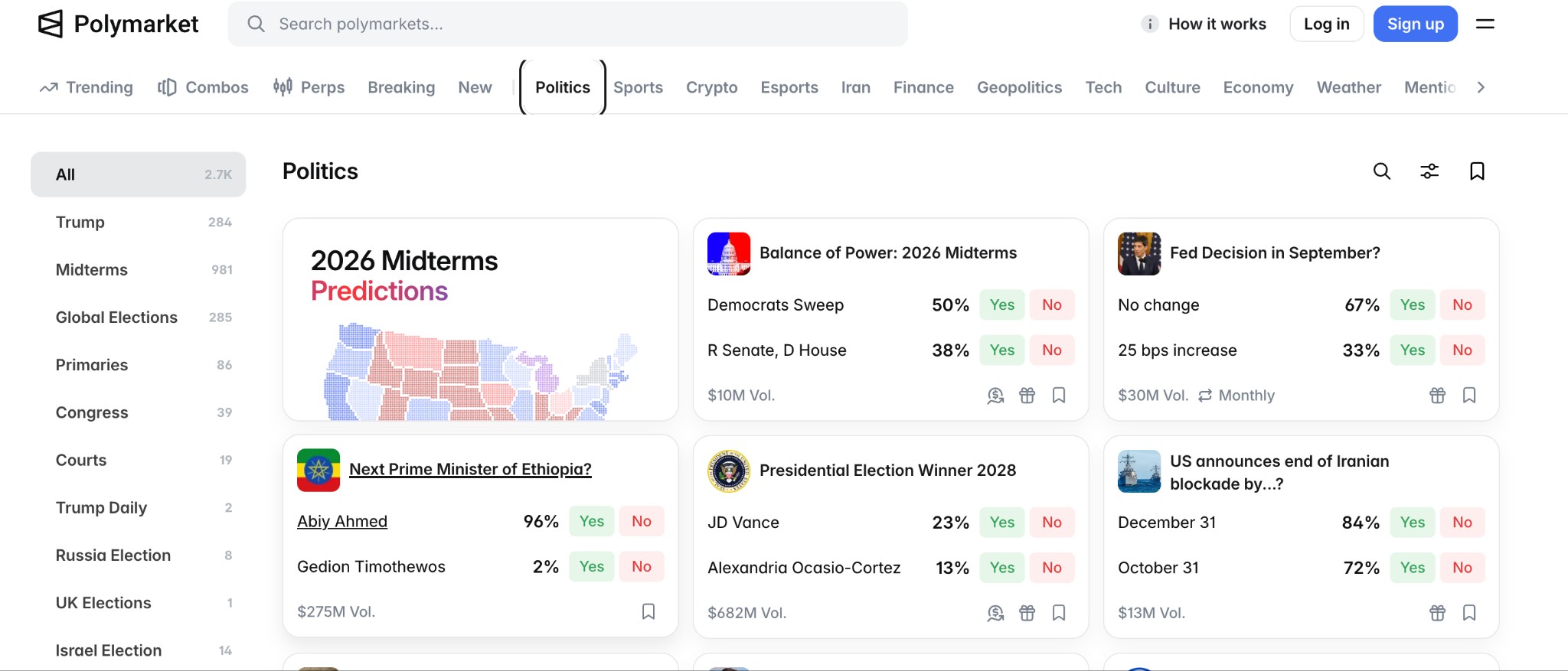
The position will then appear in your portfolio. You do not necessarily have to wait for the event to resolve: if there is sufficient liquidity, you can sell your position before resolution as market probabilities and prices change.
How does Polymarket compare to Kalshi?
Polymarket and Kalshi are two leading prediction-market platforms, but they differ in geographic focus, funding, fees and market coverage. Both use order-book trading and contracts that typically settle at $1 for the winning outcome. In the US, both now operate CFTC-designated contract markets, although Polymarket's international platform remains a separate service.
| Feature | Polymarket | Kalshi |
|---|---|---|
| Market coverage | 15+ major categories | 10+ major categories |
| US regulation | CFTC DCM since 2025 | CFTC DCM since 2020 |
| Funding | USDC / crypto / fiat on-ramp | USD |
| Trading fees | Dynamic; peak 1–1.75% on major fee-enabled categories | Contract-based |
| Maker fee | 0% + eligible rebates | Varies by market |
| International platform | Yes, with geographic restrictions | Primarily US-focused |
| Settlement | UMA oracle (international) | Exchange rules and specified sources |
Use Polymarket to identify pricing opportunities, not simply to predict outcomes

I view Polymarket primarily as a market for pricing uncertainty. The platform is most valuable when you can form an independent view of an event’s probability and compare that assessment with the probability implied by the market.
My recommendation is to concentrate on areas where you have a genuine analytical advantage. Before taking a position, establish what you believe to be a reasonable probability, assess the strength of the available information, and determine whether the difference between your estimate and the market price is significant enough to justify the risk.
For newer users, I would prioritize discipline over trading frequency. Start with modest exposure, focus on well-defined markets, and pay close attention to how prices respond to new information. The objective should be to develop a consistent process for evaluating probability and expected value rather than trying to predict every event correctly.
Approached this way, Polymarket can serve as a useful tool for testing forecasts, challenging assumptions and making more structured decisions under uncertainty.
Conclusion
Polymarket stands out as a dynamic prediction market platform, offering traders a unique way to capitalize on their knowledge of real-world events—whether it's the next presidential election or a major crypto move. Its strength lies in market-driven pricing, a diverse range of markets, and the flexibility to exit positions early, making it an appealing tool for savvy, probability-focused traders. However, users must be mindful of trading fees, fluctuating liquidity, and strict location-based restrictions. For those who can accurately assess probabilities and are comfortable with event-driven risk, Polymarket provides a compelling space to test analysis against real-world outcomes. Ultimately, its greatest value comes not just from predicting events, but from identifying where the market's odds diverge from your well-founded expectations.
FAQs
What are the key risks to consider when trading on Polymarket in 2026?
How does Polymarket's fee structure impact trading strategies?
What steps should international users take before joining Polymarket?
Can beginners use Polymarket effectively, and what precautions should they take?
Editors' Top Picks and Insights






Related Articles
Team that worked on the article
Aleksandra Chaikina has been a contributor to Traders Union since 2021. With over 15 years of experience in copywriting and more than 5 years focused on financial content, she specializes in producing detailed guides, analytics, and comparative reviews across various sectors, including cryptocurrencies, Forex, investment strategies, and financial technologies.
Ciaran Ryan is a veteran financial journalist based in South Africa, where he covers cryptocurrency, mining, stock markets, and governance for Moneyweb. He also hosts the weekly Moneyweb Crypto Podcast.
Chinmay Soni is a financial analyst with more than 5 years of experience in working with stocks, Forex, derivatives, and other assets. As a founder of a boutique research firm and an active researcher, he covers various industries and fields, providing insights backed by statistical data.
Index in trading is the measure of the performance of a group of stocks, which can include the assets and securities in it.
A limit order is a type of order used in trading where an investor specifies a particular price at which they want to buy or sell a financial asset. The order will only be executed if the market price reaches or exceeds the specified limit price, ensuring that the trader gets the desired price or better when the trade is executed.
An investor is an individual, who invests money in an asset with the expectation that its value would appreciate in the future. The asset can be anything, including a bond, debenture, mutual fund, equity, gold, silver, exchange-traded funds (ETFs), and real-estate property.
Economic indicators — a tool of fundamental analysis that allows to assess the state of an economic entity or the economy as a whole, as well as to make a forecast. These include: GDP, discount rates, inflation data, unemployment statistics, industrial production data, consumer price indices, etc.
Cryptocurrency is a type of digital or virtual currency that relies on cryptography for security. Unlike traditional currencies issued by governments (fiat currencies), cryptocurrencies operate on decentralized networks, typically based on blockchain technology.

-
 Afghanistan
-
 Albania
-
 Algeria
-
 Angola
-
 Argentina
-
 Armenia
-
 Australia
-
 Austria
-
 Azerbaijan
-
 Bahamas
-
 Bahrain
-
 Bangladesh
-
 Belarus
-
 Belgium
-
 Bolivia
-
 Botswana
-
 Brazil
-
 Brunei
-
 Bulgaria
-
 Cambodia
-
 Cameroon
-
 Canada
-
 Chile
-
 China
-
 Colombia
-
 Congo
-
 Costa Rica
-
 Cote d'Ivoire
-
 Croatia
-
 Cuba
-
 Cyprus
-
 Czechia
-
 DR Congo
-
 Denmark
-
 Dominican Republic
-
 Ecuador
-
 Egypt
-
 El Salvador
-
 Estonia
-
 Eswatini
-
 Ethiopia
-
 Finland
-
 France
-
 Georgia
-
 Germany
-
 Ghana
-
 Greece
-
 Haiti
-
 Hong Kong
-
 Hungary
-
 India
-
 Indonesia
-
 Iran, Islamic republic
-
 Iraq
-
 Ireland
-
 Israel
-
 Italy
-
 Jamaica
-
 Japan
-
 Jordan
-
 Kazakhstan
-
 Kenya
-
 Korea
-
 Kuwait
-
 Kyrgyzstan
-
 Laos
-
 Latvia
-
 Lebanon
-
 Lesotho
-
 Libya
-
 Lithuania
-
 Luxembourg
-
 Madagascar
-
 Malaysia
-
 Malta
-
 Mauritius
-
 Mexico
-
 Moldova
-
 Mongolia
-
 Montenegro
-
 Morocco
-
 Mozambique
-
 Myanmar
-
 Namibia
-
 Nepal
-
 Netherlands
-
 New Zealand
-
 Nigeria
-
 North Macedonia
-
 Norway
-
 Oman
-
 Pakistan
-
 Palestine
-
 Panama
-
 Papua New Guinea
-
 Paraguay
-
 Peru
-
 Philippines
-
 Poland
-
 Portugal
-
 Puerto Rico
-
 Qatar
-
 Reunion
-
 Romania
-
 Rwanda
-
 Saudi Arabia
-
 Serbia
-
 Singapore
-
 Slovakia
-
 Slovenia
-
 Somalia
-
 South Africa
-
 Spain
-
 Sri Lanka
-
 Sweden
-
 Switzerland
-
 Syria
-
 Taiwan
-
 Tajikistan
-
 Tanzania
-
 Thailand
-
 Trinidad and Tobago
-
 Tunisia
-
 Turkey
-
 UAE
-
 Uganda
-
 Ukraine
-
 United Kingdom
-
United States
-
 Uruguay
-
 Uzbekistan
-
 Venezuela
-
 Vietnam
-
 Yemen
-
 Zambia
-
 Zimbabwe
- Forex
- Crypto












