
Why the Stablecoin-Based Bull Case For Ethereum May Not Be Sustainable


Editorial Note: While we adhere to strict Editorial Integrity, this post may contain references to products from our partners. Here's an explanation for How We Make Money. None of the data and information on this webpage constitutes investment advice according to our Disclaimer.
Ethereum’s stablecoin-driven growth faces risks as issuers like Tether (USDT) and Circle (USDC) build their own blockchains. While Ethereum currently hosts about 70% of all stablecoins, “stablechains” promise cheaper, faster, and more direct transfers, potentially bypassing ETH altogether. This could weaken Ethereum’s bull case, forcing it to rely more on ETH and crypto-native tokens for long-term utility.
After a rough few years in which Ethereum’s native crypto asset (ETH) underperformed its key competitors in terms of both its sound money (bitcoin) and blockchain technology (Solana) use cases, the world’s second largest crypto asset by market cap has seemingly turned things around. While still down roughly 50% against bitcoin since the completion of the Ethereum network’s move to proof-of-stake (known as The Merge), ETH has now recovered around 60% against bitcoin over the past six months.
While there tend to be a variety of different bullish talking points around ETH whenever the asset starts to perform well, this most recent run has largely been discussed in the context of stablecoins.
Risk warning: Cryptocurrency markets are highly volatile, with sharp price swings and regulatory uncertainties. Research indicates that 75-90% of traders face losses. Only invest discretionary funds and consult an experienced financial advisor.
Stablecoins as Ethereum’s “ChatGPT moment”
Tom Lee, who is chairman of digital asset treasury company BitMine, referred to stablecoins as Ethereum’s “ChatGPT moment” in an interview with CNBC earlier this year. SharpLink Gaming co-CEO Joseph Chalom has also expressed his bullishness around ETH in relation to stablecoins.
And to their credit, the data backs up the claim that Ethereum has been the main hub of stablecoins up to this point. According to a recent report from CoinLaw, 70% of the total stablecoin supply can be found on Ethereum, so it’s clear that’s where much of the stablecoin activity is taking place.
However, while the hype around Ethereum as the major platform for the proliferation of stablecoins is clearly backed by the empirical data today, the increasing centralization in terms of how blockchain technology is used could spell trouble for this investment thesis over the long term. Due to the inherent centralization found in stablecoins by way of the tokens’ issuers, it’s unclear if the decentralization of Ethereum will be worth the associated costs.
Notably, this is not necessarily a new general thesis when it comes to Ethereum. I previously wrote on the issues with Ethereum’s reliance on centralized shortcuts four years ago during the previous crypto bull market.
Stablecoin issuers build out their own platforms
One of the key properties of stablecoins that must be remembered is these tokens are not necessarily sticky in terms of the blockchain networks upon which they operate. For example, Tether (USDT), which is by far the largest and most popular stablecoin in the world, originally launched on a Bitcoin metaprotocol known as Omni Layer (previously known as Mastercoin). Due to the limited on-chain capacity of Bitcoin, USDT eventually branched out to Ethereum in search of lower fees and enhanced programmability. When the crypto bull market of 2021 led to much higher fees on Ethereum as well, much of the USDT supply moved over to TRON in search of cheaper transaction costs once again.
Now, stablecoin issuers such as Tether and its main competitor Circle (issuer of the USDC stablecoin) are launching their own platforms that could cut crypto networks such as Ethereum and TRON out of the equation completely. And there’s good reason to believe much of the stablecoin supply will move to blockchain systems incubated by issuers or built around the stablecoins themselves.
From a user perspective, stablecoins issued on a chain that is built specifically for those tokens have a number of benefits. As recently outlined by Stable, which is a layer-one blockchain focused on USDT, these benefits include guaranteed blockspace, deterministic finality, and zero-fee transfers between USDT users. Circle also pointed to some of the same benefits for users of the USDC-native Arc blockchain, in addition to opt-in privacy features.
The benefits of a stablecoin-focused blockchain are perhaps even more obvious for the stablecoin issuer. An increase in the quality of the product is an obvious boost to stablecoin demand, in addition to the added demand that comes from the stablecoin’s use as the means of paying for gas on the network. This increased demand is of critical importance, as stablecoin company revenues generally come from the reserves held by the issuer (oftentimes via interest on U.S. treasury holdings). In other words, more demand for the stablecoin means more potential revenue, whether via interest or other means, for the issuer.
In this way, the stablecoin issuer is cutting out a middleman of sorts in terms of the holders and stakers of the native tokens of general-purpose blockchains such as ETH on Ethereum and SOL on Solana.
While the market caps of USDC and USDT are already immensely impressive, it makes sense to at least try to grab some of the value that is held in ETH, SOL, and other crypto assets that derive part of their value from stablecoins. In the case of Circle, the existence of their own layer-one blockchain for USDC may also make holders of those tokens think about investing in Circle stock (CRCL) instead, as it’s a publicly-traded company. Notably, a recent valuation of Tether based on their ongoing fundraising efforts reported in Bloomberg would make the stablecoin company one of the most valuable privately-held companies in the world.
Can Ethereum still play a useful role for stablecoins?
Ethereum proponents tend to respond to the points outlined in this article with the claim that stablecoins still need a neutral layer of interoperability with each other, which Ethereum can provide. However, these open networks from stablecoin issuers can be interoperable with each others’ blockchain networks directly, and Ethereum does not help with the inherent counterparty risk found with centrally-issued stablecoins.
While it’s true that Ethereum’s decentralization is valuable when using ETH or ERC-20 tokens that are native to the crypto realm, that is an increasingly small percentage of the overall Ethereum economy. On top of that, many of the tokens associated with various DeFi applications that appear to be crypto-native assets, such as Uniswap’s UNI, also rely on centralized stablecoins for the majority (oftentimes the vast majority) of their usage.
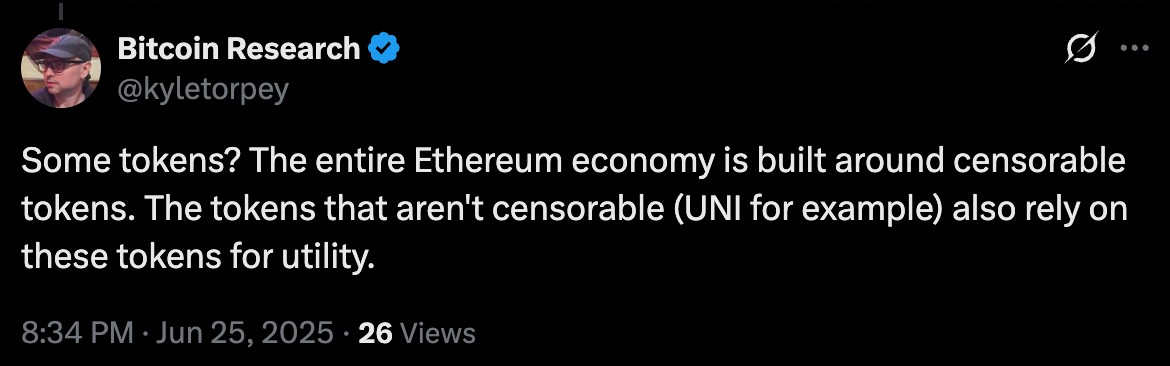
If stablecoin issuers are successful in bringing much of their respective coins’ supplies to so-called “stablechains,” then it’s possible Ethereum will need to focus on building utility around ETH and other crypto-native tokens instead of relying on centrally-issued assets for usage and transaction fees. Of course, the Ethereum economy would collapse without the centralized stablecoins, and this may lead to a crisis of purpose and utility for these sorts of general-purpose blockchains.
For now, ETH still appears to be in a bull market, and it’s likely it will take some time for stablechains like Stable and Arc to start eating away at the Ethereum economy in a meaningful way (if ever).
Losing stablecoins as a growth driver could push Ethereum to redefine its role

From my perspective, the biggest challenge for Ethereum is not simply the migration of stablecoins to dedicated blockchains but the narrative risk that comes with it. Ethereum has benefited for years from being seen as the default settlement layer for stable assets, yet that role may erode as issuers optimize for cost and control. If Ethereum loses its identity as the “stablecoin hub,” it will need to prove its value elsewhere – most likely by doubling down on ETH’s role as collateral in DeFi and by enabling use cases that stablechains won’t prioritize, like decentralized identity, autonomous organizations, or composable smart contracts.
My recommendation for investors is to watch how quickly user behavior shifts once stablecoin-native chains like Arc or Stable reach critical mass. If adoption accelerates, Ethereum must pivot its ecosystem narrative from being the backbone of stablecoin liquidity to being the indispensable infrastructure for crypto-native innovation. That transition won’t be easy, but if done correctly, it could insulate ETH from becoming overly dependent on assets that were never fully aligned with the ethos of decentralization in the first place.
Conclusion
Ethereum’s reliance on stablecoins has fueled growth, but it also exposes the network to risks beyond its control. As issuers like Tether and Circle build their own ecosystems, Ethereum’s future will hinge on how effectively it can shift from being a settlement layer for centralized assets to a platform that unlocks truly decentralized innovation. Whether that means reinforcing ETH’s role in DeFi or pioneering new use cases, the network’s resilience will depend on its ability to evolve faster than the narratives that currently support it.
FAQs
What is a stablecoin?
A stablecoin is a digital asset on a blockchain that is intended to track the value of a stable, real-world asset (usually the U.S. dollar). Stablecoins are usually issued by centralized third parties, but there has also been some experimentation with more decentralized alternatives at a smaller scale.
What is Tether?
Tether is the issuer of the largest stablecoin in the world, known as USDT. Originally launching on the Omni metaprotocol layer on top of Bitcoin and then seeing immense growth on Ethereum, USDT is now proliferating on more stablecoin-focused blockchains like Stable.
What is a Circle?
Circle is the issuer of the USDC stablecoin, generally known as the main competitor to Tether’s USDT. Circle has incubated their own layer-one blockchain, known as Arc, after primarily finding success on the Ethereum blockchain since it was originally launched through a partnership with Coinbase.
What is a general-purpose blockchain?
A general-purpose blockchain is a blockchain that is intended to be used for a wide variety of different use cases and tokens. Ethereum is the most prominent general-purpose blockchain in existence, with other examples including Solana, BNB Chain, and TRON.
Editors' Top Picks and Insights






Related Articles
Team that worked on the article
Kyle began exploring Bitcoin in 2013, when public interest in cryptocurrencies was just beginning to grow. At first, it was more of a hobby.
Dan Blystone began his trading career in 1998 as an arbitrage clerk on the floor of the Chicago Mercantile Exchange (CME). He later traded bond and Eurex futures at proprietary firms such as Altea Trading, gaining valuable experience in high-frequency trading and risk management.
Chinmay Soni is a financial analyst with more than 5 years of experience in working with stocks, Forex, derivatives, and other assets. As a founder of a boutique research firm and an active researcher, he covers various industries and fields, providing insights backed by statistical data.
An investor is an individual, who invests money in an asset with the expectation that its value would appreciate in the future. The asset can be anything, including a bond, debenture, mutual fund, equity, gold, silver, exchange-traded funds (ETFs), and real-estate property.
Index in trading is the measure of the performance of a group of stocks, which can include the assets and securities in it.
Ethereum is a decentralized blockchain platform and cryptocurrency that was proposed by Vitalik Buterin in late 2013 and development began in early 2014. It was designed as a versatile platform for creating decentralized applications (DApps) and smart contracts.
Cryptocurrency is a type of digital or virtual currency that relies on cryptography for security. Unlike traditional currencies issued by governments (fiat currencies), cryptocurrencies operate on decentralized networks, typically based on blockchain technology.
A bear market is a period of time in which an investment asset, such as stocks, bonds, or commodities, experiences a decline in price for an extended period of time.

-
 Afghanistan
-
 Albania
-
 Algeria
-
 Angola
-
 Argentina
-
 Armenia
-
 Australia
-
 Austria
-
 Azerbaijan
-
 Bahamas
-
 Bahrain
-
 Bangladesh
-
 Belarus
-
 Belgium
-
 Bolivia
-
 Botswana
-
 Brazil
-
 Brunei
-
 Bulgaria
-
 Cambodia
-
 Cameroon
-
 Canada
-
 Chile
Chile
-
 China
China
-
 Colombia
-
 Congo
Congo
-
 Costa Rica
-
 Cote d'Ivoire
-
 Croatia
-
 Cuba
Cuba
-
 Cyprus
-
 Czechia
-
 DR Congo
-
 Denmark
-
 Dominican Republic
-
 Ecuador
-
 Egypt
Egypt
-
 El Salvador
-
 Estonia
-
 Eswatini
-
 Ethiopia
-
 Finland
-
 France
-
 Georgia
-
 Germany
-
 Ghana
Ghana
-
 Greece
-
 Haiti
Haiti
-
 Hong Kong
-
 Hungary
-
 India
India
-
 Indonesia
-
 Iran, Islamic republic
-
 Iraq
Iraq
-
 Ireland
-
 Israel
-
 Italy
Italy
-
 Jamaica
-
 Japan
Japan
-
 Jordan
-
 Kazakhstan
-
 Kenya
Kenya
-
 Korea
Korea
-
 Kuwait
-
 Kyrgyzstan
-
 Laos
Laos
-
 Latvia
-
 Lebanon
-
 Lesotho
-
 Libya
Libya
-
 Lithuania
-
 Luxembourg
-
 Madagascar
-
 Malaysia
-
 Malta
Malta
-
 Mauritius
-
 Mexico
-
 Moldova
-
 Mongolia
-
 Montenegro
-
 Morocco
-
 Mozambique
-
 Myanmar
-
 Namibia
-
 Nepal
Nepal
-
 Netherlands
-
 New Zealand
-
 Nigeria
-
 North Macedonia
-
 Norway
-
 Oman
Oman
-
 Pakistan
-
 Palestine
-
 Panama
-
 Papua New Guinea
-
 Paraguay
-
 Peru
Peru
-
 Philippines
-
 Poland
-
 Portugal
-
 Puerto Rico
-
 Qatar
Qatar
-
 Reunion
-
 Romania
-
 Rwanda
-
 Saudi Arabia
-
 Serbia
-
 Singapore
-
 Slovakia
-
 Slovenia
-
 Somalia
-
 South Africa
-
 Spain
Spain
-
 Sri Lanka
-
 Sweden
-
 Switzerland
-
 Syria
Syria
-
 Taiwan
-
 Tajikistan
-
 Tanzania
-
 Thailand
-
 Trinidad and Tobago
-
 Tunisia
-
 Turkey
-
 UAE
UAE
-
 Uganda
-
 Ukraine
-
 United Kingdom
-
United States
-
 Uruguay
-
 Uzbekistan
-
 Venezuela
-
 Vietnam
-
 Yemen
Yemen
-
 Zambia
-
 Zimbabwe
- Forex
- Crypto












