
Best Market Alerts For Day Trading In 2026



Editorial Note: While we adhere to strict Editorial Integrity, this post may contain references to products from our partners. Here's an explanation for How We Make Money. None of the data and information on this webpage constitutes investment advice according to our Disclaimer.

If you're too busy to read the entire article and want a quick answer, the best market alerts for day trading in 2026 are provided by Trading.com USA. Why? Here are its key advantages:
- Is legit in your country (Identified as United States
 )
) - Has a good user satisfaction score
- Has a broad market coverage with alerts for a wide range of assets
- Provide detailed information with alerts
The best day trading alerts are:
The Trading Analyst - real-time options alerts with proven profitability and educational resources.
Market Chameleon - versatile research platform for stock and options trading opportunities.
Mindful Trader - data driven swing trade alerts.
Learn2Trade - high-success-rate swing trade alerts across various assets.
HowToTrade - real-time analysis and trade recommendations for currencies.
Day trading requires precision and quick decisions, especially in the fast-moving market of 2026. With the current dynamics, trusting your gut alone won’t get you very far. To stay ahead, you need market alerts that do more than just send a notification when a stock hits a price. The best market alerts in 2026 offer up-to-the-minute updates, smart notifications, and insights that align with your unique trading style. These tools help you spot opportunities early, giving you a competitive edge in the market. We have compiled a list of these alerts, which we will discuss along with other important factors in this article.
As the markets continue to evolve, traders seek real-time insights and actionable signals to seize opportunities and navigate the financial landscape effectively. In this article, we will look at the best day trading software services with alerts in 2026.
Best day trading alerts in 2026
| Alerts Provider | Alert channel | Markets | Costs |
|---|---|---|---|
| The Trading Analyst | SMS | Stocks | Monthly Plan: $147, Annual Plan: $787, Quarterly: $357 |
| Market Chameleon | Stocks and options | Free Service: $0, Stock Trader: $39/month, Options Trader: $69/month, Earnings Trader: $79/month, Total Access: $99/month | |
| Mindful Trader | Email, SMS | Stocks, options, futures | $47/month |
| Learn2Trade | Email, SMS, Telegram | Forex, stocks, CFDs, crypto, commodities | 1-month subscription: £40, 3-month subscription: £30, 6-month subscription: £21.5, Lifetime subscription: £399, trading group: £50 |
| HowToTrade | Email, SMS | Forex | The Apprentice: $59/month w/ 50% discount, The Committed: $37/month w/ 50% discount, The Professional: $26/month w/ 50% discount |
The Trading Analyst

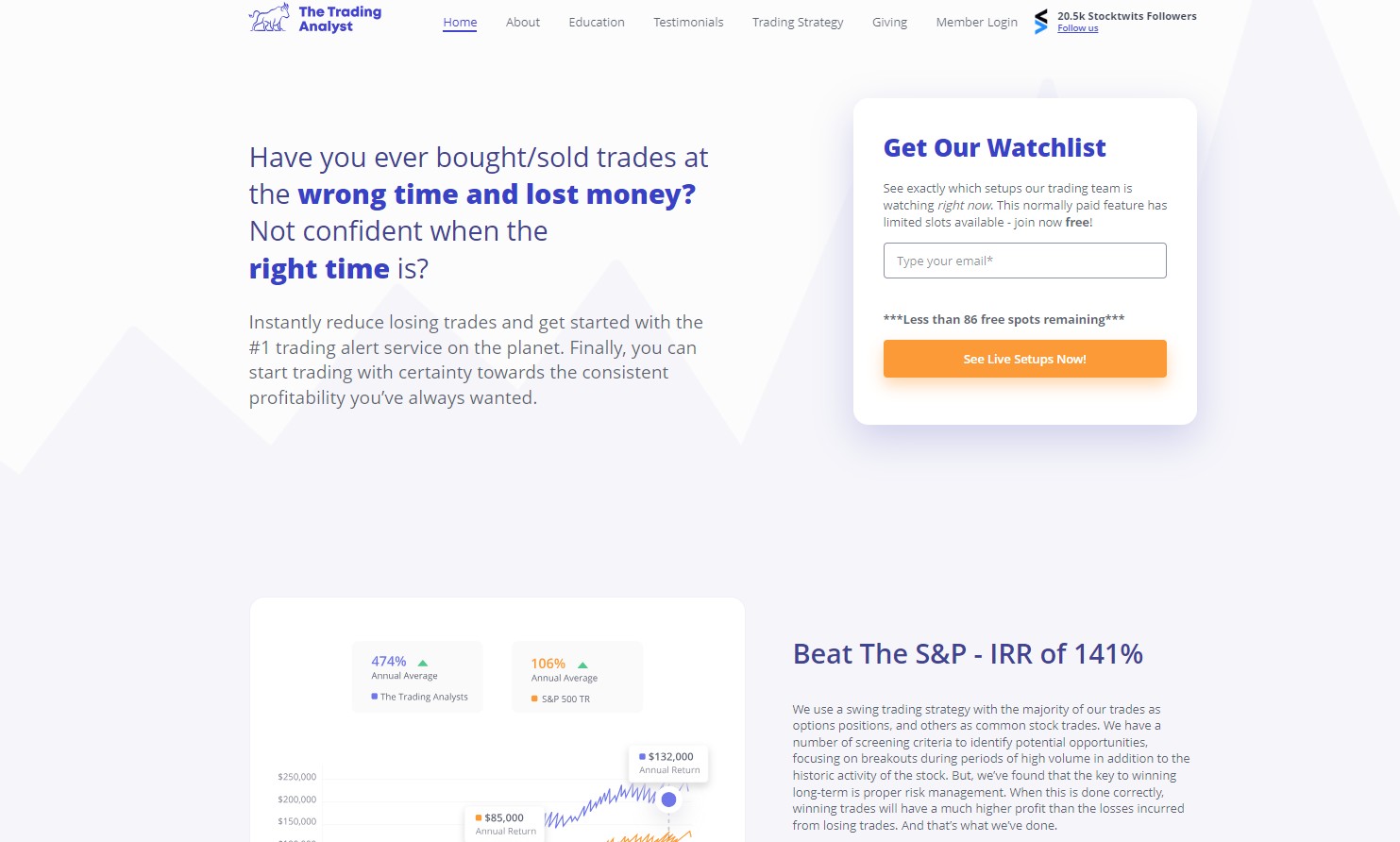
The Trading Analyst is a good option for traders looking to make informed decisions without emptying their wallets. This service provides real-time trading alerts via SMS, making it particularly appealing to beginners. Its offering includes reasonable pricing, a track record of profitability, frequent alerts, and access to educational materials.
Upon subscribing to The Trading Analyst, traders receive timely alerts with clear signals and precise pricing. This approach tries to ensure that traders never miss out on trading opportunities. The service places a strong emphasis on achieving long-term, consistent profits, targeting gains ranging from 10% to 25% per trade, all while promoting sound risk management practices. Priced at an annual subscription fee of $787, The Trading Analyst offers an affordable means to access valuable trading insights and potentially gain a competitive edge in the market.
Key features:
Profound insights from seasoned traders.
Real-time trading alerts featuring exact entry prices and profit targets.
Implementation of a distinctive volume confirmation algorithm for secure trading.
A comprehensive collection of educational resources.
Multiple membership plans catering to various needs and budgets.
Transparent disclosure of performance results and strategies.
A thriving community for networking and support.
Abundant research opportunities and strategies for risk management.
Market Chameleon

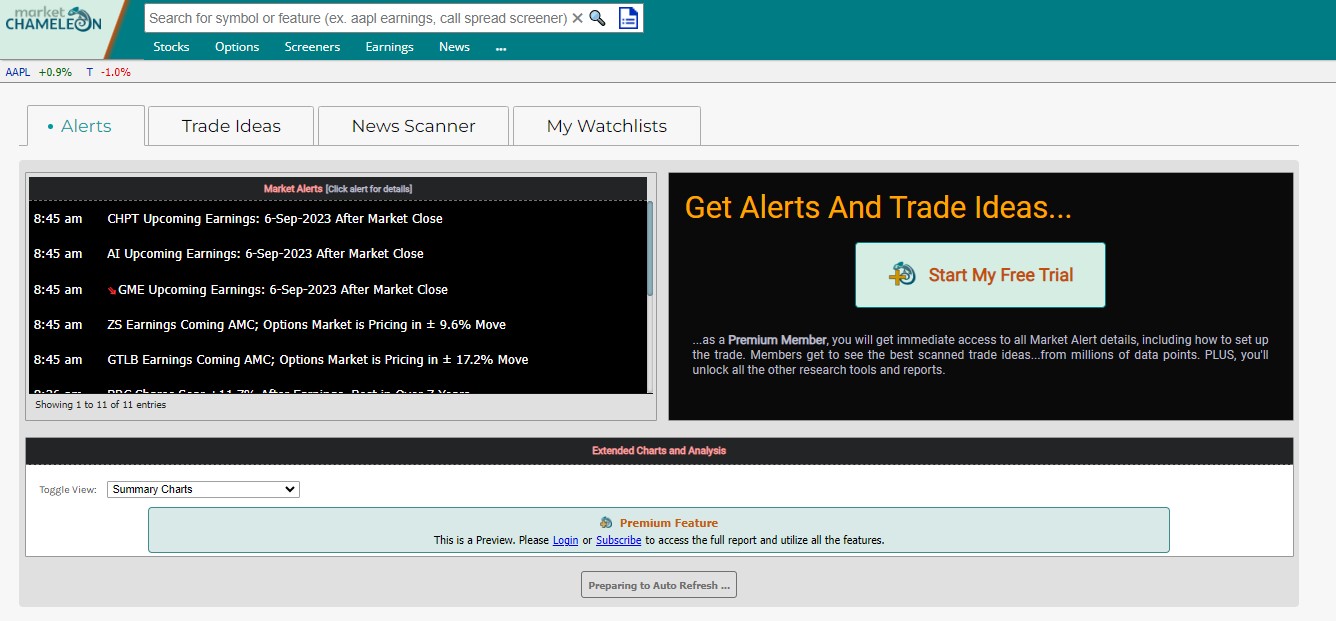
Market Chameleon is a versatile trading research platform designed to help traders uncover trading opportunities in the U.S. stock and options markets. The platform's toolkit is replete with tools like stock and options screeners, earnings research, and volume reports, making it a powerful resource for investors and traders alike.
Key features:
A wide array of features, including stock, options, and earnings research.
Availability of newsletters and customizable stock watchlists.
Pre-market trading data for early birds.
Historical analysis of Gap Up and Gap Down stock prices.
In-depth examination of after-hours trading activity.
Insights into market order imbalances.
Options volume and volatility scanners.
A comprehensive earnings calendar for strategic planning.
Diverse stock and options screeners with customizable filters.
Mindful Trader

Mindful Trader, founded by Eric Ferguson in 2020, stands out as a day trade alert service with a solid foundation. Armed with a Stanford University degree in Economics, Ferguson delved into the intricate world of stock price action, trading patterns, and strategies. His extensive analysis paved the way for the creation of Mindful Trader, using a data-driven approach.
One of the key highlights of Mindful Trader is its impressive 20-year backtest, revealing a winning scenario with an average annual return of 181%. This remarkable track record sets the stage for the service's success.
Mindful Trader offers its members a stream of day trade alerts that have proven their worth. Subscribers receive between five to fifteen trade alerts each week, all generated using Eric Ferguson's data-driven methodology.
Members gain access to valuable resources, including the creator's watchlist, real-time positions displayed on the member dashboard, and a detailed trading history dating back to the service's inception. This paid day trading alerts service equips traders to capitalize on short-term market movements, providing clear instructions on when to open and close positions.
Mindful Trader offers its service at a cost of $47 per month, with the flexibility to cancel at any time.
Key features:
A robust foundation built on comprehensive backtesting and analysis.
Clear and defined trade conditions with precise entry and exit details.
Access to the creator's watchlist prior to trade execution.
A transparent display of the entire trading history and live positions on the member dashboard.
A strong emphasis on achieving a balanced risk-reward ratio.
In-depth trade analysis.
Transparent trading history for scrutiny.
Real-time trade alerts.
Comprehensive educational resources.
Strategy backtesting tools.
Learn2Trade

Learn2Trade emerges as a platform for receiving trading price alerts with a high success rate and probability. This all-encompassing solution caters to both beginners and seasoned professionals, offering insightful trade ideas, market news, and price alerts.
Learn2Trade's versatility extends beyond geographical boundaries and financial instruments. It covers Forex currencies, stocks, CFDs, cryptocurrencies, and commodities, ensuring a wide range of trading options. Regardless of your broker, you can receive asset-specific alerts by signing up with Learn2Trade.
The platform offers both free and paid versions, with the premium option unlocking additional features and benefits. Signals are conveniently delivered via Telegram, either through the Telegram app or directly to your phone.
Learn2Trade's signals are generated by experienced experts with over 15 years of industry knowledge, enhancing their reliability. Operating from the UK, the platform's analysts are well-positioned to provide timely and accurate insights.
With a diverse community of over 50,000 members, Learn2Trade offers price alerts that go beyond mere figures, providing traders with comprehensive information for informed decision-making. These alerts include take profit and stop-loss levels.
Key features:
Daily technical analysis & weekly webinars.
Alerts on economic events.
Unlock entry price.
Mobile notifications & Telegram alerts on all signals.
3 VIP Forex signals a week.
HowToTrade

HowToTrade offers a subscription-based online service designed to provide real-time analysis and trade recommendations for currency pairs. Accessible through a mobile app and online platform, it ensures flexibility and convenience for traders.
A standout feature of Forex Signals is its extensive market analysis, combining technical and fundamental factors to generate daily trade recommendations. Beyond market insights, the platform emphasizes education, offering video tutorials, webinars, and tools to enhance trading skills.
Key features:
Real-time analysis and trade recommendations for currency pairs.
Accessibility through mobile app and online platform.
Comprehensive market analysis blending technical and fundamental factors.
Educational resources, including video tutorials and webinars.
Diverse range of strategies, including day trading, swing trading and scalping.
Trading Room for live trading with professionals.
Free tools such as lot size and profit calculators.
Currency heat map for tracking currency pair performance.
You can also use free signals offered by brokers. We have studied the conditions and suggest you to read the comparison table:
| Trading.com USA | zForex | Plus500 | OANDA | FOREX.com | |
|---|---|---|---|---|---|
|
Demo |
Yes | Yes | Yes | Yes | Yes |
|
Min. deposit, $ |
50 | 10 | 100 | No | 100 |
|
Tradable assets |
69 | 80 | 2800 | 129 | 5500 |
|
Currency pairs |
69 | 50 | 60 | 68 | 80 |
|
Stocks |
No | Yes | Yes | Yes | Yes |
|
Crypto |
No | Yes | Yes | Yes | Yes |
|
Indices |
No | No | Yes | Yes | Yes |
|
Open an account |
Go to broker Your capital is at risk. |
Go to broker Your capital is at risk.
|
Go to broker 80% of retail CFD accounts lose money. |
Go to broker Your capital is at risk. |
Study review |
What is day trading?
Day trading focuses on capitalizing on intraday price swings by buying and selling securities within the same day. While it offers the chance for quick gains, it demands experience, risk tolerance, and sufficient capital. Transaction costs, including taxes and commissions, can significantly impact profits, making it unsuitable for beginners or those with limited resources.
What are trading alerts?
Trading alerts serve as valuable tools that notify traders of potential trading opportunities, rooted in predefined criteria or significant market occurrences. These alerts are spread through various channels, including email, text messages, or directly within trading platforms. These alert services specialize in different timeframes, encompassing intra-session day trading, multi-day, weekly, or monthly swing trades, and even medium-to-long-term strategies focused on momentum or growth stocks.
How do trading alerts work?
Trading alerts serve as real-time notifications, delivering valuable insights into potential trading opportunities that align with predefined criteria or noteworthy market shifts. These alerts can draw upon a range of sources, including technical indicators, fundamental analysis, or a fusion of both methodologies.
Trading alerts specifically inform traders when a favorable trade setup emerges in the market, requiring traders to subscribe to signal providers for access. For example, Sarah, a part-time trader, subscribes to a trading alert service focused on tech stocks. One afternoon, the system identifies a breakout pattern in Company A after its price rises 5% due to a product launch. Sarah receives an alert: "Breakout Alert! Company A (Ticker: COMP) at $150, up 5%. Suggested target: $160. Stop-loss: $145."
Evaluating the opportunity, Sarah buys shares at $150, sets her stop-loss, and exits when the price hits $160, making a $10 profit per share. Trading alerts save Sarah time, highlight opportunities, and provide actionable guidance. However, they require her to evaluate risks and align them with her trading strategy for consistent success.
Pros and Cons of trading alerts
- Pros
- Cons
Capitalizes on short-term trends by enabling traders to profit from daily price movements.
Broadens perspectives by uncovering new trading opportunities.
Streamlines watchlists, helping traders focus on profitable trades.
Enhances market tracking with updates on setups and company news.
Offers competitive advantages with real-time SMS alerts and proven returns.
Saves time by simplifying decision-making while providing valuable insights.
Supports rapid decision-making for short-term investors.
Variable profitability due to changing market conditions.
Challenges in ensuring alert precision and relevance.
Risk of receiving too many alerts, leading to overwhelm.
No guarantee of profits, requiring careful selection of alert providers.
How to find the best software for trading alerts?
Try to match the following criteria when choosing the alerts for yourself:
Define your alert requirements. Identify the type of alerts you need, whether for day trading, swing trading, or another style, to align with your strategy.
Conduct comprehensive research. Compare software options, focusing on features, functionality, and user reviews to ensure suitability.
Real-time alert capability. Select software that delivers real-time alerts via email, SMS, or directly within your trading platform for timely updates.
Customizable charting and tools. Opt for tools that allow tailored charting and include essential trade resources to match your preferences.
Technical signal detection. Look for software that highlights critical technical signals, helping you make informed decisions. Discover the best day trading signal providers.
Alert services. Ensure the package includes actionable watchlists, efficient scanners, and idea-vetting resources.
Portfolio tracking. Choose software with real-time portfolio tracking and possibly an educational database to enhance your knowledge.
Trial period and guarantees. Select software offering a free trial or money-back guarantee to test compatibility risk-free.
User feedback analysis. Read reviews and ratings from traders to assess real-world reliability and effectiveness.
Cost. Balance the features with your budget to find software that meets your needs without overextending your finances.
Multi-factor and predictive alerts can improve your day trading strategy

When you’re day trading, quick decision-making is key, and being able to act fast on market shifts can make or break your trade. But don’t just rely on basic price alerts—alerts that track more factors like volume, volatility, and news sentiment offer deeper insights. Price action alone can miss the bigger picture, such as a sudden rise in market interest or a shift caused by breaking news. By using alerts that combine these elements, you get a more complete view, helping you spot opportunities early and stay ahead of the game.
Another valuable tip is to incorporate alerts that track market behavior and momentum over time. These don’t just tell you when a price hits a certain level, but predict how the market is likely to react based on past patterns. With forecasting in your alerts, you can better position yourself to take advantage of major price movements. While price alerts work for beginners, these advanced alert systems help you trade more strategically, giving you a significant advantage over others who only follow basic price signals.
Conclusion
In 2026, successful day trading increasingly depends on leveraging advanced market alert systems that go beyond mere price notifications. The most effective alert providers—such as The Trading Analyst, Market Chameleon, Mindful Trader, Learn2Trade, and HowToTrade—stand out for combining real-time signals, educational resources, and multi-factor analysis to offer actionable, timely opportunities. For example, tools that mix price, volume, and sentiment analysis can help traders identify lucrative setups others might miss. Ultimately, the edge goes to traders who use sophisticated alert platforms tailored to their unique strategies, ensuring they are not just reacting to the market but proactively seizing the advantage in fast-moving conditions.
FAQs
What types of markets can be covered by the best market alerts for day trading?
How do real-time market alerts improve decision-making for day traders?
What features should traders look for when choosing market alert software for day trading?
What are the common risks or drawbacks associated with relying on market alerts for day trading?
Editors' Top Picks and Insights

Amazon flooded with AI books: Crisis of trust in literature market

From stablecoins to the metaverse: Meta's biggest bets that failed

Gold and silver: Why to buy in July

AI push hits Apple: MacBook and iPad prices rise as shares fall

Where World Cup 2026 stars invest: Football clubs, technology and crypto

CBDC ban: Why the U.S. does not need a digital dollar
Related Articles
Team that worked on the article
Peter Emmanuel Chijioke is a professional personal finance, Forex, crypto, blockchain, NFT, and Web3 writer and a contributor to the Traders Union website. As a computer science graduate with a robust background in programming, machine learning, and blockchain technology, he possesses a comprehensive understanding of software, technologies, cryptocurrency, and Forex trading.
Dan Blystone began his trading career in 1998 as an arbitrage clerk on the floor of the Chicago Mercantile Exchange (CME). He later traded bond and Eurex futures at proprietary firms such as Altea Trading, gaining valuable experience in high-frequency trading and risk management.
Chinmay Soni is a financial analyst with more than 5 years of experience in working with stocks, Forex, derivatives, and other assets. As a founder of a boutique research firm and an active researcher, he covers various industries and fields, providing insights backed by statistical data.
After-hours trading occurs outside of regular market hours, allowing investors to react to news and events that arise after the official market close.
Options trading is a financial derivative strategy that involves the buying and selling of options contracts, which give traders the right (but not the obligation) to buy or sell an underlying asset at a specified price, known as the strike price, before or on a predetermined expiration date. There are two main types of options: call options, which allow the holder to buy the underlying asset, and put options, which allow the holder to sell the underlying asset.
Volatility refers to the degree of variation or fluctuation in the price or value of a financial asset, such as stocks, bonds, or cryptocurrencies, over a period of time. Higher volatility indicates that an asset's price is experiencing more significant and rapid price swings, while lower volatility suggests relatively stable and gradual price movements.
Scalping in trading is a strategy where traders aim to make quick, small profits by executing numerous short-term trades within seconds or minutes, capitalizing on minor price fluctuations.
Trade execution is knowing how to place and close trades at the right price. This is the key to turning your trading plans into real action and has a direct impact on your profits.
-
 Afghanistan
-
 Albania
-
 Algeria
-
 Angola
-
 Argentina
-
 Armenia
-
 Australia
-
 Austria
-
 Azerbaijan
-
 Bahamas
-
 Bahrain
-
 Bangladesh
-
 Belarus
-
 Belgium
-
 Bolivia
-
 Botswana
-
 Brazil
-
 Brunei
-
 Bulgaria
-
 Cambodia
-
 Cameroon
-
 Canada
-
 Chile
Chile
-
 China
China
-
 Colombia
-
 Congo
Congo
-
 Costa Rica
-
 Cote d'Ivoire
-
 Croatia
-
 Cuba
Cuba
-
 Cyprus
-
 Czechia
-
 DR Congo
-
 Denmark
-
 Dominican Republic
-
 Ecuador
-
 Egypt
Egypt
-
 El Salvador
-
 Estonia
-
 Eswatini
-
 Ethiopia
-
 Finland
-
 France
-
 Georgia
-
 Germany
-
 Ghana
Ghana
-
 Greece
-
 Haiti
Haiti
-
 Hong Kong
-
 Hungary
-
 India
India
-
 Indonesia
-
 Iran, Islamic republic
-
 Iraq
Iraq
-
 Ireland
-
 Israel
-
 Italy
Italy
-
 Jamaica
-
 Japan
Japan
-
 Jordan
-
 Kazakhstan
-
 Kenya
Kenya
-
 Korea
Korea
-
 Kuwait
-
 Kyrgyzstan
-
 Laos
Laos
-
 Latvia
-
 Lebanon
-
 Lesotho
-
 Libya
Libya
-
 Lithuania
-
 Luxembourg
-
 Madagascar
-
 Malaysia
-
 Malta
Malta
-
 Mauritius
-
 Mexico
-
 Moldova
-
 Mongolia
-
 Montenegro
-
 Morocco
-
 Mozambique
-
 Myanmar
-
 Namibia
-
 Nepal
Nepal
-
 Netherlands
-
 New Zealand
-
 Nigeria
-
 North Macedonia
-
 Norway
-
 Oman
Oman
-
 Pakistan
-
 Palestine
-
 Panama
-
 Papua New Guinea
-
 Paraguay
-
 Peru
Peru
-
 Philippines
-
 Poland
-
 Portugal
-
 Puerto Rico
-
 Qatar
Qatar
-
 Reunion
-
 Romania
-
 Rwanda
-
 Saudi Arabia
-
 Serbia
-
 Singapore
-
 Slovakia
-
 Slovenia
-
 Somalia
-
 South Africa
-
 Spain
Spain
-
 Sri Lanka
-
 Sweden
-
 Switzerland
-
 Syria
Syria
-
 Taiwan
-
 Tajikistan
-
 Tanzania
-
 Thailand
-
 Trinidad and Tobago
-
 Tunisia
-
 Turkey
-
 UAE
UAE
-
 Uganda
-
 Ukraine
-
 United Kingdom
-
United States
-
 Uruguay
-
 Uzbekistan
-
 Venezuela
-
 Vietnam
-
 Yemen
Yemen
-
 Zambia
-
 Zimbabwe
- Forex
- Crypto










