
Biggest Prop Trading Firms For 2026


Editorial Note: While we adhere to strict Editorial Integrity, this post may contain references to products from our partners. Here's an explanation for How We Make Money. None of the data and information on this webpage constitutes investment advice according to our Disclaimer.
Biggest prop trading companies in the world are:
- FundedNext - Beginners-friendly offers (free trial, trade copier software is allowed)
- Goat Funded Trader - A prop trading firm offering simulated capital of up to $400,000 for Forex and CFD trading
- SabioTrade - Best for those who want to work as non-staff traders with up to 90% of profit
- Funded Trading Plus - Instant funding accounts without profit target (max drawdown 6%)
- Plutus Trade Base - A proprietary trading firm, offering profit split up to 95%, and multiple evaluation models for Forex and CFD trading.
Proprietary trading, or prop trading, allows traders to access firm-funded capital instead of relying solely on their own money. In return, traders share a portion of their profits with the firm while benefiting from larger account sizes, professional trading platforms, and structured evaluation programs.
The biggest prop trading firms stand out through generous funding limits, competitive profit splits, flexible evaluation models, and opportunities to scale trading capital over time. This guide compares the largest prop trading firms in the world, explains how they differ, and highlights the key factors beginners and experienced traders should consider before choosing a firm.
Risk warning: Proprietary trading involves substantial financial risk. Using firm capital can lead to gains or losses, and failure to meet targets may result in account closure. Over 85% of prop traders do not achieve long-term profitability. Understand the risks and seek professional guidance.
Biggest prop trading firms in the world
Several factors determine whether a prop trading firm can be considered one of the largest in the industry. Since there is no universal ranking system, traders typically compare firms based on their maximum funding, range of tradable assets, global availability, trading technology, and overall reputation. Together, these factors provide a more complete picture than any single metric.
The biggest prop trading firms are typically distinguished by:
High funding limits. Many firms allow successful traders to scale from relatively small accounts to several million dollars in trading capital.
Flexible evaluation models. The largest proprietary trading firms offer one-step, two-step, and instant funding programs to accommodate different trading styles and experience levels.
Advanced trading technology. Many firms support multiple trading platforms, algorithmic trading, Expert Advisors, and risk management tools.
Global market access. The largest Forex prop firms operate in multiple countries and provide access to a broad selection of financial markets and trading instruments.
Education and trader support. Many firms offer educational resources, responsive customer support, and active trader communities to help clients improve their performance.
The table below compares six of the biggest prop trading firms based on key trading conditions, including available instruments, leverage, profit split, risk limits, minimum trading days, and overall rating.
| Funding Up To, $ | Profit split up to, % | Min Trade Days | Trading period | Max. Leverage | No-Evaluation | Instant Funding | Open account | |
|---|---|---|---|---|---|---|---|---|
| 4 000 000 | 95 | 2 | Unlimited | 1:100 | No | No | Go to broker Your capital is at risk. |
|
| 2 000 000 | 95 | 3 | Unlimited | 1:100 | Yes | Yes | Go to broker Your capital is at risk.
|
|
| 1 000 000 | 90 | No time limits | Unlimited | 1:30 | No | No | Go to broker Your capital is at risk.
|
|
| 200 000 | 90 | 7 | Unlimited | 1:30 | Yes | Yes | Go to broker Your capital is at risk. |
|
| 500 000 | 95 | No | 7 | 1:100 | No | Yes | Go to broker Your capital is at risk. |
Why trust us
15+ years of independent market analysis
140+ evaluation criteria, reviewed by 50+ experts
Data-driven reviews of 200+ platforms, updated regularly
20+ industry awards & a wide network of global media partners
Learn more about our methodology and editorial policies.


How to choose a prop trading firm?
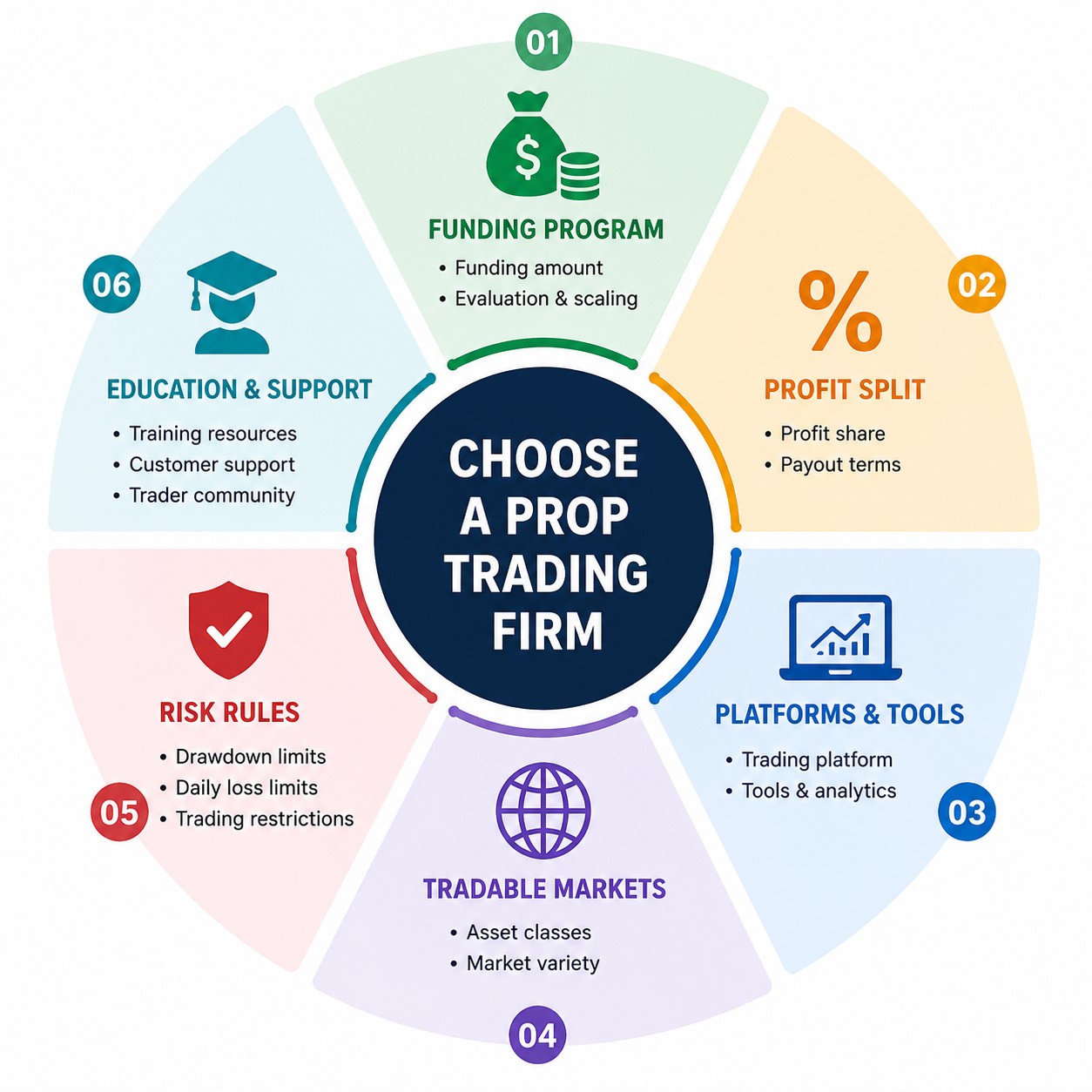
The largest prop trading firms often offer similar services, but their funding programs, trading rules, and account conditions can vary significantly. Before opening an account, compare the features that best match your trading style, experience level, and long-term goals.
Funding program. Compare the maximum funding available, evaluation requirements, and scaling opportunities. Some firms offer one-step or instant funding, while others require traders to complete a multi-stage assessment before receiving larger accounts.
Profit split. Review how profits are shared and whether the percentage increases as you meet performance targets. A generous profit split is attractive, but it should always be considered alongside the firm's trading rules and risk limits.
Trading platforms and tools. Make sure the firm supports your preferred platform and the analytical tools you rely on, including algorithmic trading, Expert Advisors, and custom indicators.
Tradable markets. Check which asset classes are available. While some firms specialize in Forex, others provide access to equities, commodities, cryptocurrencies, indices, and futures through a single account.
Risk management rules. Review the daily and maximum drawdown limits, consistency requirements, and restrictions on news or overnight trading. Strong risk controls are one of the features that distinguish the largest proprietary trading firms. Understanding these rules is just as important as knowing where to place a stop-loss.
Education and support. If you're new to prop trading, look for firms that offer training programs, responsive customer support, and active trader communities. These resources can help you complete an evaluation and develop more consistent trading habits.
Choosing a prop trading firm based on your experience
The largest prop trading firms cater to traders with different levels of experience. While beginners often benefit from strong educational resources and straightforward trading rules, experienced traders usually prioritize higher funding limits, flexible trading conditions, and advanced technology. The comparison below highlights the factors each group should consider before choosing a prop trading firm.
| If you're new to prop trading... | If you're an experienced trader... |
|---|---|
| Choose firms with educational resources, such as webinars, training, or mentorship. | Prioritize firms with scaling programs that increase funding as you perform consistently. |
| Use conservative leverage while developing your trading strategy. | Select leverage that fits your strategy and preferred markets. |
| Compare evaluation rules, including drawdown limits, trading-day requirements, and restrictions. | Look for flexible trading conditions, including algorithmic trading, Expert Advisors, and advanced tools. |
| Review evaluation fees, profit splits, and total funding costs. | Compare profit splits, scaling opportunities, and long-term earning potential. |
| Pick a firm with responsive support and an easy-to-use platform. | Evaluate platform stability, available asset classes, and trading tools. |
Regardless of your experience, compare the firm's funding model, trading conditions, risk management rules, and overall costs before opening an account. Many of the largest prop trading firms provide similar funding opportunities, but differences in evaluation requirements, platform features, and customer support can have a significant impact on your trading experience.
- Pros
- Cons
Access to larger trading capital. Prop firms provide funded accounts that allow traders to trade with substantially more capital than they could using personal funds. Many of the largest prop trading firms also offer scaling programs that reward consistent performance.
Professional trading tools. Leading firms provide advanced trading platforms, market data, and analytical tools that can improve execution and decision-making.
Attractive earning potential. Competitive profit-sharing models allow successful traders to keep a significant share of their profits while trading larger account sizes.
Opportunities for growth. Many firms support traders with educational resources, mentorship, and performance feedback to help them improve over time.
Profit sharing. Traders must share a portion of their profits with the firm, reducing their overall earnings.
Evaluation requirements. Many firms require traders to pass an evaluation before receiving a funded account, and failing to meet the rules may require paying for another challenge.
Fees. Evaluation, platform, or subscription fees can increase the overall cost of participating in a funding program.
Trading restrictions. Firms may impose limits on drawdowns, trading during major news events, overnight positions, or the use of certain strategies.
Risks and warnings
While prop trading provides a high-reward environment, it's important to understand the potential risks involved. Even when working with the biggest prop trading firms in the world, traders should remember that funded accounts come with strict rules and performance requirements.
Potential risks. Trading with high leverage can magnify both profits and losses. Without disciplined risk management, traders can incur substantial losses. This risk exists even when trading with the largest prop trading firms, where larger funded accounts require careful control of market exposure.
Evaluation and compliance standards. Many firms require traders to complete an evaluation and comply with strict trading rules before receiving or maintaining a funded account. Failing to meet these standards can result in losing access to trading capital. Such evaluation systems help firms maintain consistent risk management policies.
Fee structures. Entry fees, platform charges, and performance-based costs can add up over time. Compare fee structures carefully, as they vary among the biggest prop firms competing in the funded trading market.
Regulatory compliance. Make sure the firm complies with the financial regulations that apply in your jurisdiction to reduce legal and operational risks. Reputable platforms, including some of the largest prop firms, typically maintain transparent operating policies.
Emotional and psychological pressure. Trading under profit targets and drawdown limits can be demanding. Maintaining discipline and emotional resilience is essential for long-term success, regardless of account size.
Focus on tools that support better trading decisions

When choosing your first prop trading firm, look beyond marketing claims and funding amounts. Pay attention to the tools the firm provides to help you improve your trading. The best platforms offer more than basic charting software. They provide data-driven insights into market activity, order flow, and trade performance that can help you better understand price movements and refine your strategy over time. Many beginners start by comparing the largest prop trading firms because these companies often invest more heavily in trading technology and analytical tools.
Another factor worth considering is practical risk management education. Managing risk in a funded account requires more than simply placing stop-loss orders. Look for firms that provide guidance on position sizing, drawdown management, and trading discipline through webinars, educational resources, or mentoring. The biggest prop trading firms often combine funded accounts with structured learning opportunities to help traders build consistent habits and manage risk more effectively.
Conclusion
Choosing among the biggest prop trading firms means more than just comparing funding amounts—it’s about finding the environment that enables your trading style and supports your growth as a trader. Industry leaders like FundedNext and Goat Funded Trader distinguish themselves through generous funding limits, advanced trading technology, and robust support systems to help both beginners and experienced traders excel. However, even with these advantages, traders must approach prop trading with discipline and a strong understanding of each firm’s evaluation requirements, risk controls, and fee structures. Ultimately, the best prop trading firm is the one that not only amplifies your capital but also gives you the tools and education to achieve consistent, long-term success in dynamic markets.
FAQs
What criteria help determine the biggest prop trading firms in the world?
How do the funding programs of large prop trading firms differ?
What types of trading restrictions are common among the largest prop trading firms?
What educational and support resources do reputable prop trading firms provide?
Editors' Top Picks and Insights






Related Articles
Team that worked on the article
Aleksandra Chaikina has been a contributor to Traders Union since 2021. With over 15 years of experience in copywriting and more than 5 years focused on financial content, she specializes in producing detailed guides, analytics, and comparative reviews across various sectors, including cryptocurrencies, Forex, investment strategies, and financial technologies.
Ciaran Ryan is a veteran financial journalist based in South Africa, where he covers cryptocurrency, mining, stock markets, and governance for Moneyweb. He also hosts the weekly Moneyweb Crypto Podcast.
Chinmay Soni is a financial analyst with more than 5 years of experience in working with stocks, Forex, derivatives, and other assets. As a founder of a boutique research firm and an active researcher, he covers various industries and fields, providing insights backed by statistical data.
Cryptocurrency is a type of digital or virtual currency that relies on cryptography for security. Unlike traditional currencies issued by governments (fiat currencies), cryptocurrencies operate on decentralized networks, typically based on blockchain technology.
Copy trading is an investing tactic where traders replicate the trading strategies of more experienced traders, automatically mirroring their trades in their own accounts to potentially achieve similar results.
Proprietary trading (prop trading) is a financial trading strategy where a financial firm or institution uses its own capital to trade in various financial markets, such as stocks, bonds, commodities, or derivatives, with the aim of generating profits for the company itself. Prop traders typically do not trade on behalf of clients but instead trade with the firm's money, taking on the associated risks and rewards.
Bitcoin is a decentralized digital cryptocurrency that was created in 2009 by an anonymous individual or group using the pseudonym Satoshi Nakamoto. It operates on a technology called blockchain, which is a distributed ledger that records all transactions across a network of computers.
Index in trading is the measure of the performance of a group of stocks, which can include the assets and securities in it.


