
Top Halal Investment Options In Malaysia For 2026


Editorial Note: While we adhere to strict Editorial Integrity, this post may contain references to products from our partners. Here's an explanation for How We Make Money. None of the data and information on this webpage constitutes investment advice according to our Disclaimer.
Best halal investments in Malaysia:
Halal stocks – shariah-screened Malaysian equities across chemicals, telecoms, energy, and plantations with compliant financial ratios and active market presence.
Halal index funds – passively managed funds like PMB Shariah Index and MyETFMSCI Islamic offering broad halal equity exposure at low cost.
Halal mutual funds – professionally managed equity funds (e.g. PIDF, PMB Aggressive) combining growth or income strategies under strict Shariah supervision.
Sukuk (Islamic bonds) – asset-backed investment certificates offering halal fixed-income returns through rental or profit-sharing mechanisms, issued by both government and corporate entities, with yields typically ranging from 3.5% to 5.2%.
ASNB & tabung haji funds – government-backed unit trusts with fixed or growth-oriented pricing, low entry, and annual Shariah-compliant payouts.
EPF shariah account – dedicated Islamic retirement savings option under EPF with 6.3% return in 2024 and full Shariah asset allocation.
Islamic fixed deposits – capital-preserving short-term savings tools based on murabahah/wakalah with returns up to 5% and PIDM insurance.
To qualify as a halal investment in Malaysia, products must avoid riba (interest), maysir (speculation), and gharar (excessive uncertainty). The system is regulated under the Islamic Financial Services Act 2013, covering takaful, Islamic banking, and asset management. Both the central bank and Securities Commission oversee compliance, including fund certification and screening. As a leader in global sukuk, Malaysia handles over half of worldwide issuances. The country also runs Bursa Malaysia-i, a dedicated platform for Shariah-compliant trading. This guide highlights major paths for Islamic investment in Malaysia, covering funds, assets, and structured products for 2026. Let’s explore all the available halal investment options in Malaysia.
Risk warning: All investments carry risk, including potential capital loss. Economic fluctuations and market changes affect returns, and 40-50% of investors underperform benchmarks. Diversification helps but does not eliminate risks. Invest wisely and consult professional financial advisors.
What is halal investment in Malaysia?
Malaysia’s halal finance scene is huge. For example, food services hit US$31 billion in 2021 and could reach US$47.6 billion by 2025. But Islamic halal investment in Malaysia goes beyond that: RM 2.6 trillion is tied up in Shariah-compliant assets as of November 2024, making Malaysia one of the top places in the world for this kind of finance.
Almost 80% of companies listed on Bursa Malaysia qualify for Shariah compliant investment in Malaysia. What many don’t realize is how the local screening works. Islamic experts and financial pros set debt limits and income rules based on Malaysia's specific corporate world, meaning the system is custom-tailored and not just copied from global models.
A game-changing shift is happening thanks to fintech. New micro-investment apps are making it easy for everyone to join Islamic halal investment in Malaysia by buying small slices of Shariah-checked sukuk or stock bundles. And right in the background, Islamic experts are keeping things halal with instant checks, leaving no room for hidden interest to slip through.
Budget 2025 confirmed the government is backing this. They’ve set aside RM 100 million for new ideas in Islamic finance. That money will help roll out smart sukuk tokens, digital wa’d hedges, and tools for everyday investors to enter sukuk.
But here’s a twist: Shariah compliant investment in Malaysia isn’t only about avoiding interest, gambling, or bad industries. Many Islamic funds also filter out companies with poor labor or environmental records, even if they pass financial checks. They’re halal and built to be good for people and the planet.
Best halal investments in Malaysia
Halal stocks
Malaysia remains a global leader in Islamic finance, and its equity market offers a wide range of Shariah-compliant investment opportunities. The table below highlights several prominent halal stocks in Malaysia across core sectors such as energy, telecommunications, and plantations. These companies meet Shariah screening criteria, offering investors exposure to ethically aligned businesses with strong market presence. Performance metrics such as YTD return, market capitalization, and P/E ratio provide a snapshot of each stock's investment profile as of 2026.
| Company (Ticker) | Sector | YTD return (%) | Market cap (MYR BN) | P/E (TTM) |
|---|---|---|---|---|
| Chemicals Group Bhd (PCHEM.KL) | Chemicals | –35.98 | 26.6 | 24.6 |
| CelcomDigi Bhd (CDB.KL) | Telecommunications | 6 | 41.4 | 28.8 |
| Press Metal Aluminium (8869.KL) | Metals & Mining | 2.81 | 41.2 | 22.7 |
| Petronas Gas Bhd (PETGAS.KL) | Utilities – Gas | 3.56 | 35.8 | 19.5 |
| Sime Darby Plantation (SIMEPLT.KL) | Plantations | 0.54 | 19.7 | 8.5 |
Halal index funds and ETFs
ETFs and index funds in Malaysia are a core component of Shariah-compliant investing in the country. These funds offer exposure to equity markets without the influence of active portfolio management or market speculation. Instead, they follow a passive investment approach, tracking well-defined Shariah indices.
| Fund / Index | NAV (MYR) | Expense Ratio (%) | Dividend Yield (%) | YTD Return (%) | Volatility (Annualized) |
|---|---|---|---|---|---|
| PMB Shariah Index Fund (tracks FBMSHA) | RM 0.5716 | 0.75 % | ~1.80 sen (annual) | +11.14 % | Moderate (~6–9 %) |
| MyETF MSCI Malaysia Islamic Dividend ETF | RM 1.095 | 0.51 % | 1.07 % | –9.23 % | Benchmark: ~17.9 % (5-yr) |
| MSCI Malaysia Islamic Index (Benchmark only) | N/A | N/A | 3.16 % (5-yr avg) | +5.04 % | 17.88 % (5-year) |
Halal mutual funds
For Muslim investors seeking halal investment opportunities, Malaysia’s halal mutual funds offer a professionally managed and Shariah-screened path to portfolio growth. These funds avoid non-compliant sectors such as alcohol, gambling, or conventional finance, and are reviewed regularly by certified Shariah boards.
The table below compares some of Malaysia’s most prominent Shariah-compliant mutual funds based on key financial metrics - including Assets Under Management (AUM), 1-year and 3-year performance, volatility, and minimum investment. This data helps investors evaluate which fund matches their risk appetite and financial goals, whether they seek income, capital growth, or portfolio diversification.
| Fund Name | AUM (RM million) | 1Y Return (%) | 3Y Annualized (%) | Volatility (%) | Min Investment (RM) |
|---|---|---|---|---|---|
| Public Islamic Dividend Fund (PIDF) | 3,200+ | 7.8 | 6.5 | 9.1 | 1,000 |
| Manulife Shariah Flexi Fund | ~510 | 10.3 | 8.2 | 11.6 | 500 |
| PMB Shariah Aggressive Fund | ~245 | 12.7 | 10.1 | 14.9 | 100 |
| CIMB Islamic DALI Equity Growth Fund | 1,950+ | 8.4 | 7.3 | 10.2 | 500 |
| Principal Islamic Equity Growth Fund | ~610 | 9.1 | 8.0 | 10.5 | 500 |
Sukuk (Islamic Bonds)
Sukuk are Shariah-compliant investment certificates that serve as halal alternatives to conventional bonds. Instead of paying interest, sukuk generates returns through profit-sharing or rental income from underlying tangible assets. In Malaysia, sukuk are widely issued by both the government and corporate sectors, providing a steady income stream backed by real assets. The market is highly liquid and well-regulated, with instruments ranging from short-term sovereign sukuk to long-term infrastructure financing. Retail-friendly options are increasingly available through digital sukuk platforms, robo-advisors, and Islamic banks. In 2025, average sukuk yields range between 3.5% and 5.2% depending on tenor and issuer rating, making them a popular low-risk core holding in halal portfolios.
| Issuer | Type | Tenure | Yield (%) | Minimum Investment |
|---|---|---|---|---|
| Government of Malaysia | Sovereign Sukuk (MGII) | 5–10 years | 3.8–4.5% | RM 1,000 (via brokers) |
| Khazanah Nasional | Corporate Sukuk | 3–7 years | 4.2–4.9% | RM 5,000 |
| Maybank Islamic | Structured Retail Sukuk | 1–3 years | 3.5–4.1% | RM 1,000 |
| Sukuk PRIHATIN | Social Sukuk (Gov-backed) | 2 years | 2.5% + tax incentives | RM 500 |
| Wahed Invest | Digital Sukuk Portfolio | Flexible | 4.0–5.2% (projected) | RM 100 (via app) |
Unit trust funds: ASNB and Tabung Haji
Similar to halal mutual funds, ASNB funds remain one of the most popular tools available for Malaysians pursuing ethical investing. They offer fixed-price units, a straightforward onboarding process, and annual income payouts. In 2025, the ASB‑2 fund recorded a 5.5% return with over RM 2.18 billion distributed. All investments are made in full accordance with Shariah principles, excluding sectors that are not permissible. Tabung Haji, while primarily a Hajj savings fund, also functions as a broader investment vehicle. It follows strict screening rules on income sources and portfolio composition. These government-backed instruments make Shariah-compliant investment in Malaysia widely accessible, even to small-scale investors.
| Fund Name | Fund Type | AUM (RM bn, 2025) | Minimum Investment | Target Return (3-Yr Annualised) |
|---|---|---|---|---|
| ASB (Amanah Saham Bumiputera) | Fixed-price equity | 153 | RM 100 | ~5.50 sen/unit per annum |
| ASM, ASM 2, ASM 3 | Equity growth | Included in RM 350 bn total | RM 1 | 5.00–5.50 sen/unit per annum |
| ASN Equity Global | Global equity | N/A | RM 100 / US $25 | 3.8% p.a. (3‑yr) |
| ASNB Fixed Price Funds Total | Multi equity | RM 350 bn combined | RM 1 | Diverse equity returns |
EPF Shariah (Shariah retirement account)
Through the Shariah-compliant EPF account, contributors can channel their savings exclusively into assets approved by Islamic finance principles. This fund is entirely separate from the conventional EPF pool and is supervised by a dedicated Shariah Advisory Council. In 2024, it declared a 6.3% dividend, which matched the returns of the conventional scheme. Members can opt into the Shariah option once, after which all future contributions and earnings are invested only in approved assets. It’s a secure choice for those building long-term retirement savings within a clearly defined Shariah investment in Malaysia structure.
| Feature | Detail |
|---|---|
| Eligibility | EPF members can opt-in any month from April 2025 |
| Investment Allocation | Between conventional and Shariah, self-selectable |
| Dividend (2024) | 6.3% for both conventional & Shariah |
| Growth Strategy | EPF plans to allocate ~RM 25 bn/year to Shariah assets, aiming ≥45% allocation |
Islamic fixed deposits
For those seeking steady returns and capital preservation, Islamic fixed deposits are a reliable option. These are structured around murabaha and wakalah contracts, offering annual returns ranging from 2.2% to 5% as of 2025. Leading offerings include CIMB Islamic, Standard Chartered i, and RHB’s Term Deposit-i (Premier account). Each is vetted by the respective bank’s Shariah board and is insured under PIDM. By eliminating interest and adhering strictly to Islamic financial guidelines, these deposits are trusted tools for short- to medium-term savings aligned with halal values.
| Bank | Product name | Tenure | Profit rate p.a. (%) |
|---|---|---|---|
| CIMB Islamic | eFixed Deposit-i | 3–6 months | 3.45% |
| Standard Chartered i | Term Deposit-i campaign | 12 months | 3.70% |
| RHB | Term Deposit-i (Premier account) | 3 months | 4.70–5.00% |
| Maybank Islamic | Islamic Fixed Deposit | 1–12 months | 2.20–2.30% |
| Bank Islam / Rakyat | Term Deposit-i | Varies, up to 60 months | 2.15–2.30% |
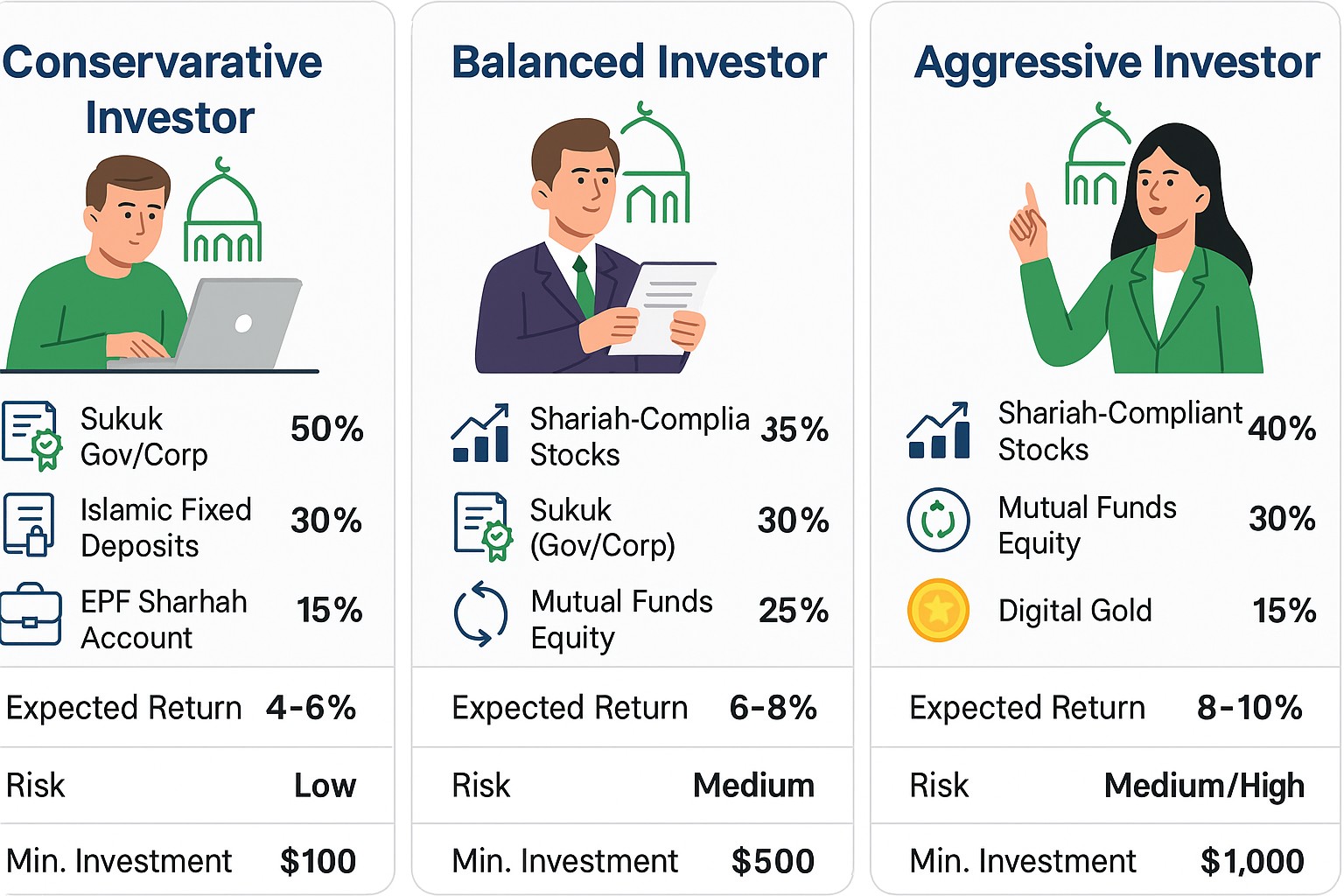
Proposed portfolio allocation
After reviewing the wide spectrum of halal investment vehicles available in Malaysia - from equities and sukuk to digital gold and Islamic fixed deposits - Muslim investors may consider building a diversified portfolio aligned with both Shariah principles and their personal risk profile. The table below presents a sample allocation for a balanced investor, aiming to combine stable income with moderate growth while maintaining strict compliance with Islamic finance rules.
Shariah compliance system
The Shariah compliance system for halal investment in Malaysia and Islamic investment in Malaysia isn’t just about ticking boxes, it’s one of the world’s most advanced systems. Twice a year, in May and November, the Shariah Advisory Council and Bursa Malaysia review over 900 listed companies and identify around 550 as Shariah-compliant.
They use a two-step checking system by examining what companies do and enforcing tight debt and interest rules, for example, ensuring interest-bearing debt stays below roughly 33% of total assets. They also factor in how the public views a company, which adds a social filter many investors don’t expect.
Malaysia goes further by using Islamic finance powered by tech. Programs like Fikra and Bank Negara’s fintech sandbox support around 40 fintech firms that offer robo-advisors, auto-check compliance tools, and apps that show Shariah status in real time.
The ecosystem truly shines in how all parts work together: banks, takaful firms, regulators, and benchmarks. Over 20% of Malaysia’s sukuk issuance funds halal-certified companies, and 40% of EPF’s USD 238 billion in assets are invested in a Shariah-compliant manner.
Malaysia also offers tools to manage risk that many don’t know about. These include Shariah-screened crude palm oil futures and single-stock futures, allowing investors to hedge while staying fully compliant with Islamic principles.
Alternative investment ways in Malaysia
Gold
Digital gold accounts offered by institutions like Bank Muamalat, Bank Rakyat, and apps such as HelloGold enable halal gold trading and investing by providing easy access to physical gold backed by LBMA certification. Investors can redeem gold in small denominations, starting from just 0.5 grams. For example, the MiGOLD fund operates as a fund-of-funds built on physical gold ETFs, excluding any speculative trades, futures, or leverage. Since these are fully backed by tangible assets and free from interest-based elements, they are widely accepted as part of Shariah-compliant investment in Malaysia, offering investors a low-risk, halal way to preserve wealth.
| Option | Type | Minimum Investment | Highlights |
|---|---|---|---|
| Physical Gold Bars & Coins | Tangible gold | From 1 g | LBMA-certified, flexible sizes |
| CIMB eGIA | Digital gold | 1 g | Trade online via CIMB Clicks |
| Maybank MIGA-i | Islamic Gold Account | 1 g | 999.9 purity, can convert to physical gold |
| Bursa Gold Dinar | Exchange platform | 1 coin | Digital and physical coin trading |
Real estate
Investing in property is considered permissible under Islamic guidelines when the assets are used for lawful purposes. Rental income must come from Shariah-approved activities, which means properties leased to businesses involving alcohol, gambling, or conventional banking are excluded. Both direct ownership and structured co-investment methods, like ijarah and diminishing musharakah, are acceptable when terms are transparent. In addition, halal REITs - Real Estate Investment Trusts - provide investors with a Shariah-compliant way to gain exposure to diversified property portfolios, as these trusts are carefully screened to ensure that rental income and tenants’ activities adhere to Islamic principles. Real estate, when structured accordingly, is a practical option for anyone exploring Shariah investment in Malaysia, especially for those seeking long-term, asset-based income.
| Platform | Structure | Target Return (%) | Notes |
|---|---|---|---|
| Shariah i-REITs (Bursa Malaysia) | Listed REITs | ~5–7% yield | Compliant per SC Malaysia |
| Ethis Malaysia | Crowdfunding (SPV) | 9–13% estimated annual | Shariah-approved, $12M+ invested |
Cryptocurrency
Digital assets backed by tangible commodities (like gold or real estate), structured under Shariah contracts (e.g., wakalah, mudarabah), and with low volatility may be considered compliant. Notable examples include:
HelloGold (HGT) - gold-backed, with prior approval from Malaysian Shariah advisors.
OneGram (OGC) - tied to physical gold, launched with public fatwas from Gulf scholars.
Gold-backed or commodity-tied tokens typically score higher on compliance platforms like Zoya and Islamicly. However, due caution is advised, as regulators continue to warn investors about unverified and volatile coins. Under strict guidelines and expert review, selective crypto holdings can be included in long-term Shariah-compliant investment in Malaysia strategies.
| Category | Details |
|---|---|
| Legal status | Legal as digital securities, not legal tender |
| Regulatory authority | Regulated by Securities Commission Malaysia (SCM) via AML/CFT rules |
| Shariah perspective | Mixed scholarly opinion; acceptable if asset-backed, avoid speculation |
| Access platforms | SCOMI, Luno, Tokenize via SC-approved exchanges |
Shariah-compliant investments aren't limited to Malaysia. Thanks to global brokers offering Islamic accounts, Muslims can now access halal investment options across borders. These brokers provide platforms for international equities, ETFs, and more, making ethical investing a global opportunity.
| GTCFX | Pepperstone | Vantage Markets | XM | Fusion Markets | |
|---|---|---|---|---|---|
|
Swap Free |
Yes | Yes | Yes | Yes | Yes |
|
Crypto |
No | Yes | Yes | No | Yes |
|
Stocks |
Yes | Yes | Yes | Yes | Yes |
|
Currency pairs |
150 | 90 | 40 | 57 | 90 |
|
Min. deposit, $ |
30 | No | 50 | 5 | 1 |
|
Regulation |
VFSC, FSC, FCA, ASIC | ASIC, FCA, DFSA, BaFin, CMA, SCB, CySec | ASIC, FCA, FSCA, VFSC | CySEC, FSC (Belize), DFSA, FSCA, FSA (Seychelles), FSC (Mauritius), SCA (United Arab Emirates), CMA (Kenya) | ASIC, VFSC, FSA |
|
TU overall score |
9.2 | 9.3 | 7.95 | 9.35 | 9.25 |
|
Open an account |
Go to broker Your capital is at risk. |
Go to broker Your capital is at risk.
|
Go to broker Your capital is at risk. |
Go to broker Your capital is at risk. |
Go to broker Your capital is at risk. |
Risks & caveats in halal investing
Even Shariah-compliant investments carry risks. Here are key factors Malaysian investors should consider before allocating funds:
Shariah compliance status may change. A stock or fund can be reclassified during biannual reviews by the Shariah Advisory Council, potentially making once-compliant assets non-halal.
Currency risk in global ETFs or foreign mutual funds. Investments tied to USD, EUR, or other non-MYR currencies may expose portfolios to exchange rate fluctuations, impacting real returns.
Inflation erosion for fixed deposits. While Islamic fixed deposits offer stability, returns between 2.2% and 5% may not outpace inflation, especially during high CPI cycles.
Low liquidity in sukuk and unit trusts. Some sukuk and smaller mutual funds may have limited secondary market access, making it harder to exit positions quickly in emergencies.
Boost halal returns in Malaysia by tapping underused sukuk ladders and digital waqf assets

If you're just getting started with halal investing in Malaysia, try looking beyond the usual stock lists. One smart move is building a sukuk ladder, a setup where you buy sukuk with different maturity dates, so your money keeps coming back in intervals. That way, you're not locked in, and you can reinvest bit by bit. It keeps your income steady and halal, without gambling on stock price swings. Most people miss this strategy because they think sukuk are boring, but with the right structure, they’re surprisingly flexible.
There’s also a newer, meaningful route few beginners notice: investing in digital waqf. These are endowment-based projects that now let you buy in through tokenized units, sometimes with just a small amount of capital. You get modest returns while supporting long-term social goals like education or healthcare. It’s not just about profits, it’s about purpose too. For new investors, this is a rare chance to grow money while doing good, without crossing into risky speculation.
Conclusion
Malaysia stands out as a global leader in halal investing, offering Muslim investors a comprehensive suite of Shariah-compliant options across equities, sukuk, mutual funds, and even innovative digital assets. The nation's robust regulatory framework ensures every product, from government-backed ASNB funds to gold accounts and digital waqf projects, navigates religious and ethical requirements without sacrificing growth or accessibility. Newcomers and seasoned investors alike can diversify their portfolios by combining stable instruments like Islamic fixed deposits with growth-oriented halal stocks, always under the vigilant eye of Malaysia's Shariah Advisory Council. Ultimately, halal investing here is not just about avoiding the forbidden: it is about building wealth with purpose, paving the way for a future where financial returns and lasting positive impact go hand in hand.
FAQs
How does Malaysia regulate Shariah-compliant investments for investor protection?
What factors can cause a previously halal investment to lose its Shariah compliance in Malaysia?
Are there Shariah-compliant investment options in Malaysia for environmentally or socially conscious investors?
What role does technology play in expanding access to halal and Shariah-compliant investments in Malaysia?
Editors' Top Picks and Insights





Related Articles
Team that worked on the article
Alamin Morshed is a contributor at Traders Union. He specializes in writing articles for businesses that want to improve their Google search rankings to compete with their competition.
Chinmay Soni is a financial analyst with more than 5 years of experience in working with stocks, Forex, derivatives, and other assets. As a founder of a boutique research firm and an active researcher, he covers various industries and fields, providing insights backed by statistical data.
Mirjan Hipolito is a journalist and news editor at Traders Union. She is an expert crypto writer with five years of experience in the financial markets.

-
 Afghanistan
-
 Albania
-
 Algeria
-
 Angola
-
 Argentina
-
 Armenia
-
 Australia
-
 Austria
-
 Azerbaijan
-
 Bahamas
-
 Bahrain
-
 Bangladesh
-
 Belarus
-
 Belgium
-
 Bolivia
-
 Botswana
-
 Brazil
-
 Brunei
-
 Bulgaria
-
 Cambodia
-
 Cameroon
-
 Canada
-
 Chile
Chile
-
 China
China
-
 Colombia
-
 Congo
Congo
-
 Costa Rica
-
 Cote d'Ivoire
-
 Croatia
-
 Cuba
Cuba
-
 Cyprus
-
 Czechia
-
 DR Congo
-
 Denmark
-
 Dominican Republic
-
 Ecuador
-
 Egypt
Egypt
-
 El Salvador
-
 Estonia
-
 Eswatini
-
 Ethiopia
-
 Finland
-
 France
-
 Georgia
-
 Germany
-
 Ghana
Ghana
-
 Greece
-
 Haiti
Haiti
-
 Hong Kong
-
 Hungary
-
 India
India
-
 Indonesia
-
 Iran, Islamic republic
-
 Iraq
Iraq
-
 Ireland
-
 Israel
-
 Italy
Italy
-
 Jamaica
-
 Japan
Japan
-
 Jordan
-
 Kazakhstan
-
 Kenya
Kenya
-
 Korea
Korea
-
 Kuwait
-
 Kyrgyzstan
-
 Laos
Laos
-
 Latvia
-
 Lebanon
-
 Lesotho
-
 Libya
Libya
-
 Lithuania
-
 Luxembourg
-
 Madagascar
-
 Malaysia
-
 Malta
Malta
-
 Mauritius
-
 Mexico
-
 Moldova
-
 Mongolia
-
 Montenegro
-
 Morocco
-
 Mozambique
-
 Myanmar
-
 Namibia
-
 Nepal
Nepal
-
 Netherlands
-
 New Zealand
-
 Nigeria
-
 North Macedonia
-
 Norway
-
 Oman
Oman
-
 Pakistan
-
 Palestine
-
 Panama
-
 Papua New Guinea
-
 Paraguay
-
 Peru
Peru
-
 Philippines
-
 Poland
-
 Portugal
-
 Puerto Rico
-
 Qatar
Qatar
-
 Reunion
-
 Romania
-
 Rwanda
-
 Saudi Arabia
-
 Serbia
-
 Singapore
-
 Slovakia
-
 Slovenia
-
 Somalia
-
 South Africa
-
 Spain
Spain
-
 Sri Lanka
-
 Sweden
-
 Switzerland
-
 Syria
Syria
-
 Taiwan
-
 Tajikistan
-
 Tanzania
-
 Thailand
-
 Trinidad and Tobago
-
 Tunisia
-
 Turkey
-
 UAE
UAE
-
 Uganda
-
 Ukraine
-
 United Kingdom
-
United States
-
 Uruguay
-
 Uzbekistan
-
 Venezuela
-
 Vietnam
-
 Yemen
Yemen
-
 Zambia
-
 Zimbabwe
- Forex
- Crypto












