
Is Commodity Trading Halal? A Comprehensive Guide


Editorial Note: While we adhere to strict Editorial Integrity, this post may contain references to products from our partners. Here's an explanation for How We Make Money. None of the data and information on this webpage constitutes investment advice according to our Disclaimer.
Yes, commodity trading can be halal if it follows Sharia principles. The trade must involve real, tangible goods (like gold, oil, or wheat), avoid interest (riba), excessive uncertainty (gharar), and ensure immediate ownership and delivery. Speculative or futures contracts without possession are generally not allowed in Islamic finance.
Commodity trading plays a major role in today’s global financial markets and continues to attract both experienced investors and those just starting out. For Muslim traders, however, a key concern persists: Is commodity trading halal in Islam? In this article, we examine that question from the perspective of Islamic finance, considering scholarly views, the nature of different commodities, trading methods, and the practical steps needed to ensure Shariah-compliant participation in commodity markets.
Risk warning: All investments carry risk, including potential capital loss. Economic fluctuations and market changes affect returns, and 40-50% of investors underperform benchmarks. Diversification helps but does not eliminate risks. Invest wisely and consult professional financial advisors.
What is commodity trading?
Commodity trading refers to the buying and selling of raw materials or primary goods such as gold, silver, oil, wheat, and coffee. These assets are typically traded either on the spot market or through derivative instruments like futures and options contracts, and CFDs. In 2025, the global commodity market surpassed $16 trillion in value, with growing involvement from Muslim-majority countries and institutions aligned with Islamic finance principles. Against this background, many Muslim traders ask a practical question: is arbitrage halal when applied to commodity markets, where real assets, clear ownership, and spot transactions can align with core Islamic finance principles?

Main categories of commodities:
Hard commodities. These include natural resources such as oil and metals like gold and silver.
Soft commodities. These cover agricultural goods including wheat, sugar, and coffee.
Is commodity trading Halal or Haram?
Common scholarly views:
Halal. Spot trading with real assets and immediate exchange.
Haram. Futures contracts, options, and speculation without underlying asset ownership.
The question many ask is whether commodity trading is halal or haram, and the answer depends heavily on the structure and intention behind the transaction.
The halal status of commodity trading isn’t just about what you're trading — it’s about how the transaction is structured. This is also true for other assets like equities, where many Muslims ask, is the stock market halal or haram, depending on how shares are bought and held.
Also some Muslims don’t realize that even if the asset is halal (like wheat, oil, or gold), the method can make the trade haram. Futures contracts, for instance, are a major red flag. Why? Because they often involve selling something you don’t own yet, which violates the Prophet’s clear instruction: “Do not sell what you do not possess.” This becomes even more problematic when there's no intention to take delivery of the goods — only to profit from price movements, which looks a lot like speculation, not trade.
Even spot commodity platforms can be shady if they rely on “paper” trades without physical settlement. Some brokers claim Shariah compliance but quietly operate on margin, using interest-based borrowing to fund positions. That means even if you’re trading halal goods, your gains might come from haram financing. One overlooked solution? Using a broker that offers 100% physical-backed, fully paid transactions, where you own the commodity outright — even if you later choose to sell it. This shifts the transaction from speculative to real, which is a crucial difference in Islamic finance. Also find out the answer to the question, is swing trading halal or haram in Islam?
Key shariah principles in commodity trading
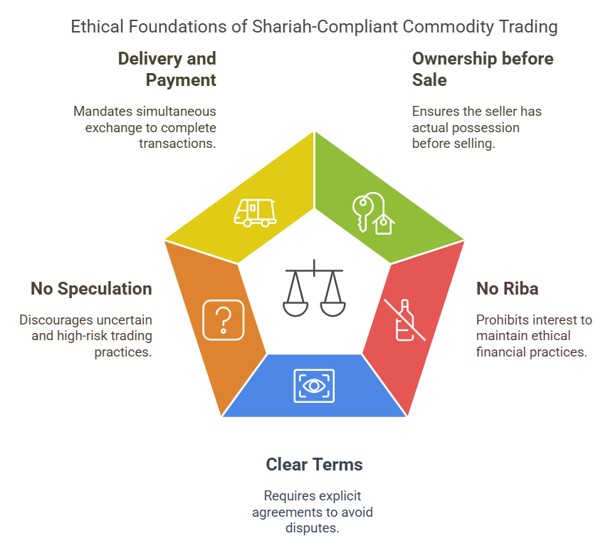
To determine if commodity trading is halal, traders must adhere to several core principles of Islamic finance:
Ownership before sale. You must take possession of the asset before selling it. This requirement is affirmed in Shariah Standards No. 1 and 21 issued by AAOIFI, ensuring that the sale is not speculative or based on something you do not yet control.
No riba (interest). All trading must be free from any form of interest. This prohibition is central to Islamic finance and is consistently reinforced across nearly all Shariah rulings.
Clear terms and conditions. Contracts must be transparent and specific, with no uncertainty or ambiguity (gharar). Notably, over 73% of Islamic finance disputes in 2022 were linked to unclear or incomplete contract terms.
No speculation or gambling. Trades that are driven purely by speculation or chance are considered haram. The International Shari’ah Research Academy (ISRA) explains that if there’s no genuine intent to take delivery of the asset, the trade falls under maysir (gambling), which is prohibited.
Delivery and payment. In spot transactions, both delivery of the commodity and payment must be immediate. This condition is agreed upon by all major schools of classical Islamic jurisprudence and helps maintain fairness and real economic exchange.
Types of commodity trading and their rulings
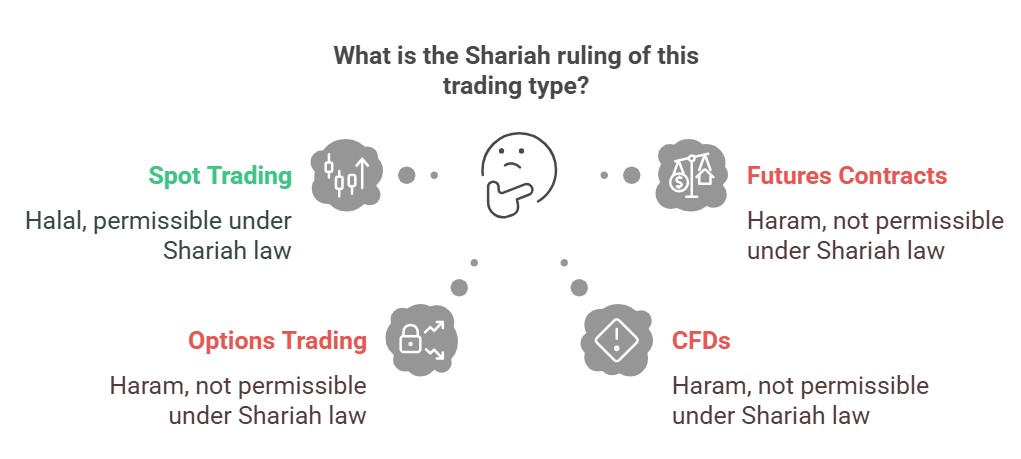
Islamic finance classifies commodity trading based on the type of ownership, the timing of delivery, and how the deal is financially structured. Each element plays a role in determining whether a transaction meets Shariah requirements. The emphasis is on keeping things transparent, ensuring real asset involvement, and avoiding riba (interest), gharar (excessive uncertainty), and maysir (speculation or gambling).
Understanding the various forms of commodity trading is crucial when assessing whether a particular practice aligns with Islamic finance principles. Each approach comes with its own risks and structural characteristics, which ultimately influence whether it's considered halal or not.
| Type | Halal Status | Notes |
|---|---|---|
| Spot trading | Halal | Permissible as long as there is immediate delivery and payment. Ideal for physical commodities like gold or wheat. |
| Futures contracts | Haram | Deemed non-compliant because they involve deferred delivery and can lead to speculation, which is maysir (gambling). |
| Options trading | Haram | Options grant the right but not the obligation to buy/sell, making them speculative and lacking in actual asset transfer. |
| CFDs (Contracts for Difference) | Haram | CFD contracts are purely speculative, often involve leverage and interest, and do not result in ownership of any underlying asset. |
Halal ways to trade commodities
If you want to ensure your commodity trading is Shariah-compliant:
Avoid “paper-only” trades. A lot of commodity trades today involve buying and selling without ever taking possession — that's usually not Halal. Real Shariah-compliant trading requires physical delivery or at least proven ownership, even if it's brief.
Spot trading is your safest bet. Forward contracts and speculation-heavy trades often fall into grey or outright prohibited zones. Spot trades (where you pay and receive ownership immediately) are much cleaner Islamically.
Commodity-backed Sukuk is a real option. It is useful for those who avoid interest-based instruments like bonds, which are typically non-compliant in Islamic finance.If you want long-term exposure to commodities without direct trading, look into Sukuk backed by physical assets like oil, metal, or agricultural products — these are structured to meet Shariah principles.
Delivery can be symbolic — but must be legitimate. In modern platforms, actual delivery may be handled via a warehouse receipt or a custodial transfer, but you still need clear proof of control to make it Halal.
Never trade with interest-bearing margins. Many brokers offer margin trading, but if interest (riba) is involved in the borrowing or holding costs, it immediately disqualifies the trade from being Halal.
Use Islamic brokers or certified Halal trading accounts. Some platforms now offer accounts designed around Shariah compliance — no interest, real asset backing, and proper contract structures like Murabaha or Salam.
Short selling is off the table. Selling something you don’t own yet (hoping to buy it later at a lower price) is a big no-go in Islamic finance — ownership and risk must be real and present at the time of sale.
Speculation is not the same as risk. Shariah allows risk (gharar) to an extent, but pure speculative trading — buying just because prices might rise — is discouraged unless it’s based on real demand, data, or business use.
You can trade gold and silver — but only under strict rules. Gold and silver are considered ribawi items, meaning you must settle trades immediately — no delays in payment or delivery allowed, even by minutes.
Understand the contract type before clicking “Buy.” Whether it’s a Salam contract (advance payment for future delivery) or Murabaha (markup-based resale), the contract structure changes the Halal status of the entire trade.
Many platforms now support Islamic commodity trading, offering halal investment tools for conscientious traders. We have presented the top platforms below:
| Swap Free | Commodities | Oil | Gold | Min. deposit, $ | Regulation | TU overall score | Open an account | |
|---|---|---|---|---|---|---|---|---|
| No | Yes | Yes | Yes | 100 | CySEC, FCA, ASIC, FMA, FSCA, FSA Seychelles, EFSA, MAS, DFSA, SCB | 7.7 | Go to broker 81% of retail CFD accounts lose money. |
|
| Yes | Yes | Yes | Yes | No | FSC (BVI), ASIC, IIROC, FCA, CFTC, NFA | 6.63 | Go to broker Your capital is at risk. |
|
| Yes | Yes | Yes | Yes | 100 | CIMA, FCA, FSA (Japan), NFA, IIROC, ASIC, CFTC | 6.47 | Study review | |
| No | Yes | Yes | Yes | 1 | FCA, BaFin, ASIC, MAS, CySec, FINMA, BMA, CFTC, NFA | 6.38 | Study review | |
| No | Yes | Yes | Yes | No | SEC, FINRA, SIPC, FCA, NSE, BSE, SEBI, SEHK, HKFE, IIROC, ASIC, CFTC, NFA | 6.37 | Study review |
Common misconceptions
Islamic commodity trading is built on real assets and ethical transactions, but there are layers that traders should understand.
Spot delivery isn’t always “instant.” Many think Islamic trading only allows on-the-spot exchange, but Sharia permits short delays if clearly defined and agreed — what matters is certainty and fairness, not speed alone.
You can’t bypass gharar with fancy paperwork. Some platforms try to hide uncertainty with layers of contracts, but if the core deal is vague or speculative, it’s still gharar, no matter how neat the PDF looks.
Most “gold trading” platforms fail the Sharia test. If you're buying digital gold without physical allocation, delivery, or vaulting rights — you’re basically just speculating, not trading a real asset.
You can’t sell what you haven’t taken possession of — literally. Many think digital confirmation is enough, but in Islamic law, possession means control — physical delivery, authority to move/sell, or clear custodianship.
Some Islamic brokers just repackage conventional tools. Don’t be fooled by Arabic labels or “Sharia-compliant” checkboxes — always ask how the trade is executed, not just what they call it.
Price manipulation invalidates the deal — even if it’s legal. If the trade is based on artificial pricing (like benchmark-fixing), it could violate Islamic ethics, even if regulators allow it.
Spot delivery and asset linkage determine halal compliance in commodity trading

Many beginners assume commodity trading is halal as long as it avoids riba — but that’s an oversimplification. One key factor that often gets overlooked is ownership and possession at the time of sale. In Shariah, you can’t sell what you don’t own, and this makes a huge difference in modern online platforms where traders speculate on price without ever taking actual delivery or risk of the asset.
Contracts that involve “paper commodities” or margin-based speculation often violate the conditions of bay (sale), particularly if the trader doesn’t have real custody, even briefly. This means that even gold or oil trading — halal by nature — can become haram if the structure is purely speculative or lacks clear asset transfer.
Another issue that trips up many new traders is the timing of payment and delivery, especially in forward contracts. In Shariah-compliant commodity trades, salam contracts (advance payment with deferred delivery) are allowed — but with strict conditions: full payment must be made upfront, the delivery date must be fixed, and the commodity must be well-defined and measurable.
Mixing these conditions — like partial payments or vague delivery windows — can push the contract into gharar territory. Many trading platforms blur these lines, so if you're serious about halal compliance, it’s not just what you trade — it’s how and when you trade that truly matters.
Conclusion
Commodity trading can be halal, provided it aligns with Islamic financial principles. Avoid speculative instruments and focus on physical or spot transactions with immediate delivery and payment. As a trader, always verify whether the platform or method you’re using is truly Shariah-compliant. This will ensure that your investments are not only profitable but also permissible. So for those wondering, commodity trading is halal or haram depending on whether it adheres to Shariah principles like ownership, immediacy, and transparency.
FAQs
Can I trade commodities using AI-driven algorithms in Islamic finance?
Yes, but only if the algorithm follows Shariah principles — meaning no speculation, no margin, and clear asset ownership. If the bot is just automating halal spot trades with full delivery and no interest, it’s permissible. But if it’s chasing trends or using leverage, it’s a no-go.
Is commodity trading halal if done through crowdfunding platforms?
It depends. If the platform offers pooled investment into real, physical assets with clear contracts and no interest-based funding, it can be halal. But if it lacks transparency, or if profits are guaranteed, it likely violates Islamic principles like risk-sharing and prohibition of riba.
Does the source of the commodity affect its halal status?
Yes, especially with soft commodities. If the goods come from unethical or exploitative practices (like unfair labor or environmental harm), many scholars argue it goes against Islamic ethics, even if the trade structure is technically Shariah-compliant.
Can I hold commodities long-term as an investment in Islamic finance?
Absolutely, as long as you own the asset outright and there's no riba or speculative flipping involved. Long-term holding of physical commodities like gold, silver, or agricultural goods aligns well with Islamic principles of real asset-backed wealth and ethical investing.
Editors' Top Picks and Insights





Related Articles
Team that worked on the article
Alamin Morshed is a contributor at Traders Union. He specializes in writing articles for businesses that want to improve their Google search rankings to compete with their competition.
Chinmay Soni is a financial analyst with more than 5 years of experience in working with stocks, Forex, derivatives, and other assets. As a founder of a boutique research firm and an active researcher, he covers various industries and fields, providing insights backed by statistical data.
Mirjan Hipolito is a journalist and news editor at Traders Union. She is an expert crypto writer with five years of experience in the financial markets.
Index in trading is the measure of the performance of a group of stocks, which can include the assets and securities in it.
An investor is an individual, who invests money in an asset with the expectation that its value would appreciate in the future. The asset can be anything, including a bond, debenture, mutual fund, equity, gold, silver, exchange-traded funds (ETFs), and real-estate property.
Swing trading is a trading strategy that involves holding positions in financial assets, such as stocks or forex, for several days to weeks, aiming to profit from short- to medium-term price swings or "swings" in the market. Swing traders typically use technical and fundamental analysis to identify potential entry and exit points.
Bitcoin is a decentralized digital cryptocurrency that was created in 2009 by an anonymous individual or group using the pseudonym Satoshi Nakamoto. It operates on a technology called blockchain, which is a distributed ledger that records all transactions across a network of computers.
A futures contract is a standardized financial agreement between two parties to buy or sell an underlying asset, such as a commodity, currency, or financial instrument, at a predetermined price on a specified future date. Futures contracts are commonly used in financial markets to hedge against price fluctuations, speculate on future price movements, or gain exposure to various assets.

-
 Afghanistan
-
 Albania
-
 Algeria
-
 Angola
-
 Argentina
-
 Armenia
-
 Australia
-
 Austria
-
 Azerbaijan
-
 Bahamas
-
 Bahrain
-
 Bangladesh
-
 Belarus
-
 Belgium
-
 Bolivia
-
 Botswana
-
 Brazil
-
 Brunei
-
 Bulgaria
-
 Cambodia
-
 Cameroon
-
 Canada
-
 Chile
Chile
-
 China
China
-
 Colombia
-
 Congo
Congo
-
 Costa Rica
-
 Cote d'Ivoire
-
 Croatia
-
 Cuba
Cuba
-
 Cyprus
-
 Czechia
-
 DR Congo
-
 Denmark
-
 Dominican Republic
-
 Ecuador
-
 Egypt
Egypt
-
 El Salvador
-
 Estonia
-
 Eswatini
-
 Ethiopia
-
 Finland
-
 France
-
 Georgia
-
 Germany
-
 Ghana
Ghana
-
 Greece
-
 Haiti
Haiti
-
 Hong Kong
-
 Hungary
-
 India
India
-
 Indonesia
-
 Iran, Islamic republic
-
 Iraq
Iraq
-
 Ireland
-
 Israel
-
 Italy
Italy
-
 Jamaica
-
 Japan
Japan
-
 Jordan
-
 Kazakhstan
-
 Kenya
Kenya
-
 Korea
Korea
-
 Kuwait
-
 Kyrgyzstan
-
 Laos
Laos
-
 Latvia
-
 Lebanon
-
 Lesotho
-
 Libya
Libya
-
 Lithuania
-
 Luxembourg
-
 Madagascar
-
 Malaysia
-
 Malta
Malta
-
 Mauritius
-
 Mexico
-
 Moldova
-
 Mongolia
-
 Montenegro
-
 Morocco
-
 Mozambique
-
 Myanmar
-
 Namibia
-
 Nepal
Nepal
-
 Netherlands
-
 New Zealand
-
 Nigeria
-
 North Macedonia
-
 Norway
-
 Oman
Oman
-
 Pakistan
-
 Palestine
-
 Panama
-
 Papua New Guinea
-
 Paraguay
-
 Peru
Peru
-
 Philippines
-
 Poland
-
 Portugal
-
 Puerto Rico
-
 Qatar
Qatar
-
 Reunion
-
 Romania
-
 Rwanda
-
 Saudi Arabia
-
 Serbia
-
 Singapore
-
 Slovakia
-
 Slovenia
-
 Somalia
-
 South Africa
-
 Spain
Spain
-
 Sri Lanka
-
 Sweden
-
 Switzerland
-
 Syria
Syria
-
 Taiwan
-
 Tajikistan
-
 Tanzania
-
 Thailand
-
 Trinidad and Tobago
-
 Tunisia
-
 Turkey
-
 UAE
UAE
-
 Uganda
-
 Ukraine
-
 United Kingdom
-
United States
-
 Uruguay
-
 Uzbekistan
-
 Venezuela
-
 Vietnam
-
 Yemen
Yemen
-
 Zambia
-
 Zimbabwe
- Forex
- Crypto












