
Best Crypto Tax Software in 2026


Editorial Note: While we adhere to strict Editorial Integrity, this post may contain references to products from our partners. Here's an explanation for How We Make Money. None of the data and information on this webpage constitutes investment advice according to our Disclaimer.
Best crypto tax reporting tools:
Summ – best overall crypto tax tool with full portfolio tracking and audit-ready tax reports across exchanges, wallets, and DeFi.
Koinly – beginner-friendly platform with simple setup and automatic transaction syncing.
CoinTracking – powerful analytics and tax reporting solution for active and professional traders.
TokenTax – premium service combining tax software with expert CPA support for complex cases.
Managing crypto taxes can be simple at first, but once you start trading across multiple exchanges, using DeFi protocols, or earning from staking and NFTs, things get complicated fast. Tracking transactions manually becomes nearly impossible, and errors can lead to serious compliance issues.
That’s why using reliable crypto tax reporting tools is essential. The best platforms automate transaction tracking, calculate gains and losses accurately, and generate audit-ready reports that comply with evolving regulations.
Risk warning: Cryptocurrency markets are highly volatile, with sharp price swings and regulatory uncertainties. Research indicates that 75-90% of traders face losses. Only invest discretionary funds and consult an experienced financial advisor.
Best tools for crypto tax reporting in 2026
The crypto tax software market has evolved significantly, with platforms now offering far more than basic calculations. From advanced reconciliation to multi-chain tracking, each tool brings a different approach to handling complex portfolios. Here are the top solutions worth considering in 2026.
Summ – best overall for accuracy and full crypto coverage
Summ is a crypto tax and portfolio tracking platform designed for modern traders who operate across multiple chains, exchanges, and DeFi ecosystems. As regulatory requirements tighten, especially with frameworks like IRS Form 1099-DA, having a tool that produces audit-ready reports is no longer оptional.
What sets Summ apart is its ability to consolidate your entire crypto activity into one system and ensure the data is actually correct, not just calculated.

Key advantages:
extensive integrations – connects to 3,500+ sources, including 150+ exchanges, 500+ wallets, and 2,300+ DeFi protocols;
audit-ready accuracy – identifies missing cost basis and data gaps, guiding users to fix them before generating reports;
compliance-focused – built for current IRS requirements and transparent calculation logic;
global support – covers 100+ countries with localized reporting across 23 jurisdictions;
all-in-one platform – combines portfolio tracking and tax reporting to avoid inconsistencies;
direct integrations – works with TurboTax and H&R Block, and is an official tax partner of Coinbase and MetaMask.
Getting started is simple: connect your wallets and exchanges via API or CSV, let Summ import and categorize transactions, resolve flagged issues, and generate a complete tax report ready for submission.
For traders dealing with complex portfolios, Summ stands out as one of the most reliable and precise crypto tax tools available today.
Trader Union readers can get 20% off their first year at Summ with code TU20.
Koinly – best for ease of use
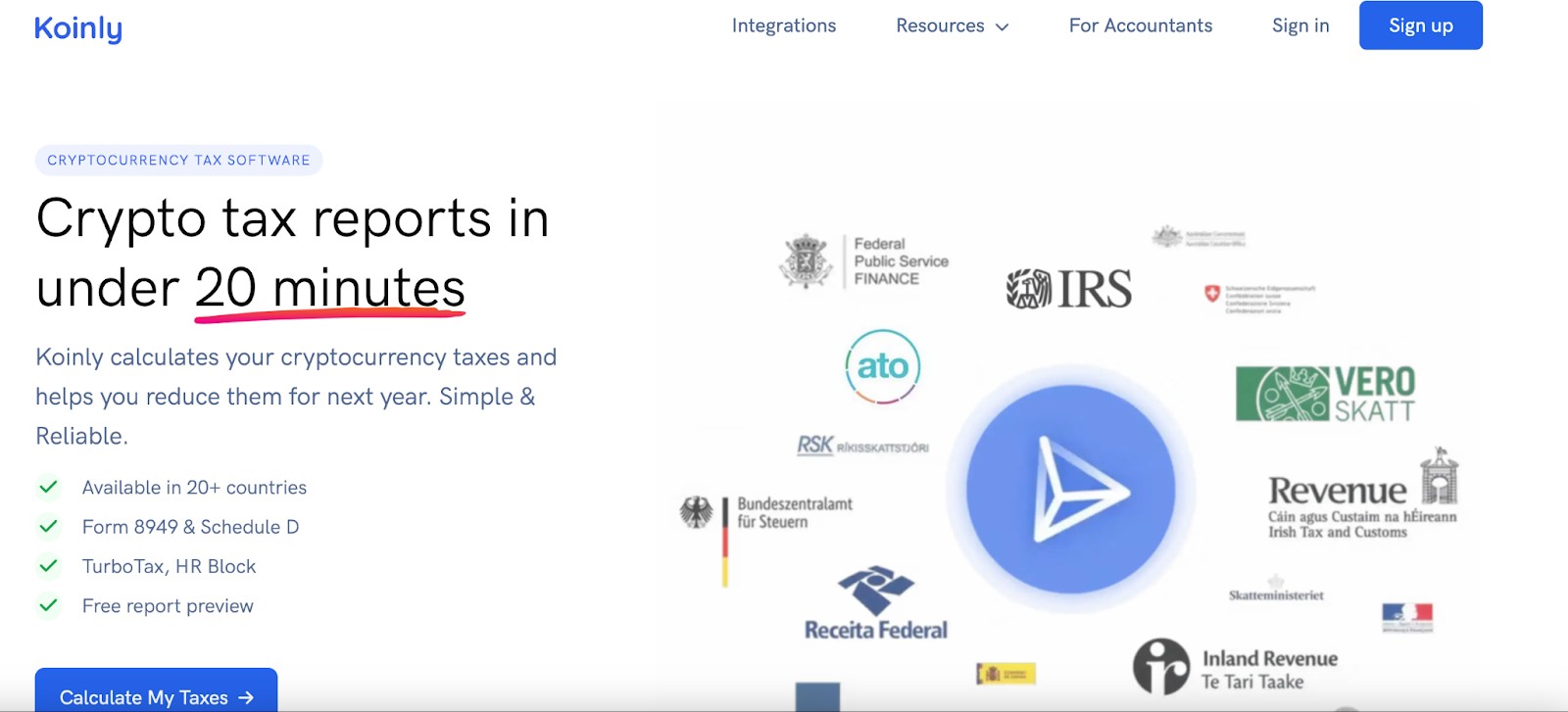
Koinly is one of the most popular crypto tax tools, known for its user-friendly interface and quick setup process. It supports a wide range of exchanges and wallets and is especially suitable for beginners.
Key features:
automatic transaction syncing;
capital gains and income reports;
support for multiple tax jurisdictions;
simple dashboard for tracking portfolio performance.
Koinly is a solid choice if you want a straightforward solution without diving too deep into reconciliation details.
CoinTracking – best for advanced traders
CoinTracking is a powerful platform aimed at experienced traders who need detailed analytics alongside tax reporting.

Key features:
in-depth trading analytics and performance reports;
support for thousands of cryptocurrencies;
tax reports compatible with multiple jurisdictions;
historical data tracking for long-term analysis.
While the interface can feel complex, it offers one of the most comprehensive datasets for active traders.
TokenTax – best for full-service tax support
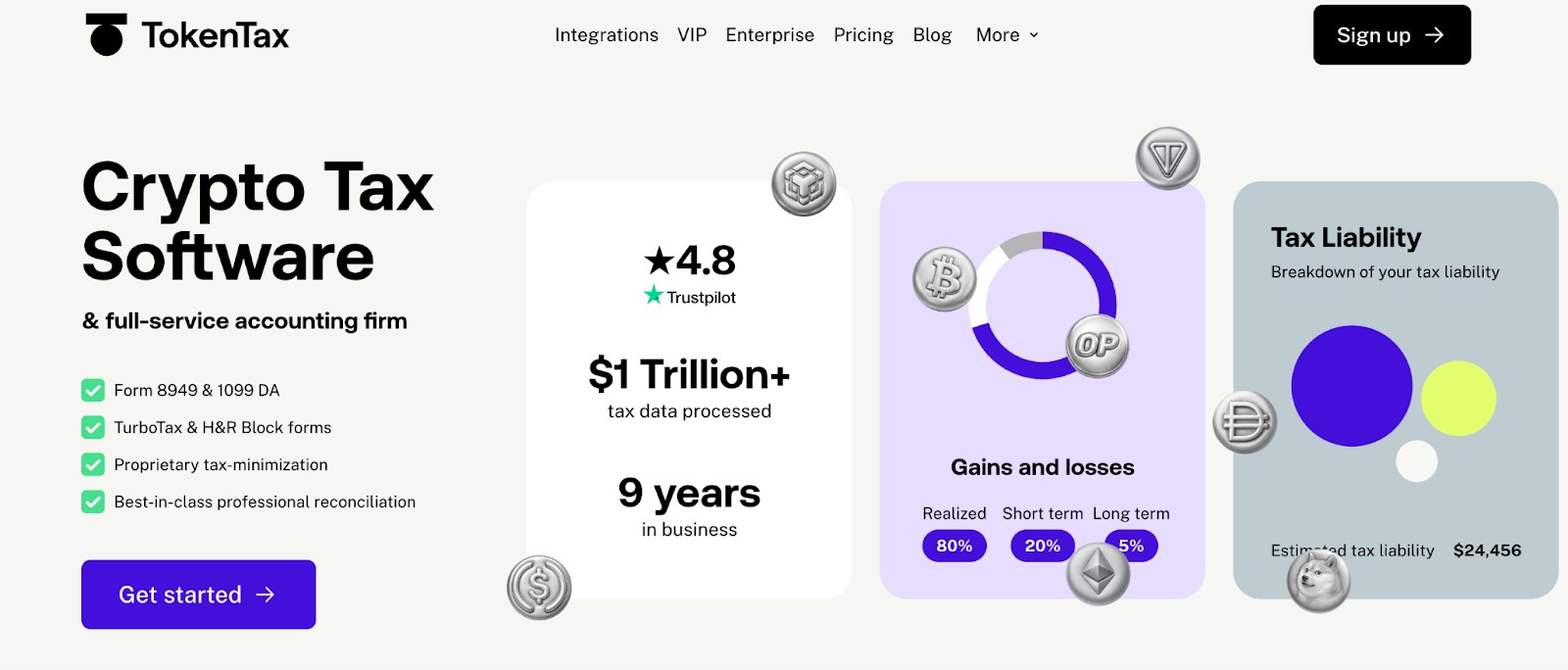
TokenTax combines software with professional tax services, making it ideal for users who want expert assistance alongside automation.
Key features:
tax report generation and CPA support;
DeFi and NFT tax handling;
integration with major exchanges;
personalized tax filing assistance.
It’s more expensive than most tools but valuable for high-net-worth traders or those with complicated tax situations.
Why crypto tax software is no longer optional
Crypto taxation has changed dramatically over the past few years. What used to be a loosely regulated space is now subject to strict reporting requirements in many countries. In the US, the introduction of Form 1099-DA and global frameworks like CARF mean that exchanges and regulators already have access to transaction data.
Every taxable event – from selling crypto to swapping tokens, earning staking rewards, or using DeFi – must be reported. Manually calculating this across multiple wallets and platforms is not just time-consuming, but highly error-prone.
Crypto tax software automates this process, ensuring accurate cost basis tracking, proper classification of transactions, and generation of compliant tax reports.
How to choose the right crypto tax tool
When selecting a crypto tax reporting platform, consider the following:
integration coverage – make sure it supports your exchanges, wallets, and DeFi activity;
accuracy and reconciliation – tools that detect missing data are critical;
compliance support – especially important with tightening global regulations;
ease of use – beginners may prefer simpler dashboards;
pricing model – some tools charge per transaction volume.
However, even the most advanced tax tool depends on the quality of your underlying data. The exchanges and platforms you use play a key role in how accurately your transactions are recorded and later processed for tax reporting. Choosing reliable crypto exchanges with transparent reporting and strong integration support can significantly simplify the entire process.
Below is a comparison of popular crypto exchanges that are widely supported by leading tax reporting tools and offer features that help maintain clean and trackable transaction histories.
| Coinbase | OKX | BTCC | Cryptohopper | Crypto.com | |
|---|---|---|---|---|---|
|
Min. Deposit, $ |
10 | 10 | 10 | No | 1 |
|
Coins Supported |
400+ | 600+ | 399 | 1000 | 400+ |
|
Spot Taker fee, % |
0.5 | 0.1 | 0.3 | 0 | 0.5 |
|
Spot Maker Fee, % |
0.5 | 0.08 | 0.2 | 0 | 0.25 |
|
Alerts |
Yes | Yes | No | Yes | Yes |
|
Copy trading |
No | Yes | Yes | Yes | No |
|
TU overall score |
8.5 | 8.46 | 8.08 | 7.8 | 7.76 |
|
Open an account |
Go to broker Your capital is at risk. |
Go to broker Your capital is at risk. |
Go to broker Your capital is at risk.
|
Go to broker Your capital is at risk. |
Go to broker Your capital is at risk. |
Tax tracking should be integrated into your trading workflow

Over the years of working with crypto portfolios ranging from straightforward spot trading to more complex multi-platform and DeFi activity, one consistent pattern stands out: the primary risk is not market movement, but poor data management. Even minor gaps or inconsistencies in transaction records can lead to significant complications when it comes to reporting and verification.
From a professional standpoint, tax tracking should be integrated into your overall trading workflow rather than treated as a once-a-year obligation. It is important to rely on a solution that not only performs calculations, but also provides transparency and traceability of each figure. If the underlying data cannot be clearly validated, the reliability of the final report is inherently limited.
In my experience, traders who maintain structured, accurate records from the outset operate with greater confidence and control. This approach not only minimizes compliance risks but also provides a more accurate understanding of performance over time, supporting better decision-making and long-term consistency.
Conclusion
Reliable crypto tax reporting tools are now essential rather than optional, ensuring accurate, audit-ready tax reports for modern traders navigating increasingly complex portfolios. Platforms like Summ excel at consolidating multi-exchange, wallet, and DeFi transactions to deliver unmatched accuracy, while beginners might appreciate Koinly’s intuitive setup and simplicity. Integrating tax tracking into your trading workflow not only minimizes compliance risks but also provides greater clarity and confidence in managing your portfolio. Ultimately, the true power of these tools lies in their ability to turn overwhelming data into transparent, actionable insights that support smarter trading decisions.
FAQs
Can crypto tax reporting tools support users in multiple countries with varying tax regulations?
How do crypto tax tools ensure the accuracy of tax reports when data is missing or inconsistent?
What role do data quality and record-keeping play in effective crypto tax reporting?
Is it necessary to use different crypto tax tools for portfolio tracking and tax reporting?
Editors' Top Picks and Insights






Related Articles
Team that worked on the article
Anastasiia has 17 years of experience in finance and content marketing. She believes that the support of information and expert opinion is very important for the success of investors and new traders.
Dan Blystone began his trading career in 1998 as an arbitrage clerk on the floor of the Chicago Mercantile Exchange (CME). He later traded bond and Eurex futures at proprietary firms such as Altea Trading, gaining valuable experience in high-frequency trading and risk management.
Chinmay Soni is a financial analyst with more than 5 years of experience in working with stocks, Forex, derivatives, and other assets. As a founder of a boutique research firm and an active researcher, he covers various industries and fields, providing insights backed by statistical data.
Ethereum is a decentralized blockchain platform and cryptocurrency that was proposed by Vitalik Buterin in late 2013 and development began in early 2014. It was designed as a versatile platform for creating decentralized applications (DApps) and smart contracts.
CFD is a contract between an investor/trader and seller that demonstrates that the trader will need to pay the price difference between the current value of the asset and its value at the time of contract to the seller.
Bitcoin is a decentralized digital cryptocurrency that was created in 2009 by an anonymous individual or group using the pseudonym Satoshi Nakamoto. It operates on a technology called blockchain, which is a distributed ledger that records all transactions across a network of computers.
Index in trading is the measure of the performance of a group of stocks, which can include the assets and securities in it.
Cryptocurrency is a type of digital or virtual currency that relies on cryptography for security. Unlike traditional currencies issued by governments (fiat currencies), cryptocurrencies operate on decentralized networks, typically based on blockchain technology.

-
 Afghanistan
-
 Albania
-
 Algeria
-
 Angola
-
 Argentina
-
 Armenia
-
 Australia
-
 Austria
-
 Azerbaijan
-
 Bahamas
-
 Bahrain
-
 Bangladesh
-
 Belarus
-
 Belgium
-
 Bolivia
-
 Botswana
-
 Brazil
-
 Brunei
-
 Bulgaria
-
 Cambodia
-
 Cameroon
-
 Canada
-
 Chile
Chile
-
 China
China
-
 Colombia
-
 Congo
Congo
-
 Costa Rica
-
 Cote d'Ivoire
-
 Croatia
-
 Cuba
Cuba
-
 Cyprus
-
 Czechia
-
 DR Congo
-
 Denmark
-
 Dominican Republic
-
 Ecuador
-
 Egypt
Egypt
-
 El Salvador
-
 Estonia
-
 Eswatini
-
 Ethiopia
-
 Finland
-
 France
-
 Georgia
-
 Germany
-
 Ghana
Ghana
-
 Greece
-
 Haiti
Haiti
-
 Hong Kong
-
 Hungary
-
 India
India
-
 Indonesia
-
 Iran, Islamic republic
-
 Iraq
Iraq
-
 Ireland
-
 Israel
-
 Italy
Italy
-
 Jamaica
-
 Japan
Japan
-
 Jordan
-
 Kazakhstan
-
 Kenya
Kenya
-
 Korea
Korea
-
 Kuwait
-
 Kyrgyzstan
-
 Laos
Laos
-
 Latvia
-
 Lebanon
-
 Lesotho
-
 Libya
Libya
-
 Lithuania
-
 Luxembourg
-
 Madagascar
-
 Malaysia
-
 Malta
Malta
-
 Mauritius
-
 Mexico
-
 Moldova
-
 Mongolia
-
 Montenegro
-
 Morocco
-
 Mozambique
-
 Myanmar
-
 Namibia
-
 Nepal
Nepal
-
 Netherlands
-
 New Zealand
-
 Nigeria
-
 North Macedonia
-
 Norway
-
 Oman
Oman
-
 Pakistan
-
 Palestine
-
 Panama
-
 Papua New Guinea
-
 Paraguay
-
 Peru
Peru
-
 Philippines
-
 Poland
-
 Portugal
-
 Puerto Rico
-
 Qatar
Qatar
-
 Reunion
-
 Romania
-
 Rwanda
-
 Saudi Arabia
-
 Serbia
-
 Singapore
-
 Slovakia
-
 Slovenia
-
 Somalia
-
 South Africa
-
 Spain
Spain
-
 Sri Lanka
-
 Sweden
-
 Switzerland
-
 Syria
Syria
-
 Taiwan
-
 Tajikistan
-
 Tanzania
-
 Thailand
-
 Trinidad and Tobago
-
 Tunisia
-
 Turkey
-
 UAE
UAE
-
 Uganda
-
 Ukraine
-
 United Kingdom
-
United States
-
 Uruguay
-
 Uzbekistan
-
 Venezuela
-
 Vietnam
-
 Yemen
Yemen
-
 Zambia
-
 Zimbabwe
- Forex
- Crypto












