
How To Find Your Telegram Wallet Address? Step-by-Step Guide


Editorial Note: While we adhere to strict Editorial Integrity, this post may contain references to products from our partners. Here's an explanation for How We Make Money. None of the data and information on this webpage constitutes investment advice according to our Disclaimer.
To find your Telegram wallet address, follow these simple steps:
In cryptocurrency, a wallet address works the same way as a bank account number. It is required to receive funds, transfer assets to exchanges, or send coins to another user. Each address is unique and tied to a specific coin and network, meaning that a mistake when entering it can result in a loss of funds. In this article, we explain how to find your Telegram wallet address and how to use it properly.
Risk warning: Cryptocurrency markets are highly volatile, with sharp price swings and regulatory uncertainties. Research indicates that 75-90% of traders face losses. Only invest discretionary funds and consult an experienced financial advisor.
How to check your wallet address in Telegram? Step-by-step guide
We prepared a detailed guide on how to find your wallet number in Telegram. For clarity, we’ll use Telegram Wallet (@wallet), one of the most popular storage solutions for cryptocurrency in the messenger.
Step 1. Log in to the wallet
Before checking your wallet address in Telegram, log in to your wallet. Enter your password (if required). If you don't have one yet, first create a Telegram Wallet and complete the setup process.

Step 2. Select the option to top up with cryptocurrency
To view your Telegram wallet address, choose the crypto deposit option. In your Telegram Wallet, click Add Crypto, then External Wallet.

Step 3. Choose the cryptocurrency
Next, select the coin you want to deposit. Remember, each coin has its own unique wallet address. If a coin supports multiple networks (for example, USDT supports ERC-20, TRC-20, TON), you’ll also need to select the network.
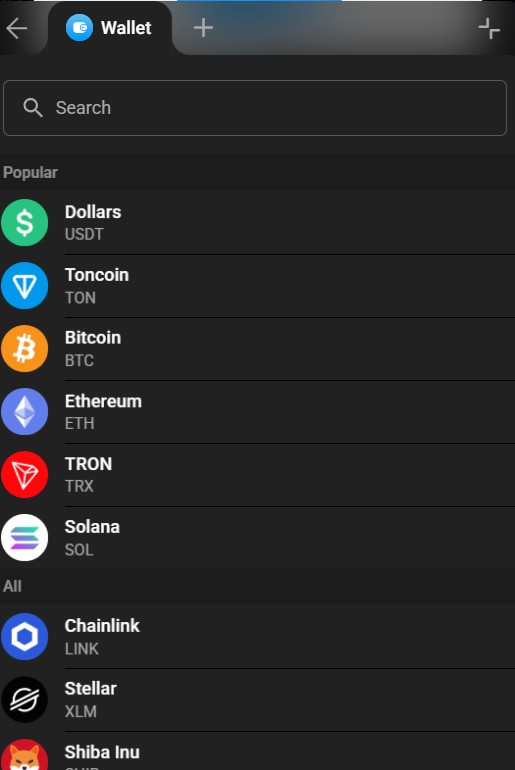
Step 4. Get the address
After choosing the cryptocurrency and network, you’ll see a QR code and a text address. This is your Telegram wallet address.
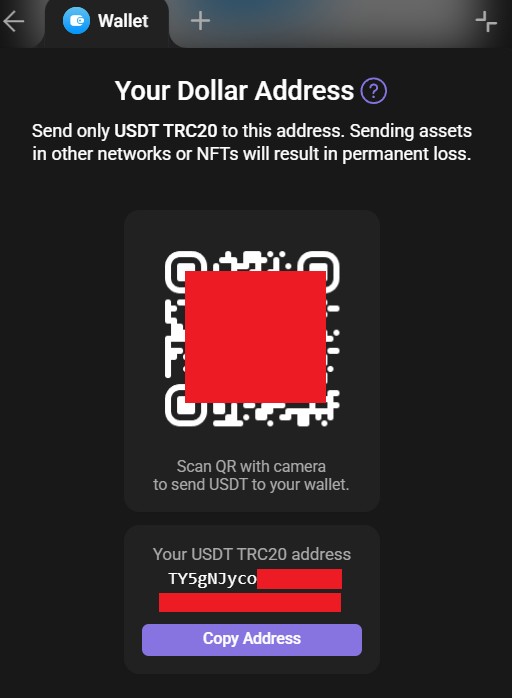
Do note that finding your Telegram wallet address is only the first step. To actually use it, whether for deposits, withdrawals, or converting crypto into fiat, you’ll need to connect with a trusted crypto exchange. Exchanges act as the bridge between your Telegram wallet and the broader financial system, giving you access to more coins, trading pairs, and bank transfers. Choosing the right platform in your region ensures faster processing, lower fees, and stronger security. Below, we highlight the best crypto exchanges available where you are.
| Coinbase | OKX | BTCC | Cryptohopper | Crypto.com | |
|---|---|---|---|---|---|
|
Min. Deposit, $ |
10 | 10 | 10 | No | 1 |
|
Coins Supported |
400+ | 600+ | 399 | 1000 | 400+ |
|
Spot Taker fee, % |
0.5 | 0.1 | 0.3 | 0 | 0.5 |
|
Spot Maker Fee, % |
0.5 | 0.08 | 0.2 | 0 | 0.25 |
|
Alerts |
Yes | Yes | No | Yes | Yes |
|
Copy trading |
No | Yes | Yes | Yes | No |
|
TU overall score |
8.5 | 8.46 | 8.08 | 7.8 | 7.76 |
|
Open an account |
Go to broker Your capital is at risk. |
Go to broker Your capital is at risk. |
Go to broker Your capital is at risk.
|
Go to broker Your capital is at risk. |
Go to broker Your capital is at risk. |
Where to find MEMO in a Telegram Wallet
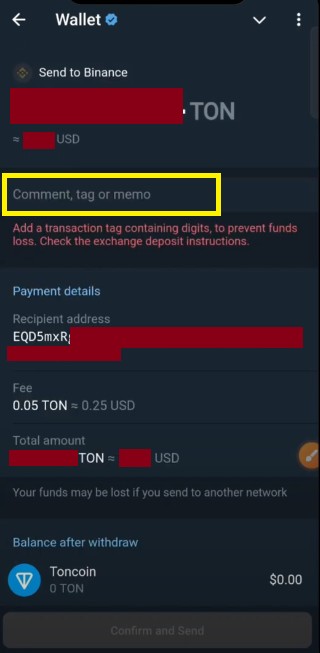
MEMO (also called Tag or Target ID) is an additional parameter sometimes required when transferring cryptocurrency, especially to exchanges. It ensures the system correctly credits your account, since many users share the same deposit address. Entering MEMO incorrectly may result in your funds not being credited.
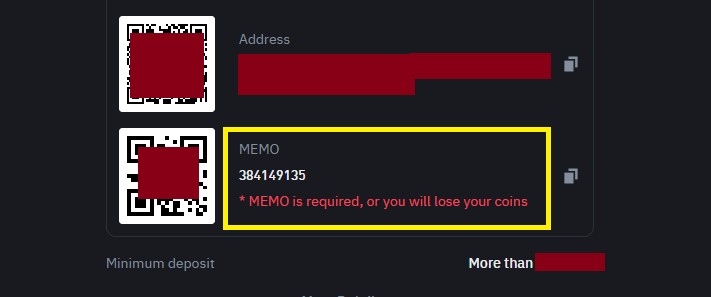
MEMO is not always required, only for some coins and networks (for example, USDT in certain networks or TON deposits to exchanges). To find it:
Step 1: Go to the exchange
Open the exchange where you’re making the deposit. Choose the cryptocurrency that requires MEMO (for example, TON).
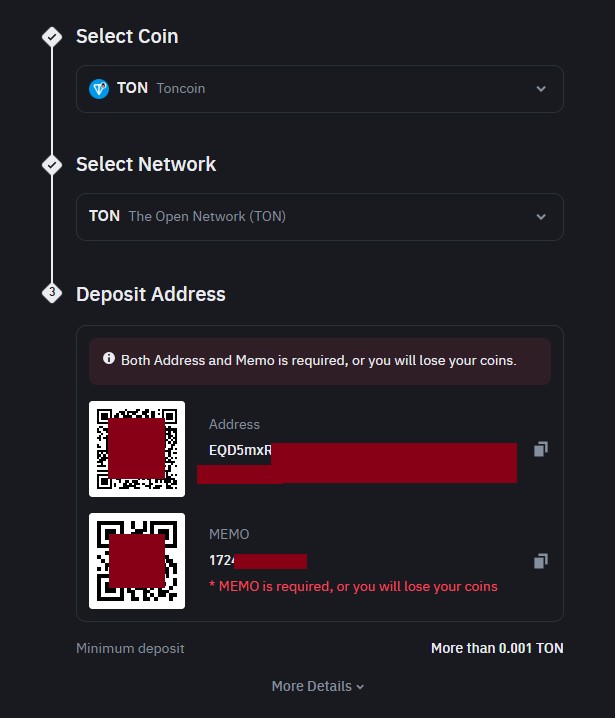
Step 2. In the transfer field, enter the wallet address and MEMO
In Telegram Wallets, there’s a dedicated field for MEMO.
What is a Telegram wallet address?
A crypto wallet address is a unique string of characters that serves as an identifier for receiving and sending digital assets. In Telegram, it is automatically generated inside the built-in Telegram Wallet service and works just like addresses in other crypto wallets. Without this address, you cannot receive cryptocurrency.
Why you need a crypto wallet address
Your Telegram wallet address is used for:
Receiving transfers from other users or exchanges.
Sending cryptocurrency to other wallets.
Storing and managing assets in the TON ecosystem and other supported networks.
Structure of a Telegram wallet address
It is a combination of letters and numbers generated by the blockchain (for example, UQ… for TON or T… for USDT TRC-20).
Each network has its own unique format (TON, Bitcoin, TRON, etc.).
Sometimes an address is accompanied by MEMO/Tag (especially for exchange deposits).
Risks and warnings
Using Telegram wallets is convenient but carries risks every trader must consider. Even small mistakes can result in the loss of funds:
Sending funds to the wrong network (e.g., USDT TRC-20 to a TON address).
Malware replacing your copied address.
Wallet freezes due to missing KYC or suspicious activity (custodial wallets only).
Phishing bots and fake websites imitating real wallets.
Risk of losing funds in custodial wallets where you don’t control private keys.
Always check the network, verify addresses, and use secure methods for storing crypto.
How to safely use your Telegram wallet ID
Transactions in blockchain are irreversible, so mistakes can result in lost funds. Even though sending crypto may seem as simple as “copy and paste,” extra care is needed.
Safety recommendations
Always double-check the network before sending (e.g., USDT TRC-20 cannot be sent to a TON address).
Compare the first and last characters of the wallet address before confirming the transfer.
Use QR codes to avoid copy-paste errors.
Send a small test transfer before sending large amounts.
Never share your seed phrase or private keys. Sharing your wallet address is fine, but the seed phrase gives full access to your wallet.
Store large sums in hardware or non-custodial wallets. Use Telegram Wallet for everyday operations.
Make sure you’re using the official @wallet and the official Telegram app, not fake bots or phishing sites.
Beware of malware that can replace copied addresses in your clipboard.
Do not store all your crypto in one wallet. Diversify between Telegram Wallet and exchanges.
Always check the network before transferring, verify the address characters

A Telegram wallet address is a key element for working with digital assets inside the messenger. Whether you use a mobile wallet, hardware device, or built-in Telegram Wallet, the principle is the same: each coin and network has a unique wallet address. Mistakes are irreversible and result in permanent loss.
The process of finding your Telegram wallet address is similar across wallets, though details vary. Always check the network first, as entering the wrong one can send your funds to the wrong place. Transactions in blockchain cannot be reversed.
Verify address characters, use QR codes, and test with small transfers. Custodial wallets are fine for everyday use, but long-term storage is safer in hardware or non-custodial solutions. This balance ensures both convenience and security.
Conclusion
Finding and using your Telegram wallet address is a straightforward process, but it requires careful attention to detail to avoid irreversible mistakes. Each coin and network has its own unique address format, making it crucial to always verify you are using the correct details before transferring funds. For example, sending USDT TRC-20 to a TON address or neglecting to add a required MEMO can result in lost assets. Ultimately, while Telegram Wallet offers impressive convenience for daily crypto transactions, true security comes from vigilance, using only official apps, and never sharing private keys.
FAQs
How does a Telegram wallet address differ from traditional bank account numbers?
Is it necessary to use a MEMO or Tag when transferring crypto to a Telegram wallet?
What steps can users take to enhance the security of their Telegram wallet address?
Can you recover cryptocurrency if it is sent to the wrong Telegram wallet address or network?
Editors' Top Picks and Insights




Related Articles
Team that worked on the article
Rinat Gismatullin is an entrepreneur and a business expert with 9 years of experience in trading. He focuses on long-term investing, but also uses intraday trading.
Dan Blystone began his trading career in 1998 as an arbitrage clerk on the floor of the Chicago Mercantile Exchange (CME). He later traded bond and Eurex futures at proprietary firms such as Altea Trading, gaining valuable experience in high-frequency trading and risk management.
Chinmay Soni is a financial analyst with more than 5 years of experience in working with stocks, Forex, derivatives, and other assets. As a founder of a boutique research firm and an active researcher, he covers various industries and fields, providing insights backed by statistical data.
Index in trading is the measure of the performance of a group of stocks, which can include the assets and securities in it.
Risk management is a risk management model that involves controlling potential losses while maximizing profits. The main risk management tools are stop loss, take profit, calculation of position volume taking into account leverage and pip value.
Cryptocurrency is a type of digital or virtual currency that relies on cryptography for security. Unlike traditional currencies issued by governments (fiat currencies), cryptocurrencies operate on decentralized networks, typically based on blockchain technology.
Day trading involves buying and selling financial assets within the same trading day, with the goal of profiting from short-term price fluctuations, and positions are typically not held overnight.
CFD is a contract between an investor/trader and seller that demonstrates that the trader will need to pay the price difference between the current value of the asset and its value at the time of contract to the seller.

-
 Afghanistan
-
 Albania
-
 Algeria
-
 Angola
-
 Argentina
-
 Armenia
-
 Australia
-
 Austria
-
 Azerbaijan
-
 Bahamas
-
 Bahrain
-
 Bangladesh
-
 Belarus
-
 Belgium
-
 Bolivia
-
 Botswana
-
 Brazil
-
 Brunei
-
 Bulgaria
-
 Cambodia
-
 Cameroon
-
 Canada
-
 Chile
Chile
-
 China
China
-
 Colombia
-
 Congo
Congo
-
 Costa Rica
-
 Cote d'Ivoire
-
 Croatia
-
 Cuba
Cuba
-
 Cyprus
-
 Czechia
-
 DR Congo
-
 Denmark
-
 Dominican Republic
-
 Ecuador
-
 Egypt
Egypt
-
 El Salvador
-
 Estonia
-
 Eswatini
-
 Ethiopia
-
 Finland
-
 France
-
 Georgia
-
 Germany
-
 Ghana
Ghana
-
 Greece
-
 Haiti
Haiti
-
 Hong Kong
-
 Hungary
-
 India
India
-
 Indonesia
-
 Iran, Islamic republic
-
 Iraq
Iraq
-
 Ireland
-
 Israel
-
 Italy
Italy
-
 Jamaica
-
 Japan
Japan
-
 Jordan
-
 Kazakhstan
-
 Kenya
Kenya
-
 Korea
Korea
-
 Kuwait
-
 Kyrgyzstan
-
 Laos
Laos
-
 Latvia
-
 Lebanon
-
 Lesotho
-
 Libya
Libya
-
 Lithuania
-
 Luxembourg
-
 Madagascar
-
 Malaysia
-
 Malta
Malta
-
 Mauritius
-
 Mexico
-
 Moldova
-
 Mongolia
-
 Montenegro
-
 Morocco
-
 Mozambique
-
 Myanmar
-
 Namibia
-
 Nepal
Nepal
-
 Netherlands
-
 New Zealand
-
 Nigeria
-
 North Macedonia
-
 Norway
-
 Oman
Oman
-
 Pakistan
-
 Palestine
-
 Panama
-
 Papua New Guinea
-
 Paraguay
-
 Peru
Peru
-
 Philippines
-
 Poland
-
 Portugal
-
 Puerto Rico
-
 Qatar
Qatar
-
 Reunion
-
 Romania
-
 Rwanda
-
 Saudi Arabia
-
 Serbia
-
 Singapore
-
 Slovakia
-
 Slovenia
-
 Somalia
-
 South Africa
-
 Spain
Spain
-
 Sri Lanka
-
 Sweden
-
 Switzerland
-
 Syria
Syria
-
 Taiwan
-
 Tajikistan
-
 Tanzania
-
 Thailand
-
 Trinidad and Tobago
-
 Tunisia
-
 Turkey
-
 UAE
UAE
-
 Uganda
-
 Ukraine
-
 United Kingdom
-
United States
-
 Uruguay
-
 Uzbekistan
-
 Venezuela
-
 Vietnam
-
 Yemen
Yemen
-
 Zambia
-
 Zimbabwe
- Forex
- Crypto












