
How To Find Your Telegram Wallet MEMO?


Editorial Note: While we adhere to strict Editorial Integrity, this post may contain references to products from our partners. Here's an explanation for How We Make Money. None of the data and information on this webpage constitutes investment advice according to our Disclaimer.
How to find a MEMO in your Telegram wallet:
The integration of cryptocurrency into Telegram through the TON blockchain has brought millions of users into crypto. While wallets inside Telegram make sending and receiving coins easier than ever, many newcomers encounter confusion around one technical detail: the Telegram wallet MEMO. This guide explains what it is, why it matters, how to find it, and what the latest research and reports say about its role in the growing TON ecosystem.
Risk warning: Cryptocurrency markets are highly volatile, with sharp price swings and regulatory uncertainties. Research indicates that 75-90% of traders face losses. Only invest discretionary funds and consult an experienced financial advisor.
What is a Telegram wallet MEMO?
A Telegram wallet MEMO (also called a MEMO, tag, or destination comment) is a unique identifier attached to blockchain transactions. It is required when funds are being sent to a shared deposit address, such as those used by custodial wallets, exchanges, or payment processors.
The wallet address is like the street address of a hotel.
The MEMO is like the room number, ensuring your funds arrive in the right account.
Without the correct MEMO, your transaction might still reach the address but remain uncredited or stuck in limbo.
MEMOs are a crucial safeguard against transaction misrouting on blockchains like TON, XRP, and Stellar, where exchanges often rely on a single address to process thousands of deposits daily.
How to find your Telegram wallet MEMO
Let’s clarify where to locate a MEMO tag in the Telegram Wallet. First, it’s important to note: the Telegram Wallet does not provide a MEMO field by default. A MEMO is only required when transferring funds to exchanges or services that use a shared wallet address and an additional identifier. With this in mind, here’s a step-by-step guide on how to find and use MEMO in the Telegram Wallet. For this example, we’ll use Telegram Wallet and the Binance exchange.
Step 1. Log in to your wallet and select “Send”
Open your crypto wallet in Telegram. Choose the Send option.

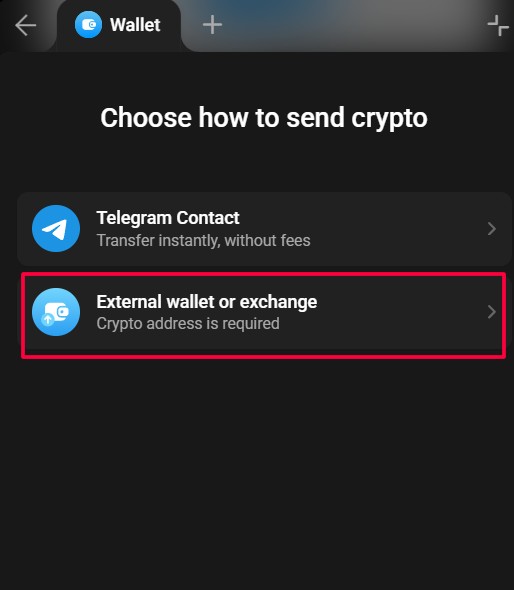
Step 2. Select how you want to send crypto
Choose External wallet or exchange since you’re transferring funds to an exchange. In other cases, a MEMO tag is not required in the Telegram Wallet.
Step 3. Open your cryptocurrency exchange
After selecting the sending method, the wallet will ask for an address. To get it, log in to your account and open your exchange wallet.

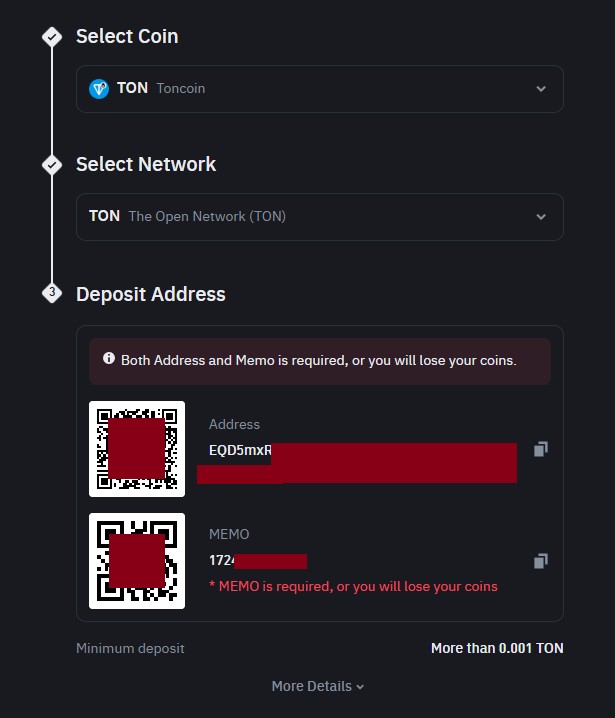
Step 4. Choose the coin and network, then get the address and MEMO
Next, select the cryptocurrency and network. For example, TON on The Open Network. Click Get Address. The exchange will generate both an address and a MEMO – shown as two QR codes and two text strings. These are the details you’ll need to enter in the Telegram Wallet if required.
Step 5. Send crypto from Telegram Wallet to the exchange wallet
Now, here’s the answer to where you actually find MEMO in the Telegram Wallet. Copy the deposit address from the exchange and paste it into the recipient field in Telegram Wallet. The wallet will automatically identify the exchange account. Click on it, and a form will open where you enter the transfer amount and the MEMO (highlighted in yellow in the screenshot). Paste the MEMO into the designated field.
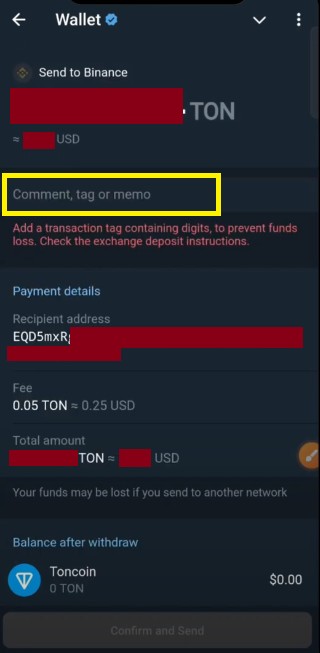
Important: Before confirming the transaction, always double-check the address, amount, fees, and MEMO in the Telegram Wallet. Only confirm once all details are verified.
Why does the MEMO matter?
The MEMO plays a critical role in ensuring your funds are processed correctly. Ignoring it can turn a simple transaction into a frustrating experience with delays, recovery requests, or even permanent loss.
Correct fund allocation. Exchanges like Binance, KuCoin, and OKX require MEMOs for TON or USDT deposits. If the MEMO is missing or wrong, the system cannot assign the funds to your account.
Risk of delays and fees. A missing MEMO means you’ll have to file a support ticket and provide transaction IDs for manual recovery. Some platforms charge a recovery fee of $5–50 or even decline recovery for small transfers.
TON ecosystem growth. As TON expands into staking, DeFi, and NFTs inside Telegram, MEMOs remain a vital part of ensuring accuracy in multi-user financial flows.
As MEMOs highlight, details can make or break a transaction. And while Telegram wallets simplify transfers, most traders still rely on exchanges for fiat ramps, broader asset access, or advanced trading tools. To bridge the two, choosing a trusted platform matters. Below we highlight the best crypto exchanges in your region, helping you fund your wallet, withdraw securely, and trade with confidence.
| Coinbase | OKX | BTCC | Cryptohopper | Crypto.com | |
|---|---|---|---|---|---|
|
Min. Deposit, $ |
10 | 10 | 10 | No | 1 |
|
Coins Supported |
400+ | 600+ | 399 | 1000 | 400+ |
|
Spot Taker fee, % |
0.5 | 0.1 | 0.3 | 0 | 0.5 |
|
Spot Maker Fee, % |
0.5 | 0.08 | 0.2 | 0 | 0.25 |
|
Alerts |
Yes | Yes | No | Yes | Yes |
|
Copy trading |
No | Yes | Yes | Yes | No |
|
TU overall score |
8.5 | 8.46 | 8.08 | 7.8 | 7.76 |
|
Open an account |
Go to broker Your capital is at risk. |
Go to broker Your capital is at risk. |
Go to broker Your capital is at risk.
|
Go to broker Your capital is at risk. |
Go to broker Your capital is at risk. |
Common mistakes and how to avoid them
Even experienced crypto users sometimes slip up when handling MEMOs. These errors are usually simple but can have costly consequences. Knowing the most frequent mistakes will help you avoid them and keep every transfer safe.
Leaving the MEMO field blank when the service specifies one.
Mixing up MEMO and chat messages the MEMO is strictly for transactions, not for personal notes.
Copying only the wallet address without the MEMO when withdrawing to an exchange.
If the receiving wallet states “No MEMO required,” you can safely skip it.
What to do if you forget the MEMO
If you send funds without the required MEMO:
Contact the support team of the receiving service immediately.
Provide your TXID (transaction ID), amount, and sending address.
Be prepared for a waiting period and possibly a recovery fee.
On average, manual recovery can take between 1–14 days depending on the exchange and the network’s traffic.
Real-world context: TON and MEMO relevance
The MEMO is not just a technical detail it is becoming more important as TON adoption accelerates.
Telegram Wallet expansion (2026). Telegram introduced the built-in TON wallet globally, including in the U.S., unlocking access for over 800 million users.
DeFi and NFT integration. With growing demand for decentralized apps (DApps), shared service wallets will rely heavily on MEMOs for accurate routing.
TON Space and Tonkeeper. Popular wallets confirm that MEMOs are required only when sending to custodial services, not for peer-to-peer TON transactions.
Develop the habit of double-checking every field, including MEMO

For a trader, MEMO isn’t just a technical detail – it’s a key risk management tool. I strongly recommend building a simple habit: before every transfer, verify not only the address and network but also all additional fields, including MEMO.
Keep screenshots of your transactions and copies of TXIDs – these can speed up the recovery process if needed. If you work across multiple exchanges, create your own checklist outlining where MEMO is mandatory and where it isn’t. Beginners should always confirm the specific requirements of the platform they’re using, while advanced traders should factor in potential delays when making large transfers.
This approach helps minimize risks and keeps your focus on trading rather than troubleshooting technical issues.
Conclusion
Mastering the use of your Telegram Wallet MEMO is essential for seamless and secure TON transactions. As highlighted, the MEMO field plays a critical role in ensuring your transfers reach the correct recipient, particularly when dealing with exchanges or multi-user wallets. Overlooking this small yet vital step can result in lost funds or delayed processing, underscoring the importance of double-checking your transaction details. For instance, always verify MEMO requirements before sending TON or risk financial inconvenience. Ultimately, attention to the MEMO not only saves you from costly errors but also empowers you to fully harness the efficiency of blockchain transfers within Telegram.
FAQs
How does a Telegram Wallet MEMO differ from a regular wallet address?
In which situations do you not need to use a MEMO when sending cryptocurrency from your Telegram Wallet?
What are the potential risks of entering an incorrect MEMO in your Telegram Wallet transaction?
How are MEMOs used in Telegram Wallet transactions as the TON ecosystem grows?
Editors' Top Picks and Insights





Related Articles
Team that worked on the article
Ivan is a financial expert and analyst specializing in Forex, crypto, and stock trading. He prefers conservative trading strategies with low and medium risks, as well as medium-term and long-term investments.
Dan Blystone began his trading career in 1998 as an arbitrage clerk on the floor of the Chicago Mercantile Exchange (CME). He later traded bond and Eurex futures at proprietary firms such as Altea Trading, gaining valuable experience in high-frequency trading and risk management.
Chinmay Soni is a financial analyst with more than 5 years of experience in working with stocks, Forex, derivatives, and other assets. As a founder of a boutique research firm and an active researcher, he covers various industries and fields, providing insights backed by statistical data.
CFD is a contract between an investor/trader and seller that demonstrates that the trader will need to pay the price difference between the current value of the asset and its value at the time of contract to the seller.
Index in trading is the measure of the performance of a group of stocks, which can include the assets and securities in it.
Copy trading is an investing tactic where traders replicate the trading strategies of more experienced traders, automatically mirroring their trades in their own accounts to potentially achieve similar results.
Cryptocurrency is a type of digital or virtual currency that relies on cryptography for security. Unlike traditional currencies issued by governments (fiat currencies), cryptocurrencies operate on decentralized networks, typically based on blockchain technology.
Bitcoin is a decentralized digital cryptocurrency that was created in 2009 by an anonymous individual or group using the pseudonym Satoshi Nakamoto. It operates on a technology called blockchain, which is a distributed ledger that records all transactions across a network of computers.

-
 Afghanistan
-
 Albania
-
 Algeria
-
 Angola
-
 Argentina
-
 Armenia
-
 Australia
-
 Austria
-
 Azerbaijan
-
 Bahamas
-
 Bahrain
-
 Bangladesh
-
 Belarus
-
 Belgium
-
 Bolivia
-
 Botswana
-
 Brazil
-
 Brunei
-
 Bulgaria
-
 Cambodia
-
 Cameroon
-
 Canada
-
 Chile
Chile
-
 China
China
-
 Colombia
-
 Congo
Congo
-
 Costa Rica
-
 Cote d'Ivoire
-
 Croatia
-
 Cuba
Cuba
-
 Cyprus
-
 Czechia
-
 DR Congo
-
 Denmark
-
 Dominican Republic
-
 Ecuador
-
 Egypt
Egypt
-
 El Salvador
-
 Estonia
-
 Eswatini
-
 Ethiopia
-
 Finland
-
 France
-
 Georgia
-
 Germany
-
 Ghana
Ghana
-
 Greece
-
 Haiti
Haiti
-
 Hong Kong
-
 Hungary
-
 India
India
-
 Indonesia
-
 Iran, Islamic republic
-
 Iraq
Iraq
-
 Ireland
-
 Israel
-
 Italy
Italy
-
 Jamaica
-
 Japan
Japan
-
 Jordan
-
 Kazakhstan
-
 Kenya
Kenya
-
 Korea
Korea
-
 Kuwait
-
 Kyrgyzstan
-
 Laos
Laos
-
 Latvia
-
 Lebanon
-
 Lesotho
-
 Libya
Libya
-
 Lithuania
-
 Luxembourg
-
 Madagascar
-
 Malaysia
-
 Malta
Malta
-
 Mauritius
-
 Mexico
-
 Moldova
-
 Mongolia
-
 Montenegro
-
 Morocco
-
 Mozambique
-
 Myanmar
-
 Namibia
-
 Nepal
Nepal
-
 Netherlands
-
 New Zealand
-
 Nigeria
-
 North Macedonia
-
 Norway
-
 Oman
Oman
-
 Pakistan
-
 Palestine
-
 Panama
-
 Papua New Guinea
-
 Paraguay
-
 Peru
Peru
-
 Philippines
-
 Poland
-
 Portugal
-
 Puerto Rico
-
 Qatar
Qatar
-
 Reunion
-
 Romania
-
 Rwanda
-
 Saudi Arabia
-
 Serbia
-
 Singapore
-
 Slovakia
-
 Slovenia
-
 Somalia
-
 South Africa
-
 Spain
Spain
-
 Sri Lanka
-
 Sweden
-
 Switzerland
-
 Syria
Syria
-
 Taiwan
-
 Tajikistan
-
 Tanzania
-
 Thailand
-
 Trinidad and Tobago
-
 Tunisia
-
 Turkey
-
 UAE
UAE
-
 Uganda
-
 Ukraine
-
 United Kingdom
-
United States
-
 Uruguay
-
 Uzbekistan
-
 Venezuela
-
 Vietnam
-
 Yemen
Yemen
-
 Zambia
-
 Zimbabwe
- Forex
- Crypto












