
Trustee Plus Card: A Full Guide


Editorial Note: While we adhere to strict Editorial Integrity, this post may contain references to products from our partners. Here's an explanation for How We Make Money. None of the data and information on this webpage constitutes investment advice according to our Disclaimer.
The Trustee Plus Card is an innovative payment solution that allows users to spend their crypto directly without the need to manually convert it beforehand. It is connected to the Trustee Plus wallet and makes everyday spending simple, from online shopping and bill payments to ATM withdrawals, while keeping your funds secure under non-custodial control. The card is issued through the partner application Quicko Digital, which connects to your verified Trustee Plus account during setup.
Crypto adoption today goes far beyond simple investing or trading; it’s about making digital currencies usable in real life. For most users, the real challenge has been connecting the crypto stored in their wallets with traditional payment systems. Tools like the Trustee crypto card are helping bridge this gap, enabling people to use their digital assets as smoothly as cash or cards in the regular economy.
The Trustee wallet card represents this growing shift toward practical crypto utility. Instead of being just another trading instrument, it’s designed for real-world use: a reliable, seamless payment option that integrates digital assets into everyday transactions. For crypto holders, it’s a step toward treating their coins as spendable money, not just an investment.
Risk warning: Cryptocurrency markets are highly volatile, with sharp price swings and regulatory uncertainties. Research indicates that 75-90% of traders face losses. Only invest discretionary funds and consult an experienced financial advisor.
Understanding the Trustee crypto card
The Trustee Plus Card is a crypto debit card on the Mastercard network that is connected to your personal Trustee Plus non-custodial wallet. It allows you to spend digital assets as easily as traditional money by converting cryptocurrencies such as BTC, ETH, and stablecoins into euros at the moment of payment. The card works through the partner application Quicko Digital, which links to your verified Trustee Plus account during setup.
The system integrates with the wallet’s built-in exchange, so purchases, online payments, and ATM withdrawals are processed instantly without manual conversions. This closes the gap between blockchain assets and everyday spending. Instead of transferring coins through exchanges, you simply pay as with a regular bank card using Apple Pay, Google Pay, or a physical chip or NFC.
In practice, Trustee Plus transforms your crypto portfolio into a multi-asset payment account that remains under your full control. (According to the company, the app now has about 500,000 users and 100,000 issued cards globally.)

When using this card, holders retain access to their private keys and ownership of their assets. Because the Trustee is non-custodial, even if the card is lost, the funds remain safe in the wallet. More than 30 cryptocurrencies are supported, including BTC, ETH, USDT, and TRX, as well as fiat currencies such as EUR and UAH. Payments are accepted worldwide wherever Mastercard operates, at more than 60 million locations. The card automatically converts your selected crypto balance to euros at the point of sale with an approximate 0.5% fee, ensuring merchants receive payment in their local currency. This approach allows users to rely on stablecoins such as USDT or USDC to minimize volatility, as the conversion occurs only during the transaction.
Overall, the Trustee Plus Card, issued through Quicko Digital, is a convenient and practical link between blockchain assets and traditional payment systems.
How to get and use the Trustee Plus card
Obtaining a Quicko Digital Card is simple and fully managed through Trustee Plus.
To qualify, you must:
Be a verified Trustee Plus user with a valid European ID document.
Have your account funded in euros or supported cryptocurrencies such as USDC, ETH, or BTC.
Once those conditions are met, follow these steps to issue your card:
Open the Trustee Plus app and tap “Digital Card” on the home screen.
Download and launch the Quicko Digital app, then sign in using the same phone number linked to your Trustee Plus account. Tap “Connect.”
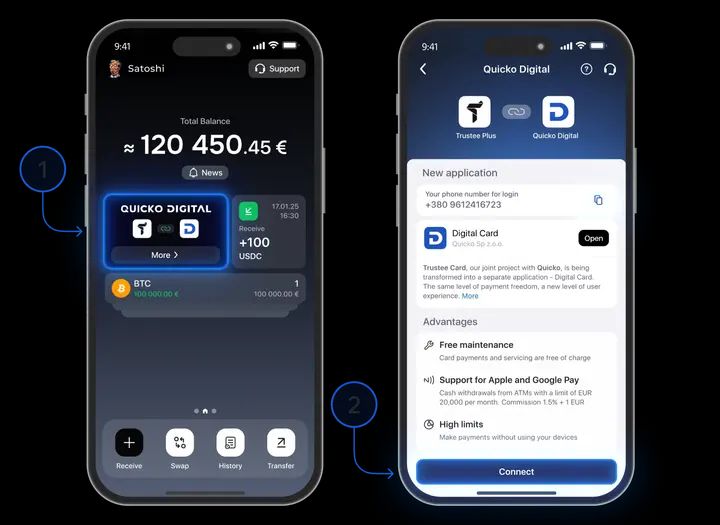
Enter your Quicko account ID when prompted.
On the Quicko dashboard, press “Get a Card.”
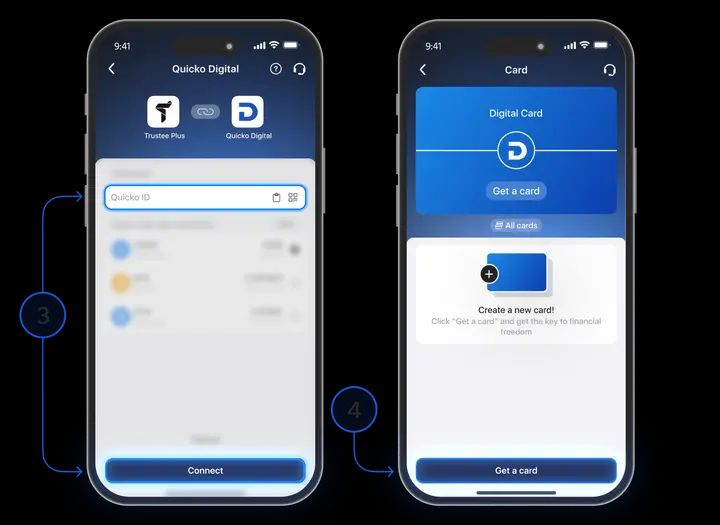
Read and accept the Terms of Use, then tap “Next.”
Choose the card type (for example, virtual or physical) and proceed by tapping “Next.”
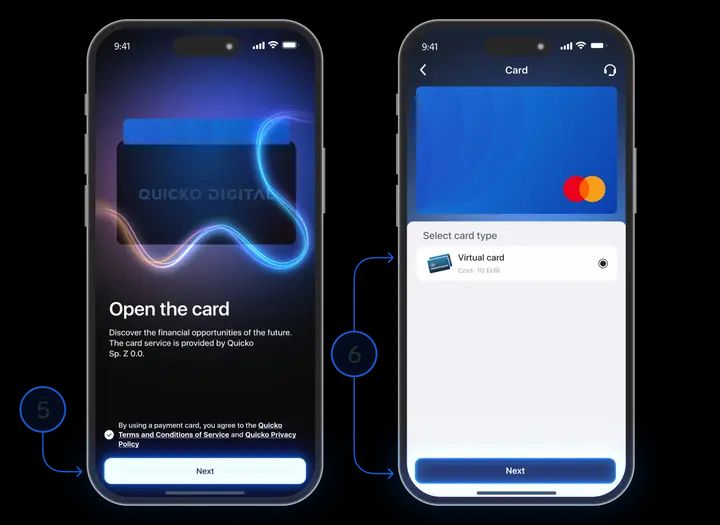
Wait a few moments while your card is being created, then add it to Apple Pay or Google Pay for instant use.

Issuance of the virtual Quicko card is completely free, and there are no monthly service fees. Transactions are processed with a 0% settlement commission, and recharging your balance through Trustee Plus is also free of charge. The card remains valid for five years, giving users a long-term, cost-free way to spend crypto conveniently.
Trustee card fees and real costs
Every payment tool is judged by its costs. Trustee Plus keeps them clear and competitive:
Card issuance fee. A one-time fee (~€10) applies to get the (virtual) card. The physical metal card costs about €25 (one-time). Thereafter, no monthly maintenance fee is charged in most regions. Trustee Plus crypto card fees are transparent: you see each fee during payment.
Conversion fee (crypto → EUR). When you spend, Trustee Plus auto-converts your crypto to euros at a competitive rate (about 0.5% of the amount). This is comparable or lower than many crypto cards. No hidden spreads, the fee is applied as soon as you tap.
ATM withdrawal fee. With the physical card, you can take cash from ATMs. Each withdrawal carries a fee (~ 1.5% plus €1 per transaction).
(Note: many crypto cards give your first monthly cashout free; with Trustee it’s always charged, so best used sparingly.)
Foreign exchange fee. When paying in currencies other than EUR, Trustee Plus uses Mastercard’s FX rate with no extra FX fee. In practice this means low-cost international spending. For example, paying $50 in USD would only incur the 0.5% crypto conversion, there is no additional currency fee for the transaction.
Free crypto top-ups. Transferring cryptocurrency into Trustee incurs no fee (especially via Binance Pay at 0% commission). You can also pull crypto from Binance into Trustee with zero fee. This makes wallet funding cheap compared to using bank wires or card top-ups on other platforms.
Transparent pricing. All major costs (issuance, conversion, cashouts) are spelled out by Trustee. Users praise the straightforward fee table in-app. Unlike some cards with hidden spreads or high FX surcharges, Trustee’s model is easy to understand. The only variable expense is on-chain network gas when moving crypto in/out of the wallet (outside Trustee’s control).
| Fee type | Approx. Cost (Trustee Plus) |
|---|---|
| Card issuance (virtual) | ~€10 one-time |
| Card issuance (physical) | ~€25 one-time (Physical cards may be temporarily unavailable. Please stay tuned for updates) |
| Monthly service fee | €0 (no recurring fee) |
| Crypto-to-fiat conversion | ~0.5% per transaction |
| ATM cash withdrawal | 1.5% of amount + €1 (per withdrawal) |
| Currency exchange (FX) | 0% extra (uses Mastercard rate; see above) |
| Crypto deposits/top-ups | 0% (especially via Binance Pay) |
| P2P/transfers within Trustee | 0% (free crypto transfers between users) |
Spending power and Trustee Plus card limits
Spending thresholds show how practical the card is for real life. Trustee Plus sets higher limits than many competitors:
High purchase limits. The Trustee Plus Card is designed for big spenders and frequent travelers. It allows up to ~€5,000 per day and €50,000 per month in total card purchases. This is well above many crypto cards, matching limits of standard bank debit cards.
Cash withdrawal limits. ATM withdrawals (physical card, NFC) are capped around €2,000 per day and €20,000 per month. These generous caps make it practical to access large cash sums if needed, e.g. on international trips.
Multiple sub-accounts. Each Trustee account can issue up to three cards (sub-accounts), each with its own limits. In theory, a single user could sustain up to €150,000 per month in spending by using all three cards. (This is useful for households or businesses linking multiple crypto balances.)
Flexible per-transaction spend. Individual transactions can be up to the daily cap (e.g. a single €5,000 purchase is allowed). There’s no minimum; you can pay a few cents or many thousands, just like a normal debit card. The app also supports splitting a payment across multiple crypto coins if needed.
Quick top-up threshold. Because the card funds come from your crypto wallet, you simply need enough crypto balance. Low-value purchases (<€1000) typically clear without delay. (Above certain amounts, the Trustee may trigger auto KYC verification for security, briefly holding the transaction pending review.)
Integration with payment networks and exchanges
Ease of use often decides whether people adopt a card. Trustee Plus scores high in this regard:
Apple Pay & Google Pay ready. The Trustee Plus virtual Mastercard works with all major mobile wallets. Once issued, add it to Apple Wallet or Google Wallet for instant tap-and-pay. This makes contactless crypto payments as smooth as any digital bankcard. The physical card can also use NFC on payment terminals.
Mastercard acceptance. Because it’s on the Mastercard network, the card is accepted at ~60 million locations worldwide (stores, websites, hotels, etc.). It behaves exactly like a regular debit card at checkout, no “crypto” label or limitations for merchants. You can book flights on airlines, rent cars, shop online or in-store, wherever Mastercard is taken.
Binance connectivity. Trustee Plus has a direct partnership with Binance Pay. This lets you instantly top up Trustee in cryptocurrency (USDT/BTC/ETH) from Binance with zero fee. In the app, just choose Binance Pay as your deposit method, authenticate in your Binance account, and crypto flows into Trustee immediately. It’s the simplest way to fund your crypto card without bank fees or conversion hassles.
Fiat on-ramps. Besides crypto transfers, Trustee supports buying crypto with bank cards or SEPA wires. You can load your wallet with EUR via Visa/Mastercard (small fee) or free SEPA. Once in crypto form, the card uses those balances for spending. This multi-rail approach (fiat-card top-ups, crypto links) means you’re not locked into any one ecosystem.
Mainstream travel services. The card works on all travel-booking sites that accept Mastercard. For example, you can pay on platforms like Booking.com, Airbnb, Expedia, and airline portals just like a bank card. Once added to your digital wallet, recurring subscription services (streaming, SaaS) and recurring bill-pay also work – Trustee acts as any standard Mastercard would.
Pros and cons of the Trustee Plus card
- Pros
- Cons
Non-custodial wallet control, users keep their keys.
Transparent fee structure, no hidden maintenance costs.
High transaction and withdrawal limits.
Apple Pay and Google Pay compatibility.
Smooth integration with Binance for zero-fee transfers.
Availability differs depending on jurisdiction.
Limited support for fiat currencies outside the euro zone.
Occasional verification holds on large deposits.
No cashback or reward program at this stage.
Requires activation through the Quicko Digital app.
Before you start spending with the Trustee Plus Card, you’ll want a reliable exchange to fund your wallet and cash out in your region. Below is a quick, trust-first shortlist of exchanges that are easy to onboard and work smoothly for everyday top-ups and withdrawals. Pick the one that’s available locally and keeps fees straightforward.
| Crypto | Foundation year | Min. Deposit, $ | Coins Supported | Spot Taker fee, % | Spot Maker Fee, % | Alerts | Copy trading | Tier-1 regulation | TU overall score | Open an account | |
|---|---|---|---|---|---|---|---|---|---|---|---|
| Yes | 2017 | 10 | 600+ | 0.1 | 0.08 | Yes | Yes | No | 8.48 | Go to broker Your capital is at risk. |
|
| Yes | 2012 | 10 | 400+ | 0.5 | 0.5 | Yes | No | Yes | 7.84 | Go to broker Your capital is at risk. |
|
| Yes | 2016 | 1 | 400+ | 0.5 | 0.25 | Yes | No | Yes | 7.8 | Go to broker Your capital is at risk. |
|
| Yes | 2018 | No | 1000 | 0 | 0 | Yes | Yes | No | 7.76 | Go to broker Your capital is at risk. |
|
| Yes | 2011 | 10 | 399 | 0.3 | 0.2 | No | Yes | Yes | 7.6 | Go to broker Your capital is at risk.
|
Trustee plus card helps cut crypto conversion losses and confirm provider credibility

Trustee Plus’s card is powerful if you treat it like a fast crypto-fiat bridge rather than a bank card. To keep conversion losses minimal, top up your Trustee wallet with a stablecoin such as USDC or USDT and use the app’s built-in exchange before spending. Trustee advertises zero percent on stablecoin swaps and allows direct payments from crypto with automatic conversion, so exchanging to a stablecoin first often provides a more stable and predictable FX result than letting the merchant or card network handle the conversion at checkout. Try a small test: load €50 in USDC, make a €4 purchase with the virtual card, then compare the conversion record in the app with the merchant receipt to see the actual spread.
Remember that the Trustee Plus Card is issued and managed through the partner application Quicko Digital, which connects to your verified Trustee Plus account. Treat the Trustee card as a new issuer until you confirm reliability. Check who provides the EUR card and which bank sponsors the BIN, since refunds and disputes depend on that partner bank. There are public reports of mixed user experiences and spending limits, so start with a virtual card, keep daily transactions modest, and use separate wallets for larger holdings. Test your personal IBAN with a small transaction before relying on it fully. These small checks reveal how the app processes refunds, ATM withdrawals, and failed payments, moments where “no maintenance fee” claims might still conceal real costs.
Conclusion
In summary, the Trustee Plus Card stands out as a comprehensive tool for modern digital finance, combining flexibility, robust features, and user-centric benefits. Its transparent fee structure and enhanced security measures empower users to manage spending confidently, whether shopping online or traveling abroad. For example, instant card management options and competitive exchange rates make it a smart ally for both daily tasks and global adventures. Ultimately, by merging convenience with cutting-edge safety, the Trustee Plus Card exemplifies how digital solutions can redefine our financial habits for a smarter and more secure future.
FAQs
What are the main fees associated with using the Trustee Plus Card for everyday spending?
How does the Trustee Plus Card handle spending and withdrawal limits?
Can users split payments across multiple cryptocurrencies with the Trustee Plus Card?
How does the integration of Trustee Plus Card with payment networks benefit users?
Editors' Top Picks and Insights






Related Articles
Team that worked on the article
Andrey Mastykin is an experienced author, editor, and content strategist who has been with Traders Union since 2020. As an editor, he is meticulous about fact-checking and ensuring the accuracy of all information published on the Traders Union platform.
Dan Blystone began his trading career in 1998 as an arbitrage clerk on the floor of the Chicago Mercantile Exchange (CME). He later traded bond and Eurex futures at proprietary firms such as Altea Trading, gaining valuable experience in high-frequency trading and risk management.
Chinmay Soni is a financial analyst with more than 5 years of experience in working with stocks, Forex, derivatives, and other assets. As a founder of a boutique research firm and an active researcher, he covers various industries and fields, providing insights backed by statistical data.
Volatility refers to the degree of variation or fluctuation in the price or value of a financial asset, such as stocks, bonds, or cryptocurrencies, over a period of time. Higher volatility indicates that an asset's price is experiencing more significant and rapid price swings, while lower volatility suggests relatively stable and gradual price movements.
Copy trading is an investing tactic where traders replicate the trading strategies of more experienced traders, automatically mirroring their trades in their own accounts to potentially achieve similar results.
Cryptocurrency is a type of digital or virtual currency that relies on cryptography for security. Unlike traditional currencies issued by governments (fiat currencies), cryptocurrencies operate on decentralized networks, typically based on blockchain technology.
CFD is a contract between an investor/trader and seller that demonstrates that the trader will need to pay the price difference between the current value of the asset and its value at the time of contract to the seller.
Risk management is a risk management model that involves controlling potential losses while maximizing profits. The main risk management tools are stop loss, take profit, calculation of position volume taking into account leverage and pip value.

-
 Afghanistan
-
 Albania
-
 Algeria
-
 Angola
-
 Argentina
-
 Armenia
-
 Australia
-
 Austria
-
 Azerbaijan
-
 Bahamas
-
 Bahrain
-
 Bangladesh
-
 Belarus
-
 Belgium
-
 Bolivia
-
 Botswana
-
 Brazil
-
 Brunei
-
 Bulgaria
-
 Cambodia
-
 Cameroon
-
 Canada
-
 Chile
Chile
-
 China
China
-
 Colombia
-
 Congo
Congo
-
 Costa Rica
-
 Cote d'Ivoire
-
 Croatia
-
 Cuba
Cuba
-
 Cyprus
-
 Czechia
-
 DR Congo
-
 Denmark
-
 Dominican Republic
-
 Ecuador
-
 Egypt
Egypt
-
 El Salvador
-
 Estonia
-
 Eswatini
-
 Ethiopia
-
 Finland
-
 France
-
 Georgia
-
 Germany
-
 Ghana
Ghana
-
 Greece
-
 Haiti
Haiti
-
 Hong Kong
-
 Hungary
-
 India
India
-
 Indonesia
-
 Iran, Islamic republic
-
 Iraq
Iraq
-
 Ireland
-
 Israel
-
 Italy
Italy
-
 Jamaica
-
 Japan
Japan
-
 Jordan
-
 Kazakhstan
-
 Kenya
Kenya
-
 Korea
Korea
-
 Kuwait
-
 Kyrgyzstan
-
 Laos
Laos
-
 Latvia
-
 Lebanon
-
 Lesotho
-
 Libya
Libya
-
 Lithuania
-
 Luxembourg
-
 Madagascar
-
 Malaysia
-
 Malta
Malta
-
 Mauritius
-
 Mexico
-
 Moldova
-
 Mongolia
-
 Montenegro
-
 Morocco
-
 Mozambique
-
 Myanmar
-
 Namibia
-
 Nepal
Nepal
-
 Netherlands
-
 New Zealand
-
 Nigeria
-
 North Macedonia
-
 Norway
-
 Oman
Oman
-
 Pakistan
-
 Palestine
-
 Panama
-
 Papua New Guinea
-
 Paraguay
-
 Peru
Peru
-
 Philippines
-
 Poland
-
 Portugal
-
 Puerto Rico
-
 Qatar
Qatar
-
 Reunion
-
 Romania
-
 Rwanda
-
 Saudi Arabia
-
 Serbia
-
 Singapore
-
 Slovakia
-
 Slovenia
-
 Somalia
-
 South Africa
-
 Spain
Spain
-
 Sri Lanka
-
 Sweden
-
 Switzerland
-
 Syria
Syria
-
 Taiwan
-
 Tajikistan
-
 Tanzania
-
 Thailand
-
 Trinidad and Tobago
-
 Tunisia
-
 Turkey
-
 UAE
UAE
-
 Uganda
-
 Ukraine
-
 United Kingdom
-
United States
-
 Uruguay
-
 Uzbekistan
-
 Venezuela
-
 Vietnam
-
 Yemen
Yemen
-
 Zambia
-
 Zimbabwe
- Forex
- Crypto












