
Best Mobile Wallets for Crypto (2026)


Editorial Note: While we adhere to strict Editorial Integrity, this post may contain references to products from our partners. Here's an explanation for How We Make Money. None of the data and information on this webpage constitutes investment advice according to our Disclaimer.
The best mobile crypto wallets in 2026 are:
ZenGo – most secure with MPC keyless technology.
Trust Wallet – best for multi-asset portfolios and staking.
MetaMask – ideal for DeFi and NFT users.
Coinbase Wallet – beginner-friendly and non-custodial.
Binance Web3 – best for active traders with exchange integration.
Mobile crypto wallets have become the center of digital asset management in 2026. The global shift to smartphone-first finance means most users now prefer a crypto wallet on phone over desktop or hardware solutions. But many still wonder what the best mobile crypto wallet is, for trading, security, or even everyday use.
This article explores the top-rated crypto wallets for mobile in 2026, combines original analysis with research from independent studies, and compares features, strengths, and vulnerabilities. The goal is to help you choose the best mobile wallet for crypto that balances usability and security.
Risk warning: Cryptocurrency markets are highly volatile, with sharp price swings and regulatory uncertainties. Research indicates that 75-90% of traders face losses. Only invest discretionary funds and consult an experienced financial advisor.
Best crypto wallets in 2026
The best mobile crypto wallet is the one that balances strong security, seamless usability, and support for the assets you hold most. Below we have presented a summary of the top contenders that are widely recognized. Evaluate your priorities security, convenience, or multi-chain access and choose accordingly.
| Wallet | Supported assets | Security features | Pros | Cons | Best for |
|---|---|---|---|---|---|
| ZenGo | BTC, ETH, majors | MPC, biometric, keyless recovery | Strongest safety | Fewer niche coins | Security-first users |
| Trust Wallet | Thousands incl. NFTs | Seed backup, biometric | Multi-asset, staking | Fake app risk | Portfolio investors |
| MetaMask | ETH, EVM chains | Seed backup, biometric | DeFi leader, dApps | Weak BTC support | DeFi & NFT users |
| Coinbase Wallet | BTC, ERC-20, multi-chain | Non-custodial, biometric | Easy for beginners | Fewer pro tools | First-time traders |
| Binance Web3 | BTC + many chains | Exchange infra, PIN/seed | Liquidity & speed | Centralized risks | Active Binance users |
ZenGo
ZenGo is a self-custody wallet that removes the need for seed phrases by using MPC technology. Instead of relying on one private key, it splits access between your device and ZenGo’s servers, with biometric recovery built in. It is designed for users who want maximum safety and peace of mind.

Key features
Seedless setup with MPC and biometric recovery (3FA).
ClearSign Web3 firewall to detect risky approvals.
Theft Protection and Bitcoin Vault with time-locked withdrawals.
Trust Wallet
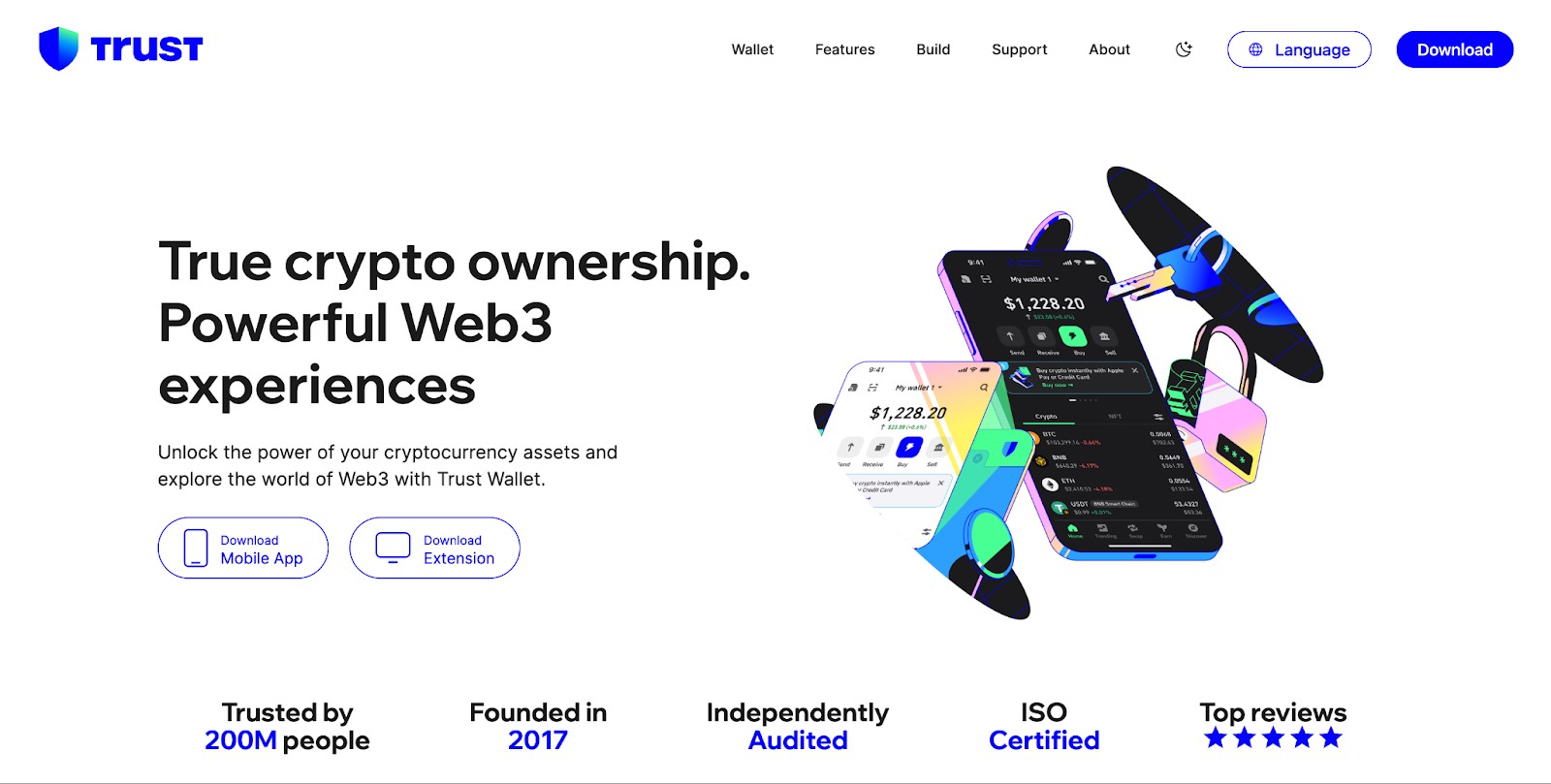
Trust Wallet is a multi-chain wallet that supports millions of tokens and NFTs across more than 100 blockchains. It offers built-in staking, swaps, and a dApp browser, making it popular with investors who manage diverse portfolios.
Key features
Wide asset support including NFTs and staking.
Security Scanner with alerts for risky approvals.
Simple mobile interface with browser extension support.
MetaMask
MetaMask remains the most widely used wallet for Ethereum and EVM-compatible networks. With Snaps, users can now add non-EVM chains, including native Solana support. It also integrates with hardware wallets for extra security.

Key features
Access to thousands of DeFi apps and NFT platforms.
Support for Solana and non-EVM chains via Snaps.
Coinbase Wallet
Coinbase Wallet is a self-custody wallet designed for simplicity and security. It offers multichain support, a clean interface, and strong protective features, making it ideal for beginners.

Key features
Token approval alerts and transaction previews.
Spam-token hiding and permission management.
Biometric locks and Ledger integration for extra safety.
Binance Web3 Wallet
Binance Web3 Wallet is built into the Binance app and uses MPC to avoid seed phrases. It provides access to multiple blockchains while staying linked to Binance’s exchange features and liquidity.

Key features
2-of-3 key share setup for secure recovery.
Emergency Export option to move private keys.
Fast integration with Binance trading, swaps, and on-ramps.
How to choose the best mobile crypto wallet in 2026
Selecting the best mobile crypto wallet in 2026 is not just about popularity, it’s about aligning features with your personal needs. With hundreds of wallet apps available, here are the most important factors to consider:
Security model
Look for wallets that are non-custodial (you control the keys), use biometric authentication, and ideally support advanced methods such as MPC (multi-party computation). The safest mobile crypto wallets also publish audit reports and maintain an active bug bounty program.
Supported assets
Decide whether you need a mobile bitcoin wallet only or a crypto wallet smartphone app that supports multiple blockchains. If you trade NFTs or DeFi tokens, ensure the wallet is compatible with Ethereum and other EVM chains.
Ease of use
The best mobile crypto wallet that would excel in user experience in 2026 would offer a clear interface, transparent fee breakdowns, and straightforward backup and recovery options. Beginners should prioritize simplicity, while advanced traders may value customization.
Integration with exchanges & dApps
If you plan to trade frequently, choose a wallet with built-in swaps or direct exchange connections. For Web3 users, dApp browser support is essential. If you don’t have an account with any crypto exchange, you can consider the options listed below. They are among the most popular ones in your region, providing a wide range of features to make your experience worthwhile.
| Coinbase | OKX | BTCC | Cryptohopper | Crypto.com | |
|---|---|---|---|---|---|
|
Min. Deposit, $ |
10 | 10 | 10 | No | 1 |
|
Coins Supported |
400+ | 600+ | 399 | 1000 | 400+ |
|
Spot Taker fee, % |
0.5 | 0.1 | 0.3 | 0 | 0.5 |
|
Spot Maker Fee, % |
0.5 | 0.08 | 0.2 | 0 | 0.25 |
|
Alerts |
Yes | Yes | No | Yes | Yes |
|
Copy trading |
No | Yes | Yes | Yes | No |
|
TU overall score |
8.5 | 8.46 | 8.08 | 7.8 | 7.76 |
|
Open an account |
Go to broker Your capital is at risk. |
Go to broker Your capital is at risk. |
Go to broker Your capital is at risk.
|
Go to broker Your capital is at risk. |
Go to broker Your capital is at risk. |
Reputation & reviews
Always verify that the app is legitimate. Download only from official app stores, check developer credentials, and review community feedback. The best options, such as Trust Wallet, MetaMask, or ZenGo, have millions of users and established reputations.
Why mobile crypto wallets matter in 2026
The role of mobile crypto wallets has expanded beyond storage. Today, they serve as gateways to DeFi, NFTs, staking, and payments.
This shift is driven by:
Accessibility. Users want a crypto wallet mobile app that works instantly.
Trading activity. Fast swaps and staking features are now expected among the best crypto wallets for mobile trading 2026.
Security concerns. Hacks and phishing attacks have surged, making the safest mobile wallet crypto a top priority.
Are mobile crypto wallets safe?
The safety of mobile crypto wallets is often debated. Studies reveal both strengths and vulnerabilities:
Research from Macquarie University showed many Android wallet apps leaked sensitive data through insecure connections and third-party SDKs. This raises concerns about long-term privacy if wallets do not improve their protocols.
An Ethereum wallet study (2025) found that only 3 out of 53 wallets effectively warned users about “address poisoning” attacks, where hackers trick victims into sending funds to fraudulent addresses.
So, crypto wallets can be safe if you pick the most secure mobile crypto wallet with biometric access, non-ustodial key storage, and clear transaction warnings. But safety also depends on your own practices: never download unofficial apps, always enable 2FA, and keep backups offline.
What makes the best mobile crypto wallet app?
When evaluating the best mobile wallet for crypto, five criteria stand out:
Security model. Non-custodial design, MPC (multi-party computation), biometric login.
User experience. Clear confirmations, simple navigation, strong visibility for fees and recipient addresses.
Coin support. From a mobile bitcoin wallet to a multi-chain crypto wallet smartphone app, asset diversity is key.
Integration. Trading, swaps, staking, and dApp browser access.
Audit history & transparency. Top wallets are regularly audited and publish updates about vulnerabilities.
The best mobile crypto wallet balances usability and security

In my experience, choosing the best mobile crypto wallet in 2026 comes down to finding the right balance between usability and security. A reliable wallet should make transactions simple while offering strong safeguards like biometric access, clear confirmation prompts, and secure key management.
I always advise looking beyond marketing and popularity and focus instead on how transparent the provider is about audits, how well the app defends against phishing, and whether it fits your trading habits. The best wallet is ultimately the one that aligns with your priorities, whether that’s convenience, advanced trading features, or maximum protection of your assets.
Conclusion
The best mobile crypto wallet in 2026 is the one that seamlessly combines robust security with practical usability, ensuring your assets are both safe and accessible on the go. Solutions like ZenGo and Trust Wallet stand out by offering advanced features such as MPC keyless technology and support for a vast range of blockchains alongside strong biometric protections. As the role of mobile wallets expands beyond storage to include DeFi, staking, and everyday trading, prioritizing transparency, regular audits, and clear transaction warnings is essential. Ultimately, a wallet that matches your unique security needs and trading style will empower you to manage digital assets confidently in the evolving crypto landscape.
FAQs
What key factors should be considered when selecting the best mobile crypto wallet in 2026?
How do mobile crypto wallets support a wide range of cryptocurrencies and NFTs?
What are the main risks associated with using mobile crypto wallets and how are they addressed?
How has the role of mobile crypto wallets evolved in recent years?
Editors' Top Picks and Insights




Related Articles
Team that worked on the article
Emilio is a futures trader and financial writer who specializes in technical analysis, market news, and trading psychology. He began his career by completing the Cornerstone Traders Qualification under the mentorship of a gold futures veteran from Bank of America on Wall Street.
Dan Blystone began his trading career in 1998 as an arbitrage clerk on the floor of the Chicago Mercantile Exchange (CME). He later traded bond and Eurex futures at proprietary firms such as Altea Trading, gaining valuable experience in high-frequency trading and risk management.
Chinmay Soni is a financial analyst with more than 5 years of experience in working with stocks, Forex, derivatives, and other assets. As a founder of a boutique research firm and an active researcher, he covers various industries and fields, providing insights backed by statistical data.
Index in trading is the measure of the performance of a group of stocks, which can include the assets and securities in it.
An investor is an individual, who invests money in an asset with the expectation that its value would appreciate in the future. The asset can be anything, including a bond, debenture, mutual fund, equity, gold, silver, exchange-traded funds (ETFs), and real-estate property.
Bitcoin is a decentralized digital cryptocurrency that was created in 2009 by an anonymous individual or group using the pseudonym Satoshi Nakamoto. It operates on a technology called blockchain, which is a distributed ledger that records all transactions across a network of computers.
Risk management is a risk management model that involves controlling potential losses while maximizing profits. The main risk management tools are stop loss, take profit, calculation of position volume taking into account leverage and pip value.
Copy trading is an investing tactic where traders replicate the trading strategies of more experienced traders, automatically mirroring their trades in their own accounts to potentially achieve similar results.

-
 Afghanistan
-
 Albania
-
 Algeria
-
 Angola
-
 Argentina
-
 Armenia
-
 Australia
-
 Austria
-
 Azerbaijan
-
 Bahamas
-
 Bahrain
-
 Bangladesh
-
 Belarus
-
 Belgium
-
 Bolivia
-
 Botswana
-
 Brazil
-
 Brunei
-
 Bulgaria
-
 Cambodia
-
 Cameroon
-
 Canada
-
 Chile
Chile
-
 China
China
-
 Colombia
-
 Congo
Congo
-
 Costa Rica
-
 Cote d'Ivoire
-
 Croatia
-
 Cuba
Cuba
-
 Cyprus
-
 Czechia
-
 DR Congo
-
 Denmark
-
 Dominican Republic
-
 Ecuador
-
 Egypt
Egypt
-
 El Salvador
-
 Estonia
-
 Eswatini
-
 Ethiopia
-
 Finland
-
 France
-
 Georgia
-
 Germany
-
 Ghana
Ghana
-
 Greece
-
 Haiti
Haiti
-
 Hong Kong
-
 Hungary
-
 India
India
-
 Indonesia
-
 Iran, Islamic republic
-
 Iraq
Iraq
-
 Ireland
-
 Israel
-
 Italy
Italy
-
 Jamaica
-
 Japan
Japan
-
 Jordan
-
 Kazakhstan
-
 Kenya
Kenya
-
 Korea
Korea
-
 Kuwait
-
 Kyrgyzstan
-
 Laos
Laos
-
 Latvia
-
 Lebanon
-
 Lesotho
-
 Libya
Libya
-
 Lithuania
-
 Luxembourg
-
 Madagascar
-
 Malaysia
-
 Malta
Malta
-
 Mauritius
-
 Mexico
-
 Moldova
-
 Mongolia
-
 Montenegro
-
 Morocco
-
 Mozambique
-
 Myanmar
-
 Namibia
-
 Nepal
Nepal
-
 Netherlands
-
 New Zealand
-
 Nigeria
-
 North Macedonia
-
 Norway
-
 Oman
Oman
-
 Pakistan
-
 Palestine
-
 Panama
-
 Papua New Guinea
-
 Paraguay
-
 Peru
Peru
-
 Philippines
-
 Poland
-
 Portugal
-
 Puerto Rico
-
 Qatar
Qatar
-
 Reunion
-
 Romania
-
 Rwanda
-
 Saudi Arabia
-
 Serbia
-
 Singapore
-
 Slovakia
-
 Slovenia
-
 Somalia
-
 South Africa
-
 Spain
Spain
-
 Sri Lanka
-
 Sweden
-
 Switzerland
-
 Syria
Syria
-
 Taiwan
-
 Tajikistan
-
 Tanzania
-
 Thailand
-
 Trinidad and Tobago
-
 Tunisia
-
 Turkey
-
 UAE
UAE
-
 Uganda
-
 Ukraine
-
 United Kingdom
-
United States
-
 Uruguay
-
 Uzbekistan
-
 Venezuela
-
 Vietnam
-
 Yemen
Yemen
-
 Zambia
-
 Zimbabwe
- Forex
- Crypto












