
Is Microsoft Undervalued Or Overvalued?


Editorial Note: While we adhere to strict Editorial Integrity, this post may contain references to products from our partners. Here's an explanation for How We Make Money. None of the data and information on this webpage constitutes investment advice according to our Disclaimer.
Microsoft’s stock is priced for leadership in cloud, AI and enterprise software, but that price reflects near perfect execution. The company is strong, yet its valuation leaves limited room for slower growth or weaker results. If cloud or AI growth slows, the stock could correct because MSFT’s valuation depends heavily on future performance. It is solid, but not cheap, and this drives debates around Microsoft valuation and its intrinsic value.
Asking whether Microsoft is overvalued means looking past earnings headlines and checking if the stock still reflects what the company is truly delivering. Azure continues to grow, but profit growth has become more selective as cloud spending moves at a slower pace. Windows and Office remain steady sources of income, but they are no longer fast growth drivers. Today the stock looks priced more on expectations than on the pace of results, which shapes how investors view Microsoft’s intrinsic value.
Understanding Microsoft
Microsoft has become one of the strongest and most influential companies in global technology. It now plays a central role in the digital economy through Windows, Office, Azure and a fast-growing range of artificial intelligence products. These segments support both consumer and enterprise markets and have helped Microsoft build a stable and recurring revenue base.
With its market cap above three trillion dollars, the company continues to deliver steady financial performance that attracts long-term investors. But as the stock trades near record levels, more people are asking whether Microsoft is overvalued or if its current price still reflects the strength of the business. Cloud services, AI integrations and consistent profitability have supported the premium, but rising competition and a forward P/E near thirty raise questions about future expectations.
The key issue is whether Microsoft can continue producing the growth needed to support MSFT valuation, or if results will slow while expectations remain high. This article examines Microsoft’s fundamentals, market trends, analyst views and valuation metrics to help you assess whether Microsoft valuation is still supported by performance and how Microsoft’s intrinsic value compares with the market price.
Microsoft's current market position
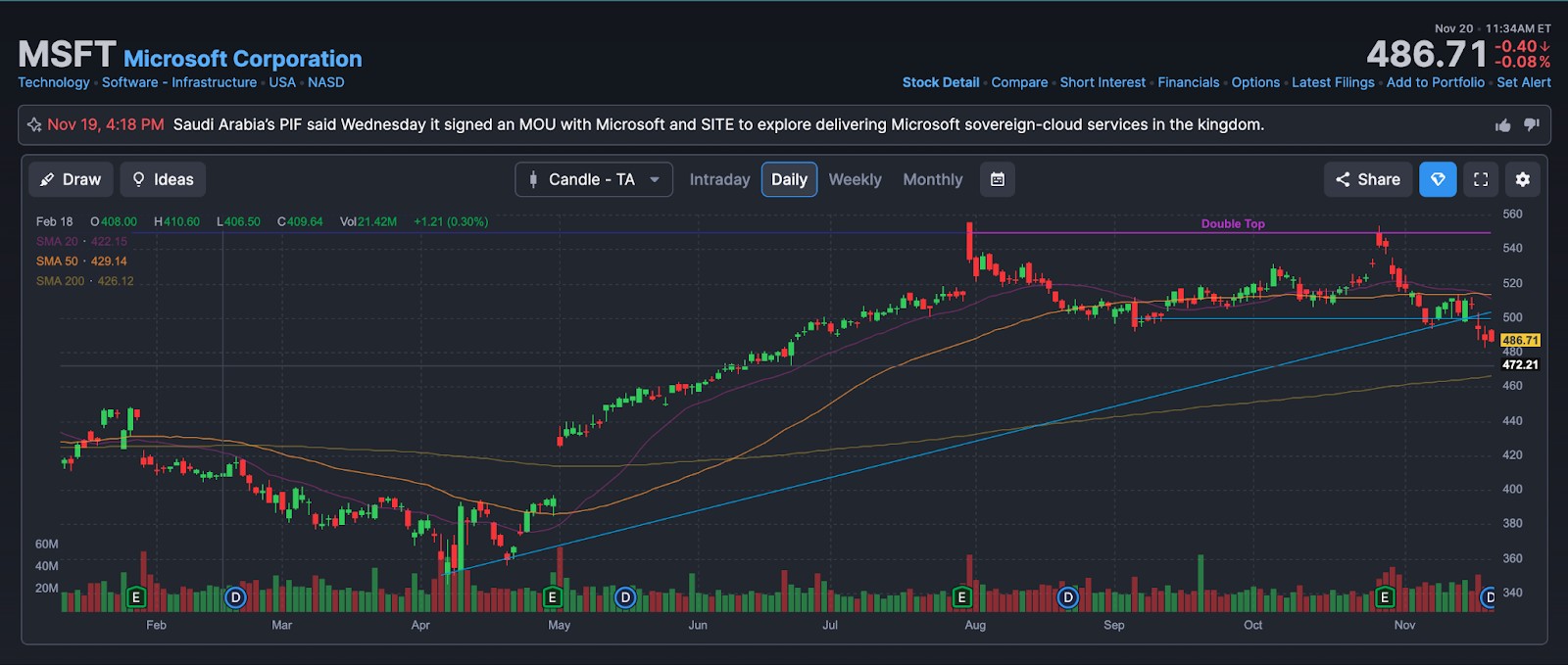
Microsoft is one of the most established and consistently profitable companies in the world. Its influence spans enterprise software, cloud infrastructure and artificial intelligence, making it a core holding for many institutional investors. The company benefits from strong demand across multiple markets, and its broad product ecosystem helps create steady, recurring revenue.
Microsoft operates across several high-margin business segments that power both consumer and enterprise technology worldwide.
How the business is structured
Productivity and business processes. This includes Microsoft Office, LinkedIn, and Dynamics, all of which contribute stable, recurring revenue.
Intelligent cloud. Azure is the centerpiece here, making Microsoft the second-largest cloud provider globally behind Amazon AWS.
More personal computing. This includes Windows OS, Surface hardware, Xbox gaming, and Bing search.
Market size and position
Microsoft’s market capitalization is above three trillion dollars, making it one of the most valuable public companies in the world. Azure now contributes a significant share of total revenue, and the company continues to invest heavily in artificial intelligence through products like Copilot, Office integrations and its partnership with OpenAI. These efforts have strengthened long term confidence in MSFT’s valuation and expanded the company’s presence in high growth markets.
What this shows
Microsoft is no longer just a software provider. It is a leader in cloud and AI infrastructure, supported by a diversified business model that offers stability, scale and long term visibility. This mix is a key part of Microsoft’s valuation and influences how investors judge the company’s intrinsic value compared with the company’s current stock price.
Microsoft’s stock performance
Microsoft’s stock has been a consistent performer, reflecting steady growth in earnings and broad investor confidence in its leadership and long-term strategy.
Stock trends and performance
As of November 2025, the stock trades around $490 per share, placing it close to its highest levels. This price reflects strong investor confidence in Microsoft’s long term direction.
The share price has outperformed major indexes, helped by stable Azure demand and wide adoption of Office, Teams and GitHub Copilot. Microsoft’s trailing P/E is about 34.5, and its forward P E is near 29, both of which remain above its long term averages. These levels continue to influence how investors evaluate MSFT’s valuation.
What has supported the rally
Azure remains the key driver of sentiment, supported by steady enterprise spending. AI powered tools across Microsoft 365, Teams and Copilot have improved engagement and supported software revenue growth. Recurring revenue from Microsoft 365, LinkedIn and Dynamics adds stability. Share buybacks and rising dividends also help support the stock.
What this signals
Microsoft continues to stand out as a trusted large cap technology company. Investors see it as a stable compounder with strong cash flow and predictable growth. This mix supports the company’s valuation and plays a central role in how Microsoft intrinsic value compares with the current stock price.
Valuation of Microsoft
Microsoft has delivered strong returns in recent years through its leadership in cloud, enterprise software and artificial intelligence. But as the stock trades near record highs, investors are asking whether the price still reflects realistic earnings growth. To understand this, it is important to look at Microsoft’s financial strength, short term market behavior and whether today’s price aligns with Microsoft valuation models.
Microsoft combines growth, profitability and financial stability at a scale few companies can match. Even so, rising expectations mean investors need to look closely at how the market is pricing that strength. The question is whether the current stock price reflects steady progress or whether it assumes faster growth than the business can deliver. This shapes how investors view MSFT’s valuation and helps determine how much Microsoft is worth based on future performance.
Microsoft fundamental analysis
Microsoft is one of the few companies that manages to combine growth, profitability, and financial strength at scale. But with its valuation creeping up, investors need to look closely at how the market is pricing that strength, and whether it still leaves room for upside.
The P/E ratio shows how much investors are willing to pay for each dollar of earnings. For Microsoft, that number is on the higher end, and it has been rising with each earnings beat. The P/E ratio shows how much investors are willing to pay for each dollar of profit. For Microsoft, this number remains on the higher side, reflecting strong confidence in the company’s long term performance. As of the latest data, Microsoft’s trailing P/E is about 34.5, and its forward P/E is near 29, both of which sit above its long term averages.
These levels show that investors view Microsoft as a premium technology company rather than a typical software provider. The valuation reflects steady earnings, strong margins and confidence in future growth from AI and cloud services.
A P/E close to twenty nine requires consistent performance. It signals trust, but it also means the company must continue posting reliable earnings for the price to hold. This expectation influences how investors assess how much is Microsoft worth compared with its future earnings potential.
Price to earnings growth (PEG) ratio
The PEG ratio adjusts the P/E based on expected earnings growth, helping show whether investors are overpaying relative to future performance.
Current estimates place Microsoft’s earnings growth near 12 to 14%, which results in a PEG ratio in the range of 2.1 to 2.5. This range shows that investors are paying a clear premium for the company’s expected growth.
A PEG above 1.5 suggests a stock is priced for stronger growth than average, and a PEG above 2 means investors are paying more for future earnings than the growth rate alone supports. This is why the PEG ratio plays an important role when evaluating MSFT’s valuation, since it shows how much optimism is already built into the price.
Microsoft trades at a higher PEG than peers such as Apple and Alphabet, which often sit between 1.4 and 1.7, reinforcing the idea that Microsoft’s valuation depends on reliable, steady performance rather than rapid acceleration. At current levels, the PEG reflects investor confidence in Microsoft’s stability, but it also reduces the margin for slower earnings growth when judging how much Microsoft is worth over time.
Operating margins and free cash flow
Microsoft continues to generate strong profits supported by its scale in cloud, software and enterprise services. For the year ended June 30 2025, the company reported operating income of $128.5 billion, up 17% from the prior year. With revenue of $281.7 billion, this implies an operating margin near 45.6%, a high level among large tech firms. Similarly, Microsoft’s free cash flow from operations reached $136.2 billion in FY25, giving the company one of the strongest cash generation profiles in the industry.
These levels of profitability and cash generation underlie investor confidence and form the basis for how many assess Microsoft’s value. That said, because expectations are high, keeping an eye on future margin trends and cash flow growth remains important when judging how much is Microsoft worth over time.
Microsoft intrinsic valuation
Intrinsic value models help show how much Microsoft may be worth based on long term cash flow and steady earnings growth. Updated discounted cash flow estimates that use revenue growth between 8% and 10% and stable operating margins place Microsoft’s fair value between $420 and $460 per share. With the stock trading around $490 as of November 2025, the company is valued slightly above many of these estimates.
Microsoft’s forward P/E near 29 and its price to free cash flow ratio near 35 show that the stock trades at a premium compared with its long term averages. These levels match other large technology companies that produce strong recurring revenue and high cash flow. The premium also reflects expectations that cloud services, AI tools and Copilot adoption will support steady long term results.
Overall, updated valuation models suggest that Microsoft trades modestly above its estimated intrinsic value but not at extreme levels.
Microsoft technical analysis
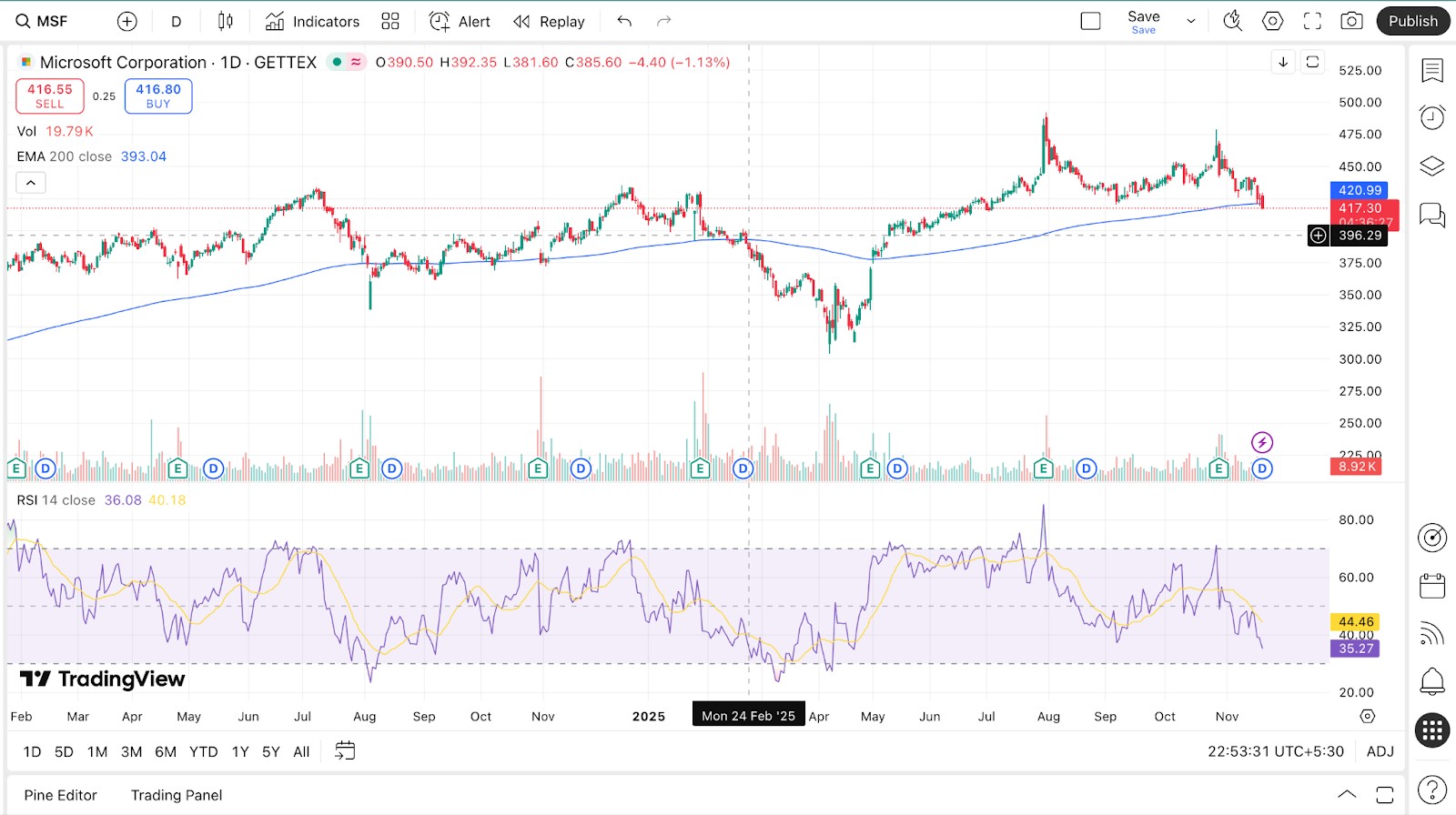
Microsoft’s chart shows the stock pulling back after a period of strength, with the current price near $420, retracing from a monthly high of around $490. The stock is trading close to the 200 day EMA around $393, which makes this an important support area. A sustained move below this level could suggest weakness, while holding above it may keep the longer trend stable.
The RSI sits near 35, which shows that momentum has weakened but has not yet reached oversold levels. This suggests cautious sentiment as the stock approaches support. Volume has remained normal through the recent decline, which means sellers are active but not aggressive.
Microsoft faces visible resistance around $420 to $425, where recent rallies have failed. Below the market, stronger support appears near $360 to $370, which has been tested multiple times in the last year. A break under that zone may lead to more downside, while a rebound above $410 could renew short term strength.
Analyst perspectives and market sentiment
Microsoft’s stock has earned a reputation for being both safe and growth-oriented, which is a rare mix. While many analysts remain bullish, others are starting to question whether the recent rally has left too little room for error. The general view is still positive, but the tone has become more cautious as expectations continue to rise.
Bullish viewpoints
Many analysts see Microsoft as one of the most dependable tech stocks available today, especially given its strong position in cloud and AI.
Why analysts are optimistic:
Azure is still gaining ground. Microsoft’s cloud division continues to expand, capturing more enterprise market share while improving margins.
AI is already showing results. Microsoft is ahead of the curve by embedding AI tools into Office, Teams, GitHub Copilot, and Azure services, all of which are seeing rising adoption.
Recurring revenue streams. Products like Microsoft 365, Dynamics, and LinkedIn offer stable, predictable revenue growth with high renewal rates.
Strong cash position. With over $70 billion in free cash flow, Microsoft has flexibility to invest, return capital, or weather downturns without financial strain.
What the bulls believe:
Microsoft’s mix of stability, innovation, and scale makes it a long-term winner.
Even at a premium price, analysts feel the stock still has room to grow as AI adoption accelerates.
Bearish viewpoints
Some analysts are more cautious, pointing to Microsoft’s high valuation and the rising competition in AI and cloud services.
What the skeptics highlight:
Valuation is not cheap. With a forward P/E near 30x, some believe Microsoft is already priced for near-perfect execution.
Cloud growth is slowing. Azure’s growth rate, while strong, has decelerated compared to its earlier years,and rivals like AWS and Google Cloud are catching up.
AI monetization is still early. While Microsoft has integrated AI tools across products, the actual revenue impact remains small in absolute terms.
Global tech regulation. With increasing scrutiny in both the U.S. and Europe, Microsoft’s ability to grow freely across markets could face new challenges.
More cautious analysts point to the company’s higher valuation and slower cloud growth. They note that Azure’s pace has decelerated compared with earlier years, and AI monetization is still at an early stage. Some also see rising competition from Amazon, Google and open source AI models, which could limit future gains. These concerns influence how investors judge Microsoft’s valuation and question how much it may be worth if growth slows.
Consensus and price targets
Most analysts still maintain positive or neutral ratings on the stock. Recent targets place fair value in the $415 to $420 range, compared with the current price near $385 to $390. The most optimistic targets reach about $470, while cautious estimates sit closer to $440. This range shows that the market expects Microsoft to keep performing well but agrees that the stock offers limited room for slow execution.
Once you have formed a view on whether the stock is worth buying at current levels, the next practical step is choosing where to invest. The section on best stock brokers for investing in stocks offers a simple starting point, helping you pick a reliable platform to execute your plan.
| eToro USA | SpeedTrader | Plus500 | TradeZero International | eOption | |
|---|---|---|---|---|---|
|
Stocks |
Yes | Yes | Yes | Yes | Yes |
|
Foundation year |
2007 | 1999 | 2008 | 2008 | 2007 |
|
Account min. |
50 | 2,500 | 500 | 500 | No |
|
Demo |
Yes | Yes | Yes | Yes | Yes |
|
Research and data |
Yes | Yes | Yes | Yes | Yes |
|
Basic stock/ETF fee |
No | $0.0025/$0,0009 | $0.006 | $0,005 | $0 |
|
TU overall score |
9.3 | 9.2 | 7.7 | 7.51 | 7.5 |
|
Open an account |
Yes | Yes | Yes | Yes | Yes |
The valuation trap hiding in Microsoft’s AI glow

When I look at Microsoft right now, I start with how much of the stock price depends on steady delivery rather than big headlines. The company has strong positions in cloud, enterprise software and AI, but the current price assumes these areas keep growing without slowing. From my experience, investors often misjudge the rhythm of Microsoft’s business. The company does not move in sudden jumps. It moves through steady wins, and the market sometimes expects faster results than the business can produce. This is why debates about MSFT’s valuation feel tense.
The stock is priced for smooth execution, and when cloud spending or AI adoption pauses for even a short time, the reaction can be stronger than expected. To judge Microsoft’s value, I focus on margins, free cash flow and how widely Copilot tools spread across enterprise users. These are the signals that truly decide how much Microsoft may be worth in the long run. The story is solid, but the pace of progress will shape how the stock behaves.
Conclusion
While Microsoft’s dominance in the cloud and AI sectors positions it at the forefront of technological innovation, its notably high valuation raises legitimate questions for prospective investors. The rapid expansion into AI, such as integrations across Office and Azure, undeniably boosts growth prospects, yet also introduces volatility and heightened expectations. Despite these risks, Microsoft’s resilient business model and history of adapting to new markets provide a compelling case for long-term conviction. Ultimately, the premium valuation reflects not just current success but also the trust in Microsoft’s capacity to define the next era of tech—a gamble only the most forward-looking investors may be willing to make.
FAQs
How does Microsoft’s business diversification influence its market valuation?
Why is Microsoft’s forward P/E ratio significant for investors evaluating its valuation?
What signals from Microsoft’s technical analysis are relevant for its valuation outlook?
How do analyst consensus and price targets inform perspectives on Microsoft’s current valuation?
Editors' Top Picks and Insights






Related Articles
Team that worked on the article
Ashutosh Sureka is a finance professional specializing in financial research, credit assessment, and equity analysis.
Dan Blystone began his trading career in 1998 as an arbitrage clerk on the floor of the Chicago Mercantile Exchange (CME). He later traded bond and Eurex futures at proprietary firms such as Altea Trading, gaining valuable experience in high-frequency trading and risk management.
Chinmay Soni is a financial analyst with more than 5 years of experience in working with stocks, Forex, derivatives, and other assets. As a founder of a boutique research firm and an active researcher, he covers various industries and fields, providing insights backed by statistical data.
Fundamental analysis is a method or tool that investors use that seeks to determine the intrinsic value of a security by examining economic and financial factors. It considers macroeconomic factors such as the state of the economy and industry conditions.
Day trading involves buying and selling financial assets within the same trading day, with the goal of profiting from short-term price fluctuations, and positions are typically not held overnight.
An investor is an individual, who invests money in an asset with the expectation that its value would appreciate in the future. The asset can be anything, including a bond, debenture, mutual fund, equity, gold, silver, exchange-traded funds (ETFs), and real-estate property.
Bitcoin is a decentralized digital cryptocurrency that was created in 2009 by an anonymous individual or group using the pseudonym Satoshi Nakamoto. It operates on a technology called blockchain, which is a distributed ledger that records all transactions across a network of computers.
Index in trading is the measure of the performance of a group of stocks, which can include the assets and securities in it.

-
 Afghanistan
-
 Albania
-
 Algeria
-
 Angola
-
 Argentina
-
 Armenia
-
 Australia
-
 Austria
-
 Azerbaijan
-
 Bahamas
-
 Bahrain
-
 Bangladesh
-
 Belarus
-
 Belgium
-
 Bolivia
-
 Botswana
-
 Brazil
-
 Brunei
-
 Bulgaria
-
 Cambodia
-
 Cameroon
-
 Canada
-
 Chile
Chile
-
 China
China
-
 Colombia
-
 Congo
Congo
-
 Costa Rica
-
 Cote d'Ivoire
-
 Croatia
-
 Cuba
Cuba
-
 Cyprus
-
 Czechia
-
 DR Congo
-
 Denmark
-
 Dominican Republic
-
 Ecuador
-
 Egypt
Egypt
-
 El Salvador
-
 Estonia
-
 Eswatini
-
 Ethiopia
-
 Finland
-
 France
-
 Georgia
-
 Germany
-
 Ghana
Ghana
-
 Greece
-
 Haiti
Haiti
-
 Hong Kong
-
 Hungary
-
 India
India
-
 Indonesia
-
 Iran, Islamic republic
-
 Iraq
Iraq
-
 Ireland
-
 Israel
-
 Italy
Italy
-
 Jamaica
-
 Japan
Japan
-
 Jordan
-
 Kazakhstan
-
 Kenya
Kenya
-
 Korea
Korea
-
 Kuwait
-
 Kyrgyzstan
-
 Laos
Laos
-
 Latvia
-
 Lebanon
-
 Lesotho
-
 Libya
Libya
-
 Lithuania
-
 Luxembourg
-
 Madagascar
-
 Malaysia
-
 Malta
Malta
-
 Mauritius
-
 Mexico
-
 Moldova
-
 Mongolia
-
 Montenegro
-
 Morocco
-
 Mozambique
-
 Myanmar
-
 Namibia
-
 Nepal
Nepal
-
 Netherlands
-
 New Zealand
-
 Nigeria
-
 North Macedonia
-
 Norway
-
 Oman
Oman
-
 Pakistan
-
 Palestine
-
 Panama
-
 Papua New Guinea
-
 Paraguay
-
 Peru
Peru
-
 Philippines
-
 Poland
-
 Portugal
-
 Puerto Rico
-
 Qatar
Qatar
-
 Reunion
-
 Romania
-
 Rwanda
-
 Saudi Arabia
-
 Serbia
-
 Singapore
-
 Slovakia
-
 Slovenia
-
 Somalia
-
 South Africa
-
 Spain
Spain
-
 Sri Lanka
-
 Sweden
-
 Switzerland
-
 Syria
Syria
-
 Taiwan
-
 Tajikistan
-
 Tanzania
-
 Thailand
-
 Trinidad and Tobago
-
 Tunisia
-
 Turkey
-
 UAE
UAE
-
 Uganda
-
 Ukraine
-
 United Kingdom
-
United States
-
 Uruguay
-
 Uzbekistan
-
 Venezuela
-
 Vietnam
-
 Yemen
Yemen
-
 Zambia
-
 Zimbabwe
- Forex
- Crypto












