
Top 10 Richest Companies In The World


Editorial Note: While we adhere to strict Editorial Integrity, this post may contain references to products from our partners. Here's an explanation for How We Make Money. None of the data and information on this webpage constitutes investment advice according to our Disclaimer.
The top 10 richest companies in the world:
Apple Inc. $3.28 trillion. Strong iPhone sales, service revenue.
Microsoft Corporation. $3.064 trillion. Cloud, AI growth.
NVIDIA Corporation. $2.87 trillion. AI, data centers, high-performance chips.
Saudi Aramco. $1.65 trillion. Oil demand, stable production.
Amazon.com Inc. $2.04 trillion. E-commerce, AWS cloud dominance.
Alphabet Inc. $1.96 trillion. Advertising, AI, cloud computing.
Tesla Inc. $800 billion. EV market, AI automation.
Berkshire Hathaway. $1.13 trillion. Diverse investments, strong portfolio.
Meta Platforms Inc. $1.48 trillion. Social media, metaverse, AI.
Tencent Holdings. $600 billion. Gaming, cloud, digital services.
The world’s richest companies show how different industries, from tech to energy, drive the global economy. They lead their markets with strong financials and innovative products, staying ahead by adapting to shifts in demand and technology. From Apple’s cutting-edge devices to Saudi Aramco’s oil dominance, each company has built its success through strategy and innovation.
These companies don’t just dominate — they influence how industries evolve. By investing in AI, renewable energy, and cutting-edge computing, they keep growing and shaping the future of business. Knowing how these companies grow can help investors make smarter decisions in an ever-changing market.
Risk warning: All investments carry risk, including potential capital loss. Economic fluctuations and market changes affect returns, and 40-50% of investors underperform benchmarks. Diversification helps but does not eliminate risks. Invest wisely and consult professional financial advisors.
What makes a company the richest?
The richest companies are measured by their market cap, which is the total value of their shares. This is calculated by multiplying the stock price by the number of shares available. Market cap shows how much a company is worth and how powerful it is in its industry.
Other factors like revenue, profits, global reach, and innovation also matter. These companies dominate their fields by creating game-changing products and services, attracting strong investor trust. They stay ahead by adapting to challenges and finding new ways to grow. In 2026, the biggest companies are leading in tech, e-commerce, energy, and finance.
Top 10 richest companies in the world (2026)
1. Apple Inc.
Industry. Technology.
Market cap. $3.28 trillion as of March 2025.
Headquarters. Cupertino, California, USA.
Apple became the world's most valuable company by creating products people love, from the iPhone to the Apple Watch. Its services, like Apple Music, iCloud, and the App Store, bring in steady income and keep users in the Apple ecosystem.
Steve Jobs and Steve Wozniak started Apple in 1976, changing how people use computers. Apple’s mix of advanced tech and sleek design has made it one of the most recognized brands on the planet.
With a loyal customer base, a vast supply chain, and growing revenue, Apple remains at the top of the business world.
2. Microsoft Corporation
Industry. Technology.
Market cap. $3.064 trillion as of March 2025.
Headquarters. Redmond, Washington, USA.
Microsoft's strength comes from a diverse range of products and services, including Windows, Office, Azure, and LinkedIn. The company's cloud computing segment, Azure, has experienced significant growth, driven by the increasing shift of businesses toward digital solutions.
Founded by Bill Gates and Paul Allen in 1975, Microsoft played a pivotal role in the personal computing revolution. Its continuous focus on innovation has kept it at the forefront of the technology industry.
Strategic acquisitions, such as the purchase of Activision Blizzard, have further strengthened Microsoft's position in the global market. As a result, Microsoft valuation today largely reflects investor confidence that these expanding business segments and strategic acquisitions will continue driving long-term revenue growth and reinforce the company’s leadership in cloud and AI technologies.
3. Saudi Aramco
Industry. Energy.
Market cap. Approximately $1.65 trillion as of March 2025.
Headquarters. Dhahran, Saudi Arabia.
Saudi Aramco is the world's largest oil producer, playing a pivotal role in the global energy sector. Its vast oil reserves and efficient production methods ensure steady revenue streams, even during economic fluctuations.
Established in 1933, Aramco has been instrumental in shaping Saudi Arabia's economy. The company went public in 2019, underscoring its position as a global energy leader.
In recent years, Aramco has invested in renewable energy projects, such as the Sudair Solar PV Project, to diversify its energy portfolio while maintaining its oil industry dominance.
4. Amazon.com Inc.
Industry. E-commerce and cloud computing.
Market cap. $2.04 trillion as of March 2025.
Headquarters. Seattle, Washington, USA.
Amazon revolutionized retail with its e-commerce platform and expanded into cloud computing with Amazon Web Services (AWS), both significantly boosting its valuation.
Jeff Bezos founded Amazon in 1994 as an online bookstore. Today, it’s a global giant offering products, services, and entertainment.
Strategic investments in logistics, AI, and entertainment keep Amazon ahead in innovation and profitability.
5. Alphabet Inc.
Industry. Technology.
Market cap. $1.96 trillion as of March 2025.
Headquarters. Mountain View, California, USA.
Alphabet, the parent company of Google, dominates online services with platforms like Google Search, YouTube, and Android. Most of its revenue comes from digital ads, making it one of the biggest players in online advertising.
Larry Page and Sergey Brin founded Google in 1998, changing how people find information forever. Alphabet has expanded beyond search, investing in AI, cloud computing, and self-driving cars through Waymo.
With a mix of established products and future-focused tech, Alphabet continues to be a major force in the industry.
6. Tesla Inc.
Industry. Automotive and clean energy.
Market cap. $800 billion as of March 2025.
Headquarters. Austin, Texas, USA.
Tesla's pioneering electric vehicles (EVs) and renewable energy solutions have reshaped the automotive industry. The Model S, Model 3, and solar products are some of its iconic offerings.
Founded by Martin Eberhard and Marc Tarpenning in 2003, Tesla's mission is to accelerate the world's transition to sustainable energy. Its innovation in battery technology and self-driving capabilities sets it apart.
Tesla's consistent growth in EV sales and expansion into energy storage highlight its potential for long-term success.
7. Berkshire Hathaway
Industry. Conglomerate.
Market cap. $1.128 trillion as of March 2025.
Headquarters. Omaha, Nebraska, USA.
Warren Buffett’s Berkshire Hathaway owns businesses across insurance, utilities, and consumer goods. It has major stakes in companies like GEICO, Dairy Queen, and BNSF Railway.
The company started as a textile business but, under Buffett’s leadership, became a top player in finance and investments. Berkshire’s strategy is all about finding undervalued companies and holding them for long-term growth.
With consistent returns and a strong portfolio, Berkshire remains one of the most trusted names in global finance.
8. NVIDIA Corporation
Industry. Technology.
Market cap. $2.87 trillion as of March 2025.
Headquarters. Santa Clara, California, USA.
NVIDIA dominates the GPU market, fueling gaming, AI, and cloud computing. Its technology is in high demand, shaping industries from entertainment to scientific research.
Founded in 1993, NVIDIA’s breakthroughs in chip design and software have made it a key player in tech. With AI and machine learning at its core, NVIDIA is set to grow as these technologies become mainstream.
9. Meta Platforms Inc.
Industry. Social media and technology.
Market cap. $1.475 trillion as of March 2025.
Headquarters. Menlo Park, California, USA.
Meta, formerly Facebook, leads with platforms like Facebook, Instagram, and WhatsApp. The company is venturing into virtual reality (VR) and the metaverse, reflecting its futuristic vision.
Founded in 2004 by Mark Zuckerberg, Meta transformed online connectivity. Recent innovations include AI-driven tools and immersive VR experiences.
Despite challenges, Meta's dominance in social media ensures its place among the world's richest companies.
10. Tencent Holdings
Industry. Technology and Entertainment
Market cap. $633 billion.
Headquarters. Shenzhen, China
Tencent is a Chinese conglomerate with interests in gaming, social media, and digital payments. Its products, like WeChat and Honor of Kings, have massive global user bases.
Founded in 1998, Tencent has become a dominant force in gaming and entertainment. Strategic investments in global tech companies strengthen its influence.
Tencent’s ability to innovate and diversify solidifies its position as a global leader.
Key sectors dominating the ratings
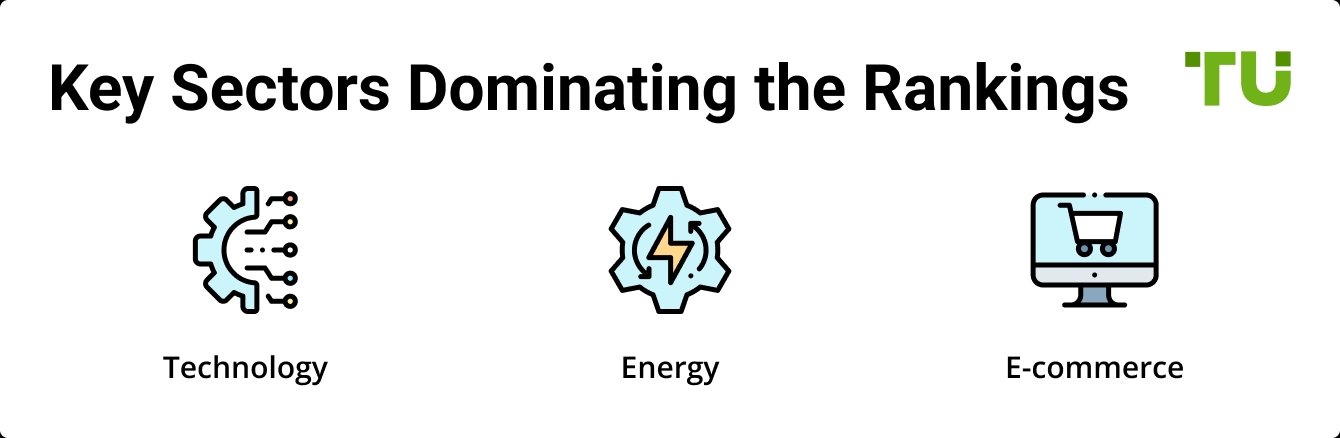
The key sectors dominating the ratings of the richest companies in the world are:
Technology
The world’s leading tech companies continue to shape industries through advancements in software, hardware, and cloud computing. From artificial intelligence to high-performance computing, their innovations influence everything from entertainment to healthcare, driving long-term growth.
Energy
Companies like Saudi Aramco remain key players as global economies balance oil dependence with investments in renewable energy. As industries shift toward cleaner alternatives, these firms work to integrate sustainable solutions while maintaining energy security.
E-commerce
Retail giants like Amazon have transformed shopping by making online purchases faster and more convenient. With efficient supply chains and personalized recommendations, they set new standards for how people shop and interact with brands.
What is the most expensive company in the world right now?
Apple Inc. is ranked as the most expensive company, with a company value of $3.3 trln in 2025. Its cutting-edge ideas, global reputation, and steady profits contribute to its worth.
Apple’s focus on customer satisfaction and seamless product connection has built unmatched customer loyalty. Smart business moves in services and new advancements ensure its long-term success. As technology keeps advancing, Apple remains a top name in tech, making it the most valuable company worldwide.
How to invest in the richest companies
Investing in the world’s biggest companies isn’t just about buying stocks — it’s about understanding their long-term potential and market power.
Look beyond stock price. A high share price doesn’t mean a company is still growing. Check revenue trends, innovation, and future plans.
Watch insider buying. If executives are buying their own stock, it’s a sign they believe in the company’s future.
Don’t blindly follow hype. Just because a company is famous doesn’t mean it’s a great investment at the moment. Timing matters.
Track global expansion. The richest companies often grow by entering new markets — watch for where they’re expanding next.
Check dividend history. If a company consistently pays dividends, it shows financial stability and long-term commitment to shareholders.
Monitor industry disruptions. Even the biggest companies can lose market share to innovation — know what’s changing their industry.
Use fractional investing. Don’t skip out on major companies just because their shares are expensive — buy small portions instead.
To invest in these companies, you would also need an account with a stock broker. We have researched the available options in your region and shortlisted the top options in the table below. You can compare their key features and choose the best one for yourself:
| eToro USA | SpeedTrader | Plus500 | TradeZero International | eOption | |
|---|---|---|---|---|---|
|
Stocks |
Yes | Yes | Yes | Yes | Yes |
|
Foundation year |
2007 | 1999 | 2008 | 2008 | 2007 |
|
Account min. |
50 | 2,500 | 500 | 500 | No |
|
Demo |
Yes | Yes | Yes | Yes | Yes |
|
Research and data |
Yes | Yes | Yes | Yes | Yes |
|
Basic stock/ETF fee |
No | $0.0025/$0,0009 | $0.006 | $0,005 | $0 |
|
Deposit Fee |
No | $0 | No | $0 | Not specified |
|
Withdrawal fee |
No | $30/$75 | No | ACH - $0-5, Wire - $15-50 | Not specified |
|
Regulation |
SEC, FINRA | FINRA, SIPC | CySEC, FCA, ASIC, FMA, FSCA, FSA Seychelles, EFSA, MAS, DFSA, SCB | Securities Commission of the Bahamas (Int); SEC, FINRA member, SIPC member (USA); Member firm of CIRO; member of CIPF (Canada); AFM, MiFID II (Europe) | FINRA, SIPC |
|
TU overall score |
9.3 | 9.2 | 7.7 | 7.51 | 7.5 |
|
Open an account |
Go to broker Your capital is at risk. |
Go to broker |
Go to broker 81% of retail CFD accounts lose money. |
Go to broker Your capital is at risk. |
Study review |
The richest companies expand power and create hidden investment opportunities

The world’s richest companies don’t just lead their industries — they shape entire economies. Their true power lies not in their revenue figures but in their ability to control supply chains, dictate market trends, and influence government policies.
Beginners often focus on stock prices or annual earnings, but a smarter approach is to track how these companies expand their influence beyond their core business. For example, Apple isn’t just a tech company — it controls a massive payments network, dominates digital media, and influences global manufacturing. Understanding these deeper layers of power can help investors predict where these companies are headed next, long before the market catches on.
Another overlooked strategy is watching how the wealthiest companies leverage exclusive partnerships and acquisitions. The biggest firms don’t always innovate from within — they often buy smaller, disruptive companies before they become a threat. Microsoft’s purchase of LinkedIn, Amazon’s acquisition of Whole Foods, and Google’s investment in AI startups weren’t just random deals — they were calculated moves to secure dominance in future markets. For beginners, studying these acquisitions and partnerships can reveal hidden investment opportunities. If you know which smaller players are attracting attention from industry giants, you can spot the next major market shift before it happens.
Conclusion
The richest companies in 2026 showcase global economic leadership across technology, energy, and commerce. These giants continue to drive innovation and shape industries worldwide. Investors should consider their market impact and future growth potential when building their portfolios.
FAQs
What determines a company’s market capitalization?
Market capitalization is calculated by multiplying a company’s current stock price by its total number of outstanding shares. It reflects the company’s market value and investor confidence.
How do companies achieve such high valuations?
High valuations result from strong financial performance, innovative products, global reach, and investor trust. Companies that dominate their sectors often attract significant investments.
What are the risks of investing in top companies?
Market volatility, regulatory changes, and competitive pressures are common risks. Diversifying investments can help reduce exposure to these risks.
Can individuals invest in these companies?
Yes, individuals can invest by purchasing stocks through brokerage platforms. Conducting thorough research and setting investment goals is essential for success.
Editors' Top Picks and Insights




Related Articles
Team that worked on the article
Alamin Morshed is a contributor at Traders Union. He specializes in writing articles for businesses that want to improve their Google search rankings to compete with their competition.
Chinmay Soni is a financial analyst with more than 5 years of experience in working with stocks, Forex, derivatives, and other assets. As a founder of a boutique research firm and an active researcher, he covers various industries and fields, providing insights backed by statistical data.
Mirjan Hipolito is a journalist and news editor at Traders Union. She is an expert crypto writer with five years of experience in the financial markets.
Volatility refers to the degree of variation or fluctuation in the price or value of a financial asset, such as stocks, bonds, or cryptocurrencies, over a period of time. Higher volatility indicates that an asset's price is experiencing more significant and rapid price swings, while lower volatility suggests relatively stable and gradual price movements.
Index in trading is the measure of the performance of a group of stocks, which can include the assets and securities in it.
Cryptocurrency is a type of digital or virtual currency that relies on cryptography for security. Unlike traditional currencies issued by governments (fiat currencies), cryptocurrencies operate on decentralized networks, typically based on blockchain technology.
An investor is an individual, who invests money in an asset with the expectation that its value would appreciate in the future. The asset can be anything, including a bond, debenture, mutual fund, equity, gold, silver, exchange-traded funds (ETFs), and real-estate property.
Legal insider buying is when company insiders buy shares of that company based on confidence in its growth and future earnings due to publicly available financial information. If an insider buys shares based on private information and does not report it to the relevant financial authorities, this becomes illegal insider trading.

-
 Afghanistan
-
 Albania
-
 Algeria
-
 Angola
-
 Argentina
-
 Armenia
-
 Australia
-
 Austria
-
 Azerbaijan
-
 Bahamas
-
 Bahrain
-
 Bangladesh
-
 Belarus
-
 Belgium
-
 Bolivia
-
 Botswana
-
 Brazil
-
 Brunei
-
 Bulgaria
-
 Cambodia
-
 Cameroon
-
 Canada
-
 Chile
Chile
-
 China
China
-
 Colombia
-
 Congo
Congo
-
 Costa Rica
-
 Cote d'Ivoire
-
 Croatia
-
 Cuba
Cuba
-
 Cyprus
-
 Czechia
-
 DR Congo
-
 Denmark
-
 Dominican Republic
-
 Ecuador
-
 Egypt
Egypt
-
 El Salvador
-
 Estonia
-
 Eswatini
-
 Ethiopia
-
 Finland
-
 France
-
 Georgia
-
 Germany
-
 Ghana
Ghana
-
 Greece
-
 Haiti
Haiti
-
 Hong Kong
-
 Hungary
-
 India
India
-
 Indonesia
-
 Iran, Islamic republic
-
 Iraq
Iraq
-
 Ireland
-
 Israel
-
 Italy
Italy
-
 Jamaica
-
 Japan
Japan
-
 Jordan
-
 Kazakhstan
-
 Kenya
Kenya
-
 Korea
Korea
-
 Kuwait
-
 Kyrgyzstan
-
 Laos
Laos
-
 Latvia
-
 Lebanon
-
 Lesotho
-
 Libya
Libya
-
 Lithuania
-
 Luxembourg
-
 Madagascar
-
 Malaysia
-
 Malta
Malta
-
 Mauritius
-
 Mexico
-
 Moldova
-
 Mongolia
-
 Montenegro
-
 Morocco
-
 Mozambique
-
 Myanmar
-
 Namibia
-
 Nepal
Nepal
-
 Netherlands
-
 New Zealand
-
 Nigeria
-
 North Macedonia
-
 Norway
-
 Oman
Oman
-
 Pakistan
-
 Palestine
-
 Panama
-
 Papua New Guinea
-
 Paraguay
-
 Peru
Peru
-
 Philippines
-
 Poland
-
 Portugal
-
 Puerto Rico
-
 Qatar
Qatar
-
 Reunion
-
 Romania
-
 Rwanda
-
 Saudi Arabia
-
 Serbia
-
 Singapore
-
 Slovakia
-
 Slovenia
-
 Somalia
-
 South Africa
-
 Spain
Spain
-
 Sri Lanka
-
 Sweden
-
 Switzerland
-
 Syria
Syria
-
 Taiwan
-
 Tajikistan
-
 Tanzania
-
 Thailand
-
 Trinidad and Tobago
-
 Tunisia
-
 Turkey
-
 UAE
UAE
-
 Uganda
-
 Ukraine
-
 United Kingdom
-
United States
-
 Uruguay
-
 Uzbekistan
-
 Venezuela
-
 Vietnam
-
 Yemen
Yemen
-
 Zambia
-
 Zimbabwe
- Forex
- Crypto












