
Cracks In The Narrative Of American Exceptionalism


Editorial Note: While we adhere to strict Editorial Integrity, this post may contain references to products from our partners. Here's an explanation for How We Make Money. None of the data and information on this webpage constitutes investment advice according to our Disclaimer.
The bearish case for the dollar rests on weakening fundamentals, shifting sentiment, and technical breakdowns. Overvaluation, diverging central bank policies, and reduced global confidence are prompting investors to rethink U.S. dollar exposure.
The bear case for the dollar has quietly matured over the past two years. While headlines continue to tout the resilience of the U.S. economy, currency markets — ever forward-looking — have already begun to reprice American exceptionalism. The Dollar Index (DXY), which peaked near 114.80 in late 2022, marked not only the top of the dollar’s outsized bull run but may also represent a psychological ceiling for years to come.
What was once a one-way trade is now a landscape of recalibration. Global investors entered 2025 overweight U.S. assets and the dollar, a legacy of pandemic-era stimulus, geopolitical uncertainty, and a perception that America alone could navigate the new economic terrain. That faith is showing signs of fray.
The Bank for International Settlements (BIS) recently offered a window into Q1 currency market dynamics, noting that dollar weakness was most pronounced during Asia Pacific trading hours. This is not mere regional volatility, it is a signal of active hedging by dollar-exposed investors. The implication is clear: risk managers are no longer comfortable leaving portfolios unhedged against dollar depreciation.
Risk warning: Forex trading carries high risks, with potential losses including your entire deposit. Market fluctuations, economic instability, and geopolitical factors impact outcomes. Studies show that 70-80% of traders lose money. Consult a financial advisor before trading.
Shifting capital flows and sentiment
Europe seems to be following suit. After buying record amounts of U.S. equities in Q4 2024, European asset managers have initiated strategic rebalancing. Hedging dollar exposure may not just be a defensive move — but also a recognition that the U.S. may not warrant its current premium. The tide is turning, not with a crash, but with a deliberate retreat.
The narrative of American exceptionalism has driven capital flows for a generation. But stories unravel in stages. Davos 2025, where several speakers labeled Europe “uninvestable,” may prove to be a contrarian signal akin to the hysteria surrounding the UK in September 2022. Remember when analysts flirted with calling Britain an emerging market during Prime Minister Truss’s brief tenure? That episode coincided with sterling’s historic low. Pessimism, when it becomes exaggerated, often marks a turning point.
Fundamentals, technicals, and central bank divergence
The dollar’s broad overvaluation adds weight to the medium-term bearish case. OECD purchasing power parity models suggest dramatic misalignment: the euro is roughly 55% undervalued, the yen 52%, and the Canadian dollar around 20%. Only the Swiss franc stands out as overvalued — by nearly 18% — among G10 currencies. Such distortions rarely persist uncorrected, especially as central banks shift policy.
As September looms, the Federal Reserve is poised to resume its rate-cutting cycle. It is likely that other G10 central banks will already be at or near the end of their easing paths. This sequencing matters: the Fed eases while others pause or tighten reinforces the downward pressure on the dollar.
We have already seen movement in the technicals. The Dollar Index has fallen below its 10-year (120-month) moving average of ~98.45 for the first time in a decade. At its peak, DXY was about 25% above this long-term average. If historical symmetry holds — say, a 20% undershoot — it would bring the index toward 79.00, a level not seen since 2014.
In this context, previous targets look modest. While I had been aiming for 95.00 by year-end, the 90.00–92.00 range now seems increasingly plausible. Looking ahead to 2026, DXY could even test the 80.00–82.00 zone. That is not alarmist — that’s arithmetic and context.
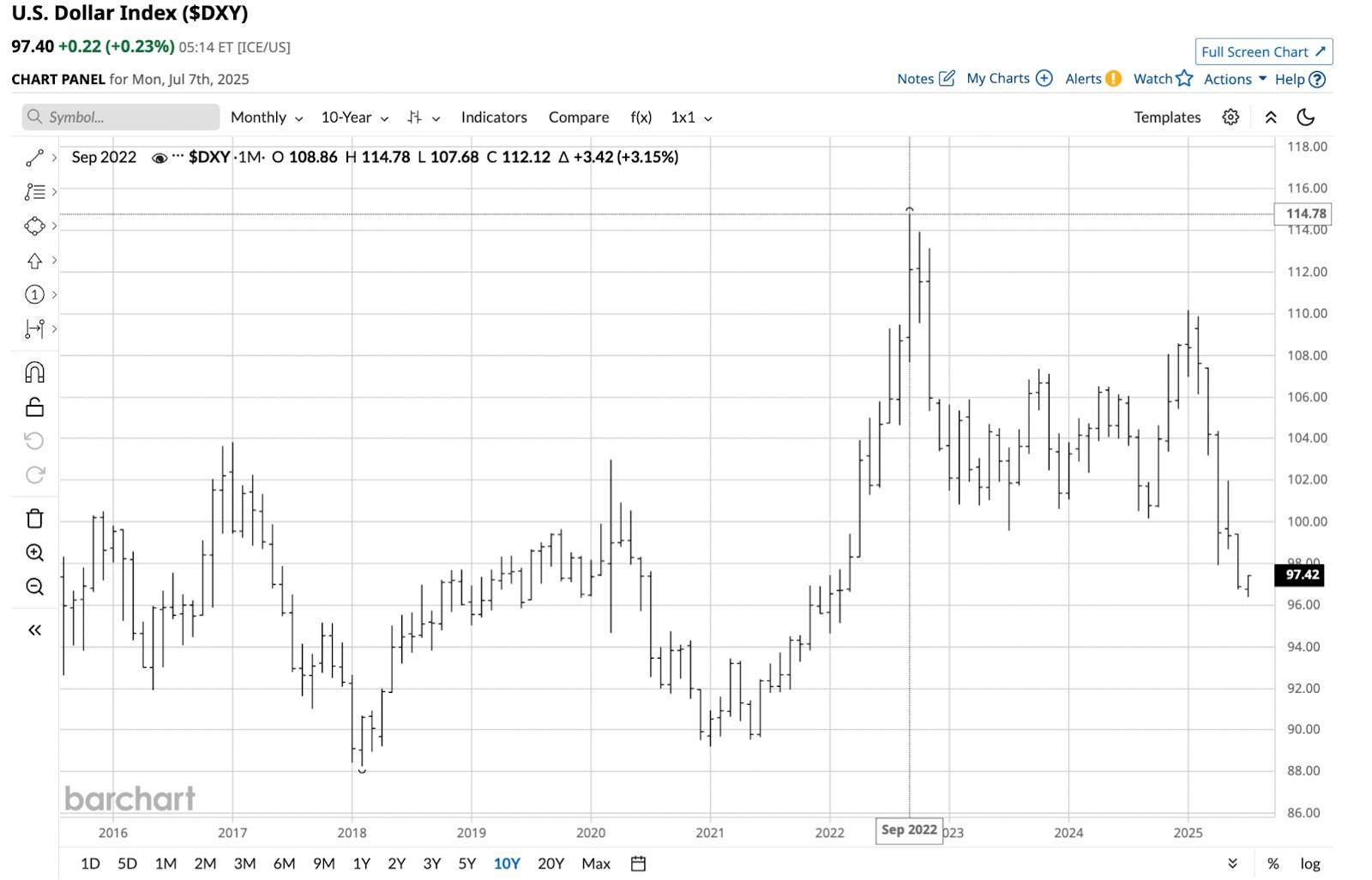
Key highlights:
Peak near 114.80 in late 2022.
Decline to approximately 97.42 by July 4, 2025.
Crossing below the 10-year moving average (~98.45).
Purpose: Illustrates the weakening trend of the US dollar, emphasizing the shift from its previous strength.
Implications for portfolios and the path ahead
This shift in sentiment and valuation is not just academic. It carries real-world consequences for portfolio construction. In the years leading up to 2022, global portfolios were often dominated by U.S. equities and credit. The dollar’s strength served as both a hedge and a tailwind. But with stretched valuations, declining relative growth, and mounting fiscal imbalances, the dollar may no longer be the anchor. It may be the risk.
Investors are now forced to reconsider the “premium” they pay for U.S. exposure. With the euro, yen, and Canadian dollar deeply undervalued relative to purchasing power, foreign assets could offer both diversification and mean-reversion potential. In other words: currency exposure could be a source of alpha, not just noise.
The dollar’s decline is no warning bell — it is a return to balance. The bull market of 2014–2022 was built on extraordinary conditions: quantitative easing, flight-to-safety flows, and geopolitical upheaval. Those supports are being gradually dismantled. What remains is a dollar still riding on legacy positioning and residual sentiment.
FX markets are notoriously fickle, subject to noise and narrative. But when the fundamentals, technicals, and sentiment all point in the same direction, investors ignore them at their peril. The dollar is drifting lower — not because the world has collapsed, but because it is recalibrating. Repricing exceptionalism is not abandonment — it is realism.
The more investors treat currency exposure as a dynamic part of portfolio construction, the better they can navigate the global reset underway.
Stop treating currency exposure as an afterthought

As someone who has analyzed FX markets through multiple macro cycles, I believe we are witnessing a structural shift in how the dollar is perceived globally. This isn’t a crash — it’s a controlled descent from overvaluation, and portfolios need to adjust accordingly.
If you're still anchored to the belief in U.S. dollar supremacy, you're likely overexposed to an asset that's lost its asymmetric advantage. Personally, I’ve begun tilting allocation toward undervalued G10 currencies, particularly the euro and yen, where purchasing power gaps are simply too wide to ignore.
My recommendation to long-term investors? Stop treating currency exposure as an afterthought. In a world of fading dollar dominance, FX is no longer background noise — it’s alpha.
Conclusion
The dollar’s decline is not a collapse, but a logical outcome of evolving global conditions. With exaggerated overvaluation, changing central bank dynamics, and shifting investor sentiment, the case for continued dollar strength has weakened significantly. As the global economy resets, embracing currency diversification and challenging long-held assumptions may be essential for staying ahead.
FAQs
Why is the dollar considered overvalued right now?
OECD models show major currencies like the euro and yen are deeply undervalued compared to the dollar, suggesting a significant misalignment from fair value.
What role does the Federal Reserve play in this bearish dollar outlook?
The Fed’s expected rate cuts, especially if other central banks are pausing or tightening, weaken the dollar by reducing its yield advantage.
How are investors responding to this shift?
Investors are actively hedging dollar exposure and reallocating toward foreign assets, signaling reduced confidence in the U.S. premium.
What does this mean for portfolio strategy?
The dollar is no longer a reliable hedge or tailwind; instead, currency exposure is becoming a potential source of alpha and diversification.
Editors' Top Picks and Insights






Related Articles
Team that worked on the article
One of the most widely respected and quoted currency experts, Marc Chandler has been analyzing and advising on the global capital markets for more than 30 years. Throughout his career on Wall Street, Chandler has advised private businesses, hedge funds and asset managers on navigating the foreign exchange market.
Chinmay Soni is a financial analyst with more than 5 years of experience in working with stocks, Forex, derivatives, and other assets. As a founder of a boutique research firm and an active researcher, he covers various industries and fields, providing insights backed by statistical data.
Mirjan Hipolito is a journalist and news editor at Traders Union. She is an expert crypto writer with five years of experience in the financial markets.
Volatility refers to the degree of variation or fluctuation in the price or value of a financial asset, such as stocks, bonds, or cryptocurrencies, over a period of time. Higher volatility indicates that an asset's price is experiencing more significant and rapid price swings, while lower volatility suggests relatively stable and gradual price movements.
A bear market is a period of time in which an investment asset, such as stocks, bonds, or commodities, experiences a decline in price for an extended period of time.
Cryptocurrency is a type of digital or virtual currency that relies on cryptography for security. Unlike traditional currencies issued by governments (fiat currencies), cryptocurrencies operate on decentralized networks, typically based on blockchain technology.
Diversification is an investment strategy that involves spreading investments across different asset classes, industries, and geographic regions to reduce overall risk.
Yield refers to the earnings or income derived from an investment. It mirrors the returns generated by owning assets such as stocks, bonds, or other financial instruments.

-
 Afghanistan
-
 Albania
-
 Algeria
-
 Angola
-
 Argentina
-
 Armenia
-
 Australia
-
 Austria
-
 Azerbaijan
-
 Bahamas
-
 Bahrain
-
 Bangladesh
-
 Belarus
-
 Belgium
-
 Bolivia
-
 Botswana
-
 Brazil
-
 Brunei
-
 Bulgaria
-
 Cambodia
-
 Cameroon
-
 Canada
-
 Chile
Chile
-
 China
China
-
 Colombia
-
 Congo
Congo
-
 Costa Rica
-
 Cote d'Ivoire
-
 Croatia
-
 Cuba
Cuba
-
 Cyprus
-
 Czechia
-
 DR Congo
-
 Denmark
-
 Dominican Republic
-
 Ecuador
-
 Egypt
Egypt
-
 El Salvador
-
 Estonia
-
 Eswatini
-
 Ethiopia
-
 Finland
-
 France
-
 Georgia
-
 Germany
-
 Ghana
Ghana
-
 Greece
-
 Haiti
Haiti
-
 Hong Kong
-
 Hungary
-
 India
India
-
 Indonesia
-
 Iran, Islamic republic
-
 Iraq
Iraq
-
 Ireland
-
 Israel
-
 Italy
Italy
-
 Jamaica
-
 Japan
Japan
-
 Jordan
-
 Kazakhstan
-
 Kenya
Kenya
-
 Korea
Korea
-
 Kuwait
-
 Kyrgyzstan
-
 Laos
Laos
-
 Latvia
-
 Lebanon
-
 Lesotho
-
 Libya
Libya
-
 Lithuania
-
 Luxembourg
-
 Madagascar
-
 Malaysia
-
 Malta
Malta
-
 Mauritius
-
 Mexico
-
 Moldova
-
 Mongolia
-
 Montenegro
-
 Morocco
-
 Mozambique
-
 Myanmar
-
 Namibia
-
 Nepal
Nepal
-
 Netherlands
-
 New Zealand
-
 Nigeria
-
 North Macedonia
-
 Norway
-
 Oman
Oman
-
 Pakistan
-
 Palestine
-
 Panama
-
 Papua New Guinea
-
 Paraguay
-
 Peru
Peru
-
 Philippines
-
 Poland
-
 Portugal
-
 Puerto Rico
-
 Qatar
Qatar
-
 Reunion
-
 Romania
-
 Rwanda
-
 Saudi Arabia
-
 Serbia
-
 Singapore
-
 Slovakia
-
 Slovenia
-
 Somalia
-
 South Africa
-
 Spain
Spain
-
 Sri Lanka
-
 Sweden
-
 Switzerland
-
 Syria
Syria
-
 Taiwan
-
 Tajikistan
-
 Tanzania
-
 Thailand
-
 Trinidad and Tobago
-
 Tunisia
-
 Turkey
-
 UAE
UAE
-
 Uganda
-
 Ukraine
-
 United Kingdom
-
United States
-
 Uruguay
-
 Uzbekistan
-
 Venezuela
-
 Vietnam
-
 Yemen
Yemen
-
 Zambia
-
 Zimbabwe
- Forex
- Crypto












