
Is the Euro Stronger Than the Dollar: A Complete Trader's Guide



Editorial Note: While we adhere to strict Editorial Integrity, this post may contain references to products from our partners. Here's an explanation for How We Make Money. None of the data and information on this webpage constitutes investment advice according to our Disclaimer.
Is the euro stronger than the dollar:
Whether the euro is stronger than the dollar has become one of the most searched queries in Forex over the past two years, and for good reason. The EUR/USD pair is the most traded currency pair in the world, and its direction affects everything from import costs to global investment flows.
Currency strength is relative and cyclical. It reflects interest rate expectations, inflation trends, trade balances, and investor sentiment, not just which number is bigger. A trader asking whether the dollar is stronger than the euro needs context, not just a price quote. This guide breaks down what is driving EUR/USD in 2026, what history tells us, and how to use that information in your trading.
Is the dollar stronger than the euro in 2026?
Yes, in 2026 the euro remains stronger than the dollar in nominal exchange rate terms. EUR/USD opened the year around 1.1747, reached a high of 1.2041 in January, and has since pulled back to the 1.16 range. One euro still buys more than one U.S. dollar, which means the euro holds a clear nominal advantage.
But the more useful question for traders is not which currency has the bigger number. It is what is driving the gap and whether it will hold.
Two central bank decisions define the 2026 picture:
The Federal Reserve. The Fed cut rates through late 2024 and 2025. By early 2026, markets expected the federal funds rate to move toward the mid-3% range, down from its 2023 peak above 5%. Further cuts to around 3.25% are expected later in 2026. A falling Fed rate reduces the yield advantage that previously made the dollar attractive to global investors.
The European Central Bank. The ECB has held its deposit rate around 2% since July 2025. With ECB easing largely complete and Fed cuts still in progress, the interest rate gap between the two has narrowed significantly. This narrowing is the single biggest reason the euro is stronger than the USD in 2026.
Other factors also matter. The Eurozone's trade balance improved as energy import costs stabilized after the 2022 shock. Meanwhile, concerns about U.S. fiscal deficits and debt levels have weighed on long-term dollar sentiment. Together, these conditions explain why EUR/USD pushed above 1.20 for the first time in years.
That said, the euro's lead is not guaranteed. If U.S. economic data surprises to the upside or global risk appetite falls sharply, demand for the dollar can recover quickly. The pair is range-bound for now, and traders should treat both scenarios as live possibilities.
For the latest rate and live market data, see our forecast
| Month | Minimum Price, $ | Average Price, $ | Maximum Price, $ |
|---|---|---|---|
| August 2026 | 1.1 | 1.1 | 1.1 |
| September 2026 | 1.1 | 1.1 | 1.1 |
| October 2026 | 1.1 | 1.1 | 1.1 |
| November 2026 | 1.1 | 1.1 | 1.1 |
| December 2026 | 1 | 1.1 | 1.1 |
What does "currency strength" actually mean?
When people ask whether the euro or the dollar is stronger, they usually mean one thing: which currency buys more of the other. By that measure, the euro wins in 2026. But professional traders use a broader definition.
True currency strength reflects three things:
Exchange rate. The most visible measure. When EUR/USD is above 1.00, one euro buys more than one dollar. This is the number most people refer to when comparing the two.
Interest rate appeal. Currencies backed by higher interest rates attract more capital. Investors move money toward the currency offering better returns, which pushes its value up. This is why central bank decisions move Forex markets more than almost anything else.
Reserve and safe-haven demand. The U.S. dollar holds roughly 57.7% of global official foreign exchange reserves. This structural demand gives the dollar a floor that no exchange rate figure fully captures. Even when EUR/USD rises, the dollar remains the world's dominant reserve currency.
EUR/USD history: From parity to recovery
Understanding where EUR/USD stands today requires knowing where it has been. The pair has gone through several distinct phases, and each one reshaped how traders and analysts look at it.
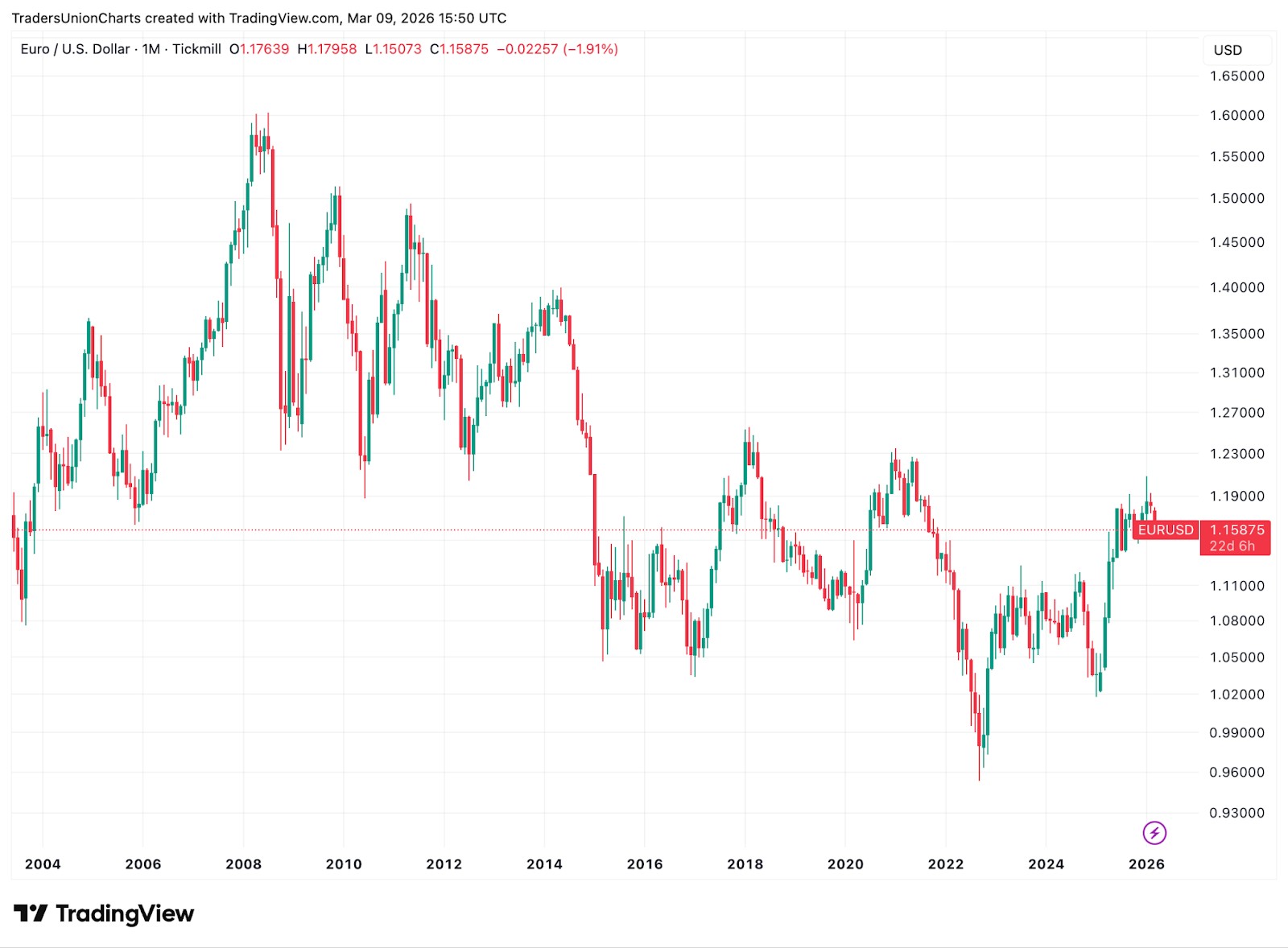
The early years (1999-2002). The euro launched in January 1999 at around 1.17 against the dollar. Within two years it had fallen below parity, dropping to a low of roughly 0.83 in 2000. At that point, the dollar was clearly stronger than the euro, driven by the U.S. tech boom and strong capital inflows.
The long euro rally (2002-2008). The euro recovered steadily and crossed back above parity in 2002. By 2008 it had reached a record high above 1.60. This was the period when the euro became definitively stronger than the dollar in exchange rate terms, supported by a weakening U.S. current account and aggressive Fed easing following the dot-com bust.
Post-crisis swings (2008-2021). The pair spent most of this period ranging between 1.05 and 1.25, with sharp moves tied to the Eurozone debt crisis, ECB quantitative easing, and shifting U.S. growth expectations. Neither currency held a commanding lead for long.
Dollar dominance and parity (2022). Aggressive Fed rate hikes in 2022 pushed the dollar to its strongest level in two decades. EUR/USD fell below parity for the first time since 2002, briefly touching 0.96. For much of that year, the dollar was stronger than the euro by a wide margin.
Recovery and 2026 levels. From late 2022 onward, the euro recovered as Fed hikes peaked and U.S. rate cuts began. By early 2026, EUR/USD had climbed back above 1.18, with a January high near 1.20. You can explore the full price timeline on the EUR/USD price history page.
The key takeaway from this history is straightforward. Leadership between the euro and dollar has changed multiple times and will change again. No single cycle is permanent.
Current EUR/USD levels and what they mean for traders
After reaching a January 2026 high near 1.20, EUR/USD has pulled back to the 1.16 range. That pullback matters. It shows that while the euro is stronger than the U.S. dollar on a nominal basis, the pair is not in a clean uptrend. It is consolidating, and that creates a different trading environment than a trending market.
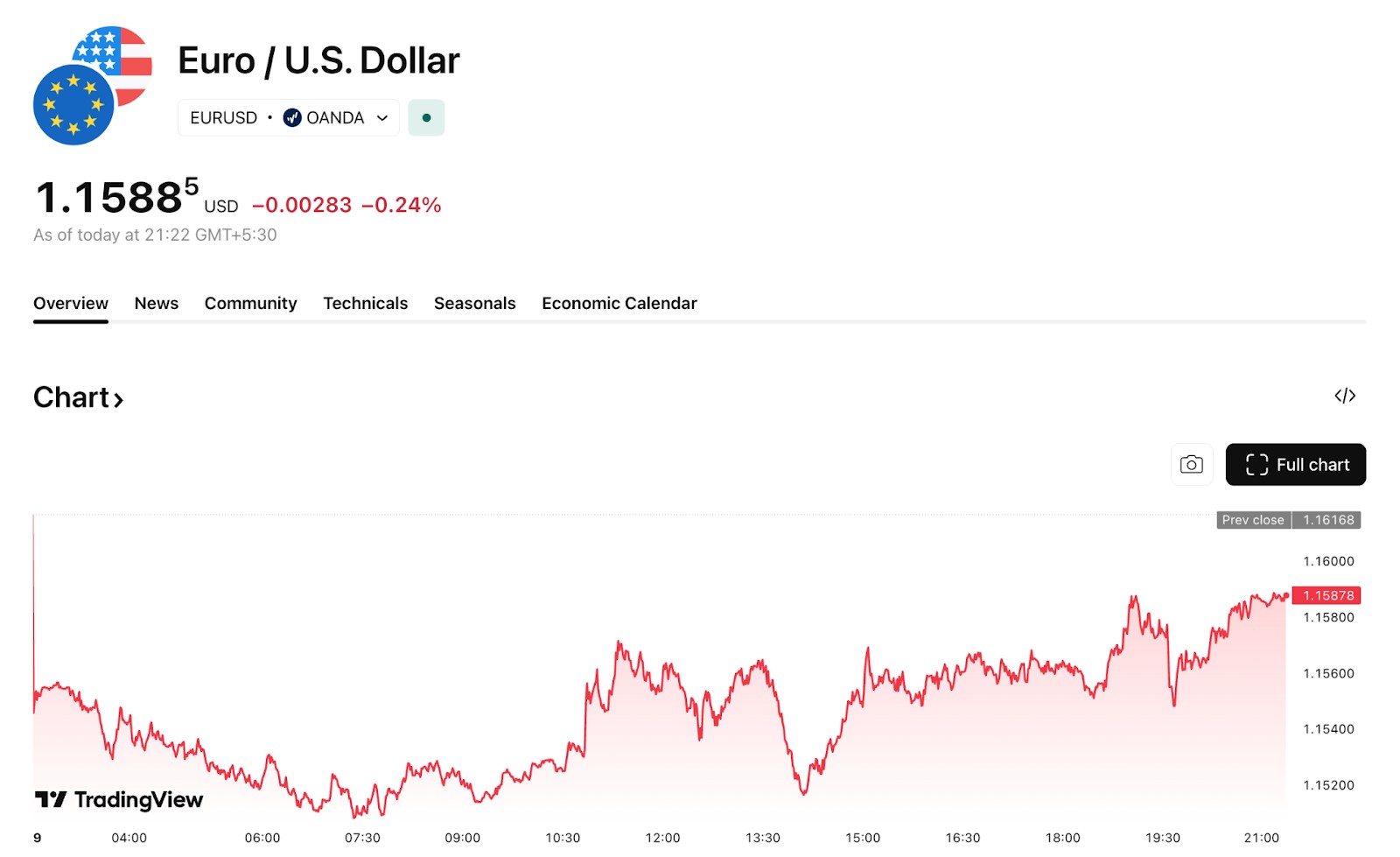
Here is what the current setup means in practical terms:
Range boundaries matter more than direction. When a pair consolidates after a strong rally, support and resistance levels become the primary trading tool. The 1.15-1.16 zone is now a key support area, while the 1.20 level acted as strong resistance. Breaks beyond either level will signal the next directional move.
Volatility is compressing. Consolidation phases tend to see tighter daily ranges. This affects position sizing and stop placement. Strategies that work in trending markets often underperform in range conditions.
Macro catalysts will drive the next leg. In a range-bound market, the next major Fed or ECB statement, inflation print, or jobs report can trigger a sharp move in either direction. Traders need to be positioned ahead of these events or react quickly after them.
Short-term and long-term views may conflict. A trader looking at a daily chart may see a bearish pullback. A trader looking at a monthly chart sees a pair that has recovered strongly from the 2022 lows. Both are correct. Knowing your timeframe is essential.
The table below gives a structured long-term forecast.
| Year | Price in the middle of the year | Price at the end of the year |
|---|---|---|
| 2026 | $1.1 | $1.1 |
| 2027 | $1.1 | $1 |
| 2028 | $1 | $1.1 |
| 2029 | $1.1 | $1.1 |
| 2030 | $1 | $1 |
When the dollar fights back
The euro's current advantage does not mean the dollar is fading permanently. History shows the dollar can reclaim strength quickly, and several conditions in 2026 could trigger exactly that.
The most reliable driver of dollar recoveries is risk aversion. When global markets sell off, investors move into U.S. assets, particularly U.S. Treasuries. That capital flow pushes dollar demand up sharply, regardless of what the Fed is doing with rates. This is why the dollar remains the world's dominant reserve currency even during periods when EUR/USD is rising.
Three specific scenarios could make the dollar stronger against the euro in 2026:
U.S. economic outperformance. If U.S. GDP growth or jobs data come in stronger than expected, markets may price out further Fed cuts. Fewer expected cuts means higher relative yields, which attracts capital back into the dollar.
Eurozone growth disappointment. Weak manufacturing data, political instability in major Eurozone economies, or a deterioration in the EU's trade balance could pressure the euro lower regardless of ECB policy.
Global risk-off event. A financial shock, geopolitical escalation, or sudden credit market stress typically sends money into the dollar as a safe haven. In these environments, asking whether the euro or dollar is stronger becomes almost irrelevant. The dollar wins by default.
None of these scenarios are the base case for 2026, but none are remote either. Traders who only position for continued euro strength are taking on asymmetric risk. A balanced view means knowing what would have to happen for the dollar to regain the upper hand, and having a plan for it.
2026 outlook: Will the euro or dollar gain more ground?
Forecasting EUR/USD direction requires weighing several moving parts at once. For 2026, the picture is neither cleanly bullish for the euro nor clearly in favor of the dollar. Most analyst projections point to a range-bound year with directional breaks tied to specific macro events.
The EUR/USD forecast page tracks consensus projections and scenario analysis updated regularly. For a broader view beyond 2026, the EUR/USD long-term forecast covers structural drivers and multi-year expectations.
The key themes shaping the outlook:
Fed easing pace. Further U.S. rate cuts are expected in 2026, but the timing and size remain uncertain. If cuts come faster than markets expect, the dollar weakens and EUR/USD pushes higher. If the Fed pauses due to sticky inflation or strong growth, the dollar stabilizes and the euro's advantage narrows.
ECB policy stability. The ECB has largely completed its easing cycle with rates holding at 2.15%. With less room to cut further, the euro is less vulnerable to sudden policy-driven selloffs than it was in prior cycles. This gives the euro a degree of stability heading into the second half of 2026.
U.S. fiscal concerns. Growing attention to U.S. deficit levels and debt sustainability has added a structural headwind for the dollar that was not present in previous cycles. This is a slow-moving factor but one that long-term investors are increasingly pricing in.
Eurozone political risk. Elections and fiscal policy debates across major EU member states remain a background risk for the euro. Any significant political disruption could weigh on sentiment quickly.
Trading EUR/USD: Practical strategies for 2026
The traders who perform consistently on EUR/USD are not the ones with the best macro opinion. They are the ones with the clearest process. Here is what a disciplined approach to EUR/USD trading looks like in 2026:
Start with the macro bias. Before looking at any chart, establish your directional view for the week. Review the latest Fed and ECB communication, check the interest rate differential, and note any major data releases scheduled. This sets the context for every trade you take.
Trade during high-liquidity sessions. EUR/USD is most active during the London session and the London-New York overlap, roughly 8am to 12pm EST. Spreads are tighter, volume is higher, and price moves are more reliable during these windows. Avoid trading during low-volume periods when moves can be erratic and misleading.
Let price confirm your bias. A macro view tells you which direction to favor. Price action tells you when to enter. Wait for the market to show momentum in your direction before committing capital. Entering too early based on opinion alone is one of the most common mistakes on this pair.
Keep position size conservative. EUR/USD can move 50 to 150 pips on a major data release. Size positions so that a 100-pip move against you does not force an emotional decision. Smaller size allows you to hold through noise and add when confirmation arrives.
For traders who want structured entry and exit guidance, the EUR/USD signals page provides regularly updated technical levels and trade ideas based on current market conditions. Those already following the EUR/USD pair, the choice of broker can also influence how smoothly positions are executed. The comparison below outlines several brokers available in your region that support EUR/USD trading and multi-asset market access.
| Plus500 | OANDA | FOREX.com | Interactive Brokers | Blackbird | |
|---|---|---|---|---|---|
|
EUR/USD |
Yes | Yes | Yes | Yes | Yes |
|
Standard EUR/USD spread |
0.7 | 0.3 | 1.0 | 0.5 | 0.3 |
|
Min. deposit, $ |
100 | No | 100 | No | 1 |
|
Max. leverage |
1:300 | 1:200 | 1:50 | 1:30 | 1:30 |
|
Deposit fee, % |
No | No | No | No | No |
|
Withdrawal fee, % |
No | No | No | Yes | No |
|
TU overall score |
7.52 | 6.8 | 6.74 | 6.63 | 5.95 |
|
Open an account |
Go to broker 80% of retail CFD accounts lose money. |
Go to broker Your capital is at risk. |
Study review | Study review | Study review |
Trading EUR/USD: Macro first, execution second, size always smaller than you think

Trading EUR/USD well in 2026 comes down to one discipline: knowing why you have a view before you take a position. I start every week by checking the interest rate gap between U.S. Treasuries and German Bunds, reviewing the latest Fed and ECB statements, and noting what data is due. That homework takes thirty minutes and saves me from chasing moves that have no fundamental backing. When the macro picture is clear, I trade with more conviction and smaller stops. When it is murky, I reduce size or stay flat entirely.
Execution is where most traders lose the edge they built through good analysis. On EUR/USD, I focus almost exclusively on the London-New York overlap. Liquidity is deep, spreads are tight, and the moves tend to follow through. Outside that window, I observe but rarely act. I also keep position sizes smaller than feels comfortable, because this pair can move sharply on a single data print.
Conclusion
In 2026, the euro's standing against the dollar is shaped by dynamic economic, political, and market-driven factors. While forecasts suggest some periods of euro strength, underlying U.S. economic resilience and global demand for the dollar continue to provide notable support for the USD. For example, divergent monetary policies and unexpected economic data releases have repeatedly shifted the balance, emphasizing the importance of timely analysis. Ultimately, the EUR/USD relationship remains fluid and sensitive to both macroeconomic trends and investor sentiment. The true edge for traders and investors lies not in predicting a fixed outcome, but in staying agile and informed amidst ever-evolving global currents.
FAQs
How does reserve currency status influence whether the euro or dollar is considered stronger in 2026?
What role does the trade balance play in the euro's strength against the dollar in 2026?
How should traders adjust their strategies during periods of EUR/USD consolidation in 2026?
Why is it important for traders to consider both short-term and long-term perspectives when analyzing EUR/USD in 2026?
Editors' Top Picks and Insights

Bitcoin mining is getting greener, but the debate isn't over

Asia's largest IPO: How CXMT became China's most valuable company

Global fintech in 2026: Three trends that matter

From Jesus Christ to aliens: Polymarket's most absurd prediction markets

Hunting crypto owners: Why criminals have gone offline

BitMEX is shutting down: Why Trump could not save the exchange
Related Articles
Team that worked on the article
Anton Kharitonov is an active trader and analyst. He employs both short- and long-term trading strategies, primarily based on fundamental factors, supported by technical indicators and intermarket analysis.
Dan Blystone began his trading career in 1998 as an arbitrage clerk on the floor of the Chicago Mercantile Exchange (CME). He later traded bond and Eurex futures at proprietary firms such as Altea Trading, gaining valuable experience in high-frequency trading and risk management.
Chinmay Soni is a financial analyst with more than 5 years of experience in working with stocks, Forex, derivatives, and other assets. As a founder of a boutique research firm and an active researcher, he covers various industries and fields, providing insights backed by statistical data.
Index in trading is the measure of the performance of a group of stocks, which can include the assets and securities in it.
Copy trading is an investing tactic where traders replicate the trading strategies of more experienced traders, automatically mirroring their trades in their own accounts to potentially achieve similar results.
Bitcoin is a decentralized digital cryptocurrency that was created in 2009 by an anonymous individual or group using the pseudonym Satoshi Nakamoto. It operates on a technology called blockchain, which is a distributed ledger that records all transactions across a network of computers.
Risk management is a risk management model that involves controlling potential losses while maximizing profits. The main risk management tools are stop loss, take profit, calculation of position volume taking into account leverage and pip value.
An investor is an individual, who invests money in an asset with the expectation that its value would appreciate in the future. The asset can be anything, including a bond, debenture, mutual fund, equity, gold, silver, exchange-traded funds (ETFs), and real-estate property.

-
 Afghanistan
-
 Albania
-
 Algeria
-
 Angola
-
 Argentina
-
 Armenia
-
 Australia
-
 Austria
-
 Azerbaijan
-
 Bahamas
-
 Bahrain
-
 Bangladesh
-
 Belarus
-
 Belgium
-
 Bolivia
-
 Botswana
-
 Brazil
-
 Brunei
-
 Bulgaria
-
 Cambodia
-
 Cameroon
-
 Canada
-
 Chile
Chile
-
 China
China
-
 Colombia
-
 Congo
Congo
-
 Costa Rica
-
 Cote d'Ivoire
-
 Croatia
-
 Cuba
Cuba
-
 Cyprus
-
 Czechia
-
 DR Congo
-
 Denmark
-
 Dominican Republic
-
 Ecuador
-
 Egypt
Egypt
-
 El Salvador
-
 Estonia
-
 Eswatini
-
 Ethiopia
-
 Finland
-
 France
-
 Georgia
-
 Germany
-
 Ghana
Ghana
-
 Greece
-
 Haiti
Haiti
-
 Hong Kong
-
 Hungary
-
 India
India
-
 Indonesia
-
 Iran, Islamic republic
-
 Iraq
Iraq
-
 Ireland
-
 Israel
-
 Italy
Italy
-
 Jamaica
-
 Japan
Japan
-
 Jordan
-
 Kazakhstan
-
 Kenya
Kenya
-
 Korea
Korea
-
 Kuwait
-
 Kyrgyzstan
-
 Laos
Laos
-
 Latvia
-
 Lebanon
-
 Lesotho
-
 Libya
Libya
-
 Lithuania
-
 Luxembourg
-
 Madagascar
-
 Malaysia
-
 Malta
Malta
-
 Mauritius
-
 Mexico
-
 Moldova
-
 Mongolia
-
 Montenegro
-
 Morocco
-
 Mozambique
-
 Myanmar
-
 Namibia
-
 Nepal
Nepal
-
 Netherlands
-
 New Zealand
-
 Nigeria
-
 North Macedonia
-
 Norway
-
 Oman
Oman
-
 Pakistan
-
 Palestine
-
 Panama
-
 Papua New Guinea
-
 Paraguay
-
 Peru
Peru
-
 Philippines
-
 Poland
-
 Portugal
-
 Puerto Rico
-
 Qatar
Qatar
-
 Reunion
-
 Romania
-
 Rwanda
-
 Saudi Arabia
-
 Serbia
-
 Singapore
-
 Slovakia
-
 Slovenia
-
 Somalia
-
 South Africa
-
 Spain
Spain
-
 Sri Lanka
-
 Sweden
-
 Switzerland
-
 Syria
Syria
-
 Taiwan
-
 Tajikistan
-
 Tanzania
-
 Thailand
-
 Trinidad and Tobago
-
 Tunisia
-
 Turkey
-
 UAE
UAE
-
 Uganda
-
 Ukraine
-
 United Kingdom
-
United States
-
 Uruguay
-
 Uzbekistan
-
 Venezuela
-
 Vietnam
-
 Yemen
Yemen
-
 Zambia
-
 Zimbabwe
- Forex
- Crypto










- Is the dollar stronger than the euro in 2026?
- What does "currency strength" actually mean?
- EUR/USD history: From parity to recovery
- Current EUR/USD levels and what they mean for traders
- When the dollar fights back
- 2026 outlook: Will the euro or dollar gain more ground?
- Trading EUR/USD: Practical strategies for 2026
- Expert opinion
- Conclusion
- FAQs


