
How Geopolitical Events Influence Forex?



Editorial Note: While we adhere to strict Editorial Integrity, this post may contain references to products from our partners. Here's an explanation for How We Make Money. None of the data and information on this webpage constitutes investment advice according to our Disclaimer.
Geopolitical events influence Forex markets primarily through changes in investor sentiment, capital flows, and central bank responses. Different types of geopolitical events affect the Forex market:
Political instability
Wars and conflicts
Trade disputes
Natural disasters
In this article we will talk in detail how geopolitical events influence Forex. You will also learn what risks there may be and what ways there are to minimize them.
Impact of geopolitical events on Forex markets
Political instability. Political instability, such as government collapses or political unrest, can lead to a loss of confidence in a country's economy, causing its currency to depreciate. For example, political turmoil in Turkey has frequently led to significant fluctuations in the value of the Turkish lira.
Wars and conflicts. Wars and conflicts create uncertainty and risk aversion among investors. For instance, the Syrian civil war and the subsequent refugee crisis had a profound impact on the Turkish lira and neighboring currencies.
Trade disputes. Trade disputes, such as the U.S.-China trade war, can disrupt global supply chains and affect currency pairs involved in the dispute. The imposition of tariffs and retaliatory measures during the U.S.-China trade war led to volatility in the Chinese yuan and the U.S. dollar. Find out how Trump's 2025 trade war will affect Forex and global markets.
Natural disasters. Natural disasters can disrupt economic activity and affect currency values. For example, the 2011 earthquake and tsunami in Japan led to significant movements in the Japanese yen as investors assessed the economic damage and recovery efforts.
How to minimize impact of geopolitical events on Forex markets
The foreign exchange (Forex) market is the largest and most liquid financial market in the world, with daily trading volumes exceeding $7.5 trillion. It operates 24 hours a day, allowing for continuous trading opportunities across various global currencies. The major participants in this market include banks, central banks, financial institutions, hedge funds, corporations, and individual traders.
Step-by-step guide for traders
To effectively manage their portfolios during geopolitical events, traders should follow these steps:
Stay informed Regularly monitor reliable news sources and economic calendars to stay updated on geopolitical events. Websites like Bloomberg, Reuters, and Forex Factory provide real-time news and analysis.
Diversify portfolio. Diversify investments across various currencies and financial instruments to mitigate risks associated with geopolitical events.
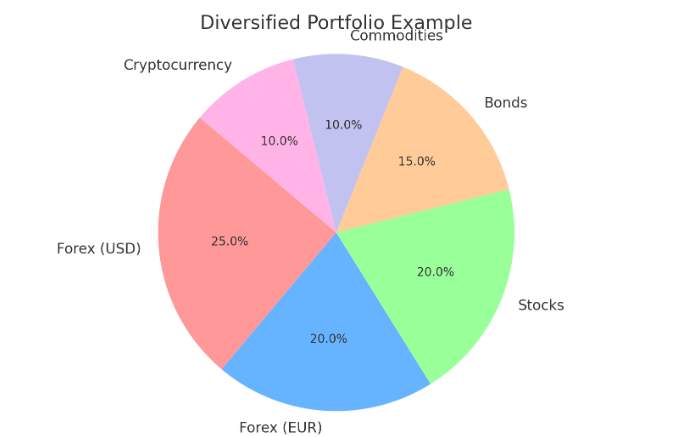
Use technical and fundamental analysis. Utilize technical analysis to identify trends and entry/exit points, and fundamental analysis to understand the underlying economic factors.

Implement risk management strategies. Employ risk management tools like stop-loss orders and position sizing to limit potential losses.
Here is a table summarizing various risk management tools:
| Risk Management Tool | Description |
|---|---|
| Stop-loss orders | Automatically closes a position at a predefined price to limit losses. |
| Position sizing | Determines the amount of capital to allocate to a specific trade based on risk tolerance. |
| Diversification | Spreads investments across various assets to reduce exposure to any single asset. |
| Hedging | Uses financial instruments to offset potential losses in investments. |
| Risk/Reward ratio | Compares the expected return of an investment to the risk taken to earn that return. |
| Trailing stop | Moves the stop-loss level in accordance with favorable price movements. |
| Limit Orders | Sets a specific price at which a position will be closed to secure profits. |
The Russo-Ukrainian war. The war between Russia and Ukraine has had significant economic repercussions, leading to sanctions and affecting the value of the Russian ruble and the Ukrainian hryvnia. European currencies also experienced volatility due to their economic ties with the region.
COVID-19 pandemic. The global pandemic triggered unprecedented economic disruptions, leading to extreme volatility in Forex markets.
U.S.-China trade war. The trade war between the U.S. and China led to tariffs and trade barriers, impacting the U.S. dollar and Chinese yuan.
Brexit The UK's decision to leave the European Union caused prolonged uncertainty, leading to significant depreciation of the British pound. The GBP/USD currency pair saw substantial swings around key Brexit milestones.
Middle East conflicts. Conflicts in the Middle East, such as the Syrian civil war, have led to instability in regional currencies like the Turkish lira.
Predicting market reactions
Role of market sentiment and investor confidence. Investor sentiment and confidence play a critical role in determining how geopolitical events impact Forex markets.
Supply and demand dynamics. Geopolitical events can affect supply and demand for currencies.
Central bank policies and interventions. Central banks may intervene in response to geopolitical events to stabilize their currencies.
Here is a table summarizing recent central bank interventions and their effects.
| Date | Central Bank | Intervention | Effect |
|---|---|---|---|
| 2023-03-15 | Federal Reserve | Interest Rate Hike | USD appreciated, stock market declined |
| 2023-06-10 | European Central Bank | Quantitative Easing | EUR depreciated, bond yields decreased |
| 2023-09-20 | Bank of Japan | Currency Intervention | JPY depreciated, export sector boosted |
| 2023-12-05 | Bank of England | Interest Rate Cut | GBP depreciated, inflation expectations moderated |
Strategies to trade during geopolitical events
Short-term vs. Long-term trading perspectives. Traders can adopt different strategies based on their investment horizons.
Using technical analysis for Entry and Exit points. Technical analysis can help traders identify optimal entry and exit points during volatile periods.
Hedging techniques and options trading Advanced traders can use hedging techniques and options to protect their portfolios from adverse movements.
Risk and warning
Understanding the risks associated with Forex trading is crucial, especially during times of geopolitical uncertainty.
Potential risks associated with geopolitical events
Geopolitical events can introduce significant risks to trading, including market volatility, economic disruptions, and unexpected policy changes.
Here is a table summarizing the examples, risk factors, and impact analysis for understanding the influence of geopolitical events on Forex markets:
| Example | Description | Impact |
|---|---|---|
| Political instability | Changes in government, political unrest, or policy shifts can lead to market uncertainty and currency volatility.Example: Political unrest in Turkey leading to depreciation of the Turkish lira (TRY). | Investor sentiment can shift, driving demand for safe-haven currencies and assets. |
| Economic sanctions | Sanctions imposed on a country can disrupt its economy and lead to significant currency devaluation.Example: Sanctions on Iran affecting the Iranian rial (IRR). | Sanctions can lead to significant currency devaluation, impacting trade and investment. |
| Trade disputes | Disputes between major trading partners can impact currency values due to changes in trade balances and economic uncertainty.Example: The impact of tariffs during the U.S.-China trade war. | Trade disputes can cause sharp and unpredictable movements in currency prices. |
| Natural disasters | Events like earthquakes, tsunamis, and hurricanes can disrupt economic activity and affect currency values.Example: The 2011 earthquake in Japan leading to fluctuations in the Japanese yen (JPY). | Natural disasters can lead to economic instability and currency fluctuations. |
| Military conflicts | Conflicts can lead to economic instability, refugee crises, and disruptions in trade, impacting currency values.Example: The Syrian civil war affecting regional currencies. | Military conflicts can cause market volatility and currency devaluation. |
Importance of regularly updating risk management plans
Regularly updating risk management plans ensures that traders are prepared for changing market conditions and can respond effectively to new risks.
Here is a table summarizing tips, strategies, and real-world examples for effective Forex trading during geopolitical events:
| Tip/Strategy | Real-world example |
|---|---|
| Stay Informed | Following Bloomberg, Reuters, and Forex Factory for real-time news and updates. |
| Diversify Investments | Allocating investments in Forex, stocks, bonds, commodities, and cryptocurrencies. |
| Use technical analysis | Using moving averages and support/resistance levels to make informed trading decisions. |
| Implement risk management | Setting a stop-loss order at 5% below the purchase price to limit potential losses. |
| Monitor Central Bank policies | Monitoring Federal Reserve interest rate decisions to anticipate USD movements. |
| Hedging techniques | Using currency options to hedge against adverse currency movements during Brexit. |
| Sentiment analysis | Utilizing tools like the Fear & Greed Index to understand market sentiment and adjust strategies. |
Warnings on over-leveraging and market overreactions
Over-leveraging can amplify losses, and market overreactions can lead to poor trading decisions. Traders should exercise caution and avoid taking excessive risks.
Expert advice how to act during geopolitical events on Forex Markets

As an experienced trader, I can tell you that geopolitical events present both challenges and opportunities. The key to success lies in preparation, adaptability, and a calm, methodical approach.
First and foremost, staying informed is paramount. Geopolitical events can unfold rapidly, and their impact on currency markets can be immediate and severe. Make it a habit to follow reliable news sources and stay updated on global developments. Real-time information is invaluable, so consider using news aggregators and alerts to ensure you don’t miss crucial updates.
Market sentiment can shift rapidly during geopolitical crises. Safe-haven currencies like the US dollar, Swiss franc, and Japanese yen often see increased demand. Being aware of these dynamics can help you position your trades more effectively. However, be cautious of over-leveraging, as it can amplify losses in volatile markets.
In summary, success in Forex trading during geopolitical events comes down to staying informed, managing risk, diversifying, leveraging both technical and fundamental analysis, understanding market sentiment, being adaptable, and maintaining emotional discipline. By following these principles, you can navigate the uncertainties of geopolitical events and capitalize on the opportunities they present.
Conclusion
Understanding the impact of geopolitical events on Forex markets is crucial for traders at all levels. These events can cause significant volatility, affecting currency values and market stability. By staying informed, diversifying portfolios, and utilizing risk management strategies, traders can navigate the complexities of trading during geopolitical instability.
Recent examples like the COVID-19 pandemic, the U.S.-China trade war, and Brexit highlight how such events can lead to rapid currency fluctuations. Effective strategies include using technical and fundamental analysis, employing hedging techniques, and paying attention to market sentiment and central bank policies.
FAQs
What are some recent geopolitical events that impacted Forex markets?
Examples include the Russo-Ukrainian conflict, the COVID-19 pandemic, the U.S.-China trade war, and Brexit, all of which caused significant currency fluctuations.
What types of currencies are considered safe havens during geopolitical instability?
Safe-haven currencies typically include the US dollar, Swiss franc, and Japanese yen, which tend to appreciate during times of geopolitical tension.
Can central bank policies mitigate the impact of geopolitical events on Forex?
Yes, central banks can intervene with measures like interest rate changes and quantitative easing to stabilize their currencies during geopolitical crises.
What are the risks of over-leveraging during geopolitical events?
Over-leveraging can amplify losses during market volatility caused by geopolitical events, so it's important to use leverage cautiously.
Editors' Top Picks and Insights

Lean Ethereum: Why Buterin wants to rebuild the network

SK Hynix debuts on Nasdaq: Largest U.S. offering by foreign company

SpaceX falls out of orbit: Does anyone still want Musk’s stock?

The crypto IPO problem: How high-profile listings became investor traps
U.S. Bitcoin reserve: Trump’s unrealized crypto promise

Aiming for leadership: Payment giants prepare a new stablecoin
Related Articles
Team that worked on the article
Parshwa is a content expert and finance professional possessing deep knowledge of stock and options trading, technical and fundamental analysis, and equity research. As a Chartered Accountant Finalist, Parshwa also has expertise in Forex, crypto trading, and personal taxation.
Chinmay Soni is a financial analyst with more than 5 years of experience in working with stocks, Forex, derivatives, and other assets. As a founder of a boutique research firm and an active researcher, he covers various industries and fields, providing insights backed by statistical data.
Mirjan Hipolito is a journalist and news editor at Traders Union. She is an expert crypto writer with five years of experience in the financial markets.
A Trailing Stop Order is a type of order that automatically adjusts the stop-loss level as the market price moves in a favorable direction, helping to protect profits.
Forex trading, short for foreign exchange trading, is the practice of buying and selling currencies in the global foreign exchange market with the aim of profiting from fluctuations in exchange rates. Traders speculate on whether one currency will rise or fall in value relative to another currency and make trading decisions accordingly. However, beware that trading carries risks, and you can lose your whole capital.
Fundamental analysis is a method or tool that investors use that seeks to determine the intrinsic value of a security by examining economic and financial factors. It considers macroeconomic factors such as the state of the economy and industry conditions.
An investor is an individual, who invests money in an asset with the expectation that its value would appreciate in the future. The asset can be anything, including a bond, debenture, mutual fund, equity, gold, silver, exchange-traded funds (ETFs), and real-estate property.
Options trading is a financial derivative strategy that involves the buying and selling of options contracts, which give traders the right (but not the obligation) to buy or sell an underlying asset at a specified price, known as the strike price, before or on a predetermined expiration date. There are two main types of options: call options, which allow the holder to buy the underlying asset, and put options, which allow the holder to sell the underlying asset.

-
 Afghanistan
-
 Albania
-
 Algeria
-
 Angola
-
 Argentina
-
 Armenia
-
 Australia
-
 Austria
-
 Azerbaijan
-
 Bahamas
-
 Bahrain
-
 Bangladesh
-
 Belarus
-
 Belgium
-
 Bolivia
-
 Botswana
-
 Brazil
-
 Brunei
-
 Bulgaria
-
 Cambodia
-
 Cameroon
-
 Canada
-
 Chile
Chile
-
 China
China
-
 Colombia
-
 Congo
Congo
-
 Costa Rica
-
 Cote d'Ivoire
-
 Croatia
-
 Cuba
Cuba
-
 Cyprus
-
 Czechia
-
 DR Congo
-
 Denmark
-
 Dominican Republic
-
 Ecuador
-
 Egypt
Egypt
-
 El Salvador
-
 Estonia
-
 Eswatini
-
 Ethiopia
-
 Finland
-
 France
-
 Georgia
-
 Germany
-
 Ghana
Ghana
-
 Greece
-
 Haiti
Haiti
-
 Hong Kong
-
 Hungary
-
 India
India
-
 Indonesia
-
 Iran, Islamic republic
-
 Iraq
Iraq
-
 Ireland
-
 Israel
-
 Italy
Italy
-
 Jamaica
-
 Japan
Japan
-
 Jordan
-
 Kazakhstan
-
 Kenya
Kenya
-
 Korea
Korea
-
 Kuwait
-
 Kyrgyzstan
-
 Laos
Laos
-
 Latvia
-
 Lebanon
-
 Lesotho
-
 Libya
Libya
-
 Lithuania
-
 Luxembourg
-
 Madagascar
-
 Malaysia
-
 Malta
Malta
-
 Mauritius
-
 Mexico
-
 Moldova
-
 Mongolia
-
 Montenegro
-
 Morocco
-
 Mozambique
-
 Myanmar
-
 Namibia
-
 Nepal
Nepal
-
 Netherlands
-
 New Zealand
-
 Nigeria
-
 North Macedonia
-
 Norway
-
 Oman
Oman
-
 Pakistan
-
 Palestine
-
 Panama
-
 Papua New Guinea
-
 Paraguay
-
 Peru
Peru
-
 Philippines
-
 Poland
-
 Portugal
-
 Puerto Rico
-
 Qatar
Qatar
-
 Reunion
-
 Romania
-
 Rwanda
-
 Saudi Arabia
-
 Serbia
-
 Singapore
-
 Slovakia
-
 Slovenia
-
 Somalia
-
 South Africa
-
 Spain
Spain
-
 Sri Lanka
-
 Sweden
-
 Switzerland
-
 Syria
Syria
-
 Taiwan
-
 Tajikistan
-
 Tanzania
-
 Thailand
-
 Trinidad and Tobago
-
 Tunisia
-
 Turkey
-
 UAE
UAE
-
 Uganda
-
 Ukraine
-
 United Kingdom
-
United States
-
 Uruguay
-
 Uzbekistan
-
 Venezuela
-
 Vietnam
-
 Yemen
Yemen
-
 Zambia
-
 Zimbabwe
- Forex
- Crypto











