
Coinomi Wallet Review 2026


Editorial Note: While we adhere to strict Editorial Integrity, this post may contain references to products from our partners. Here's an explanation for How We Make Money. None of the data and information on this webpage constitutes investment advice according to our Disclaimer.
The Coinomi crypto wallet continues to be one of the most reliable and long-standing mobile wallets in the cryptocurrency space. Known for its broad multi-asset support, advanced privacy tools, and tight security measures, it has earned a strong reputation among users since its debut in 2014. What sets Coinomi apart is its ability to store hundreds of different coins and tokens while giving users full control over their funds and identity.
This Coinomi Wallet's review takes a closer look at what makes it stand out, from the variety of coins it supports to its user-friendly design and built-in security features. We’ll also see how it holds up in today’s competitive wallet landscape. Whether you're new to crypto or looking to switch, Coinomi Wallet remains a strong contender worth considering in 2026.
Risk warning: Cryptocurrency markets are highly volatile, with sharp price swings and regulatory uncertainties. Research indicates that 75-90% of traders face losses. Only invest discretionary funds and consult an experienced financial advisor.
What is a Coinomi wallet?

The Coinomi crypto wallet is a non-custodial, multi-asset solution built for users who value privacy, independence, and control over their digital assets. It’s a secure and versatile platform that supports more than 1,700 other blockchain-based assets, making it one of the most comprehensive wallets available.
Launched in 2014 by George Kimionis, this wallet was ahead of its time in prioritizing user anonymity. It was among the first to offer privacy-first features like no KYC requirements, no IP address tracking, and no connection to personal identity.
In addition to supporting SegWit transactions, Coinomi lets users set custom transaction fees and includes integrations with ShapeShift and Changelly. It also offers advanced features like cold staking, all while ensuring that users remain in full control of their private keys, one of the core principles of its design.
Coinomi wallet security: Is it safe?
Coinomi Wallet is built on a security-first foundation. It uses industry-standard encryption, runs locally on your device, and ensures users hold full control of their private keys.
Key security features

While the above listed features do a fairly decent job for holding crypto, here’s what beginners rarely hear about the real layers of protection (and risks) inside the Coinomi crypto wallet.
It uses strong local encryption. Your private keys never leave your device, and Coinomi encrypts everything on your phone’s storage, not in the cloud.
No biometric protection by default. Unlike other wallets, Coinomi doesn’t enable fingerprint or Face ID unless you manually turn it on, which can leave a gap.
Open-source code is only partial. While some parts of Coinomi’s code are transparent, the full wallet stack isn’t open-source, making independent audits difficult.
DNS leak issue taught a lesson. A now-patched bug once exposed seed phrases via Google’s spell checker, highlighting how even simple UX features can turn into threats.
Supports privacy coins natively. Coinomi lets you store and use assets like Monero and Zcash, but that also increases your responsibility to avoid blacklisted addresses.
No KYC sounds good but isn't always. Since Coinomi doesn’t require identity verification, it offers privacy, but it also means there’s zero recovery if you lose access.
Cross-platform sync can be risky. Using the same seed across mobile and desktop increases exposure if one of the devices is compromised.
Supported coins and tokens
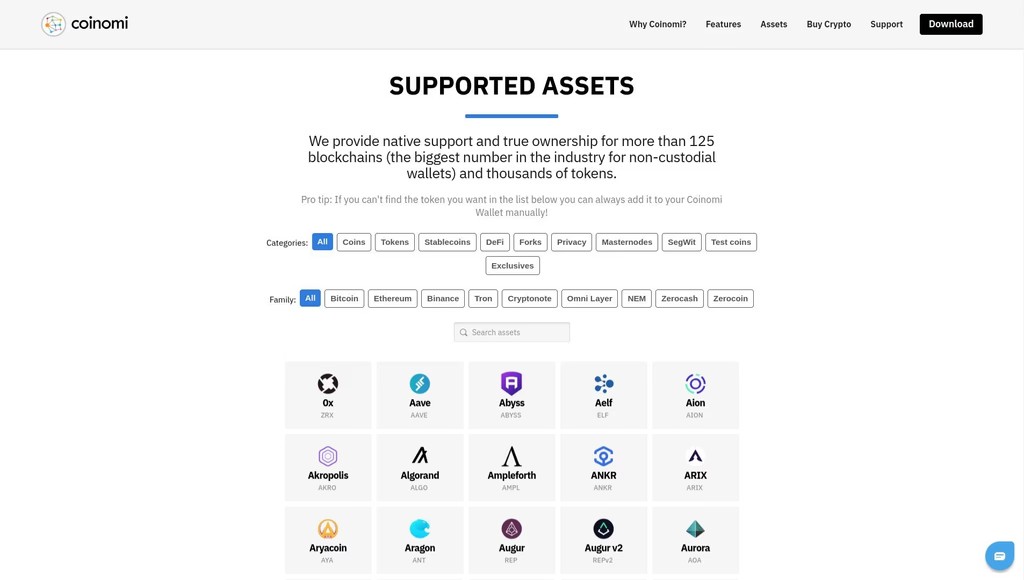
Coinomi is known for supporting a massive list of digital assets, but beginners often miss how deep and strategic that support really is. Here's a few of Coinomi Wallet's top supported coins.
Bitcoin (BTC).Coinomi’s BTC integration is SegWit-ready, enabling faster transactions with lower fees compared to wallets that don’t support this feature.
Ethereum (ETH).Coinomi doesn’t just support ETH, it includes full ERC-20 token compatibility, letting you store hundreds of altcoins under one address.
Monero (XMR). Unlike many wallets, Coinomi doesn’t support XMR due to privacy complexity, which is a key point beginners should know before transferring funds.
Dash (DASH). Dash’s InstantSend and PrivateSend features are partially supported, offering speed advantages in markets where quick confirmation matters.
Litecoin (LTC).Litecoin is integrated with support for native SegWit, but Coinomi’s fee estimator can sometimes lag during volatile hours, which may affect real-time trades.
Zcash (ZEC). Transparent address support is included, but shielded (private) transactions aren't yet fully enabled within Coinomi, unlike desktop-exclusive wallets.
Binance Coin (BNB BEP-2).Coinomi supports BNB on the Binance Chain (not Smart Chain), which is a major detail that leads to confusion and lost tokens if mishandled.
Tether (USDT - ERC-20).Coinomi handles USDT on Ethereum but doesn’t support TRC-20 or BEP-20 versions, so sending from certain exchanges could result in loss.
Pricing and fees
Basic plan (Free usage)
The Coinomi Wallet offers a completely free basic plan with no subscription cost. What most people don’t realize is that unlike many wallets, Coinomi doesn’t charge anything for receiving funds or storing them, the only cost you pay is the network fee, which goes directly to miners or validators.
This fee is not fixed by Coinomi and can be adjusted manually, making it ideal for those who want to manage their own transaction priority. For instance, sending BTC on a congested day could cost $5 or more in network fees, while off-peak hours can drop it below $1. Since Coinomi is a non-custodial wallet, users never pay a platform fee for holding or transferring crypto internally.
Paid plan (Third-party integrations)
While the app itself stays free, using third-party services integrated inside the Coinomi crypto wallet, like Changelly or Simplex, adds hidden fees. For example, crypto-to-crypto swaps via Changelly typically include a 0.25 percent spread on top of market rates, and fiat purchases via Simplex can charge 3.5 to 5 percent per transaction, with a minimum flat fee of $10.
These are not Coinomi’s charges directly, but they affect your total cost significantly. If you're planning to convert large amounts or buy with a credit card, these fees add up fast. Also, advanced users using dApp integrations or DeFi platforms through in-app browsers may face gas fees specific to those chains, which vary wildly. So while the app is technically “free,” the ecosystem around it isn't always cheap.
User interface & experience
The Coinomi crypto wallet features a clean and intuitive interface designed to serve both beginners and seasoned crypto traders. Its layout balances simplicity with functionality, making it suitable for everyday use or managing large portfolios.
Optimized for mobile users, the app runs smoothly on both iOS and Android, offering fast, fluid navigation and a user-friendly experience.
On desktop, Coinomi stands out by offering support for Windows, macOS, and Linux. This broad compatibility is uncommon among wallets in its category and gives users flexibility across devices.
Users can view and manage all their assets from a single dashboard, with no need to set up individual wallets for each cryptocurrency. This one-tap access helps streamline portfolio management.
Swapping crypto is easy with Coinomi’s built-in exchange integrations, allowing users to trade coins directly within the app, no external service required.
Advanced users will appreciate the ability to customize transaction fees for most coins and tokens, giving greater control over speed and cost.
To support its global user base, the wallet is available in over 25 languages, ensuring accessibility for people around the world.
If users need assistance, the app includes a built-in help section, with FAQs and contact options just a few taps away.
Coinomi delivers a well-rounded experience that’s approachable for newcomers yet powerful enough for long-time crypto investors who want more control and convenience in one place.
If you're just starting out in crypto trading, the first step is opening an account with an exchange that's designed to be easy for beginners to navigate. Below is a curated list of platforms known for their user-friendly interfaces and accessible features. Explore your options and pick the one that suits your comfort level and trading goals.
| Coinbase | OKX | BTCC | Cryptohopper | Crypto.com | |
|---|---|---|---|---|---|
|
Min. Deposit, $ |
10 | 10 | 10 | No | 1 |
|
Coins Supported |
400+ | 600+ | 399 | 1000 | 400+ |
|
Spot Taker fee, % |
0.5 | 0.1 | 0.3 | 0 | 0.5 |
|
Spot Maker Fee, % |
0.5 | 0.08 | 0.2 | 0 | 0.25 |
|
Alerts |
Yes | Yes | No | Yes | Yes |
|
Copy trading |
No | Yes | Yes | Yes | No |
|
TU overall score |
8.5 | 8.46 | 8.08 | 7.8 | 7.76 |
|
Open an account |
Go to broker Your capital is at risk. |
Go to broker Your capital is at risk. |
Go to broker Your capital is at risk.
|
Go to broker Your capital is at risk. |
Go to broker Your capital is at risk. |
Secure your seed phrase and turbocharge privacy with Coinomi’s hidden pairing

If you’re using Coinomi just to send and store coins, you’re barely scratching the surface. A hidden gem for beginners is Coinomi’s manual network broadcast option. When enabled, your transaction doesn’t automatically ping the Coinomi servers. Instead, it waits, giving you the power to route the broadcast through VPN or Tor manually. This breaks the link between your IP address and the transaction, making it incredibly hard to trace. For users serious about privacy, this isn’t just a feature, it’s your stealth mode.
Another powerful move: back up your recovery phrase using Coinomi’s encrypted QR export, but don’t store it digitally. Instead, print the QR onto a metal sheet or a tamper-proof sticker and hide it physically. Most people jot down the seed phrase on paper and call it a day. But if you ever need to reimport your wallet quickly or share across a cold device, scanning a QR is faster and reduces exposure to human error. It’s privacy plus efficiency in one move.
Conclusion
Coinomi Wallet stands out in the crowded crypto wallet space for its combination of wide multi-asset support and robust privacy features, making it an appealing choice for both novice and experienced users. Its security-first approach means your private keys never leave your device, giving you direct control over your funds—a critical advantage for anyone serious about safeguarding their assets. While it offers convenient built-in exchange integrations and customizable transaction fees, users should remain vigilant about protecting their recovery phrases and understand the risks of cross-platform syncing. Ultimately, Coinomi empowers you to take charge of your crypto journey with strong privacy and versatility, reminding us that real ownership in crypto means holding your own keys and understanding the tools at your disposal.
FAQs
What privacy features distinguish Coinomi Wallet from other crypto wallets?
Does Coinomi Wallet offer full open-source transparency?
How does Coinomi Wallet handle recovery and backup of funds?
What limitations exist for specific coins and tokens within Coinomi Wallet?
Editors' Top Picks and Insights




Related Articles
Team that worked on the article
Rinat Gismatullin is an entrepreneur and a business expert with 9 years of experience in trading. He focuses on long-term investing, but also uses intraday trading.
Chinmay Soni is a financial analyst with more than 5 years of experience in working with stocks, Forex, derivatives, and other assets. As a founder of a boutique research firm and an active researcher, he covers various industries and fields, providing insights backed by statistical data.
Mirjan Hipolito is a journalist and news editor at Traders Union. She is an expert crypto writer with five years of experience in the financial markets.
Ethereum is a decentralized blockchain platform and cryptocurrency that was proposed by Vitalik Buterin in late 2013 and development began in early 2014. It was designed as a versatile platform for creating decentralized applications (DApps) and smart contracts.
Bitcoin is a decentralized digital cryptocurrency that was created in 2009 by an anonymous individual or group using the pseudonym Satoshi Nakamoto. It operates on a technology called blockchain, which is a distributed ledger that records all transactions across a network of computers.
An investor is an individual, who invests money in an asset with the expectation that its value would appreciate in the future. The asset can be anything, including a bond, debenture, mutual fund, equity, gold, silver, exchange-traded funds (ETFs), and real-estate property.
Cryptocurrency is a type of digital or virtual currency that relies on cryptography for security. Unlike traditional currencies issued by governments (fiat currencies), cryptocurrencies operate on decentralized networks, typically based on blockchain technology.
Day trading involves buying and selling financial assets within the same trading day, with the goal of profiting from short-term price fluctuations, and positions are typically not held overnight.

-
 Afghanistan
-
 Albania
-
 Algeria
-
 Angola
-
 Argentina
-
 Armenia
-
 Australia
-
 Austria
-
 Azerbaijan
-
 Bahamas
-
 Bahrain
-
 Bangladesh
-
 Belarus
-
 Belgium
-
 Bolivia
-
 Botswana
-
 Brazil
-
 Brunei
-
 Bulgaria
-
 Cambodia
-
 Cameroon
-
 Canada
-
 Chile
Chile
-
 China
China
-
 Colombia
-
 Congo
Congo
-
 Costa Rica
-
 Cote d'Ivoire
-
 Croatia
-
 Cuba
Cuba
-
 Cyprus
-
 Czechia
-
 DR Congo
-
 Denmark
-
 Dominican Republic
-
 Ecuador
-
 Egypt
Egypt
-
 El Salvador
-
 Estonia
-
 Eswatini
-
 Ethiopia
-
 Finland
-
 France
-
 Georgia
-
 Germany
-
 Ghana
Ghana
-
 Greece
-
 Haiti
Haiti
-
 Hong Kong
-
 Hungary
-
 India
India
-
 Indonesia
-
 Iran, Islamic republic
-
 Iraq
Iraq
-
 Ireland
-
 Israel
-
 Italy
Italy
-
 Jamaica
-
 Japan
Japan
-
 Jordan
-
 Kazakhstan
-
 Kenya
Kenya
-
 Korea
Korea
-
 Kuwait
-
 Kyrgyzstan
-
 Laos
Laos
-
 Latvia
-
 Lebanon
-
 Lesotho
-
 Libya
Libya
-
 Lithuania
-
 Luxembourg
-
 Madagascar
-
 Malaysia
-
 Malta
Malta
-
 Mauritius
-
 Mexico
-
 Moldova
-
 Mongolia
-
 Montenegro
-
 Morocco
-
 Mozambique
-
 Myanmar
-
 Namibia
-
 Nepal
Nepal
-
 Netherlands
-
 New Zealand
-
 Nigeria
-
 North Macedonia
-
 Norway
-
 Oman
Oman
-
 Pakistan
-
 Palestine
-
 Panama
-
 Papua New Guinea
-
 Paraguay
-
 Peru
Peru
-
 Philippines
-
 Poland
-
 Portugal
-
 Puerto Rico
-
 Qatar
Qatar
-
 Reunion
-
 Romania
-
 Rwanda
-
 Saudi Arabia
-
 Serbia
-
 Singapore
-
 Slovakia
-
 Slovenia
-
 Somalia
-
 South Africa
-
 Spain
Spain
-
 Sri Lanka
-
 Sweden
-
 Switzerland
-
 Syria
Syria
-
 Taiwan
-
 Tajikistan
-
 Tanzania
-
 Thailand
-
 Trinidad and Tobago
-
 Tunisia
-
 Turkey
-
 UAE
UAE
-
 Uganda
-
 Ukraine
-
 United Kingdom
-
United States
-
 Uruguay
-
 Uzbekistan
-
 Venezuela
-
 Vietnam
-
 Yemen
Yemen
-
 Zambia
-
 Zimbabwe
- Forex
- Crypto












