
China Moves The World Closer To A Gold-Backed Currency


Editorial Note: While we adhere to strict Editorial Integrity, this post may contain references to products from our partners. Here's an explanation for How We Make Money. None of the data and information on this webpage constitutes investment advice according to our Disclaimer.
Economic analysts such as Alasdair Macleod and Mario Maneco believe that China is deliberately moving toward establishing a gold-backed yuan as the world’s premier reserve currency. China is shoring up its financial position with a massive gold reserve, while the US dollar continues to decline in value.
Most of what I’ve written in this article was derived from listening to a recent conversation between the global economic analysts, Alasdair Macleod and Mario Maneco. However, there’s also information gleaned from other sources, along with, as ever, my own observations and opinions.
Economic analyst Alasdair Macleod often makes a point of clearly explaining the basic truth about fiat currencies – that they are not anchored by anything tangible, such as gold. Thus, they only have value to the extent that users have faith in them as having value, or have faith in the government issuing the currency. If users begin having doubts about the value of a fiat currency, its value – and widespread use – can quickly plummet. And that’s exactly what Macleod believes is going on with the US dollar and other major Western currencies.
“While we go to hell in a handcart with our currencies, China is already on the way to protecting its currency from the same fate (with gold).”– Alasdair Macleod
A precarious position for the US dollar
Alasdair has long argued that the exponential rise in gold prices (and silver appears to be starting its own rocket shot upward now) is not a reflection of an actual increase in the value of gold – but, rather, a steady and accelerating decrease in the value of the US dollar and the other major fiat currencies. According to Macleod, about the only thing that’s keeping foreigners holding massive amounts of US dollars (approximately $130 trillion) is their desire to invest in US stocks. That circumstance means that a downturn in the US stock market could result in a massive dumping of US dollars by foreign investors in short order.
Besides de-dollarization around the world, the major force that’s been inflating the dollar and threatening to collapse its value is the massive overhang of US debt – more than $35 trillion. The other major Western powers, such as the UK and the EU, are locked in similar debt bubbles. That massive debt becomes ever more threatening if a recession ensues, since that would lead to a decrease in the tax revenues that are necessary to keep a debt crisis at bay.
Macleod also points out the similarity – high global debt, a roaring overvalued stock market, and major tariffs – to the conditions in 1929 that led to the Great Depression. He firmly believes that, in the end – although he freely admits that he isn’t certain about how governments will try to deal with it – there is no escaping a massive global financial crisis.
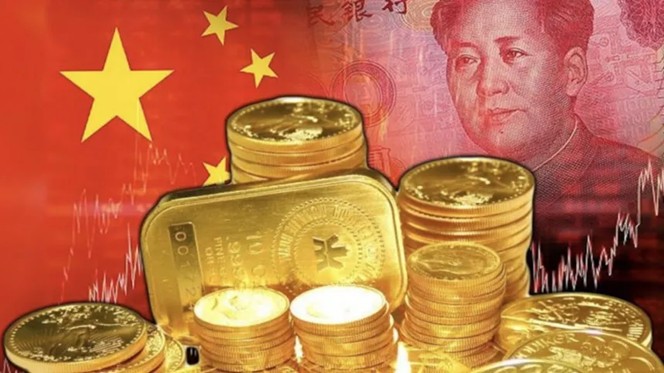
China rises – on a pile of gold
Meanwhile, China is accumulating gold and silver on an unprecedented scale. It has amassed a gigantic gold reserve – a reserve which would make China transforming the yuan into a gold-backed currency a relatively easy maneuver. By building up this massive gold reserve, China is positioning the yuan/renminbi as the number one reserve currency for the BRICS nations, the Shanghai Cooperation Organization (SCO), and, ultimately, for the whole world. Keep in mind that, with the BRICS nations, the SCO, and all the countries along the Silk Road that China is investing in – you’re talking about 70% of the world’s economy.
China’s consumer economy is already larger than that of the US, and it continues (although, admittedly, by virtue of a lot of industrial espionage) rapidly expanding its technology growth. Macleod sees China working – through BRICS, the SCO, and its Silk Road Initiative - toward what he terms a new industrial revolution for underdeveloped countries. He sees emerging market demand as likely to drive the demand for gold and other commodities higher, while driving the desire for fiat currencies lower.
A major move the Chinese government made earlier this year was announcing, through the Shanghai Gold Exchange – that it would be opening bullion vaults in Hong Kong and Saudi Arabia, and that other gold trading centers would follow. The vaults in Hong Kong were quickly opened and are creating tokenized gold investment instruments. In Alasdair Macleod’s view (and I concur), this is setting up financial centers where gold can easily flow in and out as a counterpart to the Chinese yuan. Macleod sees this as China, in effect, moving to set up a sort of new “Bretton Woods Agreement” (with China, rather than the US, as its financial centerpoint), where nations could settle international trades in what amounts to a gold-backed yuan.
XAU/USD News

AirAsia discusses Malaysian government support as fuel cost pressures rise

Italy open to further oil stock releases as Europe lags on IEA pledges

Nigeria states gain from higher revenues as World Bank flags spending priorities

Kalshi short-duration gold markets surpass Ether in fee generation

France seeks G7 action on fuel markets as diesel stock release talks widen

EU discusses diesel stock release plan amid U.S. pressure on fuel supplies
A power move for the Chinese Yuan
Macleod points out a key shift in policy. He notes that, for the past couple of years, there was a lot of talk within the BRICS countries and the SCO about settling international trades in their respective local currencies. But this year, all that talk has fallen silent. Macleod confidently concludes that the future clearly portends international trade settlements in a gold-backed yuan, stating that the Chinese are working diligently to establish the yuan as the new international reserve currency, backed by gold. China, Russia, Saudi Arabia, and India are already settling up some major trades in gold.
Yet another sign of a strengthening yuan is the expansion of the Chinese bond market. Russia is using Panda bonds to fund its operations. Egypt and Brazil have also issued bonds denominated in yuan. If you look at the financial situation across the globe, it’s only logical for countries to lean more heavily on the yuan and less so on the US dollar. I hearken back to the 2022 financial sanctions imposed on Russia by the US. That dollar weaponization was a wakeup call to the whole world – telling every country that investing in US dollars means that your money could be confiscated at any time. Since then, central banks all over the globe have been dumping dollars and stacking gold at an unprecedented rate.
In Macleod’s mind, it’s as simple as this: When it comes to international trade, countries want to settle up in a currency that has strong, stable value – and that is, ultimately, a currency that’s backed by “real money”, i.e., gold. He reminds us that gold has been the legal final monetary settlement commodity since the time of the Roman Empire.
Prepare for a multipolar monetary system, not an overnight currency shift

In my view, it is less important to predict whether China will formally launch a fully gold-backed currency and more important to recognize the broader structural shift: central banks are diversifying reserves, gold accumulation is accelerating, and the dollar’s uncontested dominance is gradually being questioned. That alone changes the long-term risk framework for global portfolios.
I would not recommend making extreme, all-in bets on a sudden dollar collapse or an imminent monetary reset. Currency transitions historically unfold over years, not months. However, I do believe investors should gradually reduce single-currency exposure risk. This means holding a diversified mix of assets: gold as a monetary hedge, selective exposure to non-Western currencies, and real assets that are less sensitive to fiat debasement.
If China does continue building a gold-anchored settlement framework within BRICS or trade blocs, the immediate implication will likely be incremental – more bilateral trade in yuan, more gold-settled contracts, and slow reserve diversification. The strategic takeaway is resilience, not speculation.
My recommendation is simple: prepare for multipolar monetary systems rather than betting on one currency replacing another overnight. In uncertain transitions, capital preservation and diversification matter more than ideological conviction about which reserve currency will win.
Conclusion
China’s strategic accumulation of gold reserves and its persistent efforts to internationalize the yuan underscore a deliberate campaign to challenge the U.S. dollar’s reserve currency dominance. By backing the yuan with solid gold assets and promoting bilateral trade deals denominated in yuan, China is signaling its intent to create a more stable and trusted alternative for global commerce. This maneuver not only enhances confidence among trading partners wary of dollar volatility but also sets a blueprint for emerging economies seeking to diversify away from dollar dependency. Ultimately, if China succeeds, the global financial order could face a seismic shift—proving that in the world of currency power, tangible assets and calculated ambition can rewrite the rules.
FAQs
What historical factors have influenced the move toward gold-backed currencies?
How might a gold-backed yuan reshape the balance of power among global reserve currencies?
What risks or challenges could China face in implementing a fully gold-backed yuan?
How does rising global debt influence the push toward alternative reserve assets like gold?
Editors' Top Picks and Insights





Related Articles
Team that worked on the article
Johnathan M. is a U.S.-based writer and investor, a contributor to the Traders Union website.
Dan Blystone began his trading career in 1998 as an arbitrage clerk on the floor of the Chicago Mercantile Exchange (CME). He later traded bond and Eurex futures at proprietary firms such as Altea Trading, gaining valuable experience in high-frequency trading and risk management.
Chinmay Soni is a financial analyst with more than 5 years of experience in working with stocks, Forex, derivatives, and other assets. As a founder of a boutique research firm and an active researcher, he covers various industries and fields, providing insights backed by statistical data.
Index in trading is the measure of the performance of a group of stocks, which can include the assets and securities in it.
The yuan (CNY) is the official currency of the People's Republic of China. The yuan is divided into 10 jiao, which are further divided into 10 fen.
Bitcoin is a decentralized digital cryptocurrency that was created in 2009 by an anonymous individual or group using the pseudonym Satoshi Nakamoto. It operates on a technology called blockchain, which is a distributed ledger that records all transactions across a network of computers.
Cryptocurrency is a type of digital or virtual currency that relies on cryptography for security. Unlike traditional currencies issued by governments (fiat currencies), cryptocurrencies operate on decentralized networks, typically based on blockchain technology.
Diversification is an investment strategy that involves spreading investments across different asset classes, industries, and geographic regions to reduce overall risk.

-
 Afghanistan
-
 Albania
-
 Algeria
-
 Angola
-
 Argentina
-
 Armenia
-
 Australia
-
 Austria
-
 Azerbaijan
-
 Bahamas
-
 Bahrain
-
 Bangladesh
-
 Belarus
-
 Belgium
-
 Bolivia
-
 Botswana
-
 Brazil
-
 Brunei
-
 Bulgaria
-
 Cambodia
-
 Cameroon
-
 Canada
-
 Chile
Chile
-
 China
China
-
 Colombia
-
 Congo
Congo
-
 Costa Rica
-
 Cote d'Ivoire
-
 Croatia
-
 Cuba
Cuba
-
 Cyprus
-
 Czechia
-
 DR Congo
-
 Denmark
-
 Dominican Republic
-
 Ecuador
-
 Egypt
Egypt
-
 El Salvador
-
 Estonia
-
 Eswatini
-
 Ethiopia
-
 Finland
-
 France
-
 Georgia
-
 Germany
-
 Ghana
Ghana
-
 Greece
-
 Haiti
Haiti
-
 Hong Kong
-
 Hungary
-
 India
India
-
 Indonesia
-
 Iran, Islamic republic
-
 Iraq
Iraq
-
 Ireland
-
 Israel
-
 Italy
Italy
-
 Jamaica
-
 Japan
Japan
-
 Jordan
-
 Kazakhstan
-
 Kenya
Kenya
-
 Korea
Korea
-
 Kuwait
-
 Kyrgyzstan
-
 Laos
Laos
-
 Latvia
-
 Lebanon
-
 Lesotho
-
 Libya
Libya
-
 Lithuania
-
 Luxembourg
-
 Madagascar
-
 Malaysia
-
 Malta
Malta
-
 Mauritius
-
 Mexico
-
 Moldova
-
 Mongolia
-
 Montenegro
-
 Morocco
-
 Mozambique
-
 Myanmar
-
 Namibia
-
 Nepal
Nepal
-
 Netherlands
-
 New Zealand
-
 Nigeria
-
 North Macedonia
-
 Norway
-
 Oman
Oman
-
 Pakistan
-
 Palestine
-
 Panama
-
 Papua New Guinea
-
 Paraguay
-
 Peru
Peru
-
 Philippines
-
 Poland
-
 Portugal
-
 Puerto Rico
-
 Qatar
Qatar
-
 Reunion
-
 Romania
-
 Rwanda
-
 Saudi Arabia
-
 Serbia
-
 Singapore
-
 Slovakia
-
 Slovenia
-
 Somalia
-
 South Africa
-
 Spain
Spain
-
 Sri Lanka
-
 Sweden
-
 Switzerland
-
 Syria
Syria
-
 Taiwan
-
 Tajikistan
-
 Tanzania
-
 Thailand
-
 Trinidad and Tobago
-
 Tunisia
-
 Turkey
-
 UAE
UAE
-
 Uganda
-
 Ukraine
-
 United Kingdom
-
United States
-
 Uruguay
-
 Uzbekistan
-
 Venezuela
-
 Vietnam
-
 Yemen
Yemen
-
 Zambia
-
 Zimbabwe
- Forex
- Crypto












