
Debitum Investments Review


Editorial Note: While we adhere to strict Editorial Integrity, this post may contain references to products from our partners. Here's an explanation for How We Make Money. None of the data and information on this webpage constitutes investment advice according to our Disclaimer.
Debitum Investments offers regulated access to SME lending in 2026 with average annual returns of 9 to 12%. Debitum operates under MiFID II regulation, requires full investor verification, and provides structured risk disclosures, collateral-backed products, and legal safeguards designed to protect retail investors.
Debitum Investments has gained attention among European investors looking for alternatives to traditional bonds and consumer-focused P2P lending. Unlike many platforms that prioritize volume, Debitum concentrates on structured business financing, regulatory compliance, and controlled risk exposure. This article examines how the platform is built, what investors can realistically expect in terms of returns, and where Debitum fits within a diversified private credit portfolio.
What is Debitum Investments?

Debitum Investments is a European peer-to-business investment platform that allows private investors to finance loans issued to small and medium-sized enterprises. Instead of offering direct loans, the platform structures investments as regulated financial instruments, giving investors exposure to business credit through clearly defined products.

Founded in 2018, Debitum initially operated as a technology-driven marketplace and later transitioned into a fully regulated investment firm under MiFID II rules. This shift marked a move away from informal P2P lending toward a more structured model focused on transparency, standardized disclosures, and investor protection.
Most Debitum Investments reviews point to the platform’s low entry barrier and straightforward onboarding as key advantages. Investors can start building diversified portfolios with investments from €10 per security, making the platform accessible even to those new to private credit investing.

Is Debitum legal and regulated?
Debitum operates as a licensed investment firm under MiFID II, which means it must follow strict European Union rules on transparency, investor protection, and reporting. The platform is supervised by the Financial and Capital Market Commission of Latvia, the national authority responsible for overseeing investment services. As a regulated investment firm, Debitum operates under EU investment laws, and this regulation allows the company to legally offer and distribute investment products across the European Economic Area.
MiFID II regulation requires Debitum to apply mandatory investor verification, clear risk disclosures, and standardized product documentation. Unlike unregulated P2P platforms, Debitum cannot list investment products without defined legal structures, underlying assets, and ongoing reporting obligations.
In addition, investors are covered by Latvia’s investor compensation scheme, which may protect claims of up to €20,000 if the investment firm becomes insolvent. This layer of protection does not eliminate investment risk, but it significantly improves legal security compared to non-regulated P2P alternatives operating outside the MiFID framework.
How the investment process works
To start investing, users create an account on Debitum Investments and complete identity verification as required under EU regulations. This process includes standard KYC checks and investor profiling to ensure the products offered match the user’s risk tolerance and experience.
Once the account is approved, investors fund it via SEPA bank transfer. After the deposit is credited, they can browse available investment products and choose between manual selection or automated portfolio tools. Each product page provides detailed information on expected returns, maturity dates, and underlying assets, allowing investors to make informed decisions.

The platform also offers automation features that help reduce idle cash and maintain diversification. Investors can define parameters such as preferred returns, durations, and product types, after which Debitum automatically allocates funds based on these rules.
For ongoing monitoring, investors can use the web interface or the Debitum app to track repayments, review portfolio performance, and receive notifications about maturing investments. This setup makes the investment process manageable even for users who prefer a more hands-off approach.

Product types and platform features
Debitum structures all investments as regulated financial instruments rather than direct loans. Investors can choose between two main product types, each designed for different risk and return preferences.
Asset-backed securities. These investments are linked to pools of SME loans supported by collateral such as invoices, equipment, or other business assets, offering a higher level of capital protection.
Promissory notes. These are unsecured obligations issued by loan originators and usually provide slightly higher returns to compensate for the increased risk.
To help investors manage risk and returns, Debitum Investments provides a range of platform tools. Filters allow users to select products based on duration, expected yield, originator, and asset structure. This makes it easier to diversify across multiple issuers and avoid overexposure to a single risk factor.
The platform also publishes detailed documentation for each investment, including risk disclosures, repayment schedules, and originator information. This level of transparency is a key feature of Debitum, setting it apart from less structured lending platforms where loan data is often limited or inconsistent.
Debitum Investments performance and return expectations
Returns on Debitum Investments typically depend on product type, loan duration, and how actively investors reinvest available cash. Based on platform data and user feedback, most investors report net annual returns in the range of 9 to 12 percent when portfolios remain well diversified and idle funds are kept low. The claimed statistics are presented in the snapshot below:
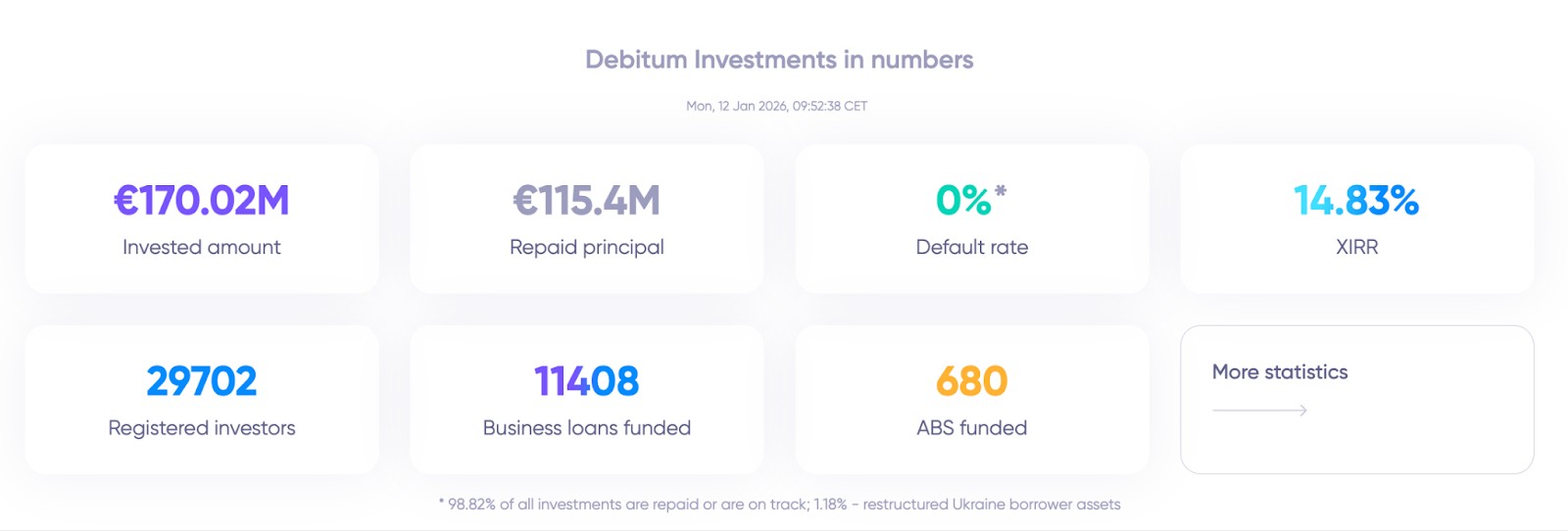
Shorter-term investments usually offer lower yields but provide faster capital turnover, while longer maturities tend to increase expected returns at the cost of reduced liquidity. Investors who rely on automation tools and regularly review their allocations often achieve results closer to the upper end of the range.
Compared to less regulated alternatives, return expectations on Debitum are generally more consistent. The trade-off is clear: investors give up aggressive yield potential in exchange for structured products, regulatory oversight, and clearer visibility into portfolio risk.
Loan originators and collateral structure
One of the core strengths of Debitum Investments lies in its controlled approach to loan originators. Unlike open marketplaces where lenders can list products with limited screening, Debitum applies strict due diligence before allowing originators to issue investment instruments on the platform.
All loan originators focus on business lending, primarily serving small and medium-sized enterprises across Europe. Before approval, originators must provide financial statements, performance history, and ongoing operational data. This information is reviewed regularly to ensure compliance with platform standards and regulatory requirements.
Collateral plays an important role in risk mitigation. Many asset-backed securities available through Debitum are supported by underlying business assets such as invoices, equipment, or other tangible collateral. This structure is designed to improve recovery prospects if borrowers face repayment difficulties.
While the platform offers a smaller number of originators compared to some large P2P marketplaces, this selective approach reduces exposure to weak or unproven lenders. For investors, this means fewer choices but stronger oversight and a clearer understanding of where risk originates within Debitum’s P2P ecosystem.
Debitum Investments reviews and community sentiment
Overall sentiment around Debitum Investments is mostly positive, especially among investors who value regulation and transparency over aggressive yield strategies. Many long-term users describe the platform as closer to a traditional investment service than a typical peer-to-peer marketplace.
Many Debitum Investments reviews focus on practical aspects of investing, such as predictable cash flow, clear documentation, and regular communication from the platform. Investors often mention that updates on loan status and operational changes are shared clearly, which helps them understand what is happening with their portfolios.
At the same time, some investor opinions about Debitum point to limitations that may affect more active users. These include occasional delays during identity verification, limited options for early exits, and a smaller number of loan originators compared to large consumer-focused platforms.
Overall, community discussions suggest that Debitum appeals most to investors seeking steady returns, legal clarity, and structured investment products rather than short-term or high-risk lending opportunities.
Why is Debitum LLC calling me?
Some investors are surprised when they receive a phone call or email from Debitum. In most cases, this contact is related to regulatory or account-related procedures rather than marketing.
As a regulated investment firm, Debitum is required to follow strict compliance rules. This means the company may contact users to confirm identity details, clarify information provided during KYC checks, or request updates required under ongoing regulatory obligations. Such communication is standard practice for firms operating under EU investment laws.
In other cases, Debitum may reach out to inform investors about important account changes, risk disclosures, or platform updates that require acknowledgment. These calls are intended to ensure that investors fully understand the products they use and the risks involved.
While occasional outreach can feel intrusive, it is generally a sign of compliance rather than aggressive sales behavior. For most users, contact from Debitum LLC is linked to investor protection requirements and maintaining account security, not unsolicited promotions.
Portfolio strategy and diversification tips
A balanced approach works best when investing through Debitum Investments. Rather than allocating funds to a single product type or originator, investors can reduce risk by spreading capital across multiple instruments, maturities, and issuers.
Combining asset-backed securities with promissory notes helps balance safety and yield. Asset-backed products tend to offer stronger capital protection, while promissory notes may increase overall returns when used in moderation. Diversifying across different loan durations also improves liquidity management and reduces exposure to delayed repayments.
Automation tools available on Debitum can support consistent portfolio allocation, but they still require regular review. Investors who adjust settings periodically and reinvest returned capital tend to achieve more stable results than those who leave portfolios unattended for long periods.
Using the Debitum app to monitor performance, review idle cash, and track upcoming maturities makes it easier to stay disciplined. Simple habits, such as monthly portfolio checks and gradual reinvestment, can significantly improve long-term outcomes within Debitum’s P2P environment.
While Debitum Investments focuses on private credit and SME lending, many investors prefer to balance this exposure with more traditional markets. Comparing some of the best brokers with a wide range of assets can help investors diversify across stocks, Forex, and other instruments alongside alternative investments. This broader approach allows users to spread risk more evenly and align different asset types within a single long-term portfolio strategy.
| Trading.com USA | Plus500 | OANDA | FOREX.com | IG Markets | |
|---|---|---|---|---|---|
|
Tradable assets |
69 | 2800 | 129 | 5500 | 20000 |
|
Demo |
Yes | Yes | Yes | Yes | Yes |
|
Min. deposit, $ |
50 | 100 | No | 100 | 1 |
|
Max. leverage |
1:50 | 1:300 | 1:200 | 1:50 | 1:200 |
|
Standard EUR/USD spread |
1.1 | 0.7 | 0.3 | 1.0 | 0.9 |
|
Regulation |
CFTC, NFA | CySEC, FCA, ASIC, FMA, FSCA, FSA Seychelles, EFSA, MAS, DFSA, SCB | FSC (BVI), ASIC, IIROC, FCA, CFTC, NFA | CIMA, FCA, FSA (Japan), NFA, IIROC, ASIC, CFTC | FCA, BaFin, ASIC, MAS, CySec, FINMA, BMA, CFTC, NFA |
|
TU overall score |
6.88 | 6.67 | 6.63 | 6.47 | 6.38 |
|
Open an account |
Go to broker Your capital is at risk. |
Go to broker 81% of retail CFD accounts lose money. |
Go to broker Your capital is at risk. |
Study review | Study review |
Ascertain the risk and make it the anchor

When I evaluate P2P platforms for long-term portfolios, the first thing I look for is how well risk is controlled, not how high the advertised returns are. From that perspective, Debitum Investments fits a very specific niche. It offers regulated access to SME lending with clear documentation, defined legal structures, and realistic return expectations.
I would recommend it to investors who want predictable cash flow and are comfortable holding positions until maturity rather than relying on frequent exits. For disciplined investors who review portfolios regularly and reinvest consistently, Debitum can play a reliable role in income-focused strategies alongside bonds or dividend assets.
Conclusion
Debitum Investments stands out as a regulated entry point for retail investors seeking stable returns from SME lending without the unpredictability common to many P2P platforms. The platform’s legal safeguards, transparent risk disclosures, and clear product structures offer significant reassurance when compared to less regulated alternatives. Investors comfortable with buy-and-hold strategies and ready to diversify across asset-backed securities and promissory notes are best positioned to benefit. Ultimately, Debitum’s disciplined approach proves that prioritizing risk control over chasing high yields can drive lasting portfolio success.
FAQs
How does Debitum Investments help protect investors through collateral and legal structures?
What level of transparency can investors expect when using Debitum Investments?
Are investor funds protected if Debitum Investments becomes insolvent?
What features make Debitum Investments accessible for new or small-scale investors?
Editors' Top Picks and Insights






Related Articles
Team that worked on the article
Johnathan M. is a U.S.-based writer and investor, a contributor to the Traders Union website.
Dan Blystone began his trading career in 1998 as an arbitrage clerk on the floor of the Chicago Mercantile Exchange (CME). He later traded bond and Eurex futures at proprietary firms such as Altea Trading, gaining valuable experience in high-frequency trading and risk management.
Chinmay Soni is a financial analyst with more than 5 years of experience in working with stocks, Forex, derivatives, and other assets. As a founder of a boutique research firm and an active researcher, he covers various industries and fields, providing insights backed by statistical data.
Diversification is an investment strategy that involves spreading investments across different asset classes, industries, and geographic regions to reduce overall risk.
Bitcoin is a decentralized digital cryptocurrency that was created in 2009 by an anonymous individual or group using the pseudonym Satoshi Nakamoto. It operates on a technology called blockchain, which is a distributed ledger that records all transactions across a network of computers.
Risk management is a risk management model that involves controlling potential losses while maximizing profits. The main risk management tools are stop loss, take profit, calculation of position volume taking into account leverage and pip value.
An investor is an individual, who invests money in an asset with the expectation that its value would appreciate in the future. The asset can be anything, including a bond, debenture, mutual fund, equity, gold, silver, exchange-traded funds (ETFs), and real-estate property.
The idea behind mitigation is to recognize and effectively trade mitigation blocks. These blocks consist of specific price action patterns that signal a change in market sentiment or demand-supply dynamics.

-
 Afghanistan
-
 Albania
-
 Algeria
-
 Angola
-
 Argentina
-
 Armenia
-
 Australia
-
 Austria
-
 Azerbaijan
-
 Bahamas
-
 Bahrain
-
 Bangladesh
-
 Belarus
-
 Belgium
-
 Bolivia
-
 Botswana
-
 Brazil
-
 Brunei
-
 Bulgaria
-
 Cambodia
-
 Cameroon
-
 Canada
-
 Chile
Chile
-
 China
China
-
 Colombia
-
 Congo
Congo
-
 Costa Rica
-
 Cote d'Ivoire
-
 Croatia
-
 Cuba
Cuba
-
 Cyprus
-
 Czechia
-
 DR Congo
-
 Denmark
-
 Dominican Republic
-
 Ecuador
-
 Egypt
Egypt
-
 El Salvador
-
 Estonia
-
 Eswatini
-
 Ethiopia
-
 Finland
-
 France
-
 Georgia
-
 Germany
-
 Ghana
Ghana
-
 Greece
-
 Haiti
Haiti
-
 Hong Kong
-
 Hungary
-
 India
India
-
 Indonesia
-
 Iran, Islamic republic
-
 Iraq
Iraq
-
 Ireland
-
 Israel
-
 Italy
Italy
-
 Jamaica
-
 Japan
Japan
-
 Jordan
-
 Kazakhstan
-
 Kenya
Kenya
-
 Korea
Korea
-
 Kuwait
-
 Kyrgyzstan
-
 Laos
Laos
-
 Latvia
-
 Lebanon
-
 Lesotho
-
 Libya
Libya
-
 Lithuania
-
 Luxembourg
-
 Madagascar
-
 Malaysia
-
 Malta
Malta
-
 Mauritius
-
 Mexico
-
 Moldova
-
 Mongolia
-
 Montenegro
-
 Morocco
-
 Mozambique
-
 Myanmar
-
 Namibia
-
 Nepal
Nepal
-
 Netherlands
-
 New Zealand
-
 Nigeria
-
 North Macedonia
-
 Norway
-
 Oman
Oman
-
 Pakistan
-
 Palestine
-
 Panama
-
 Papua New Guinea
-
 Paraguay
-
 Peru
Peru
-
 Philippines
-
 Poland
-
 Portugal
-
 Puerto Rico
-
 Qatar
Qatar
-
 Reunion
-
 Romania
-
 Rwanda
-
 Saudi Arabia
-
 Serbia
-
 Singapore
-
 Slovakia
-
 Slovenia
-
 Somalia
-
 South Africa
-
 Spain
Spain
-
 Sri Lanka
-
 Sweden
-
 Switzerland
-
 Syria
Syria
-
 Taiwan
-
 Tajikistan
-
 Tanzania
-
 Thailand
-
 Trinidad and Tobago
-
 Tunisia
-
 Turkey
-
 UAE
UAE
-
 Uganda
-
 Ukraine
-
 United Kingdom
-
United States
-
 Uruguay
-
 Uzbekistan
-
 Venezuela
-
 Vietnam
-
 Yemen
Yemen
-
 Zambia
-
 Zimbabwe
- Forex
- Crypto










- What is Debitum Investments?
- Is Debitum legal and regulated?
- How the investment process works
- Product types and platform features
- Debitum Investments performance and return expectations
- Loan originators and collateral structure
- Debitum Investments reviews and community sentiment
- Why is Debitum LLC calling me?
- Portfolio strategy and diversification tips
- Expert opinion
- Conclusion
- FAQs


