
Rakesh Jhunjhunwala Trading Strategy And Investing Philosophy


Editorial Note: While we adhere to strict Editorial Integrity, this post may contain references to products from our partners. Here's an explanation for How We Make Money. None of the data and information on this webpage constitutes investment advice according to our Disclaimer.
Rakesh Jhunjhunwala, known as the “Warren Buffett of India,” was a billionaire investor whose portfolio continues to thrive through Rare Enterprises. As of 2026, his holdings include Titan Company (₹14,329 crore), Star Health (₹6,356 crore), and Tata Motors (₹3,173 crore), among others. His strategy focused on value investing, high-conviction bets, and long-term holding. With a posthumous net worth estimated at over ₹6.5 billion, Jhunjhunwala remains India’s most influential stock investor.
More than just a prolific investor, Jhunjhunwala left behind a framework of conviction-driven investing that still shapes Indian markets today. This article takes a closer look at the structure and strategy behind his current portfolio, highlighting key holdings as of 2026 and extracting actionable insights for investors seeking to learn from his enduring legacy.
Who was Rakesh Jhunjhunwala?
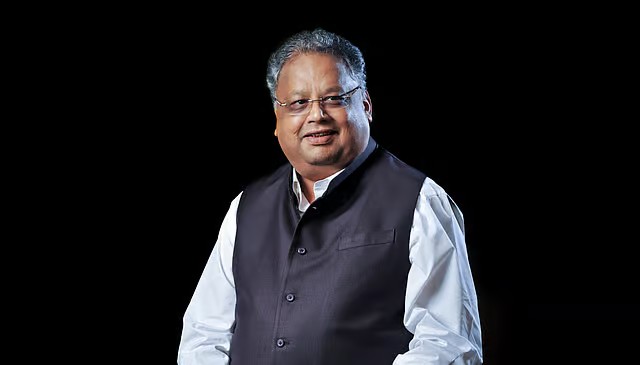
Born in 1960 and raised in Mumbai, Rakesh Jhunjhunwala began investing in Indian equities in 1985 with just ₹5,000. He earned his first major profit by betting on Tata Tea, tripling his capital within months. Over the decades, Jhunjhunwala became synonymous with long-term investing, combining deep company-level research with bold market conviction.
He was also a qualified chartered accountant and served on the boards of several Indian companies. His philanthropic efforts were significant, with plans to donate 25% of his wealth to healthcare and education.
Today, his name remains synonymous with smart investing, and his stock picks continue to outperform in Indian markets.
Rakesh Jhunjhunwala portfolio 2026
As of 2026, Rare Enterprises manages a portfolio valued at over ₹60,000 crore, spread across diversified sectors. His core holdings continue to reflect confidence in India’s consumption-driven growth. Here are a few of the largest stock holdings:
Titan Company Ltd. – 47.6 million shares | Value: ₹14,329 crore
Star Health and Allied Insurance – 100.7 million shares | Value: ₹6,356 crore
Tata Motors Ltd. – 52.3 million shares | Value: ₹3,173 crore
CRISIL Ltd. – 4 million shares | Value: ₹1,220 crore
Indian Hotels Company Ltd. – 20.5 million shares | Value: ₹1,080 crore
These numbers reflect the latest filings and show his preference for high-quality companies with strong fundamentals. The Rakesh Jhunjhunwala portfolio 2026 remains one of the most closely followed in Indian markets due to its consistent performance and strategic positioning.
Rakesh Jhunjhunwala investment strategy
Jhunjhunwala's strategy was grounded in:
Value investing. He focused on undervalued companies with long-term potential.
High conviction bets. He wasn’t afraid to allocate large portions of his capital to a few strong ideas.
Hold through cycles. He believed in the India growth story and held positions across market downturns.
Thorough research. Jhunjhunwala would often spend months studying a company before investing.
He famously said, "Be fearful when others are greedy, and greedy when others are fearful," echoing the contrarian mindset that shaped many of his winning bets. His unique discipline and clarity defined the Rakesh Jhunjhunwala investment strategy as one that emphasizes research, patience, and confidence in India’s long-term fundamentals.
Rakesh Jhunjhunwala net worth today
While he passed away in 2022, Jhunjhunwala’s estate and investments continue to grow under the Rare Enterprises brand. His net worth in 2026 is estimated to be over ₹6.5 billion, with continued gains from long-standing holdings in consumer goods, insurance, and infrastructure. The Rakesh Jhunjhunwala net worth today reflects not only capital appreciation but also his early foresight into India's long-term economic trends.
What makes him the best Indian stock investor?
Rakesh Jhunjhunwala is widely regarded as the best Indian stock investor due to his unmatched ability to spot long-term winners. His early investments in Titan and CRISIL turned modest stakes into multi-billion-rupee positions. His success inspired generations of Indian investors to take equity markets seriously.
He was a frequent speaker at investor forums and educational events, where he emphasized the importance of patience, research, and emotional discipline.
Key lessons from Jhunjhunwala's philosophy
These lessons help explain why the Rakesh Jhunjhunwala investment strategy continues to guide investors even in his absence. His success wasn’t based on timing the market but on understanding value, recognizing opportunity, and staying disciplined through cycles.
Investors can still apply his evergreen principles:
Buy businesses, not stocks. Focus on underlying fundamentals rather than short-term market movements or popular opinion.
Hold for the long term. Jhunjhunwala’s greatest returns came from holding stocks like Titan for over two decades.
Don’t panic in downturns. He saw corrections as opportunities to buy into quality businesses at discounted valuations.
Focus on economic trends. Many of his investments aligned with India’s consumption growth, financial inclusion, and rising middle class.
Back visionary management. He believed strong leadership was a key determinant of a company’s success and scalability.
Take calculated risks. High conviction positions in sectors like insurance and hospitality paid off because he researched deeply and acted decisively.
Stick to simplicity. Jhunjhunwala famously avoided overly complex strategies, instead sticking to companies he could understand easily.
By putting these principles into practice, you can navigate the world of investing with greater confidence, discipline, and purpose. However, it's equally important to understand that the choice of broker can significantly influence your trading outcomes. To help you make an informed decision, we've compiled a carefully vetted list of top brokers – selected through a comprehensive and objective evaluation process.
| Demo | Min. deposit, $ | Max. leverage | Min Spread EUR/USD, pips | Max Spread EUR/USD, pips | Negative balance protection | Investor protection | Max. Regulation Level | Open an account | |
|---|---|---|---|---|---|---|---|---|---|
| Yes | 10 | 1:1000 | 0.1 | 0.4 | Yes | No | Not regulated | Go to broker Your capital is at risk.
|
|
| Yes | 100 | 1:300 | 0.5 | 0.9 | No | €20,000 £85,000 SGD 75,000 | Tier-1 | Go to broker 80% of retail CFD accounts lose money. |
|
| Yes | 50 | 1:50 | 0.9 | No | Yes | No | Tier-1 | Go to broker Your capital is at risk. |
|
| Yes | No | 1:200 | 0.1 | 0.5 | Yes | £85,000 SGD 75,000 $500,000 | Tier-1 | Go to broker Your capital is at risk. |
|
| Yes | 100 | 1:50 | 0.7 | 1.2 | Yes | £85,000 | Tier-1 | Study review |
Don’t follow headlines or hype

While Rakesh Jhunjhunwala's portfolio continues to guide countless investors, traders should understand that his success came from long-term conviction, not quick gains. His top holdings – like Titan, Star Health, and Tata Motors – weren’t overnight winners but multi-year bets grounded in deep research and economic foresight. If you’re studying the Rakesh Jhunjhunwala portfolio 2026, don’t chase stocks just because they were in his portfolio – look at their fundamentals today.
For active traders, use his principles as a filter. Focus on companies with strong earnings visibility, low debt, and clear sectoral tailwinds. Don’t follow headlines or hype – Jhunjhunwala’s biggest profits came when others were doubtful. He often invested during downturns, showing that conviction matters more than market timing. Consider building positions gradually and avoid overleveraging. His story shows that wealth is built through patience, strategy, and discipline – not daily speculation. Use that wisdom to trade smarter in today's volatile market.
Conclusion
Rakesh Jhunjhunwala’s legacy as a visionary investor lives on in 2026 through the continued performance of his carefully selected stock portfolio. With Rare Enterprises managing his holdings and delivering consistent returns, his influence remains deeply embedded in India’s investment landscape. His approach – anchored in discipline, insight, and long-term conviction – serves as a timeless blueprint for investors at all levels. Whether you're new to trading or managing your own equity portfolio, studying the life and decisions of Rakesh Jhunjhunwala can offer both inspiration and actionable wisdom.
FAQs
What sectors did Rakesh Jhunjhunwala favor in his portfolio?
He often preferred consumption, insurance, finance, and hospitality sectors, believing in India's domestic growth story.
Did Rakesh Jhunjhunwala manage his portfolio alone?
While he initially made all decisions, his firm Rare Enterprises now manages the portfolio after his passing.
How has Jhunjhunwala’s portfolio performed post-2022?
Despite his passing, the portfolio continues to outperform the broader market, thanks to early investments in high-growth sectors.
What made Titan Company a top pick for Jhunjhunwala?
He believed in its brand strength, management, and long-term scalability, leading him to hold it for over two decades.
Editors' Top Picks and Insights

Hunting crypto owners: Why criminals have gone offline

BitMEX is shutting down: Why Trump could not save the exchange

Do governments need crypto workers?

Brent nears $100: Why oil prices are rising

Gram Wallet launch: Can Telegram bring crypto to the masses?

AI without limits: How dangerous are neural networks?
Related Articles
Team that worked on the article
Parshwa is a content expert and finance professional possessing deep knowledge of stock and options trading, technical and fundamental analysis, and equity research. As a Chartered Accountant Finalist, Parshwa also has expertise in Forex, crypto trading, and personal taxation.
Andreas Kristo Saragih is a seasoned equity research analyst with over a decade of experience across both buy-side and sell-side roles, focused on the Indonesian capital market. He has extensive sector coverage, including banking, consumer goods, retail, real estate, healthcare, transportation, poultry, cement, pharmaceuticals, construction, and infrastructure.
Chinmay Soni is a financial analyst with more than 5 years of experience in working with stocks, Forex, derivatives, and other assets. As a founder of a boutique research firm and an active researcher, he covers various industries and fields, providing insights backed by statistical data.
CFD is a contract between an investor/trader and seller that demonstrates that the trader will need to pay the price difference between the current value of the asset and its value at the time of contract to the seller.
Index in trading is the measure of the performance of a group of stocks, which can include the assets and securities in it.
An investor is an individual, who invests money in an asset with the expectation that its value would appreciate in the future. The asset can be anything, including a bond, debenture, mutual fund, equity, gold, silver, exchange-traded funds (ETFs), and real-estate property.
Options trading is a financial derivative strategy that involves the buying and selling of options contracts, which give traders the right (but not the obligation) to buy or sell an underlying asset at a specified price, known as the strike price, before or on a predetermined expiration date. There are two main types of options: call options, which allow the holder to buy the underlying asset, and put options, which allow the holder to sell the underlying asset.
Fundamental analysis is a method or tool that investors use that seeks to determine the intrinsic value of a security by examining economic and financial factors. It considers macroeconomic factors such as the state of the economy and industry conditions.

-
 Afghanistan
-
 Albania
-
 Algeria
-
 Angola
-
 Argentina
-
 Armenia
-
 Australia
-
 Austria
-
 Azerbaijan
-
 Bahamas
-
 Bahrain
-
 Bangladesh
-
 Belarus
-
 Belgium
-
 Bolivia
-
 Botswana
-
 Brazil
-
 Brunei
-
 Bulgaria
-
 Cambodia
-
 Cameroon
-
 Canada
-
 Chile
Chile
-
 China
China
-
 Colombia
-
 Congo
Congo
-
 Costa Rica
-
 Cote d'Ivoire
-
 Croatia
-
 Cuba
Cuba
-
 Cyprus
-
 Czechia
-
 DR Congo
-
 Denmark
-
 Dominican Republic
-
 Ecuador
-
 Egypt
Egypt
-
 El Salvador
-
 Estonia
-
 Eswatini
-
 Ethiopia
-
 Finland
-
 France
-
 Georgia
-
 Germany
-
 Ghana
Ghana
-
 Greece
-
 Haiti
Haiti
-
 Hong Kong
-
 Hungary
-
 India
India
-
 Indonesia
-
 Iran, Islamic republic
-
 Iraq
Iraq
-
 Ireland
-
 Israel
-
 Italy
Italy
-
 Jamaica
-
 Japan
Japan
-
 Jordan
-
 Kazakhstan
-
 Kenya
Kenya
-
 Korea
Korea
-
 Kuwait
-
 Kyrgyzstan
-
 Laos
Laos
-
 Latvia
-
 Lebanon
-
 Lesotho
-
 Libya
Libya
-
 Lithuania
-
 Luxembourg
-
 Madagascar
-
 Malaysia
-
 Malta
Malta
-
 Mauritius
-
 Mexico
-
 Moldova
-
 Mongolia
-
 Montenegro
-
 Morocco
-
 Mozambique
-
 Myanmar
-
 Namibia
-
 Nepal
Nepal
-
 Netherlands
-
 New Zealand
-
 Nigeria
-
 North Macedonia
-
 Norway
-
 Oman
Oman
-
 Pakistan
-
 Palestine
-
 Panama
-
 Papua New Guinea
-
 Paraguay
-
 Peru
Peru
-
 Philippines
-
 Poland
-
 Portugal
-
 Puerto Rico
-
 Qatar
Qatar
-
 Reunion
-
 Romania
-
 Rwanda
-
 Saudi Arabia
-
 Serbia
-
 Singapore
-
 Slovakia
-
 Slovenia
-
 Somalia
-
 South Africa
-
 Spain
Spain
-
 Sri Lanka
-
 Sweden
-
 Switzerland
-
 Syria
Syria
-
 Taiwan
-
 Tajikistan
-
 Tanzania
-
 Thailand
-
 Trinidad and Tobago
-
 Tunisia
-
 Turkey
-
 UAE
UAE
-
 Uganda
-
 Ukraine
-
 United Kingdom
-
United States
-
 Uruguay
-
 Uzbekistan
-
 Venezuela
-
 Vietnam
-
 Yemen
Yemen
-
 Zambia
-
 Zimbabwe
- Forex
- Crypto












