
Donald Trump's Crypto Portfolio: A Deep Dive Into His Holdings And Market Influence


Editorial Note: While we adhere to strict Editorial Integrity, this post may contain references to products from our partners. Here's an explanation for How We Make Money. None of the data and information on this webpage constitutes investment advice according to our Disclaimer.
Donald Trump’s crypto exposure extends beyond personal holdings through his family's close ties to World Liberty Financial (WLFI), whose ecosystem includes assets such as Ethereum (ETH), Wrapped Bitcoin (WBTC), Aave (AAVE), Chainlink (LINK) and the USD1 stablecoin. Trump-affiliated entities also launched the $TRUMP meme coin, while Melania Trump introduced $MELANIA; both reached multi-billion-dollar market capitalizations at their peaks but remain highly volatile.
Donald Trump, once a vocal critic of cryptocurrencies, has made a dramatic shift by becoming a significant player in the digital asset space. From launching his own meme coins to investing in blockchain projects, Trump crypto holdings have grown into a fascinating topic of discussion. His involvement has sparked debates over financial ethics, market manipulation, and the future of crypto regulations under his influence. In this article, we explore what cryptocurrency does Trump own, his strategic investments, and the broader impact of Trump’s crypto ventures.
Risk warning: Cryptocurrency markets are highly volatile, with sharp price swings and regulatory uncertainties. Research indicates that 75-90% of traders face losses. Only invest discretionary funds and consult an experienced financial advisor.
Trump's crypto investments: An overview
Trump’s engagement with cryptocurrencies began with NFT collections, despite previously calling Bitcoin and other cryptocurrencies "a scam." Over time, his involvement expanded from digital collectibles to a broad crypto business ecosystem. His NFT collections generated tens of millions of dollars in sales and royalties, while his family later co-founded World Liberty Financial (WLFI), a DeFi platform that holds assets including Ethereum (ETH), Wrapped Bitcoin (WBTC), Chainlink (LINK), and Aave (AAVE) and launched the USD1 stablecoin.
In January 2025, Trump-affiliated entities introduced the $TRUMP meme coin, followed by $MELANIA, both of which briefly reached multi-billion-dollar market capitalizations before experiencing sharp volatility. By mid-2026, Trump's latest federal financial disclosure showed that his crypto ventures had become his largest source of income, generating more than $1.4 billion in 2025, primarily from World Liberty Financial, $TRUMP, and related licensing agreements, underscoring his transformation from crypto skeptic to one of the industry's most prominent political figures.
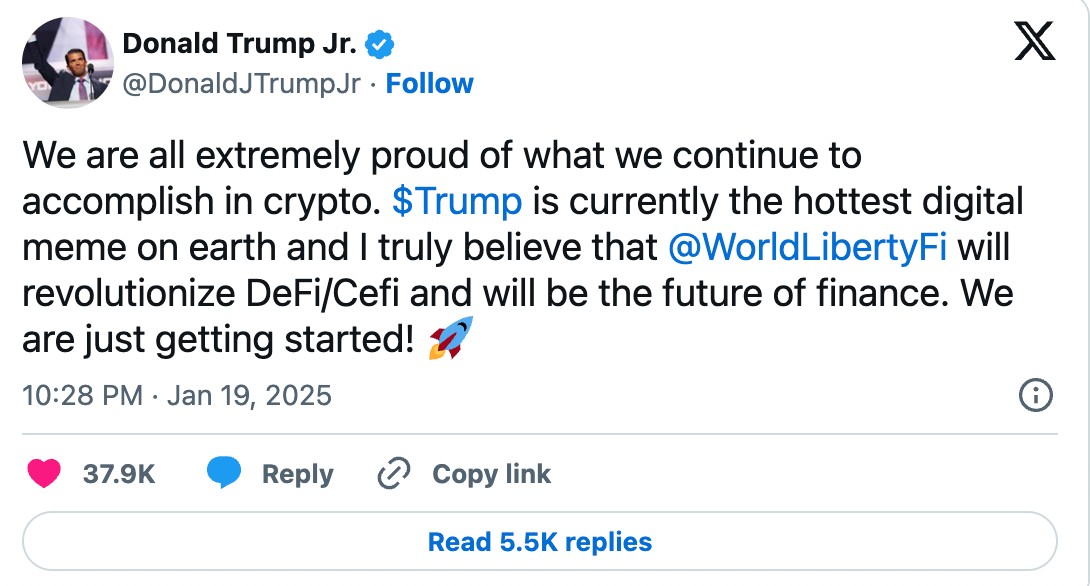
Breakdown of Trump’s cryptocurrency holdings
Initially, Donald Trump was a vocal critic of cryptocurrencies, dismissing them as speculative assets lacking intrinsic value. However, his stance underwent a notable transformation, leading to direct involvement in the crypto sector through a mix of branded tokens, DeFi investments, and political crypto advocacy.
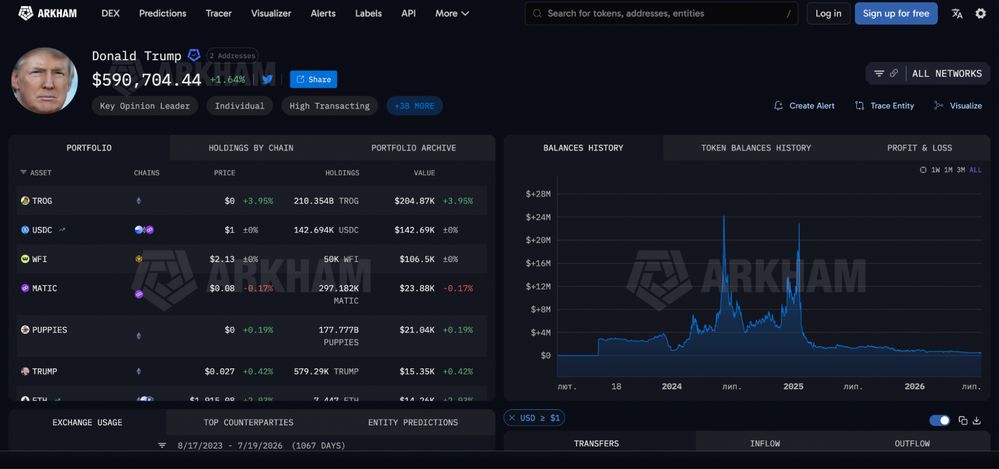
Trump’s cryptocurrency exposure extends well beyond meme coins through his family’s involvement with World Liberty Financial (WLFI). Below is a breakdown of the key assets and ventures publicly associated with the Trump crypto ecosystem.
The $TRUMP meme coin
Launched in January 2025 on the Solana blockchain with a total supply of 1 billion tokens.
Around 200 million tokens entered public circulation, while Trump-affiliated entities retained the remaining 800 million under a vesting schedule.
Reached a multi-billion-dollar market capitalization shortly after launch before experiencing extreme volatility.
By mid-2026, the token had fallen by more than 95% from its all-time high, with blockchain data showing that most holders were in loss.
Controversy: Trump's continued ties to the token have prompted scrutiny over potential conflicts of interest and market influence.
The $MELANIA coin
Launched separately by Melania Trump shortly after the $TRUMP token.
Also built on Solana and experienced a rapid surge followed by a steep decline.
Remains highly speculative, with trading activity driven primarily by retail sentiment.
Continues to exhibit significant price volatility.
Ethereum (ETH)
Largest known treasury asset held by World Liberty Financial.
WLFI substantially increased its ETH position throughout 2025, including a $47 million purchase on Trump's inauguration day.
Ethereum serves as the foundation for WLFI's DeFi products and the USD1 stablecoin ecosystem.
Wrapped Bitcoin (WBTC)
Added as a major treasury reserve in January 2025 through a $47 million acquisition.
Considered one of WLFI's core strategic holdings alongside Ethereum.
Supports diversification of the protocol's on-chain treasury.
Chainlink (LINK)
Acquired as part of WLFI's DeFi infrastructure strategy.
Used to support oracle functionality and smart contract integrations.
Remains one of the protocol's strategic ecosystem assets.
Aave (AAVE)
One of WLFI's earliest strategic investments.
The protocol itself is built on a customized version of Aave V3, making AAVE a core ecosystem asset.
Continues to play an important role in WLFI's lending platform.
Ethena (ENA)
Purchased alongside ETH, WBTC, LINK and AAVE during WLFI's early treasury expansion.
Represents WLFI's exposure to synthetic dollar infrastructure and diversified DeFi assets.
USD1 stablecoin
Launched by World Liberty Financial in 2025.
Backed by cash and short-term U.S. Treasuries, with custody provided by BitGo.
By mid-2026, USD1 had grown into one of the world's largest fiat-backed stablecoins, with roughly $4.6 billion in circulating supply.
Non-fungible tokens (NFTs)
Trump's NFT collections marked his entry into the crypto industry.
Multiple collections – including the Mugshot Edition – generated tens of millions of dollars in sales and royalties.
The NFT launches laid the foundation for Trump's later expansion into DeFi, stablecoins, and meme coins.
World Liberty Financial (WLF): Trump’s crypto venture
Trump’s entry into the DeFi sector came with the launch of World Liberty Financial (WLF), a platform facilitating lending, borrowing, and investing in crypto.
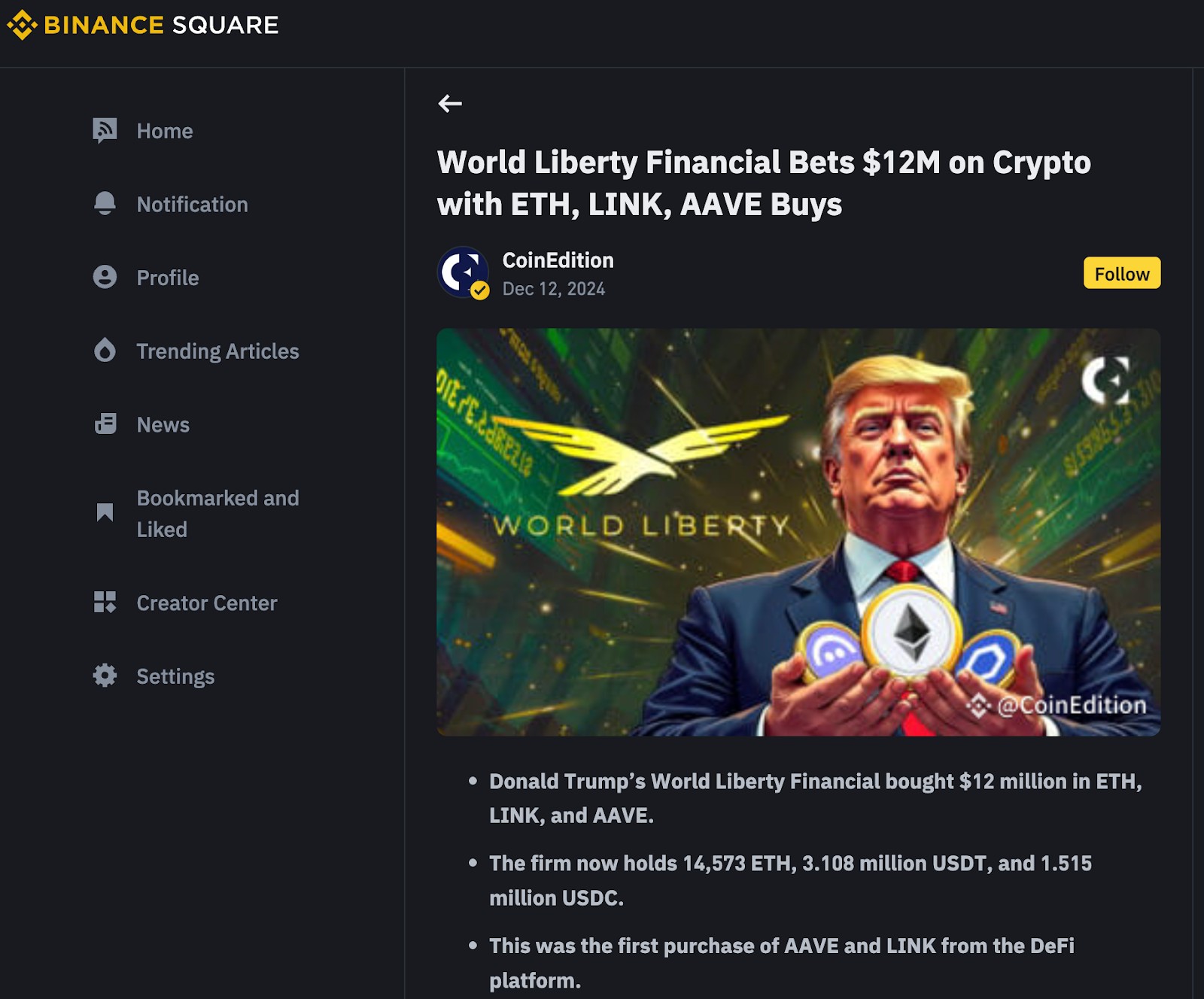
During the 2025 market downturn, World Liberty Financial (WLFI) actively accumulated Ethereum, including a widely reported purchase of roughly 86,000 ETH valued at about $220 million. Since then, the company has continued to expand its Ethereum position through additional purchases. According to recent on-chain data, WLFI holds more than 73,000 ETH, worth approximately $275–300 million at current market prices, while also staking part of its holdings through Aave to generate yield. Ethereum remains the cornerstone of WLFI's treasury strategy and underpins the company's broader DeFi ecosystem, including its USD1 stablecoin.
Latest developments:
Ethereum remains WLFI's largest treasury asset, alongside Wrapped Bitcoin (WBTC), Chainlink (LINK), Aave (AAVE), and other DeFi-related tokens.
USD1, launched in 2025, has become one of the fastest-growing U.S. dollar-backed stablecoins and is increasingly integrated into exchanges, DeFi protocols, and tokenized financial products.
Trump's 2025 financial disclosure revealed more than $1.4 billion in crypto-related income, primarily from World Liberty Financial, token sales, and licensing agreements, making crypto the largest contributor to his reported earnings.
Potential conflicts of interest:
Regulatory influence. Critics argue that Trump's role as President, combined with his family's ownership stake in World Liberty Financial, creates potential conflicts between public policymaking and private financial interests.
Revenue structure. Trump-affiliated entities reportedly receive 75% of net revenues from WLFI token sales and share in profits generated by the USD1 stablecoin, raising ongoing ethics concerns.
Political and regulatory scrutiny. Rather than facing a specific SEC enforcement action, WLFI is currently under intense congressional, media, and governance scrutiny regarding transparency, foreign investment, and conflicts of interest, while stablecoin regulation in the U.S. continues to evolve.
Financial impact and market reactions
Trump’s active participation in the cryptocurrency market has led to notable financial outcomes and shifting market trends.
Portfolio valuation
Current estimated value. Surpassed $10 million (excluding $TRUMP holdings), fueled by memecoin surges and strategic holdings.
Growth factors. Political backing, institutional involvement, and speculative trading.
Market influence
Bitcoin surge. Peaked at $100,000+ due to anticipation of Trump’s pro-crypto policies.
Exchange response. Major platforms are reluctant to list $TRUMP and $MELANIA coins due to manipulation concerns.
Institutional interest. Hedge funds monitoring Trump-affiliated coins for potential trading opportunities.
Retail trading boom. Increasing adoption by retail investors speculating on Trump’s crypto influence.
Ethical considerations and regulatory scrutiny
Trump’s deepening involvement in the crypto sector has raised concerns regarding financial ethics and regulatory oversight.
Potential conflicts of interest
Policy vs. investment. Advocating for looser crypto regulations while holding significant assets in the space.
Regulatory concerns. Fear that Trump’s policies could benefit his own financial interests.
Opaque financial disclosures. Limited transparency on total crypto assets held by Trump-affiliated entities.
Regulatory developments
Federal crypto framework. The President’s Working Group on Digital Asset Markets, created under Trump’s January 2025 executive order, has already published recommendations covering market structure, DeFi, banking, taxation, and oversight by the SEC and CFTC.
Stablecoin regulation. In July 2025, Trump signed the GENIUS Act, establishing the first federal regulatory framework for payment stablecoins, including reserve, disclosure, and compliance requirements. The rules are particularly relevant to Trump-linked World Liberty Financial and its USD1 stablecoin.
Crypto market structure. The CLARITY Act passed the House in July 2025 and moved to the Senate, where broader digital-asset market structure legislation remains an important regulatory issue. The proposal aims to clarify the respective roles of the SEC and CFTC in overseeing digital assets.
Strategic Bitcoin Reserve. Trump established a Strategic Bitcoin Reserve and U.S. Digital Asset Stockpile in March 2025, creating a formal framework for managing certain digital assets held by the federal government.
As Trump-linked assets gain traction and influence broader market sentiment, traders naturally look for reliable platforms where these tokens – along with major assets like BTC, ETH, and Solana – can be traded with high liquidity and transparent fee structures. To help navigate this fast-moving environment, below is a comparison of leading cryptocurrency exchanges frequently used for trading assets connected to Trump’s portfolio and the wider DeFi ecosystem.
| Coinbase | OKX | BTCC | Cryptohopper | Crypto.com | |
|---|---|---|---|---|---|
|
Min. Deposit, $ |
10 | 10 | 10 | No | 1 |
|
Coins Supported |
400+ | 600+ | 399 | 1000 | 400+ |
|
Spot Taker fee, % |
0.5 | 0.1 | 0.3 | 0 | 0.5 |
|
Spot Maker Fee, % |
0.5 | 0.08 | 0.2 | 0 | 0.25 |
|
Copy trading |
No | Yes | Yes | Yes | No |
|
TU overall score |
8.5 | 8.46 | 8.08 | 7.8 | 7.76 |
|
Open an account |
Go to broker Your capital is at risk. |
Go to broker Your capital is at risk. |
Go to broker Your capital is at risk.
|
Go to broker Your capital is at risk. |
Go to broker Your capital is at risk. |
Trump's cryptocurrency strategy
Despite criticisms, Trump’s crypto strategy appears well-calculated:
Long-term investment in DeFi and blockchain projects suggests a strategic financial move.
Public endorsement of crypto-friendly policies aligns with Trump’s crypto holdings.
Collaborations with influential investors hint at a broader plan for crypto integration into mainstream finance.
Future outlook: what’s next for Trump in crypto?
Trump’s crypto agenda has moved well beyond campaign promises. The focus is now shifting toward implementing new U.S. digital-asset rules, expanding World Liberty Financial, and integrating crypto more deeply into regulated financial infrastructure.
Watch the CLARITY Act. Trump is pushing Congress to pass the CLARITY Act, which would establish a broader regulatory framework for U.S. digital-asset markets. On August 19, 2026, he again called for its passage, although the bill continues to face political and ethics-related obstacles.
Follow World Liberty Financial’s banking expansion. In August 2026, World Liberty Financial received preliminary conditional approval for a national trust bank charter. If the remaining requirements are met, the structure could strengthen the regulated infrastructure supporting its USD1 stablecoin and digital-asset custody operations.
Expect further growth around USD1. Stablecoins have become an important part of both Trump-linked crypto businesses and U.S. policy. The GENIUS Act established a federal framework for payment stablecoins, while USD1 has already grown to more than $4 billion in circulation.
Monitor the overlap between policy and private crypto interests. The Trump administration has already established a Strategic Bitcoin Reserve and pursued a broader pro-crypto regulatory agenda. At the same time, Trump’s family maintains substantial financial interests in crypto ventures, making conflicts of interest and disclosure requirements an important issue to watch as new legislation develops.
Risks and warnings
Investing in Trump-affiliated cryptocurrencies and DeFi ventures carries significant risks. The high volatility of $TRUMP and $MELANIA coins makes them highly speculative assets, often subject to extreme price swings based on political events or public sentiment. Regulatory scrutiny also remains a major concern, as the SEC and other agencies continue to monitor potential manipulation and transparency issues surrounding Trump-related crypto ventures.
Additionally, liquidity risks are present in meme coins, where large holders—many of whom are Trump-affiliated entities—control significant portions of supply. There’s also the broader uncertainty of how political developments, legal challenges, or financial disclosure requirements could impact these assets. Investors should approach with caution, conduct thorough research, and consider diversification strategies to mitigate exposure to such unpredictable investments.
Focus on fundamentals, not political narratives

Trump's crypto ecosystem is increasingly resembling a diversified digital financial conglomerate rather than a collection of speculative token bets. For investors, the key takeaway is to evaluate these assets based on their underlying business models and revenue sources – not political headlines or social media momentum. Exposure to projects such as World Liberty Financial should be viewed separately from highly volatile meme coins like $TRUMP and $MELANIA, as they carry fundamentally different risk profiles. Given the rapid evolution of regulation and the concentration of ownership across Trump-linked ventures, investors should prioritize diversification, monitor on-chain treasury activity and official financial disclosures, and avoid making investment decisions based solely on political narratives or short-term market sentiment.
Conclusion
Donald Trump’s transformation from a crypto skeptic to a major industry player highlights the growing intersection of politics and digital finance. His deep involvement—ranging from launching the $TRUMP and $MELANIA coins to guiding World Liberty Financial’s DeFi and stablecoin expansion—has not only influenced market trends but also raised critical questions about ethics and regulatory oversight. As Trump’s crypto ecosystem matures into a multifaceted financial powerhouse, investors must look past political headlines and evaluate assets on fundamental business merits. Ultimately, the true test for Trump’s crypto ventures will be whether they can deliver sustainable value amid evolving regulation and ongoing scrutiny.
FAQs
How has Trump’s stance on crypto evolved since his initial criticism?
What regulatory changes related to crypto have taken place during Trump’s presidency?
What ethical concerns have been raised about Trump’s crypto activities?
How do Trump-linked NFTs differ from his other crypto ventures?
Editors' Top Picks and Insights






Related Articles
Team that worked on the article
Parshwa is a content expert and finance professional possessing deep knowledge of stock and options trading, technical and fundamental analysis, and equity research. As a Chartered Accountant Finalist, Parshwa also has expertise in Forex, crypto trading, and personal taxation.
Ciaran Ryan is a veteran financial journalist based in South Africa, where he covers cryptocurrency, mining, stock markets, and governance for Moneyweb. He also hosts the weekly Moneyweb Crypto Podcast.
Chinmay Soni is a financial analyst with more than 5 years of experience in working with stocks, Forex, derivatives, and other assets. As a founder of a boutique research firm and an active researcher, he covers various industries and fields, providing insights backed by statistical data.
Cryptocurrency is a type of digital or virtual currency that relies on cryptography for security. Unlike traditional currencies issued by governments (fiat currencies), cryptocurrencies operate on decentralized networks, typically based on blockchain technology.
Diversification is an investment strategy that involves spreading investments across different asset classes, industries, and geographic regions to reduce overall risk.
Index in trading is the measure of the performance of a group of stocks, which can include the assets and securities in it.
Copy trading is an investing tactic where traders replicate the trading strategies of more experienced traders, automatically mirroring their trades in their own accounts to potentially achieve similar results.
Bitcoin is a decentralized digital cryptocurrency that was created in 2009 by an anonymous individual or group using the pseudonym Satoshi Nakamoto. It operates on a technology called blockchain, which is a distributed ledger that records all transactions across a network of computers.

-
 Afghanistan
-
 Albania
-
 Algeria
-
 Angola
-
 Argentina
-
 Armenia
-
 Australia
-
 Austria
-
 Azerbaijan
-
 Bahamas
-
 Bahrain
-
 Bangladesh
-
 Belarus
-
 Belgium
-
 Bolivia
-
 Botswana
-
 Brazil
-
 Brunei
-
 Bulgaria
-
 Cambodia
-
 Cameroon
-
 Canada
-
 Chile
Chile
-
 China
China
-
 Colombia
-
 Congo
Congo
-
 Costa Rica
-
 Cote d'Ivoire
-
 Croatia
-
 Cuba
Cuba
-
 Cyprus
-
 Czechia
-
 DR Congo
-
 Denmark
-
 Dominican Republic
-
 Ecuador
-
 Egypt
Egypt
-
 El Salvador
-
 Estonia
-
 Eswatini
-
 Ethiopia
-
 Finland
-
 France
-
 Georgia
-
 Germany
-
 Ghana
Ghana
-
 Greece
-
 Haiti
Haiti
-
 Hong Kong
-
 Hungary
-
 India
India
-
 Indonesia
-
 Iran, Islamic republic
-
 Iraq
Iraq
-
 Ireland
-
 Israel
-
 Italy
Italy
-
 Jamaica
-
 Japan
Japan
-
 Jordan
-
 Kazakhstan
-
 Kenya
Kenya
-
 Korea
Korea
-
 Kuwait
-
 Kyrgyzstan
-
 Laos
Laos
-
 Latvia
-
 Lebanon
-
 Lesotho
-
 Libya
Libya
-
 Lithuania
-
 Luxembourg
-
 Madagascar
-
 Malaysia
-
 Malta
Malta
-
 Mauritius
-
 Mexico
-
 Moldova
-
 Mongolia
-
 Montenegro
-
 Morocco
-
 Mozambique
-
 Myanmar
-
 Namibia
-
 Nepal
Nepal
-
 Netherlands
-
 New Zealand
-
 Nigeria
-
 North Macedonia
-
 Norway
-
 Oman
Oman
-
 Pakistan
-
 Palestine
-
 Panama
-
 Papua New Guinea
-
 Paraguay
-
 Peru
Peru
-
 Philippines
-
 Poland
-
 Portugal
-
 Puerto Rico
-
 Qatar
Qatar
-
 Reunion
-
 Romania
-
 Rwanda
-
 Saudi Arabia
-
 Serbia
-
 Singapore
-
 Slovakia
-
 Slovenia
-
 Somalia
-
 South Africa
-
 Spain
Spain
-
 Sri Lanka
-
 Sweden
-
 Switzerland
-
 Syria
Syria
-
 Taiwan
-
 Tajikistan
-
 Tanzania
-
 Thailand
-
 Trinidad and Tobago
-
 Tunisia
-
 Turkey
-
 UAE
UAE
-
 Uganda
-
 Ukraine
-
 United Kingdom
-
United States
-
 Uruguay
-
 Uzbekistan
-
 Venezuela
-
 Vietnam
-
 Yemen
Yemen
-
 Zambia
-
 Zimbabwe
- Forex
- Crypto












