
Cryptocurrency Regulation In France: What Investors Need To Know



Editorial Note: While we adhere to strict Editorial Integrity, this post may contain references to products from our partners. Here's an explanation for How We Make Money. None of the data and information on this webpage constitutes investment advice according to our Disclaimer.
In France, cryptocurrencies are regulated as digital assets and transactions with them are taxed. Since January 1, 2023, income from professional activities with cryptocurrencies has been taxed under the "bénéfices non commerciaux" (BNC) system. Individuals can choose between a flat rate of 30% or a progressive income tax scale.
France has become a top player in Europe when it comes to crypto adoption and rules. By taking early action, the French government has set clear rules to keep markets steady while encouraging new ideas in the crypto industry. The PACTE (Plan d’Action pour la Croissance et la Transformation des Entreprises) Act, introduced in 2019, set the groundwork for rules on crypto service providers and put anti-money laundering (AML) laws in place. Here, we break down the important points about crypto rules and taxes in France and help investors understand the laws, taxes, and compliance steps they need to follow.
How are cryptocurrencies regulated in France
Cryptocurrencies in France are regulated under the PACTE Law, which was passed on May 22, 2019. This law set clear rules for handling digital assets and officially recognized digital asset service providers (DASPs). It also laid out the conditions these providers must meet to operate legally.

Key provisions of the PACTE law
The PACTE law introduced a structured framework for cryptocurrency businesses in France, balancing regulation with innovation while ensuring investor protection. Here are some unique insights into its provisions.
Mandatory registration for crypto custodians. Any company holding or storing digital assets for clients must register with the AMF, ensuring compliance with anti-money laundering (AML) rules and strict operational standards.
Optional licensing for better credibility. Unlike other markets, France offers an optional license for crypto service providers, allowing them to gain stronger reputational trust and access to banking services if they comply with higher standards.
Clear tax benefits for long-term holders. The PACTE law provides reduced tax rates for individuals holding crypto assets for extended periods, making France one of the few countries incentivizing long-term investment over speculative trading.
ICO approval framework with legal protections. The AMF can approve initial coin offerings (ICOs) that meet transparency and investor protection standards, making France one of the few jurisdictions where regulated ICOs can legally operate with investor confidence.
Institutional access to crypto with safeguards. The law allows regulated financial institutions to offer crypto-related services, including investment funds and custodial solutions, bridging the gap between traditional finance and digital assets while maintaining strict oversight.
The role of the Autorité des Marchés Financiers (AMF)
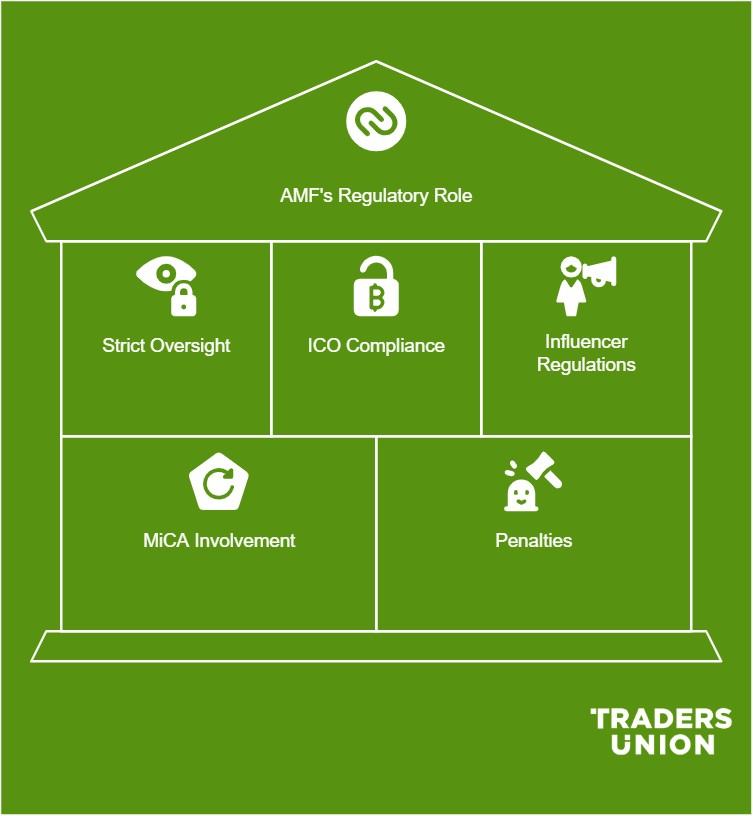
The AMF plays a crucial role in shaping how cryptocurrencies operate in France, ensuring investor protection while fostering a regulated market.
Strict oversight of digital asset service providers. The AMF enforces mandatory registration for all crypto service providers, including exchanges and custody services, requiring detailed disclosures on security measures, anti-money laundering (AML) compliance, and internal controls to prevent fraud.
High compliance barrier for ICO approvals. While France allows Initial Coin Offerings (ICOs), the AMF only grants approval to projects that meet transparency, investor protection, and whitepaper disclosure standards, significantly reducing the risk of fraudulent token sales compared to other jurisdictions.
Tough stance on influencer crypto promotions. The AMF prohibits unregistered influencers from promoting crypto products unless they comply with strict financial promotion rules, ensuring that misleading claims and hype-driven marketing do not mislead retail investors.
Involvement in the European MiCA framework. The AMF actively shapes EU-wide crypto regulations under the Markets in Crypto-Assets (MiCA) framework, making France a leader in developing standardized rules that will apply across all EU member states.
Heavy penalties for non-compliant firms. The AMF imposes substantial fines on crypto firms that fail to register or mislead investors, with past cases seeing millions in penalties, reinforcing the importance of compliance in the French market.
Requirements for the registration of digital asset service providers (DASPs)
Companies planning to provide digital asset services in France must register with the AMF. This requires:
Register a legal entity in France.
Provide detailed information on the company structure, management and beneficiaries.
Develop and implement AML/CFT procedures.
Ensure the availability of sufficient financial resources to cover operational risks.
Once registered, DASPs are required to comply with all applicable regulations and report regularly to the AMF.
Taxation of cryptocurrencies in France
In France, income from cryptocurrency transactions is subject to taxation. Since 2019, a flat tax rate of 30% has been in effect, including 12.8% income tax and 17.2% social security contributions. This regime applies to capital gains from the sale of digital assets. Here are some other pointers to consider.
Crypto-to-crypto trades are tax-exempt. In France, swapping one cryptocurrency for another doesn't trigger taxes, allowing you to trade digital assets freely.
Annual gains under €305 are tax-free. If your yearly crypto profits are €305 or less, you won't owe taxes on them, though you still need to report these earnings.
Mining income is taxed as non-commercial profits. Money made from mining crypto is treated as non-commercial income and can be taxed up to 45%, depending on how much you earn overall.
Foreign crypto accounts must be declared. Even if you haven't used them, any crypto accounts you hold outside France must be reported to the tax authorities to avoid hefty fines.
Utilizing the micro-BNC regime for small-scale mining. If your mining activities bring in less than €77,700 a year, you can take advantage of the micro-BNC tax option, which gives a 34% allowance on your earnings, lowering your taxable income.
Tax exemption threshold
If the amount of cryptocurrency sales transactions does not exceed 305 euros per year, such transactions are exempt from taxation. This allows small investors not to declare small transactions.
Differences between private investors and professional traders
The tax regime depends on the nature of the activity with cryptocurrencies:
Private investors. Persons who carry out transactions with digital assets irregularly are taxed at a flat rate of 30%.
Professional traders. If transactions with cryptocurrencies are systematic and professional, the income is classified as commercial profit. In this case, a progressive income tax scale is applied, which can reach 45%, and social security contributions are also charged.
Declaration of income from cryptocurrencies
Declaring cryptocurrency income in France can be intricate. Here are some tailored tips to guide you:
Understanding the €305 tax exemption. If your yearly crypto gains are under €305, they're tax-free, but you still need to report them to avoid penalties.
Reporting foreign crypto accounts. Have crypto accounts outside France? You must declare each one using Form 3916-bis to steer clear of hefty fines.
Balancing gains with losses. You can reduce your taxable income by offsetting crypto losses against gains within the same year. This can lessen your tax burden.
Keeping up with staking and DeFi tax rules. Tax rules for staking and DeFi are still in the works. It's wise to consult a tax expert to stay compliant as things evolve.
Preparing for new EU crypto tax regulations. New EU rules (DAC8) will soon increase information sharing about crypto assets. Be ready by keeping detailed records of all your crypto transactions.
Future changes in taxation
In 2025, the French Senate approved a budget that includes a tax on "non-productive wealth" covering cryptocurrencies. This innovation may affect the current tax regime for holders of digital assets.
How to declare cryptocurrency taxes in France
In France, both individuals and legal entities are required to declare income from cryptocurrency transactions. Failure to do so may result in fines and other sanctions.
Reporting obligations for individuals and legal entities
Individuals must declare capital gains from the sale or exchange of cryptocurrencies for fiat money or other goods and services. Even if the transactions are carried out on foreign platforms, they are subject to taxation in France. Legal entities engaged in cryptocurrency activities are required to account for income from such transactions in their financial statements and pay the corresponding taxes.
Step-by-step guide to filing a tax return
Collecting information. Collect all the details of cryptocurrency transactions for the reporting period, including dates, amounts, types of transactions, and platforms used.
Calculating capital gains. Determine the difference between the purchase and sale prices for each transaction. Note that exchanges between different cryptocurrencies are not taxable; the tax only applies when converting cryptocurrency into fiat money or using it to buy goods and services.
Completing the declaration form. Use form Cerfa 2042 for individuals or Cerfa 2042 C for additional income. In the appropriate sections, report the total capital gains from transactions with digital assets.
Providing information about foreign accounts. If you use foreign cryptocurrency exchanges or wallets, you must complete form Cerfa 3916 to declare foreign accounts.
Filing the declaration. Submit the completed declaration online through the official portal of the French tax office or on paper if you do not have access to the Internet.
Common mistakes and penalties for non-compliance
Many crypto traders in France unknowingly violate tax laws due to complex regulations, leading to hefty fines and legal issues. Here are some specialized insights to avoid costly mistakes.
Failure to report foreign crypto accounts. If you hold crypto on non-French platforms like Binance or Kraken, you must declare these accounts under the foreign asset disclosure rule. You could be fined €1,500 per undeclared account, or €10,000 if the platform is in a non-cooperative jurisdiction.
Incorrect classification of crypto gains. The French tax system treats occasional traders under the flat 30% tax (Prélèvement Forfaitaire Unique), but frequent traders might face income tax as high as 45%. Misclassifying your trading activity can result in back taxes and penalties.
Not applying the FIFO rule properly. France mandates a First-In, First-Out (FIFO) approach to calculating capital gains, meaning your oldest crypto holdings are sold first. If you miscalculate your gains, the tax authorities can correct errors, impose penalties, and add interest.
Underestimating social security contributions. Professional crypto traders must pay social security contributions (cotisations sociales), which can add an extra 17.2% to their tax bill. Many traders assume they only owe capital gains tax and end up with unexpected charges from URSSAF.
Misreporting crypto-to-crypto trades. Unlike some countries, France requires capital gains reporting for crypto-to-crypto transactions. Swapping Bitcoin for Ethereum, for example, is taxable. If flagged in an audit, you may have to pay back taxes and penalties.
Ignoring tax filing deadlines. French tax authorities impose late fees of 10% for missed filings, increasing to 40% if they find intentional omissions. If they determine fraud, penalties can go up to 80%, plus interest on overdue amounts.
Compliance and the future of regulation
The Markets in Cryptoassets Regulation (MiCA) entered into force in the European Union on December 30, 2024, establishing uniform rules for the cryptocurrency market. MiCA aims to increase transparency, ensure investor protection and prevent financial crime.
Impact of MiCA on France
As part of the EU, France must adopt MiCA into its national laws. This will unify crypto regulations across Europe. It will make compliance easier for digital asset service providers (DASPs) and help build investor trust. MiCA sets clear rules for stablecoin issuers, requiring them to hold reserves and operate with full transparency.
AML/KYC requirements
France enforces strict AML and KYC rules for crypto businesses. Since 2021, crypto firms must verify user identities, no matter the transaction size, effectively banning anonymous transactions. Every transaction now requires full identity verification.
MiCA expands these rules, requiring crypto platforms to actively fight money laundering and fraud. Companies need clear policies to spot suspicious transactions and train staff on AML/KYC compliance to stay compliant with the evolving regulations.
Possible changes in tax and legal policies
With the implementation of MiCA, France is likely to revise its crypto tax laws. The country may adjust regulations to align with EU standards and create consistent tax rules. New legal updates could focus on protecting investors and improving market transparency. MiCA’s adoption in France will reshape how the crypto market is regulated. Stricter rules on transparency, security, and accountability will apply to businesses and investors. Market players will need to pay closer attention to compliance.
| Available in France | CEX | DEX | P2P | Coins Supported | Spot Taker fee, % | Spot Maker Fee, % | TU overall score | Open an account | |
|---|---|---|---|---|---|---|---|---|---|
| Yes | Yes | No | No | 278 | 0.4 | 0.25 | 9.2 | Go to broker Your capital is at risk. |
|
| Yes | Yes | No | No | 415 | 0.1 | 0.1 | 9.2 | Go to broker Your capital is at risk.
|
|
| Yes | Yes | No | Yes | 2276 | 0.05 | 0 | 8.7 | Go to broker Your capital is at risk. |
|
| Yes | Yes | No | Yes | 831 | 0.1 | 0.1 | 8.6 | Go to broker Your capital is at risk. |
|
| Yes | Yes | No | Yes | 415 | 0.1 | 0.1 | 8.5 | Go to broker Your capital is at risk. |
Why trust us
15+ years of independent market analysis
140+ evaluation criteria, reviewed by 50+ experts
Data-driven reviews of 200+ platforms, updated regularly
20+ industry awards & a wide network of global media partners
Learn more about our methodology and editorial policies.


Wallet transfers and staking can increase crypto taxes in France

Many crypto traders in France don’t realize that where they store their crypto can affect their taxes. If you keep assets in a cold wallet (hardware or paper wallet), they’re not taxed until you move them to an exchange. But as soon as you transfer crypto to a centralized platform — even without selling — it can raise red flags if it’s tied to past undeclared income. French tax authorities monitor blockchain movements, and any unexplained transfers might lead to tax reassessments, penalties, or even audits. To avoid this, keep a detailed transaction log and don’t move funds between wallets without records.
Another common pitfall is the taxation of airdrops and staking rewards. If you sell these right away, they fall under the 30% capital gains tax. But if you restake or reinvest them, tax authorities might classify you as a professional trader, which could mean higher income tax rates of up to 45% plus additional social charges. Many traders wrongly assume staking rewards are only taxable when withdrawn, but in France, they’re taxed as soon as they hit your wallet. The safest approach? Log all staking rewards, airdrops, and reinvestments clearly to show you’re not running a professional trading business.
Conclusion
France has well-defined rules for crypto taxation and regulations. Private investors pay a flat 30% tax, while frequent traders face progressive tax rates. Once MiCA takes effect, France’s crypto laws will align more closely with EU standards. Check the AMF website, French tax authorities, and EU updates for the latest rule changes. Filing accurate reports and declarations can help you avoid fines or legal trouble. Regulations aim to increase market transparency, so staying updated can help adjust your approach.
FAQs
Which cryptocurrency transactions are tax-free in France?
The exchange of one cryptocurrency for another is not taxable, as it is not considered a sale of capital. Also, transactions of less than 305 euros per year are not taxable. However, using cryptocurrency to pay for goods and services is already considered a taxable event.
Do I need to declare crypto assets if they are stored on foreign platforms?
Yes, if you have accounts on foreign exchanges or wallets, you must notify the tax office. The declaration must be submitted annually, and failure to do so may result in fines.
What happens if you do not declare cryptocurrency income in France?
If the tax office detects undeclared cryptocurrency income, fines and penalties may be assessed. Depending on the amount of unpaid tax, additional sanctions are possible, including tax investigations.
How will the MiCA regulation affect the use of stablecoins in France?
The MiCA regulation introduces strict requirements for stablecoin issuers, including reserve requirements and transparent reporting. Operations with such assets will be regulated at the EU level, which will increase their legitimacy, but may lead to restrictions for unregulated assets.
Editors' Top Picks and Insights

The privacy paradox: How the crypto mixer market has changed

Is Bitcoin right for you? Five traits shared by many cryptocurrency holders

Chasing hits: Why investors are losing interest in Netflix

Tokenized stocks in the spotlight: How do they work and are they worth trading?

Do politicians make the best stock traders?

Crypto test drive: How automakers are exploring digital assets
Related Articles
Team that worked on the article
Maxim Nechiporenko has been a contributor to Traders Union since 2023. He started his professional career in the media in 2006.
Chinmay Soni is a financial analyst with more than 5 years of experience in working with stocks, Forex, derivatives, and other assets. As a founder of a boutique research firm and an active researcher, he covers various industries and fields, providing insights backed by statistical data.
Mirjan Hipolito is a journalist and news editor at Traders Union. She is an expert crypto writer with five years of experience in the financial markets.

-
 Afghanistan
-
 Albania
-
 Algeria
-
 Angola
-
 Argentina
-
 Armenia
-
 Australia
-
 Austria
-
 Azerbaijan
-
 Bahamas
-
 Bahrain
-
 Bangladesh
-
 Belarus
-
 Belgium
-
 Bolivia
-
 Botswana
-
 Brazil
-
 Brunei
-
 Bulgaria
-
 Cambodia
-
 Cameroon
-
 Canada
-
 Chile
Chile
-
 China
China
-
 Colombia
-
 Congo
Congo
-
 Costa Rica
-
 Cote d'Ivoire
-
 Croatia
-
 Cuba
Cuba
-
 Cyprus
-
 Czechia
-
 DR Congo
-
 Denmark
-
 Dominican Republic
-
 Ecuador
-
 Egypt
Egypt
-
 El Salvador
-
 Estonia
-
 Eswatini
-
 Ethiopia
-
 Finland
-
 France
-
 Georgia
-
 Germany
-
 Ghana
Ghana
-
 Greece
-
 Haiti
Haiti
-
 Hong Kong
-
 Hungary
-
 India
India
-
 Indonesia
-
 Iran, Islamic republic
-
 Iraq
Iraq
-
 Ireland
-
 Israel
-
 Italy
Italy
-
 Jamaica
-
 Japan
Japan
-
 Jordan
-
 Kazakhstan
-
 Kenya
Kenya
-
 Korea
Korea
-
 Kuwait
-
 Kyrgyzstan
-
 Laos
Laos
-
 Latvia
-
 Lebanon
-
 Lesotho
-
 Libya
Libya
-
 Lithuania
-
 Luxembourg
-
 Madagascar
-
 Malaysia
-
 Malta
Malta
-
 Mauritius
-
 Mexico
-
 Moldova
-
 Mongolia
-
 Montenegro
-
 Morocco
-
 Mozambique
-
 Myanmar
-
 Namibia
-
 Nepal
Nepal
-
 Netherlands
-
 New Zealand
-
 Nigeria
-
 North Macedonia
-
 Norway
-
 Oman
Oman
-
 Pakistan
-
 Palestine
-
 Panama
-
 Papua New Guinea
-
 Paraguay
-
 Peru
Peru
-
 Philippines
-
 Poland
-
 Portugal
-
 Puerto Rico
-
 Qatar
Qatar
-
 Reunion
-
 Romania
-
 Rwanda
-
 Saudi Arabia
-
 Serbia
-
 Singapore
-
 Slovakia
-
 Slovenia
-
 Somalia
-
 South Africa
-
 Spain
Spain
-
 Sri Lanka
-
 Sweden
-
 Switzerland
-
 Syria
Syria
-
 Taiwan
-
 Tajikistan
-
 Tanzania
-
 Thailand
-
 Trinidad and Tobago
-
 Tunisia
-
 Turkey
-
 UAE
UAE
-
 Uganda
-
 Ukraine
-
 United Kingdom
-
United States
-
 Uruguay
-
 Uzbekistan
-
 Venezuela
-
 Vietnam
-
 Yemen
Yemen
-
 Zambia
-
 Zimbabwe
- Forex
- Crypto











