
Prop Trading Platforms That Accept Card Payments


Editorial Note: While we adhere to strict Editorial Integrity, this post may contain references to products from our partners. Here's an explanation for How We Make Money. None of the data and information on this webpage constitutes investment advice according to our Disclaimer.
Best prop firms that accept card payments:
- FundedNext - Beginners-friendly offers (free trial, trade copier software is allowed)
- Goat Funded Trader - A prop trading firm offering simulated capital of up to $400,000 for Forex and CFD trading
- SabioTrade - Best for those who want to work as non-staff traders with up to 90% of profit
- FTMO - One of the largest prop companies with favorable conditions (profit split up to 90%)
- Instant Funding - Prop firm offering instant funding with account sizes up to $80,000
Card payments have become one of the most convenient ways to access proprietary trading challenges, offering traders a familiar and widely accepted alternative to bank transfers and cryptocurrency. Fast processing, broad availability, and built-in consumer protections make debit and credit cards a preferred payment method for many users, although support varies considerably between firms.
Choosing among prop trading platforms that accept card payments involves more than checking whether Visa or Mastercard is accepted. Payment processing, refund policies, regional availability, and transaction fees all influence the overall experience. This guide explains how card payments work in prop trading, compares leading providers, and highlights the key factors to consider before purchasing a challenge.
Risk warning: Proprietary trading involves substantial financial risk. Using firm capital can lead to gains or losses, and failure to meet targets may result in account closure. Over 85% of prop traders do not achieve long-term profitability. Understand the risks and seek professional guidance.
Best prop firms with card payment options
Many proprietary trading firms now accept debit and credit cards, but the overall payment experience can vary significantly. Differences in supported card types, payment processing, trading conditions, and account features all influence how convenient it is to purchase and begin an evaluation.
The table below compares leading prop trading platforms that accept card payments, highlighting their payment support alongside key trading conditions to help traders identify the most suitable option for their needs.
| FundedNext | Goat Funded Trader | SabioTrade | FTMO | Instant Funding | OFP | |
|---|---|---|---|---|---|---|
|
Bank Card |
Yes | Yes | Yes | Yes | Yes | Yes |
|
Funding Up To, $ |
4,000,000 | 2,000,000 | 1,000,000 | 2,000,000 | 120,000 | 5,000,000 |
|
Profit split up to, % |
95 | 95 | 90 | 90 | 90 | 80 |
|
Trading period |
Unlimited | Unlimited | Unlimited | Unlimited | Unlimited/7 days for Rapid | Unlimited |
|
One-time-payment |
Yes | Yes | Yes | Yes | Yes | Yes |
|
TU overall score |
9.4 | 9.2 | 9.1 | 8.9 | 8.1 | 8.07 |
|
Open an account |
Go to broker Your capital is at risk. |
Go to broker Your capital is at risk.
|
Go to broker Your capital is at risk.
|
Go to broker Your capital is at risk. |
Go to broker Your capital is at risk.
|
Go to broker Your capital is at risk.
|






Why trust us
15+ years of independent market analysis
140+ evaluation criteria, reviewed by 50+ experts
Data-driven reviews of 200+ platforms, updated regularly
20+ industry awards & a wide network of global media partners
Learn more about our methodology and editorial policies.


Why payment methods matter in prop trading
Paying for a prop trading challenge is the first step in accessing a funded account, making the payment process an important part of the overall trading experience. While traders often compare evaluation rules, profit splits, and drawdown limits, payment methods can also influence convenience, costs, and the speed of onboarding.
Card payments have become a popular option because they offer instant processing, broad availability, and additional consumer protections compared with bank transfers or cryptocurrency. However, not every platform supports card transactions, and accepted payment methods can vary by region, payment processor, and internal policies.
For this reason, comparing prop trading platforms that accept card payments involves more than checking whether Visa or Mastercard is available. Payment reliability, refund policies, regional support, and transaction fees all contribute to a smoother and more predictable onboarding experience.
How card payments work in prop firms
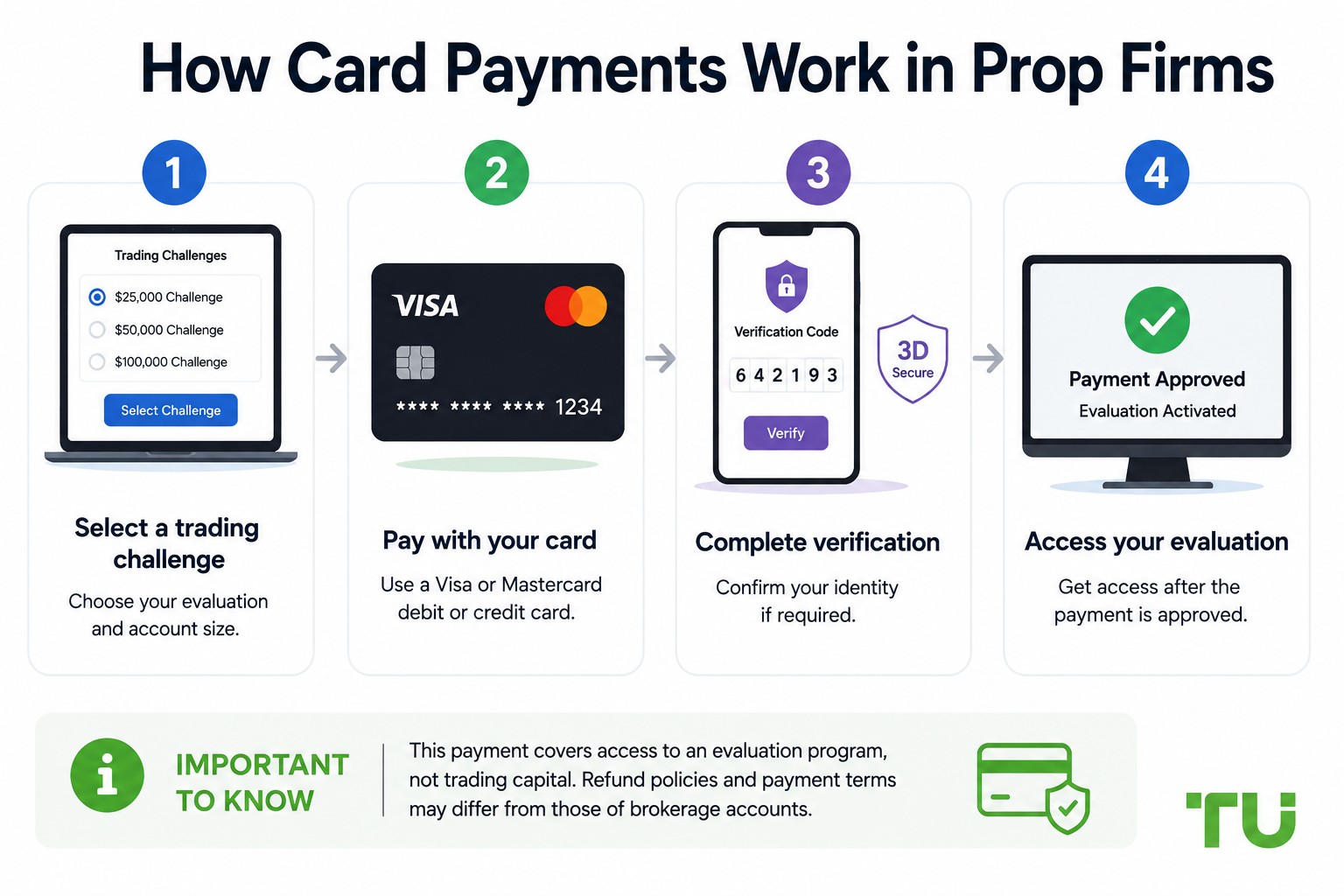
Most prop firms process card payments through established payment gateways such as Stripe or Checkout.com. After selecting a trading challenge, traders complete the purchase using a debit or credit card, and the evaluation account is typically activated once the transaction has been approved.
Unlike brokers, prop firms do not accept deposits for trading. The payment covers access to an evaluation program rather than trading capital, which means refund policies and payment terms differ from those associated with brokerage accounts.
The payment process generally follows four steps:
Select a trading challenge.
Pay using a Visa or Mastercard debit or credit card.
Complete any required payment verification.
Receive access to the evaluation after the transaction is approved.
This payment model is widely used by prop trading platforms that accept card payments, although supported cards, payment providers, and regional availability may differ between firms.
Key advantages of card payments
Card payments have become one of the most widely used methods for purchasing prop trading challenges because they combine convenience with broad accessibility. Compared with alternative payment methods, they offer several practical benefits throughout the onboarding process:
Instant access. Payments are typically processed within minutes, allowing traders to begin an evaluation without unnecessary delays.
Familiar payment experience. Visa and Mastercard are widely accepted, making the checkout process straightforward for most users.
Consumer protection. Many card issuers provide additional security features and dispute procedures that are not available with irreversible payment methods.
Simplified expense tracking. Card statements make it easier to monitor challenge purchases and manage trading-related costs.
Card payments continue to dominate global e-commerce. More than 40% of online transactions worldwide were completed using payment cards in recent years, Statista reported, reflecting their widespread adoption and user preference.
For traders comparing the best prop firms for card payment options, fast processing, transparent pricing, and reliable payment infrastructure often provide greater long-term value than card acceptance alone.
Why some prop firms avoid card payments
Although card payments are convenient for traders, they create additional costs and operational challenges for proprietary trading firms. The most common reasons some firms choose alternative payment methods include:
Chargeback risk. Unlike cryptocurrency transactions, card payments can be disputed or reversed, increasing financial and operational risk.
Payment fraud. Stolen cards, unauthorized transactions, and identity fraud require additional security measures and monitoring.
Payment processor restrictions. Some providers impose stricter compliance requirements or limit support for certain business models and geographic regions.
Higher processing costs. Card transactions typically involve merchant fees that may be higher than those associated with alternative payment methods.
As a result, many firms rely primarily on cryptocurrency or bank transfers to simplify payment processing and reduce transaction risk. By contrast, prop firms with the best card payment options typically invest in secure payment infrastructure, fraud prevention, and established processing partners, allowing them to offer reliable card payments while maintaining high transaction approval rates.
What to check before paying with a card
Accepting Visa or Mastercard does not guarantee a smooth payment experience. Before purchasing a challenge, traders should review the payment process as carefully as the trading conditions.
Payment processing
Reliable firms clearly identify their payment partners, accepted card types, and any transaction limits. Some providers route payments through third-party intermediaries, which may complicate refunds or dispute resolution.
Refund policy
Card payments typically cover access to an evaluation rather than trading capital, making refund eligibility dependent on the firm's challenge rules. Clear policies outlining conditions, timelines, and exceptions help reduce uncertainty.
Currency and fees
If the challenge is priced in a different currency from the payment card, banks or payment processors may apply conversion charges. Additional processing fees can further increase the overall cost of purchasing a challenge.
Regional availability
Card acceptance can vary depending on the issuing bank, payment processor, or country of residence. Platforms with broader international support generally provide a more consistent payment experience across different regions.
Payment security
Many firms use 3D Secure or similar verification systems to reduce fraud and unauthorized transactions. While these checks may add an extra step during checkout, they also improve payment security and reduce the likelihood of declined or disputed transactions.
When comparing prop firms with the best card payment options, these factors provide a more complete picture than card acceptance alone. Transparent payment policies and reliable transaction processing are often better indicators of a smooth onboarding experience than the availability of a single payment method.
Who should choose card-friendly prop firms
Card payments are not essential for every trader, but they can make purchasing and accessing a funded trading challenge faster and more convenient. This payment method is particularly well suited to:
Beginner traders looking for a simple and familiar way to purchase their first evaluation challenge.
Traders who prefer traditional payment methods over cryptocurrency or international bank transfers.
International traders with access to widely accepted Visa or Mastercard payment cards.
Traders evaluating multiple firms, where fast and straightforward checkout simplifies purchasing additional challenges.
For these traders, prop trading platforms that accept card payments can reduce onboarding friction and make the evaluation process more accessible without changing the underlying trading conditions.
Risks and warnings
Card payments offer speed and convenience, but they are not free from potential issues. Banks or payment providers may decline transactions with proprietary trading firms because of internal risk policies, even when sufficient funds are available. Delayed or unsuccessful payments can postpone access to an evaluation challenge.
Traders should also consider the total cost of card payments. Currency conversion charges, payment processing fees, and non-refundable evaluation costs can increase the overall expense, particularly when purchasing multiple challenges or paying in a foreign currency.
Security and transparency remain equally important. Before entering card details, verify that the platform uses secure payment processing and clearly explains its refund policy. Since most prop firms treat challenge purchases as service fees rather than trading deposits, unsuccessful evaluations generally do not qualify for refunds.
Test the payment process before committing

Choosing a prop firm based solely on trading conditions is not enough. The payment experience should also be part of the evaluation process. Before purchasing a larger challenge, consider starting with the lowest-priced option to verify how the platform handles card payments, transaction approvals, and customer support. A smooth payment process often reflects stronger operational standards overall.
It is equally important to look beyond the initial transaction. Review refund policies, monitor any currency conversion or processing fees, and confirm that payments remain reliable over multiple purchases. When comparing prop trading platforms that accept card payments, consistent payment processing and transparent policies are often more valuable than simply offering Visa or Mastercard as payment options.
Methodology for compiling our ratings of prop firms
Traders Union applies a rigorous methodology to evaluate prop companies using over 100 quantitative and qualitative criteria. Multiple parameters are given individual scores that feed into an overall rating.
Key aspects of the assessment include:
-
Trader testimonials and reviews. Collecting and analyzing feedback from existing and past traders to understand their experiences with the firm.
-
Trading instruments. Companies are evaluated on the range of assets offered, as well as the breadth and depth of available markets.
-
Challenges and evaluation process. Analyzing the firm's challenge system, account types, evaluation criteria, and the process for granting funding.
-
Profit split. Reviewing the profit split structure and terms, scaling plans, and how the firm handles profit distributions.
-
Trading conditions. Examining leverage, execution speeds, commissions, and other trading costs associated with the firm.
-
Platform and technology. Assessing the firm's proprietary trading platform or third-party platforms it supports, including ease of use, functionality, and stability.
-
Education and support. Quality and availability of training materials, webinars, and one-on-one coaching.
Conclusion
Choosing a prop trading platform that accepts card payments can significantly simplify and speed up the onboarding process, especially for new and international traders. While Visa and Mastercard offer unmatched convenience and consumer protections, the true value lies in a firm’s payment transparency, processing reliability, and clear refund policies. For example, platforms that invest in secure payment gateways and upfront communication about fees and policies tend to deliver a smoother, more predictable experience than those simply accepting cards. Ultimately, assessing payment infrastructure alongside trading conditions ensures traders start their evaluations with confidence, underscoring that how you pay can be as important as where you trade.
FAQs
What specific fees should traders watch out for when using card payments with prop firms?
How do refund policies for card payments differ from other payment methods in prop trading?
Are card payments universally available for prop trading platforms worldwide?
What security measures do prop trading firms use to protect card transactions?
Editors' Top Picks and Insights






Related Articles
Team that worked on the article
Aleksandra Chaikina has been a contributor to Traders Union since 2021. With over 15 years of experience in copywriting and more than 5 years focused on financial content, she specializes in producing detailed guides, analytics, and comparative reviews across various sectors, including cryptocurrencies, Forex, investment strategies, and financial technologies.
Ciaran Ryan is a veteran financial journalist based in South Africa, where he covers cryptocurrency, mining, stock markets, and governance for Moneyweb. He also hosts the weekly Moneyweb Crypto Podcast.
Chinmay Soni is a financial analyst with more than 5 years of experience in working with stocks, Forex, derivatives, and other assets. As a founder of a boutique research firm and an active researcher, he covers various industries and fields, providing insights backed by statistical data.
Prop trading firms come in a variety of forms, each with its own unique characteristics and strategies. These include: independent prop trading firms, bank prop trading desks, broker-dealer prop trading desks, market-making firms
Xetra is a German Stock Exchange trading system that the Frankfurt Stock Exchange operates. Deutsche Börse is the parent company of the Frankfurt Stock Exchange.
Cryptocurrency is a type of digital or virtual currency that relies on cryptography for security. Unlike traditional currencies issued by governments (fiat currencies), cryptocurrencies operate on decentralized networks, typically based on blockchain technology.
Bitcoin is a decentralized digital cryptocurrency that was created in 2009 by an anonymous individual or group using the pseudonym Satoshi Nakamoto. It operates on a technology called blockchain, which is a distributed ledger that records all transactions across a network of computers.
Proprietary trading (prop trading) is a financial trading strategy where a financial firm or institution uses its own capital to trade in various financial markets, such as stocks, bonds, commodities, or derivatives, with the aim of generating profits for the company itself. Prop traders typically do not trade on behalf of clients but instead trade with the firm's money, taking on the associated risks and rewards.


