
Most Reliable Prop Trading Firms for Payouts


Editorial Note: While we adhere to strict Editorial Integrity, this post may contain references to products from our partners. Here's an explanation for How We Make Money. None of the data and information on this webpage constitutes investment advice according to our Disclaimer.
Best prop firms for payouts:
- FundedNext - Beginners-friendly offers (free trial, trade copier software is allowed)
- Goat Funded Trader - A prop trading firm offering simulated capital of up to $400,000 for Forex and CFD trading
- SabioTrade - Best for those who want to work as non-staff traders with up to 90% of profit
- Funded Trading Plus - Instant funding accounts without profit target (max drawdown 6%)
- Plutus Trade Base - A proprietary trading firm, offering profit split up to 95%, and multiple evaluation models for Forex and CFD trading.
The most reliable prop trading firms for payouts combine fixed withdrawal schedules, transparent rules, and a proven record of repeated payments. Many process approved withdrawals within 24 to 72 hours and allow requests every 1 to 14 days. This guide explains how to identify prop firms that actually pay out, compare payout models, and spot conditions that may cause delays or refusals.
Risk warning: Proprietary trading involves substantial financial risk. Using firm capital can lead to gains or losses, and failure to meet targets may result in account closure. Over 85% of prop traders do not achieve long-term profitability. Understand the risks and seek professional guidance.
Most reliable prop trading firms for payouts
Choosing a prop trading firm requires more than comparing profit splits or promotional offers. Traders should evaluate how each firm handles withdrawals in practice, including approval times, payout schedules, trading requirements, and the consistency of payments over multiple withdrawal cycles. Firms with transparent policies and clearly defined rules generally provide a more predictable trading experience.
The table below compares the most reliable prop trading firms for payouts, highlighting key trading conditions, funding terms, and features that influence withdrawal reliability. It provides a practical starting point for identifying firms with transparent payout policies and a proven record of paying traders on time.
| FundedNext | Goat Funded Trader | SabioTrade | Funded Trading Plus | Plutus Trade Base | Earn2Trade | |
|---|---|---|---|---|---|---|
|
Max. Leverage |
1:100 | 1:100 | 1:30 | 1:30 | 1:100 | 1:30 |
|
Refundable Fee |
Yes | No | Yes | No | No | No |
|
Funding Up To, $ |
4 000 000 | 2 000 000 | 1 000 000 | 200 000 | 500 000 | 400 000 |
|
Profit split up to, % |
95 | 95 | 90 | 90 | 95 | 80 |
|
Trading period |
Unlimited | Unlimited | Unlimited | Unlimited | 7 | Unlimited |
|
One-time-payment |
Yes | Yes | Yes | Yes | Yes | No |
|
TU overall score |
9.4 | 9.2 | 9.1 | 8.7 | 8.37 | 8.26 |
|
Open an account |
Go to broker Your capital is at risk. |
Go to broker Your capital is at risk.
|
Go to broker Your capital is at risk.
|
Go to broker Your capital is at risk. |
Go to broker Your capital is at risk. |
Go to broker Your capital is at risk. |






Why trust us
15+ years of independent market analysis
140+ evaluation criteria, reviewed by 50+ experts
Data-driven reviews of 200+ platforms, updated regularly
20+ industry awards & a wide network of global media partners
Learn more about our methodology and editorial policies.


How to measure payout reliability
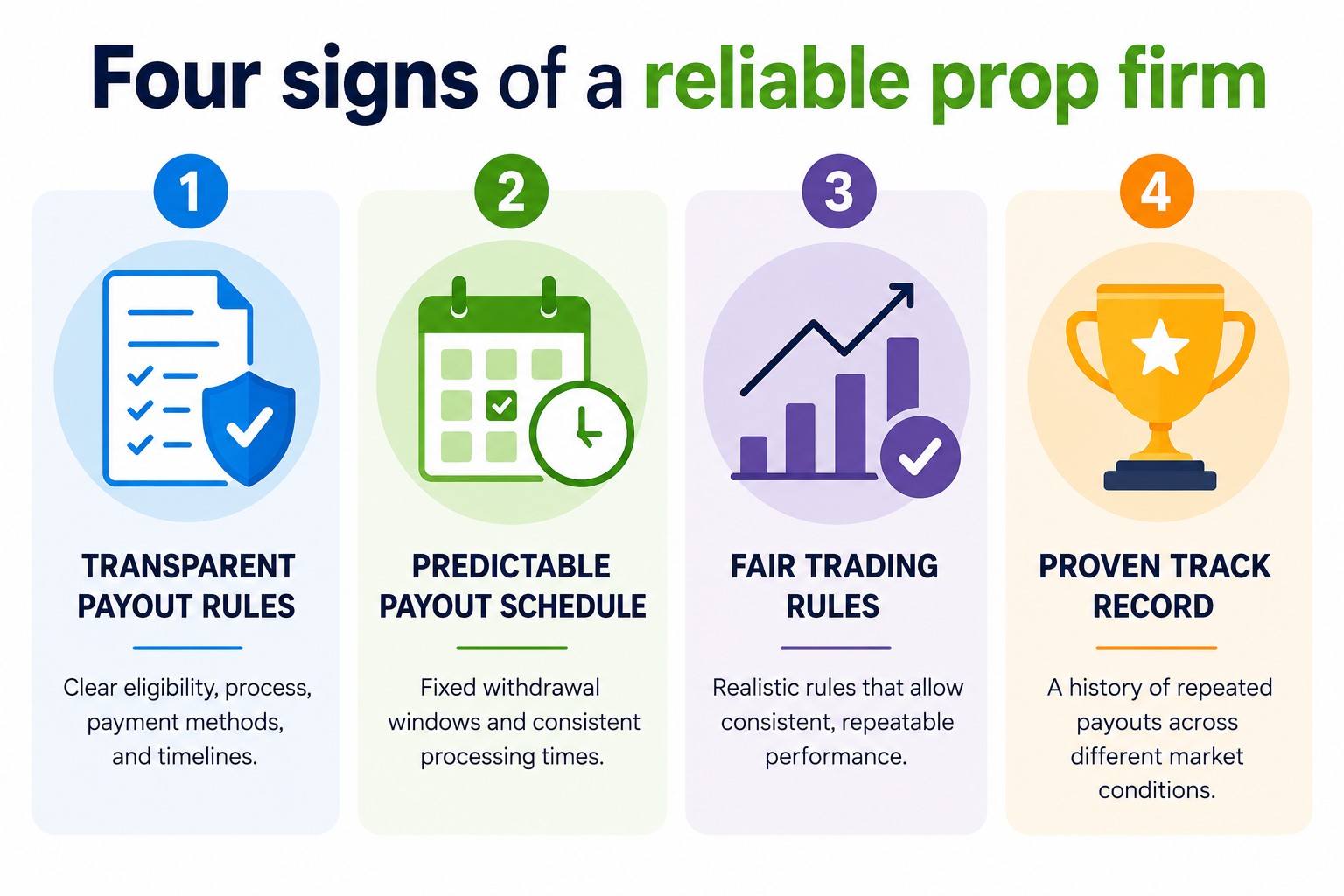
Transparent payout rules
A fast payout promise means little if the process is unclear. Reliable firms explain when traders become eligible for a withdrawal, how requests are reviewed, which payment methods are available, and how long processing typically takes.
In practice, prop firms that do not delay payouts usually publish fixed withdrawal schedules instead of broad estimates, making the process more predictable for traders.
Consistent withdrawals
A 90% or even 100% profit split looks attractive, but it matters less if payouts are difficult to qualify for or frequently delayed. Experienced traders often prefer prop firms that actually pay out consistently over providers that promote exceptional terms but have an inconsistent payout history.
For long-term funded trading, repeatable withdrawals are generally a better indicator of reliability than a single large payout.
Realistic trading rules
The biggest obstacle to receiving a payout is often the firm's rulebook rather than the withdrawal request itself. Daily drawdown limits, consistency requirements, minimum trading days, profit thresholds, and restricted trading strategies all influence whether profits become eligible for withdrawal.
From this perspective, genuine prop firms that payout are those whose trading rules support realistic, repeatable performance instead of creating unnecessary barriers to withdrawals.
Track record
A longer track record does not guarantee reliability, but it provides more evidence that a firm's payout process has remained stable across different market conditions. Firms with an established track record generally present less operational uncertainty than newly launched providers.
For this reason, many traders look for top-rated prop trading companies that pay out, combining transparent payout policies with several years of successful operation.
Types of payout models used by prop firms
Prop trading firms use different payout models to balance trader flexibility with risk management. Understanding how each structure works can help traders choose a firm that matches their trading style and income expectations.
No single payout model is universally better. The right choice depends on whether a trader prioritizes regular income, immediate access to profits, or long-term account growth.
| Payout model | Frequency | Key condition | Best for |
|---|---|---|---|
| Fixed cycle | 7–14 days | Minimum trading period | Stable income |
| On-demand | Anytime | Profit threshold reached | Fast access to profits |
| Milestone-based | Variable | Trading days or targets | Disciplined trading |
| Scaling-based | Progressive | Performance growth | Long-term growth |
Fixed-cycle payouts remain the most common model. They allow traders to request withdrawals on a predetermined schedule, typically every seven to 14 days, making them a popular choice among prop firms that pay you out on time.
On-demand payouts provide greater flexibility by allowing withdrawals once a minimum profit threshold has been reached. While these models are often offered by prop firms that actually pay out, traders should carefully review any eligibility requirements before requesting a withdrawal.
Milestone-based models link payouts to trading activity or performance targets, rewarding traders who demonstrate consistent results over time. Scaling-based models gradually increase account size or profit share as performance improves, making them well suited to traders focused on long-term growth rather than frequent withdrawals.
Reliability is not the same as speed
A same-day or next-day withdrawal can be appealing, but payout speed alone does not determine reliability. The real test is whether a firm processes withdrawals consistently over time without unexpected delays, changing conditions, or unclear exceptions.
When comparing trustworthy prop firms with no payout scams, traders should look beyond promotional claims and evaluate withdrawal schedules, approval requirements, and the firm's history of paying traders across multiple payout cycles.
Red flags and common reasons for payout rejection
Most payout disputes are not caused by the withdrawal process itself. They usually stem from either unclear firm policies or traders failing to meet the conditions required for a payout. Before purchasing a challenge, review the following warning signs and understand the rule violations that most often lead to rejected withdrawal requests.
Common red flags
Unclear withdrawal policies. Approval times, payment methods, or eligibility requirements are not clearly explained.
Complex trading rules. Marketing materials promise simple payouts, while the rulebook contains restrictive or difficult-to-interpret conditions.
Limited operating history. New firms may be legitimate, but established providers generally offer more evidence of consistent payouts. This is one reason many traders prefer top-rated prop firms without payout issues.
Unrealistic guarantees. Claims such as "guaranteed payouts" or "we never refuse withdrawals" should always be verified independently. Even the most reliable firms reserve the right to reject payouts when traders violate their rules.
Common reasons payouts are rejected
Exceeding daily or maximum drawdown limits.
Failing to meet minimum trading day requirements.
Violating consistency rules through uneven profit distribution.
Requesting a withdrawal before reaching the required profit threshold.
Using prohibited trading strategies or breaching other account rules.
The most reliable prop trading firms for payouts make their requirements clear from the outset. Taking the time to review the payout policy, trading rules, and operating history before purchasing a challenge can help traders avoid unnecessary disputes and improve the likelihood of consistent withdrawals.
Who should choose payout-focused prop firms
Not every trader has the same priorities. Some value fast access to profits, while others prefer predictable payout schedules or long-term account growth. Choosing a payout model that matches your trading style and income objectives is just as important as selecting the right prop firm.
| Trader type | Priority | Suitable payout model | Why it fits |
|---|---|---|---|
| Beginner traders | Simplicity and clarity | Fixed cycle | Easy-to-follow rules and predictable payouts |
| Consistent traders | Regular income | Fixed or milestone-based | Supports steady withdrawal cycles |
| Advanced traders | Speed and flexibility | On-demand | Faster access to realized profits |
| Risk-conscious traders | Capital preservation | Fixed cycle | Lower likelihood of rule violations |
| High-performance traders | Maximizing returns | Scaling-based | Larger payouts and account growth over time |
There is no single payout model that suits every trader. Those looking for stable income may prefer fixed payout cycles, while experienced traders often value the flexibility of on-demand withdrawals or scaling programs. When comparing prop firms that actually pay out, the best choice is the one whose payout structure aligns with your trading strategy and financial goals.
Prioritize reliable payouts over high profit splits

The best prop trading firms are not always those advertising the highest profit split. The most reliable prop trading firms for payouts combine transparent withdrawal policies, realistic trading rules, and a proven operating history. Before purchasing a challenge, review how often payouts are processed, how long approvals typically take, and whether the firm has maintained consistent payment practices over time.
Receiving a first payout is only the beginning. Long-term success depends on choosing prop firms that actually pay out consistently and maintaining disciplined trading habits that comply with the firm's rules. Monitoring approval times, staying informed about policy changes, and following a structured risk management approach can help turn payouts into a repeatable outcome rather than a one-time success.
Methodology for compiling our ratings of prop firms
Traders Union applies a rigorous methodology to evaluate prop companies using over 100 quantitative and qualitative criteria. Multiple parameters are given individual scores that feed into an overall rating.
Key aspects of the assessment include:
-
Trader testimonials and reviews. Collecting and analyzing feedback from existing and past traders to understand their experiences with the firm.
-
Trading instruments. Companies are evaluated on the range of assets offered, as well as the breadth and depth of available markets.
-
Challenges and evaluation process. Analyzing the firm's challenge system, account types, evaluation criteria, and the process for granting funding.
-
Profit split. Reviewing the profit split structure and terms, scaling plans, and how the firm handles profit distributions.
-
Trading conditions. Examining leverage, execution speeds, commissions, and other trading costs associated with the firm.
-
Platform and technology. Assessing the firm's proprietary trading platform or third-party platforms it supports, including ease of use, functionality, and stability.
-
Education and support. Quality and availability of training materials, webinars, and one-on-one coaching.
Conclusion
The most reliable prop trading firms for payouts distinguish themselves through transparent withdrawal policies, clear trading rules, and a proven history of consistently paying traders on time. Rather than being swayed by flashy profit splits or aggressive marketing, traders should prioritize firms that process withdrawals on fixed schedules and maintain predictable, repeatable payout practices—such as those that openly publish their payout timelines and eligibility criteria. Firms like these offer genuine long-term opportunity, as opposed to one-off successes or uncertain payment experiences. Ultimately, sustainable trading success comes from partnering with a prop firm whose payout model aligns with your goals and proves its commitment to reliable trader compensation with every cycle.
FAQs
What criteria should traders use to assess the payout reliability of a prop trading firm?
How do withdrawal schedules impact a trader’s experience with a prop firm?
Which trading rule violations most commonly result in rejected payout requests?
Is a higher profit split always preferable when choosing a prop trading firm for reliable payouts?
Editors' Top Picks and Insights






Related Articles
Team that worked on the article
Aleksandra Chaikina has been a contributor to Traders Union since 2021. With over 15 years of experience in copywriting and more than 5 years focused on financial content, she specializes in producing detailed guides, analytics, and comparative reviews across various sectors, including cryptocurrencies, Forex, investment strategies, and financial technologies.
Ciaran Ryan is a veteran financial journalist based in South Africa, where he covers cryptocurrency, mining, stock markets, and governance for Moneyweb. He also hosts the weekly Moneyweb Crypto Podcast.
Chinmay Soni is a financial analyst with more than 5 years of experience in working with stocks, Forex, derivatives, and other assets. As a founder of a boutique research firm and an active researcher, he covers various industries and fields, providing insights backed by statistical data.
Forex leverage is a tool enabling traders to control larger positions with a relatively small amount of capital, amplifying potential profits and losses based on the chosen leverage ratio.
Proprietary trading (prop trading) is a financial trading strategy where a financial firm or institution uses its own capital to trade in various financial markets, such as stocks, bonds, commodities, or derivatives, with the aim of generating profits for the company itself. Prop traders typically do not trade on behalf of clients but instead trade with the firm's money, taking on the associated risks and rewards.
A bear market is a period of time in which an investment asset, such as stocks, bonds, or commodities, experiences a decline in price for an extended period of time.
Swing trading is a trading strategy that involves holding positions in financial assets, such as stocks or forex, for several days to weeks, aiming to profit from short- to medium-term price swings or "swings" in the market. Swing traders typically use technical and fundamental analysis to identify potential entry and exit points.
Index in trading is the measure of the performance of a group of stocks, which can include the assets and securities in it.


