
Bounce Launchpad: How It Works And How To Join


Editorial Note: While we adhere to strict Editorial Integrity, this post may contain references to products from our partners. Here's an explanation for How We Make Money. None of the data and information on this webpage constitutes investment advice according to our Disclaimer.
Bounce launchpad is a decentralized platform for launching token sales through smart contract auctions. It supports fixed swap, Dutch, English, and sealed bid formats across networks like Ethereum and BNB Chain. To join, users connect a Web3 wallet, complete KYC when needed, and participate directly through on-chain auction mechanics.
The core feature of the Bounce launchpad is its use of programmable smart contracts to manage every stage of a token sale, from bid submission to final token allocation. Because the auction logic is executed fully on-chain, participants can verify conditions in advance, while project teams benefit from automated settlement and reduced operational risk.
From the user side, participation is handled through direct wallet interaction rather than centralized accounts. On supported networks such as Ethereum and BNB Chain, users simply connect a Web3 wallet and meet any required compliance checks. For project owners, Bounce offers flexible configuration options, including adjustable pricing mechanisms, allocation caps, and whitelist rules, allowing each sale to be tailored to the project’s fundraising strategy.
Risk warning: Cryptocurrency markets are highly volatile, with sharp price swings and regulatory uncertainties. Research indicates that 75-90% of traders face losses. Only invest discretionary funds and consult an experienced financial advisor.
What is Bounce launchpad and how it differs from Binance launchpad
Bounce launchpad is a decentralized token launch platform that allows crypto projects to raise funds through customizable smart contract auctions. Teams can choose fixed price, English, Dutch, sealed bid, or randomized draw formats. They can also adjust settings such as pricing, duration, accepted currencies, whitelists, and participation caps. Users join by connecting a Web3 wallet and interacting directly with the contract. A no-code dashboard helps non-technical teams create and run sales easily, which is why many users rely on the Bounce launchpad app for flexible project launches.
Binance launchpad is a centralized system inside the Binance exchange. Projects must pass strict internal checks before approval. Most sales use a subscription model where users commit BNB during a holding period to receive tokens based on their contribution. All steps, including token distribution, are controlled by Binance. This offers simplicity and security, but gives teams less control compared to the Bounce launchpad crypto model, which focuses on autonomy and decentralized processes.
How Bounce launchpad works
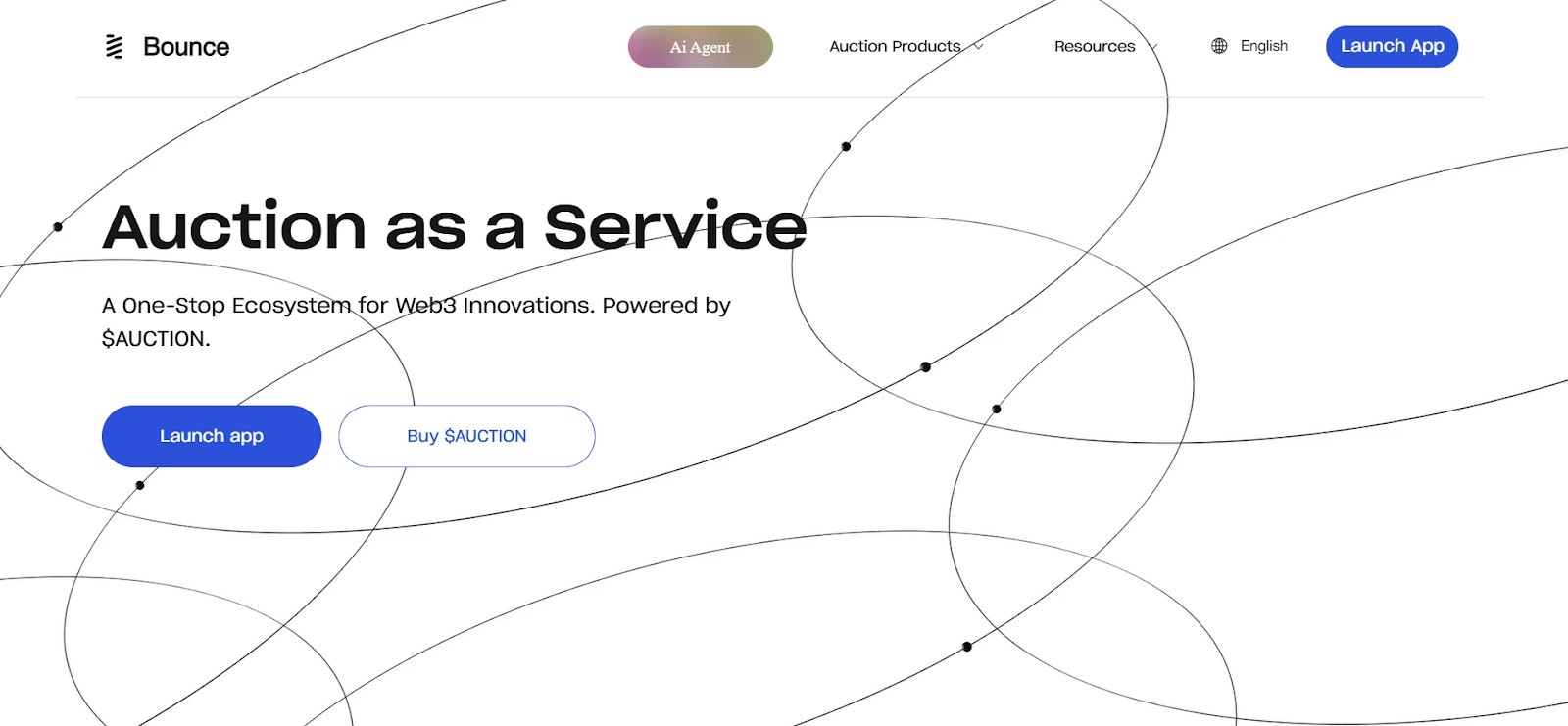
Bounce uses smart contract auctions to manage token sales, giving project teams control over how pricing, bidding, and distribution work. Each project selects the auction type, the supported token, and the participation rules before launch. Once the auction starts, these parameters cannot be changed.
Auction formats
Bounce supports several on-chain auction types designed for different fundraising needs:
Fixed price auctions. Tokens are sold at one set price. This simple model is widely used on the Bounce crypto launchpad.
English auctions. Participants place higher bids over time, and the highest bidder receives the allocation. This competitive format works well with flexible Bounce launchpad tiers.
Dutch auctions. The price starts high and decreases over time. Buyers commit funds whenever they believe the price is fair, a model supported by smart contracts.
Sealed-bid auctions. Users submit private bids. After the bidding window closes, the contract selects winners based on preset logic. This confidential process is a key feature of the Bounce launchpad app.
All auction formats execute entirely on-chain, ensuring transparent and tamper-proof settlement.
Supported networks and tokens
Bounce is multichain and works with networks such as Ethereum, BNB Chain, Arbitrum, and Base. The chosen network determines which wallet users must connect and which payment tokens are available.
Common supported assets include:
AUCTION, Bounce’s native governance token;
USDT, used as a stable-value payment asset;
other ERC-20 tokens, depending on the active network.
How to join a token sale on Bounce launchpad
To join a token sale on the Bounce launchpad, users complete a few steps through the platform’s on-chain interface. Participation is non custodial, and all actions occur directly through smart contracts.
Connect a Web3 wallet
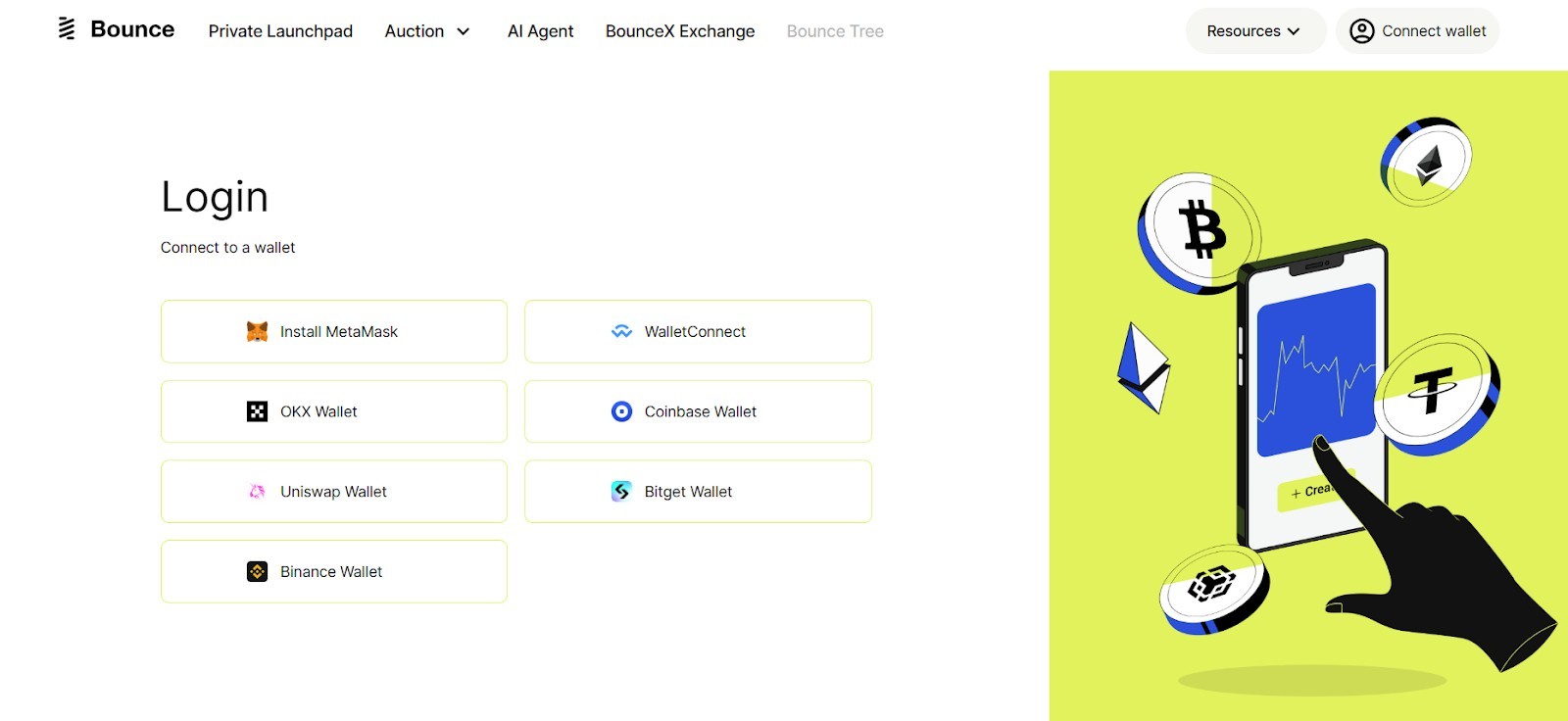
Use a wallet such as MetaMask, WalletConnect, or Coinbase Wallet. The wallet must be set to the same network as the auction, such as Ethereum, BNB Chain, Arbitrum, or Base.
Complete KYC when required
Some sales require identity verification through an external provider. KYC links the wallet address to a verified profile and allows access to restricted auctions inside the launchpad environment.
Choose an active auction
Browse current listings and review details such as auction type, payment token, start and end times, and wallet limits. Listings help users understand the rules before joining any sale through the Bounce launchpad app.
Place a bid or purchase amount
Users commit funds based on the auction format. All bidding, payments, and confirmations take place directly from the connected wallet inside the Bounce ecosystem.
Bounce launchpad rules: participation limits and refunds
All auctions on the Bounce launchpad follow smart contract rules set by the project team before launch. Once an auction begins, these settings cannot be changed, which ensures fairness and transparency for all participants.
General rules
Auction settings are fixed at launch. Teams choose the auction type, pricing logic, duration, and distribution model during setup. After deployment, the contract enforces these rules automatically.
On-chain execution. Every bid, payment, and token transfer happens directly on-chain, a core principle of the Bounce launchpad.
Participation limits
Minimum and maximum amounts per wallet. Each auction sets its own contribution limits. A fixed price sale may allow 100 to 1,000 USDT per wallet, while English or sealed-bid auctions often prioritize higher bids.
Customizable control. These limits help teams manage demand and shape participation, a key feature available through Bounce launchpad’s tiers.
Refund conditions
Automatic refunds when users do not win. In sealed-bid or Dutch auctions, users who are outbid or whose bids do not qualify automatically receive unspent funds back to their wallet.
Handling excess contributions. In fixed price formats, excess payments may be refunded or rejected depending on timing and contract settings.
Distribution logic
Format-based allocation. Tokens are distributed according to the auction type. Fixed price and Dutch auctions rely on timing and price points, while English and sealed-bid auctions reward the highest bidders.
Smart contract settlement. All distribution rules are handled by the contract, ensuring verifiable and consistent results on the Bounce finance launchpad.
How to launch crypto on Bounce launchpad
The Bounce launchpad allows crypto teams to create and run token sales through customizable on-chain auctions. The process is permissionless, giving developers full control over pricing, limits, and distribution. This flexibility is a core part of how the Bounce finance launchpad supports decentralized fundraising.
Requirements for launching a token sale
Project documentation. Teams must prepare a whitepaper or project brief that explains token utility, allocation, and tokenomics. Clear documentation helps build trust, especially when engaging users through the Bounce brand.
Deployed token contract. A verified token contract must already exist on the chosen blockchain. Final supply, decimals, and parameters must be set before creating the auction to ensure smooth operation in the Bounce launchpad ecosystem.
Marketing and community support. Because Bounce does not run promotions, teams must have their own communication channels, community managers, and outreach strategy. Visibility is essential when launching through the Bounce launchpad app.
Auction creation and listing process
Bounce has no mandatory approval step, but teams can request optional listing on the public dashboard for better exposure.
Connect a wallet
Visit the Bounce launchpad, connect a Web3 wallet, and switch to the appropriate network.
Choose an auction type
Click “Create Auction” and select a format such as fixed price, Dutch, sealed bid, or English. This flexibility is a major reason teams choose Bounce launchpad over centralized systems.
Set auction parameters
Define the accepted payment token (such as USDT), auction duration, pricing rules, wallet limits, and total raise amount. These details must align with the project’s tokenomics and launch strategy.
Define the token and extra settings
Enter the token contract details and enable options such as whitelists, KYC enforcement, or vesting if needed. These settings help maintain credibility on the Bounce launchpad.
Deploy the auction
Launch the sale through the smart contract and fund it with the required token amount. Once deployed, the auction cannot be edited, so planning is crucial.
Promote the auction
Share the auction link across your community channels and consider applying for dashboard listing. Successful campaigns often use the Bounce brand to build trust and attract quality participants.
After participating in a Bounce launchpad auction and receiving your tokens, the next step is deciding where to manage or trade them once transfers become available. At this stage, reviewing the best crypto exchanges in your region helps you understand which platforms support those tokens and offer a smooth path after the sale, without affecting how the auction itself works.
| Coinbase | OKX | BTCC | Cryptohopper | Crypto.com | |
|---|---|---|---|---|---|
|
Min. Deposit, $ |
10 | 10 | 10 | No | 1 |
|
Coins Supported |
400+ | 600+ | 399 | 1000 | 400+ |
|
Spot Taker fee, % |
0.5 | 0.1 | 0.3 | 0 | 0.5 |
|
Spot Maker Fee, % |
0.5 | 0.08 | 0.2 | 0 | 0.25 |
|
Alerts |
Yes | Yes | No | Yes | Yes |
|
Copy trading |
No | Yes | Yes | Yes | No |
|
TU overall score |
8.5 | 8.46 | 8.08 | 7.8 | 7.76 |
|
Open an account |
Go to broker Your capital is at risk. |
Go to broker Your capital is at risk. |
Go to broker Your capital is at risk.
|
Go to broker Your capital is at risk. |
Go to broker Your capital is at risk. |
Test everything, time your sale well, and communicate clearly

When I help teams prepare for an IDO on the Bounce launchpad, I always stress that the technical setup must be flawless before deployment. Once the auction goes live, every rule becomes permanent, and even a small mistake in pricing or token amounts cannot be corrected. I test the contract in a public testnet and ask another developer to review the auction settings. A second set of eyes often catches issues the team missed, and this extra step can prevent serious losses.
I also look closely at timing and token structure. Participants on the Bounce finance launchpad are usually experienced and pay attention to details. If the vesting schedule is unclear or the auction is timed poorly, they will simply skip the sale. A controlled release strategy, such as starting with a whitelist group, often helps build credibility and filters out low-quality traffic. Clear communication, transparent tokenomics, and consistent updates make a stronger impression than aggressive marketing.
Conclusion
Bounce launchpad empowers crypto projects with truly decentralized and customizable token sales through on-chain smart contract auctions. By supporting multiple auction formats such as fixed price, Dutch, English, and sealed bid, it offers unparalleled flexibility and control compared to centralized alternatives like Binance launchpad. For instance, teams can set unique participation caps or require whitelists, and users join directly with their Web3 wallet in a transparent process. Ultimately, the power of Bounce lies in its emphasis on transparency, autonomy, and rigorous preparation, making it a top choice for projects seeking a flexible yet secure path to fundraising.
FAQs
What types of auction formats can project teams choose on the Bounce Crypto Launchpad?
How does participant KYC work on the Bounce Crypto Launchpad?
Are auction parameters on the Bounce Crypto Launchpad changeable after launch?
What steps should teams take to ensure a smooth token launch on Bounce Crypto Launchpad?
Editors' Top Picks and Insights





Related Articles
Team that worked on the article
Aleksandra Chaikina has been a contributor to Traders Union since 2021. With over 15 years of experience in copywriting and more than 5 years focused on financial content, she specializes in producing detailed guides, analytics, and comparative reviews across various sectors, including cryptocurrencies, Forex, investment strategies, and financial technologies.
Dan Blystone began his trading career in 1998 as an arbitrage clerk on the floor of the Chicago Mercantile Exchange (CME). He later traded bond and Eurex futures at proprietary firms such as Altea Trading, gaining valuable experience in high-frequency trading and risk management.
Chinmay Soni is a financial analyst with more than 5 years of experience in working with stocks, Forex, derivatives, and other assets. As a founder of a boutique research firm and an active researcher, he covers various industries and fields, providing insights backed by statistical data.
Xetra is a German Stock Exchange trading system that the Frankfurt Stock Exchange operates. Deutsche Börse is the parent company of the Frankfurt Stock Exchange.
Copy trading is an investing tactic where traders replicate the trading strategies of more experienced traders, automatically mirroring their trades in their own accounts to potentially achieve similar results.
Risk management is a risk management model that involves controlling potential losses while maximizing profits. The main risk management tools are stop loss, take profit, calculation of position volume taking into account leverage and pip value.
CFD is a contract between an investor/trader and seller that demonstrates that the trader will need to pay the price difference between the current value of the asset and its value at the time of contract to the seller.
Index in trading is the measure of the performance of a group of stocks, which can include the assets and securities in it.

-
 Afghanistan
-
 Albania
-
 Algeria
-
 Angola
-
 Argentina
-
 Armenia
-
 Australia
-
 Austria
-
 Azerbaijan
-
 Bahamas
-
 Bahrain
-
 Bangladesh
-
 Belarus
-
 Belgium
-
 Bolivia
-
 Botswana
-
 Brazil
-
 Brunei
-
 Bulgaria
-
 Cambodia
-
 Cameroon
-
 Canada
-
 Chile
Chile
-
 China
China
-
 Colombia
-
 Congo
Congo
-
 Costa Rica
-
 Cote d'Ivoire
-
 Croatia
-
 Cuba
Cuba
-
 Cyprus
-
 Czechia
-
 DR Congo
-
 Denmark
-
 Dominican Republic
-
 Ecuador
-
 Egypt
Egypt
-
 El Salvador
-
 Estonia
-
 Eswatini
-
 Ethiopia
-
 Finland
-
 France
-
 Georgia
-
 Germany
-
 Ghana
Ghana
-
 Greece
-
 Haiti
Haiti
-
 Hong Kong
-
 Hungary
-
 India
India
-
 Indonesia
-
 Iran, Islamic republic
-
 Iraq
Iraq
-
 Ireland
-
 Israel
-
 Italy
Italy
-
 Jamaica
-
 Japan
Japan
-
 Jordan
-
 Kazakhstan
-
 Kenya
Kenya
-
 Korea
Korea
-
 Kuwait
-
 Kyrgyzstan
-
 Laos
Laos
-
 Latvia
-
 Lebanon
-
 Lesotho
-
 Libya
Libya
-
 Lithuania
-
 Luxembourg
-
 Madagascar
-
 Malaysia
-
 Malta
Malta
-
 Mauritius
-
 Mexico
-
 Moldova
-
 Mongolia
-
 Montenegro
-
 Morocco
-
 Mozambique
-
 Myanmar
-
 Namibia
-
 Nepal
Nepal
-
 Netherlands
-
 New Zealand
-
 Nigeria
-
 North Macedonia
-
 Norway
-
 Oman
Oman
-
 Pakistan
-
 Palestine
-
 Panama
-
 Papua New Guinea
-
 Paraguay
-
 Peru
Peru
-
 Philippines
-
 Poland
-
 Portugal
-
 Puerto Rico
-
 Qatar
Qatar
-
 Reunion
-
 Romania
-
 Rwanda
-
 Saudi Arabia
-
 Serbia
-
 Singapore
-
 Slovakia
-
 Slovenia
-
 Somalia
-
 South Africa
-
 Spain
Spain
-
 Sri Lanka
-
 Sweden
-
 Switzerland
-
 Syria
Syria
-
 Taiwan
-
 Tajikistan
-
 Tanzania
-
 Thailand
-
 Trinidad and Tobago
-
 Tunisia
-
 Turkey
-
 UAE
UAE
-
 Uganda
-
 Ukraine
-
 United Kingdom
-
United States
-
 Uruguay
-
 Uzbekistan
-
 Venezuela
-
 Vietnam
-
 Yemen
Yemen
-
 Zambia
-
 Zimbabwe
- Forex
- Crypto












