
6 Best Stock Brokers For Beginners

Editorial Note: While we adhere to strict Editorial Integrity, this post may contain references to products from our partners. Here's an explanation for How We Make Money. None of the data and information on this webpage constitutes investment advice according to our Disclaimer.
Best stock brokers for beginners:
- eToro USA - A broker for U.S. investors licensed by the SEC and FINRA, offering access to trading stocks, ETFs, options, and cryptocurrencies, including CopyTrader.
- SpeedTrader - Broker focused on day-trading with 4500+ ticker short list and 25+ routes
- Plus500 - Multi regulated broker, including CySEC, FCA, ASIC, and others, with more than 2,800 instruments, stock trading through Plus500 Invest, and CFDs on global markets.
- TradeZero International - U.S. equities trading with commission-free orders, leverage up to 1:6
- eOption - Zero-fee stock trading, no minimum deposit requirements for U.S. traders
As a stock trader or investor, choosing the right online stock brokerage is a very challenging decision. The market is filled with tons of options, and choosing the one that meets your financial needs can be very daunting. You need to make sure that the online broker that you choose not only offers a great trading environment but must also be fully regulated. It'll allow you to manage your investment in the best possible way. Moreover, it'll also help you to keep your assets and capital secure in case of any misconduct from the brokerage.
Top 6 Best Brokers to Start Stock Trading
Here’s our list of the best stock trading brokers that you can use in 2026.
| eToro USA | SpeedTrader | Plus500 | TradeZero International | eOption | Revolut | |
|---|---|---|---|---|---|---|
|
Demo |
Yes | Yes | Yes | Yes | Yes | No |
|
Account min. |
50 | 2,500 | 500 | 500 | No | No |
|
Signals |
Yes | Yes | Yes | Yes | Yes | Yes |
|
Research and data |
Yes | Yes | Yes | Yes | Yes | Yes |
|
Basic stock/ETF fee |
No | $0.0025/$0,0009 | $0.006 | $0,005 | $0 | 0.12%-0.25% |
|
Min. stock/ETF fee |
No | $0 | Not specified | $0.99 | $0 | £1.00/€1.00 |
|
Open an account |
Go to broker Your capital is at risk. |
Go to broker |
Go to broker 81% of retail CFD accounts lose money. |
Go to broker Your capital is at risk. |
Study review | Study review |






What Are Usual Stock Trading Costs?
Some online stockbrokers that are available in the market charge commission on performing stock trading. Here’s a list of the most common expenses that, as a trader, you might need to pay.
Annual Fee
Some brokers charge an annual fee which typically costs somewhere between 50 to 75 US dollars. But you can avoid that by choosing the platform that doesn’t charge an annual fee.
Inactivity Fee
Different online brokers who charge inactivity fees have different criteria that can be based on yearly, quarterly, or even monthly cycles. Typically, it can cost you about 10 to 200 US dollars. Except for Interactive brokers, all the other online trading platforms that we mentioned don’t charge an inactivity fee.
Trading Platform Fee
Most online brokers offer more than one trading platform with unique and advanced features. You’ll need to pay a fee to use those platforms, such as Thinkorswim by TD Ameritrade. These specialized platforms can cost you around 50 to over 200 US dollars monthly.
Data Subscriptions and Research
Many online brokers offer paid subscriptions to access experts’ analyses and research data that can cost you 1 to 30 US dollars per month. However, many online brokers offer these features for free, and we recommend you choose the broker with free educational and research material.
Paper Statement Charges
Online brokers offer paper statement services that allow you to receive your financial statement monthly. It typically costs 1 to 2 US dollars on each statement. It’s not advisable to use this service in this era of technology because you can always choose a free email service.
Transfer or Account Closing Fee
Most online brokers charge a fee to close your trading account or on transfer which is typically somewhere between 50 to 75 US dollars.
Important Considerations
As you can see that most of the fees can be avoided or minimized by choosing the right brokerage. But it’s important to note that your primary concern must be the trading environment that a broker offers that must suit your investing and trading style.
You can find all the information on the official websites that brokers offer regarding every type of fee. You can also contact customer services to find out everything you need to know about the brokers’ fee structure. Moreover, a great strategy is to acquire the demo account that almost all the renowned brokers offer. This way, you’ll be able to analyze all the features and tools that a broker offers without risking your real money.
How Much Can I Earn?
The only thing that’s certain in trading is that your profits can never be guaranteed. The ROI (Return on Investment) depends upon multiple factors such as your trading strategy, the performance of the underlying asset, market volatility, and more. Moreover, active investment and trading can help you to increase your profit. But at the same time, this strategy also increases the risk factor that you’ll need to minimize by devising a comprehensive risk management strategy.
According to one of the most successful and iconic investors of all time, Warren Buffett, index investing by ETF can be a better option for unprofessional investors. Moreover, he says that beginners should consider investing and trading low-cost index funds. It might sound a little intimidating, but the fact of the matter is that index funds are only a stock basket that basically represents a broad market. For example, investing in S&P 500 index fund means that you’ve bought a little part of the biggest 500 US companies which are traded publicly. In other words, it automatically mitigates the overall risk and diversifies your investments.
Here’s a list of the stock indices and most popular shares with one year and average 10-year returns.
| Stocks | 1-year performance | 10-year performance | Risk level |
|---|---|---|---|
S&P 500 Index | 40.25 percent | 14.26 percent | Average |
Nasdaq Index | 41.65 percent | 19.02 percent | Average |
FTSE 100 Index | 17.71 percent | 4.40 percent | Average |
Apple (AAPL) shares | 46.85 percent | 28.09 percent | High |
Microsoft (MSFT) shares | 33.38 percent | 27.67 percent | High |
Tesla (TSLA) shares | 240.71 percent | 61.66 percent | High |
Amazon (AMZN) shares | 23.48 percent | 33.26 percent | High |
How to Buy Stocks Online. A Beginner's Guide
If buying stocks is intimidating for you and you find it difficult, then consider following the step-by-step guide that we have prepared below.
Step One: Choose the Online Stock Broker
The first and the obvious step that you need to take in order to start your stock buying journey is to choose the right online stock brokerage. It’s the easiest way to buy stocks because other options such as directly buying shares from the company or using a full-service stockbroker can be very cumbersome. Webull is one of the best available options, and we'll use that for our example.
Step Two: Open Your Brokerage Account
The next step after choosing the online broker is to open your trading account. Webull offers a completely free signing up process without any hidden charges or any other catch. You can open your Webull account by going to its official website. Moreover, the brokerage also allows you to claim popular stocks such as SBUX, FB, GOOG, and more if you open your account by depositing 100 US dollars.
Step Three: Practice Stock Trading
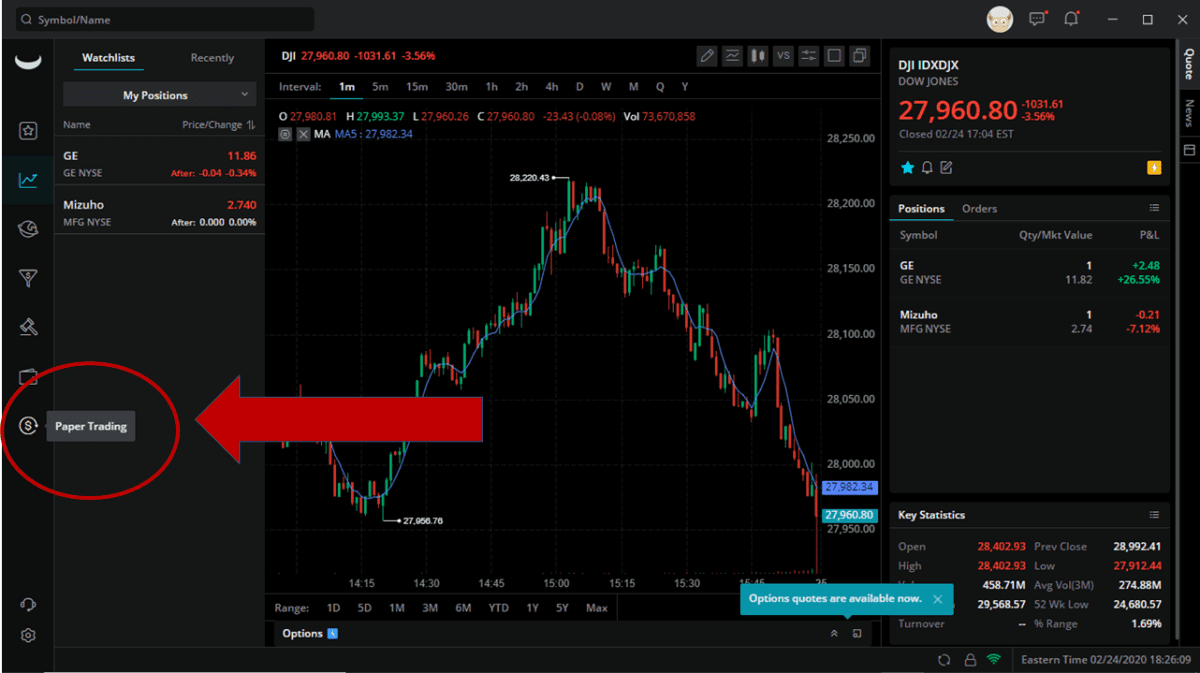
It’s one of the best features that Webull offers, where you can practice the complete trading lifecycle without involving real money. Once your account is set up, you’ll need to open it and click on the “Paper Trading” option (icon with a dollar sign), as shown in the image below.
 Webull Platform
Step Four: Setup Your Trading Account Size
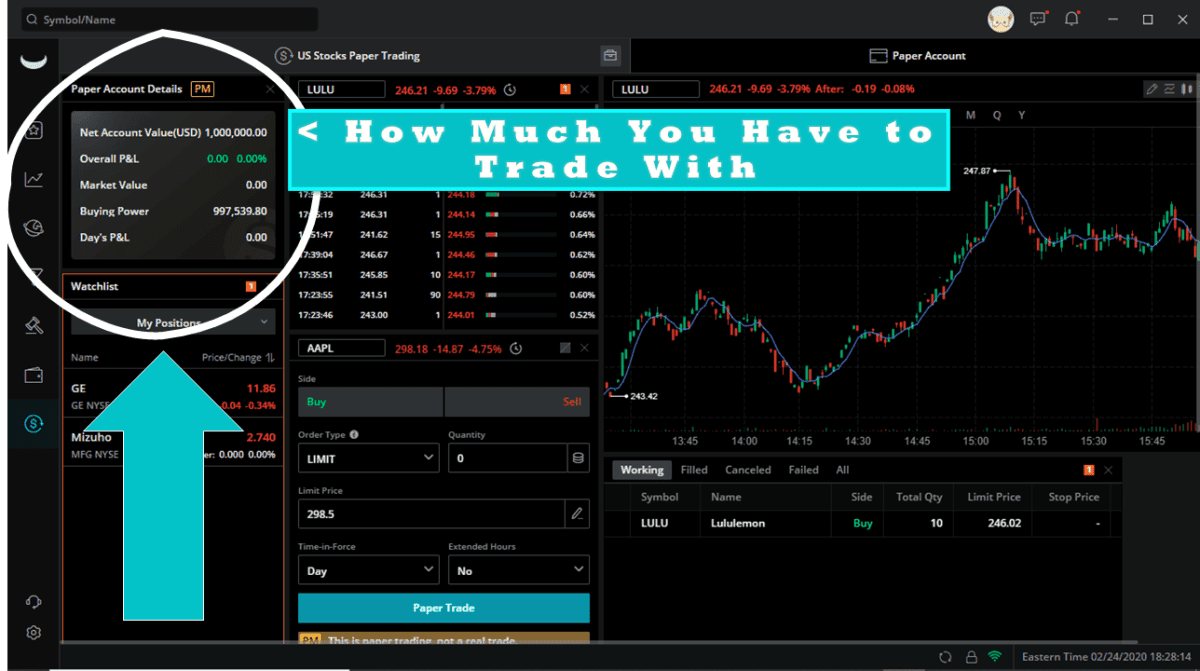
The paper trade option provides you with one million US dollars (dummy data) to test your stock trading skills. We recommend you not to utilize all of it and choose the decent amount that you feel is best. Moreover, it's advisable to use the dummy capital to trade the stocks that you'd actually take into account while trading with real money. In order to set your trading account size, you'll need to click on the "Reset" option. It'll allow you to set the amount that you want to use to start trading.
 Webull Trading Account
 Step Five: Create a Watchlist
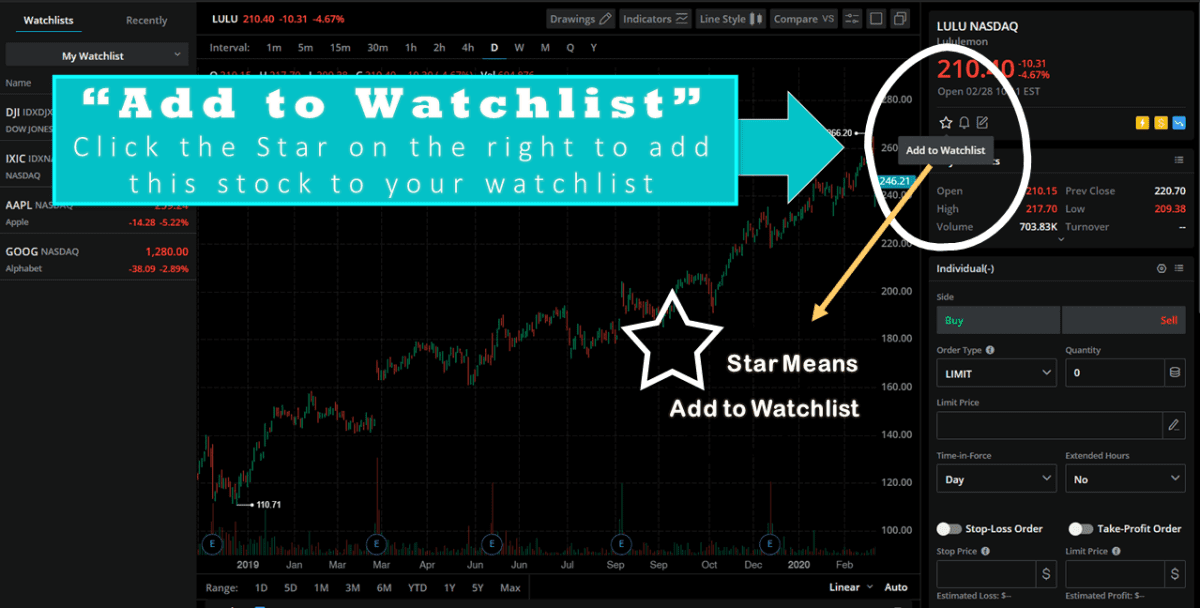
Webull offers all the major stocks such as Apple, Microsoft, Amazon, Tesla, and more. Creating a watchlist of the stocks you're interested in comes in handy to follow their market performance.
In order to find a certain stock, you’ll need to search it by writing its name in the search bar available in the top right corner. Then you’ll need to click on the “Star” icon available on the right side.
 Webull’s Watchlist
Step Six: Buy Stocks
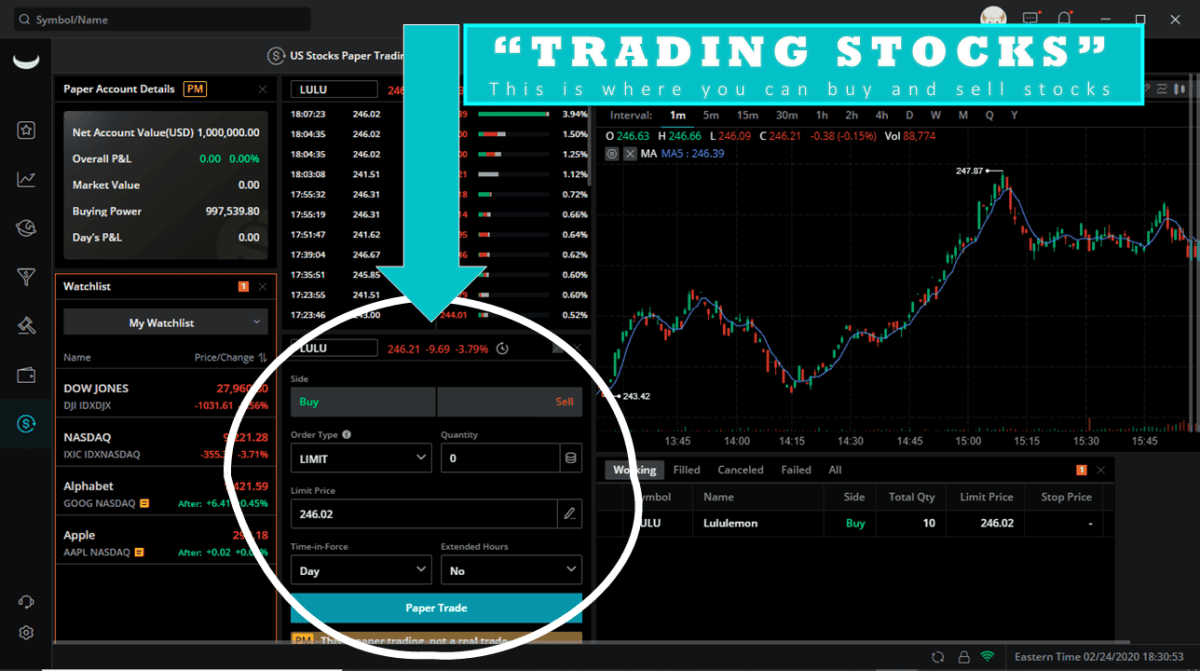
You can easily buy the stock by clicking on the buy button once it has reached the price point that you provided to the system.
 Buying Stocks in Webull
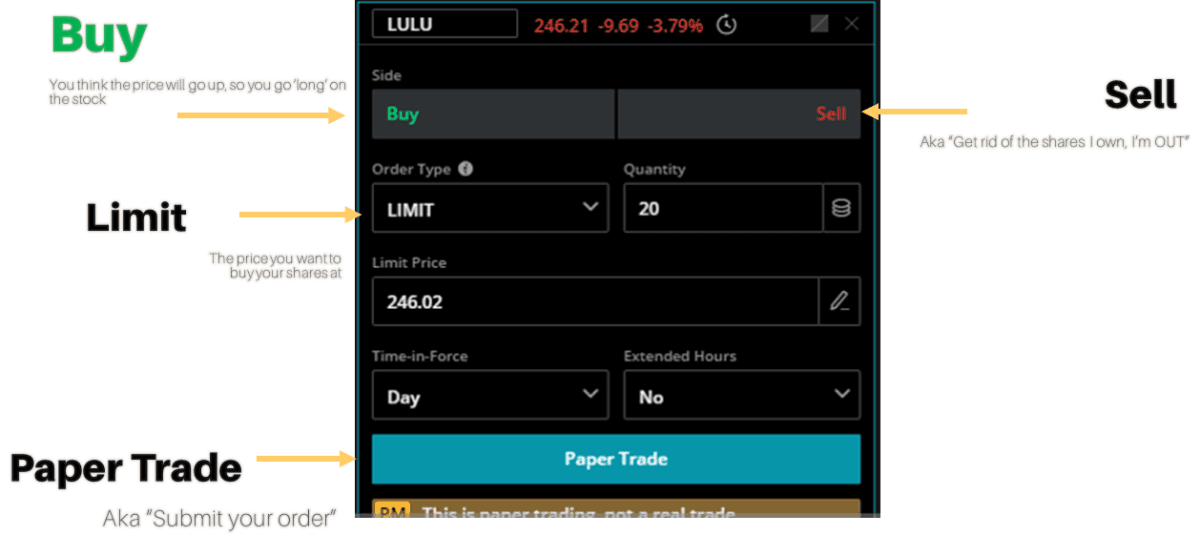 Buying Stocks in Webull
After that, you’ll need to follow the charts regularly in order to find out the stock’s market performance. You can also learn about the history of your selected stock whenever you want by using the intervals.
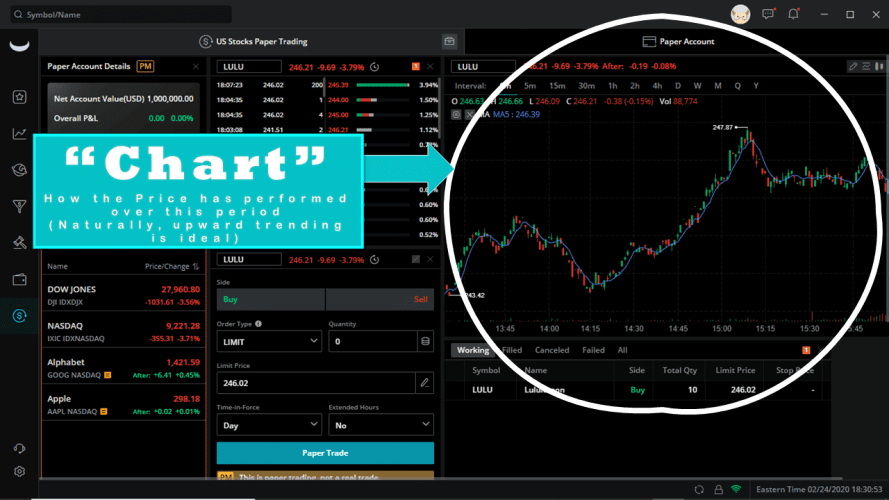 Webull’s Trading Chart
 A good broker should feel like a reliable infrastructure partner
The biggest mistake people make when choosing their first stock broker is focusing only on rankings or marketing promises instead of long-term suitability. A good broker should feel like a reliable infrastructure partner, not just a place to place trades. When I advise new traders, I always stress the importance of transparency, stability, and ease of use. If the platform is confusing, the fee structure unclear, or the reporting hard to understand, it will inevitably lead to emotional decisions and costly mistakes.
I’ve seen many beginners perform better not because they had superior strategies, but because they chose a broker that encouraged disciplined behavior: clear order execution, realistic risk tools, and access to learning resources that actually explain market mechanics instead of pushing constant trading. Early on, your goal shouldn’t be to maximize returns, but to survive market cycles while building experience. A broker that supports demo trading, gradual capital deployment, and straightforward portfolio tracking makes that process far less stressful.
From a financial expert’s perspective, regulation is not just a formal checkbox – it directly affects how disputes are handled, how client funds are segregated, and how protected you are in worst-case scenarios. Over the years, I’ve learned that peace of mind is an underrated asset in investing. When you trust the environment you’re trading in, you’re far more likely to stick to your plan, avoid overtrading, and think in years rather than weeks. That mindset, combined with a well-chosen broker, is what truly sets beginners up for sustainable growth.
Methodology for compiling our ratings of stock brokers
Traders Union applies a rigorous methodology to evaluate brokers using over 100 quantitative and qualitative criteria. Multiple parameters are given individual scores that feed into an overall rating.
Key aspects of the assessment include:
-
Regulation and safety. Brokers are evaluated based on the level/reputation of licenses and regulations they operate under.
-
User reviews. Client reviews and feedback are analyzed to determine customer satisfaction levels. Reviews are fact-checked and verified.
-
Trading instruments. Brokers are evaluated on the range of assets offered, as well as the breadth and depth of available markets.
-
Fees and commissions. All trading fees and commissions are analyzed comprehensively to determine overall costs for clients.
-
Trading platforms. Brokers are assessed based on the variety, quality, and features of platforms offered to clients.
-
Other factors like brand popularity, client support, and educational resources are also evaluated.
Conclusion
Choosing the right stock broker is a crucial first step for beginners entering the world of investing. The article highlights that platforms with low fees and intuitive interfaces, such as E*TRADE and Fidelity, are especially well-suited for new investors seeking confidence and convenience. The most powerful takeaway is that a broker’s value goes beyond commissions, encompassing educational resources, customer support, and user-friendly tools that help novices build strong investment habits. Ultimately, the right choice empowers beginners to focus on growth and learning rather than navigating complex, costly platforms. Remember: your journey in investing starts with the support and simplicity your broker provides.
FAQs
What features should beginners look for in a stock broker platform?
How can using a demo account benefit new investors before trading real money?
What types of fees can be avoided when choosing a stock broker?
Why is it important for beginners to consider their investing and trading style when selecting a broker?
Editors' Top Picks and Insights






Related Articles
Team that worked on the article
Andrey Mastykin is an experienced author, editor, and content strategist who has been with Traders Union since 2020. As an editor, he is meticulous about fact-checking and ensuring the accuracy of all information published on the Traders Union platform.

Dr. BJ Johnson is a PhD in English Language and an editor with over 15 years of experience. He earned his degree in English Language in the U.S and the UK.
Bitcoin is a decentralized digital cryptocurrency that was created in 2009 by an anonymous individual or group using the pseudonym Satoshi Nakamoto. It operates on a technology called blockchain, which is a distributed ledger that records all transactions across a network of computers.
Risk management is a risk management model that involves controlling potential losses while maximizing profits. The main risk management tools are stop loss, take profit, calculation of position volume taking into account leverage and pip value.
Paper trading, also known as virtual trading or simulated trading, is a practice where individuals or traders simulate real-life trading scenarios without using real money. Instead of placing actual trades with real capital, participants use a simulated trading platform or keep track of their trades on paper or electronically to record their buying and selling decisions.
Overtrading is a phenomenon where a trader executes too many transactions in the market, surpassing their strategy and trading more frequently than planned. It's a common mistake that can lead to financial losses.
Index in trading is the measure of the performance of a group of stocks, which can include the assets and securities in it.

-
 Afghanistan
-
 Albania
-
 Algeria
-
 Angola
-
 Argentina
-
 Armenia
-
 Australia
-
 Austria
-
 Azerbaijan
-
 Bahamas
-
 Bahrain
-
 Bangladesh
-
 Belarus
-
 Belgium
-
 Bolivia
-
 Botswana
-
 Brazil
-
 Brunei
-
 Bulgaria
-
 Cambodia
-
 Cameroon
-
 Canada
-
 Chile
Chile
-
 China
China
-
 Colombia
-
 Congo
Congo
-
 Costa Rica
-
 Cote d'Ivoire
-
 Croatia
-
 Cuba
Cuba
-
 Cyprus
-
 Czechia
-
 DR Congo
-
 Denmark
-
 Dominican Republic
-
 Ecuador
-
 Egypt
Egypt
-
 El Salvador
-
 Estonia
-
 Eswatini
-
 Ethiopia
-
 Finland
-
 France
-
 Georgia
-
 Germany
-
 Ghana
Ghana
-
 Greece
-
 Haiti
Haiti
-
 Hong Kong
-
 Hungary
-
 India
India
-
 Indonesia
-
 Iran, Islamic republic
-
 Iraq
Iraq
-
 Ireland
-
 Israel
-
 Italy
Italy
-
 Jamaica
-
 Japan
Japan
-
 Jordan
-
 Kazakhstan
-
 Kenya
Kenya
-
 Korea
Korea
-
 Kuwait
-
 Kyrgyzstan
-
 Laos
Laos
-
 Latvia
-
 Lebanon
-
 Lesotho
-
 Libya
Libya
-
 Lithuania
-
 Luxembourg
-
 Madagascar
-
 Malaysia
-
 Malta
Malta
-
 Mauritius
-
 Mexico
-
 Moldova
-
 Mongolia
-
 Montenegro
-
 Morocco
-
 Mozambique
-
 Myanmar
-
 Namibia
-
 Nepal
Nepal
-
 Netherlands
-
 New Zealand
-
 Nigeria
-
 North Macedonia
-
 Norway
-
 Oman
Oman
-
 Pakistan
-
 Palestine
-
 Panama
-
 Papua New Guinea
-
 Paraguay
-
 Peru
Peru
-
 Philippines
-
 Poland
-
 Portugal
-
 Puerto Rico
-
 Qatar
Qatar
-
 Reunion
-
 Romania
-
 Rwanda
-
 Saudi Arabia
-
 Serbia
-
 Singapore
-
 Slovakia
-
 Slovenia
-
 Somalia
-
 South Africa
-
 Spain
Spain
-
 Sri Lanka
-
 Sweden
-
 Switzerland
-
 Syria
Syria
-
 Taiwan
-
 Tajikistan
-
 Tanzania
-
 Thailand
-
 Trinidad and Tobago
-
 Tunisia
-
 Turkey
-
 UAE
UAE
-
 Uganda
-
 Ukraine
-
 United Kingdom
-
United States
-
 Uruguay
-
 Uzbekistan
-
 Venezuela
-
 Vietnam
-
 Yemen
Yemen
-
 Zambia
-
 Zimbabwe
- Forex
- Crypto











