
Top Crypto Whale Trading Strategies


Editorial Note: While we adhere to strict Editorial Integrity, this post may contain references to products from our partners. Here's an explanation for How We Make Money. None of the data and information on this webpage constitutes investment advice according to our Disclaimer.
Top crypto whale trading strategies:
Bitcoin Whale Buy-the-Dip Strategy — buy during market corrections when whale accumulation and declining exchange reserves confirm institutional demand.
Whale Scoop Trading Strategy — track gradual whale accumulation through repeated large transfers and falling exchange balances.
Whale Pattern Trading — combine on-chain whale activity with technical analysis to identify recurring accumulation and distribution patterns.
Whale Trading Algorithm — use automated on-chain analytics to monitor large wallets, exchange flows, and market liquidity in real time.
Multi-Signal Whale Trading Strategy — confirm trades by combining whale activity with technical indicators, volume, and broader market trends.
The cryptocurrency market is heavily influenced by large investors known as crypto whales. A single transaction involving thousands of BTC or millions of USDT can trigger significant price movements, affect market sentiment, and create trading opportunities. While retail traders often focus on technical indicators alone, experienced market participants increasingly combine chart analysis with whale tracking to better understand where institutional money is flowing.
In this guide, we'll explain how whale trading works, discuss the most effective crypto whale trading strategies used to follow smart money, and review the tools that help identify meaningful whale activity.
Top crypto whale trading strategies
1. Bitcoin whale buy-the-dip strategy
The bitcoin whale buy-the-dip strategy is perhaps the most widely observed behavior among long-term Bitcoin holders.
Instead of chasing rallies, whales often increase their exposure during sharp corrections when market sentiment is extremely negative. Historical blockchain data has repeatedly shown periods where large wallets accumulated BTC while retail investors exited positions.
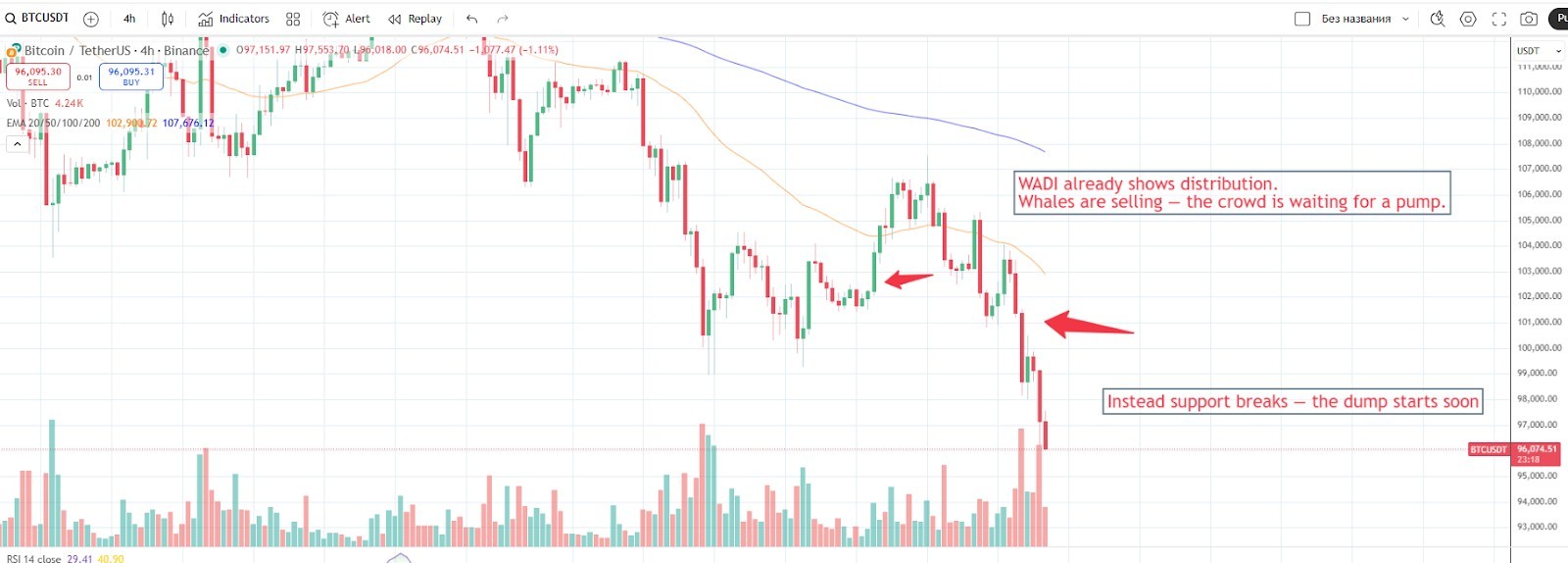
Retail traders can apply this concept by looking for confirmation through:
declining exchange reserves;
increasing wallet accumulation;
stabilizing price action after major corrections;
improving volume profiles.
Rather than buying every dip, the strategy focuses on identifying corrections supported by institutional accumulation.
2. Whale scoop trading strategy
The whale scoop trading strategy describes situations where large investors gradually purchase available liquidity without creating dramatic price spikes.
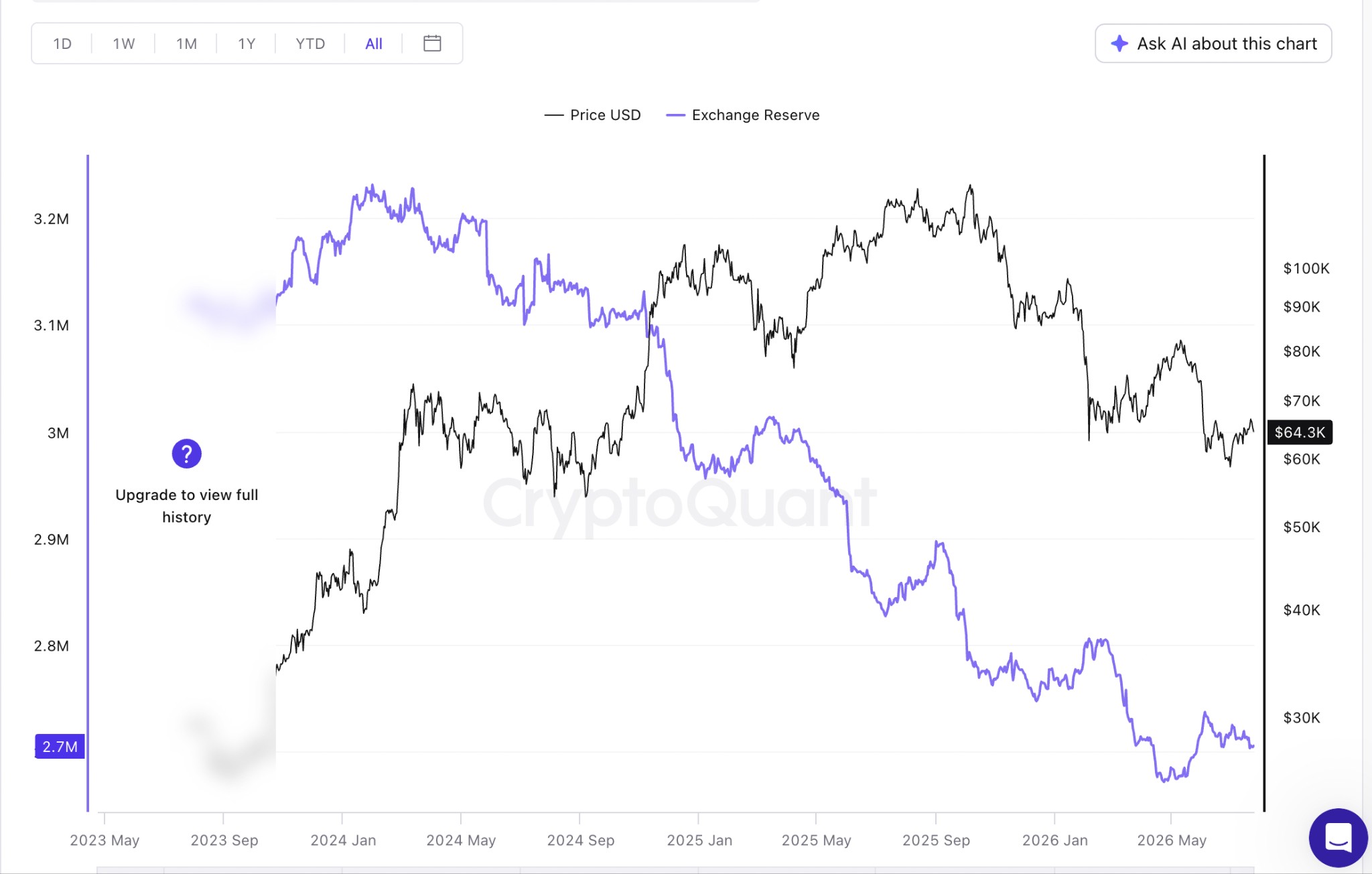
Instead of one massive market order, accumulation is spread across multiple transactions over time. This approach reduces slippage while allowing whales to build significant positions.
Typical signs include:
repeated large transfers to cold wallets;
stable price despite heavy buying;
decreasing exchange balances;
increasing long-term holder supply.
Because these movements happen quietly, traders often identify them only through blockchain analytics rather than price charts alone.
3. Whale pattern trading
Many traders practice whale pattern trading, which combines on-chain data with technical analysis.
Instead of reacting to every large transaction, they look for recurring patterns such as:
accumulation during prolonged consolidation;
increased exchange inflows near resistance;
synchronized movements across several large wallets;
repeated buying after liquidation cascades.

Pattern recognition helps filter out random transactions and focus on consistent market behavior.
4. Whale trading algorithm
Professional funds increasingly rely on automated monitoring systems, often described as a whale trading algorithm.
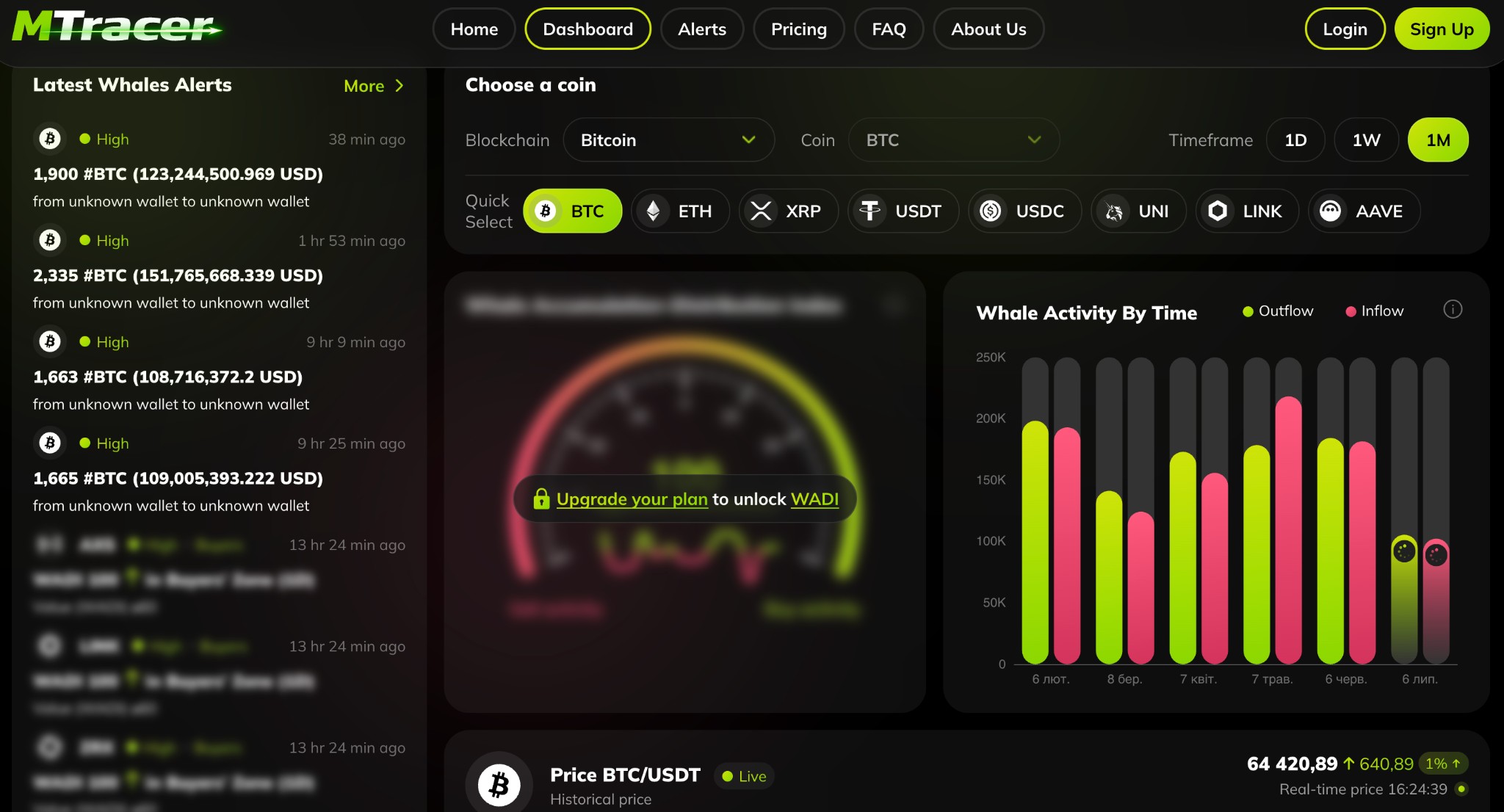
These systems continuously analyze:
blockchain transactions;
wallet balances;
exchange reserves;
derivatives positioning;
funding rates;
liquidity changes.
Retail traders rarely have access to institutional infrastructure, but many analytics platforms provide similar alerts that simplify whale monitoring.
5. Multi-signal whale trading strategy
The most effective whale trading strategy combines several independent signals instead of relying on blockchain data alone.
For example:
whale accumulation;
decreasing exchange reserves;
bullish technical breakout;
rising spot volume;
positive macroeconomic environment.
When multiple indicators align, confidence in the trade increases substantially. This multi-factor approach represents one of the most practical cryptocurrency whale trading strategies, as it reduces the risk of acting on misleading wallet transfers.
What is a crypto whale?
A crypto whale is an individual, institution, fund, or organization that owns enough cryptocurrency to influence market liquidity. While there is no universal definition, Bitcoin addresses holding more than 1,000 BTC are generally considered whales.
Large holders affect markets in several ways:
placing large buy or sell orders;
moving assets between private wallets and exchanges;
accumulating during market fear;
distributing positions near market tops.
These activities form the basis of many whale strategy approaches used by traders today. Instead of trying to predict every price movement, investors analyze whale behavior to identify periods of accumulation, distribution, and changing market sentiment.
Not every large transaction signals an upcoming rally or crash. Many transfers are internal wallet movements or over-the-counter (OTC) settlements that never reach public order books. This is why successful crypto whale strategy methods always combine blockchain data with broader market analysis.
Why whale activity matters for bitcoin price
Bitcoin remains the benchmark for the entire cryptocurrency market. Consequently, bitcoin whale strategy analysis often provides insights not only into BTC but also into broader market trends.
There are several reasons why whales have such a strong influence.
Accumulation. During bearish markets or corrections, whales frequently accumulate Bitcoin while retail investors are selling. Large withdrawals from exchanges into private wallets often indicate long-term holding intentions and reduced selling pressure.
Distribution. When significant amounts of BTC move onto centralized exchanges, traders pay close attention. Exchange inflows may indicate that large holders are preparing to sell, although context always matters.
Liquidity management. Whales frequently exploit periods of low liquidity to execute large orders with minimal market impact. These movements can create rapid price swings that smaller traders interpret as trend reversals.
Understanding these patterns helps explain the relationship between crypto whale strategies bitcoin price dynamics. Whale behavior does not determine price on its own, but it often reflects changing market confidence before trends become obvious.
Best tools to track crypto whales
Monitoring whale activity has become much easier thanks to specialized blockchain analytics platforms.
MTracer
While many blockchain explorers simply display raw transaction data, platforms such as MTracer aim to transform whale movements into actionable market insights.
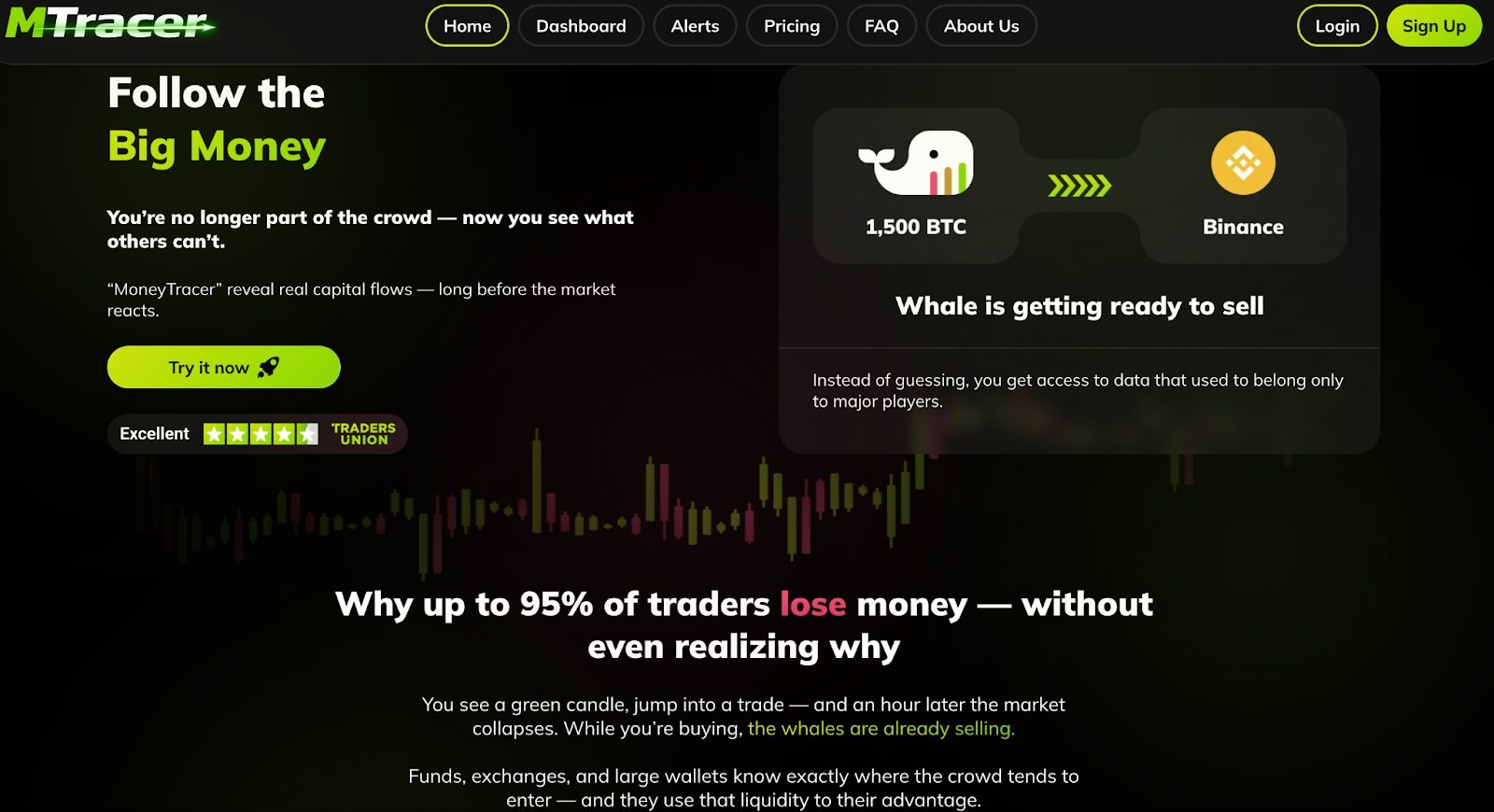
MTracer tracks large wallet activity, exchange inflows and outflows, and market behavior through proprietary indicators such as the Whale Accumulation Distribution Index (WADI). This allows traders to evaluate whether large investors are accumulating or distributing assets instead of reacting to isolated transfers.
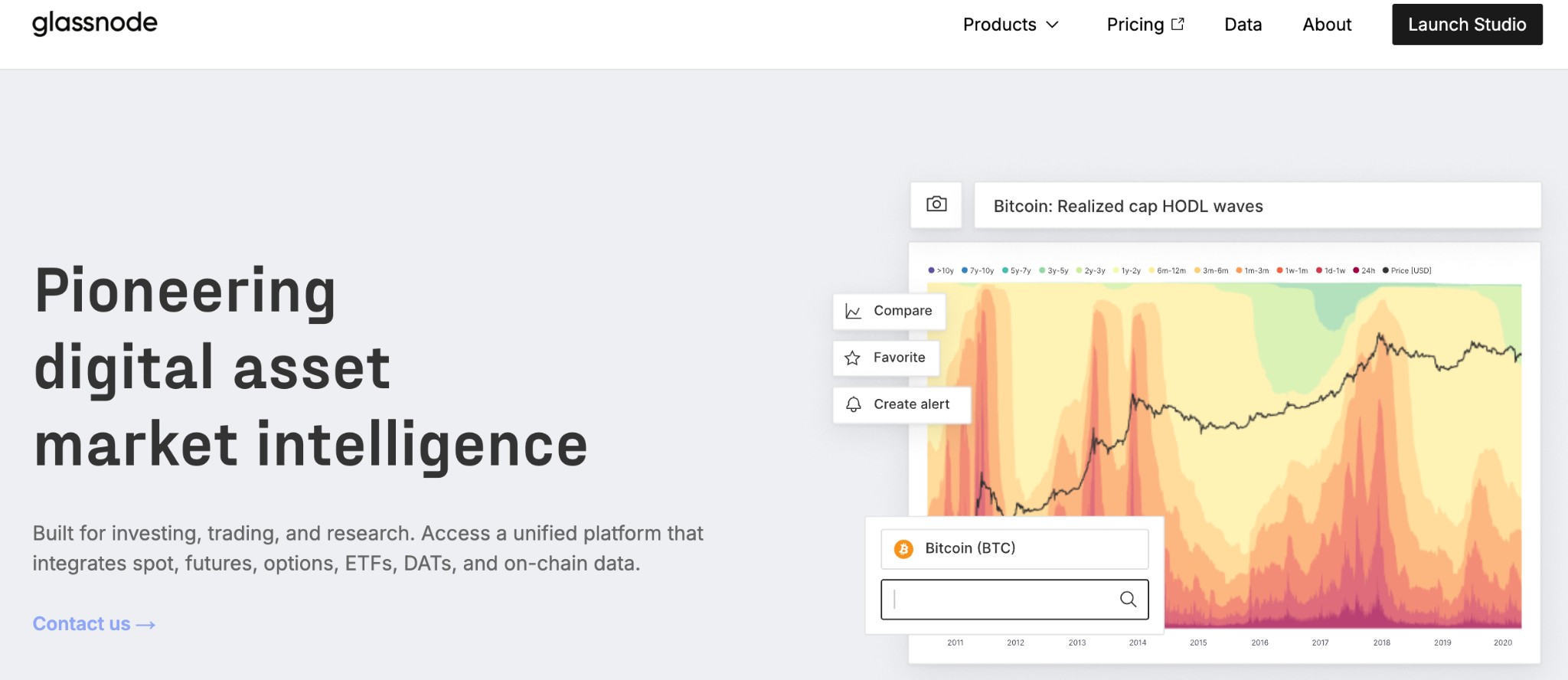
Glassnode
Glassnode provides institutional-grade on-chain metrics, including exchange balances, long-term holder supply, realized price, and accumulation trends.
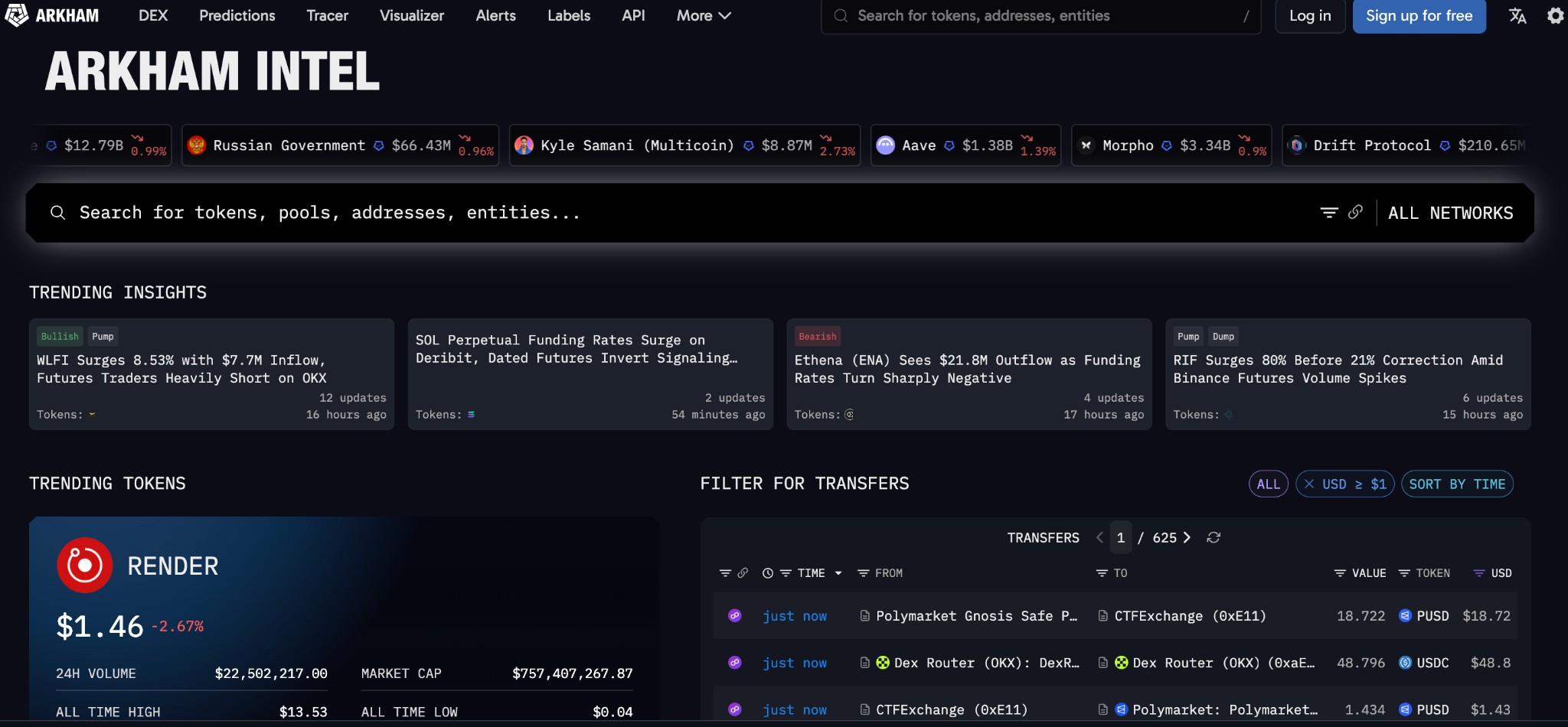
Arkham Intelligence
Arkham focuses on wallet identification and entity tracking, helping users understand who controls major blockchain addresses.
Tracking whale activity is only part of the process. Once a high-probability setup is confirmed, execution quality becomes equally important. Choosing a crypto exchange with deep liquidity, competitive trading fees, and reliable order execution can significantly improve trade outcomes. The platforms below are among the most popular choices for traders following whale-driven market opportunities.
| Coinbase | Kraken | OKX | BTCC | Crypto.com | |
|---|---|---|---|---|---|
|
Min. Deposit, $ |
10 | 10 | 10 | 10 | 1 |
|
Supported cryptocurrencies |
400+ | 400+ | 600+ | 399 | 400+ |
|
Copy trading |
No | Yes | Yes | Yes | No |
|
Staking |
Yes | Yes | Yes | Yes | Yes |
|
Yield farming |
Yes | Yes | Yes | No | Yes |
|
NFT |
Yes | Yes | Yes | Yes | Yes |
|
Spot trading |
Yes | Yes | Yes | Yes | Yes |
|
Open an account |
Go to broker Your capital is at risk. |
Go to broker Your capital is at risk. |
Go to broker Your capital is at risk. |
Go to broker Your capital is at risk.
|
Go to broker Your capital is at risk. |
Common mistakes when following whales
Whale tracking is valuable, but many traders misuse it. The most common mistakes include:
Following every large transaction. Not every wallet transfer represents buying or selling. Internal transfers, custody changes, and OTC settlements are common.
Ignoring market context. Whale accumulation during a bear market can continue for months before prices recover.
Copying trades blindly. Institutional investors often have different investment horizons and liquidity requirements than retail traders.
Overlooking risk management. Even strong on-chain signals should never justify oversized positions or trading without stop-loss protection.
It is also important to distinguish between legitimate analytics platforms and social media speculation. While the term unusual whales strategy is often mentioned online, traders should always verify information using reliable blockchain data rather than relying solely on viral posts.
Whale data needs confirmation

In my own analysis, I treat whale activity as a contextual signal rather than a standalone trading trigger. The most useful insights usually appear when on-chain behavior confirms what is already developing in market structure, liquidity, and spot demand.
I focus primarily on persistence. A single large transfer may have little informational value, but a sequence of withdrawals, sustained accumulation by large wallets, and declining exchange balances can reveal a meaningful shift in supply. I then compare these signals with price acceptance above key levels, spot volume, and derivatives positioning.
This approach helps me distinguish genuine accumulation from operational wallet movements or short-term speculation. In practice, I prefer to enter only when the on-chain signal, technical structure, and liquidity conditions support the same scenario. That reduces false positives and makes position sizing more disciplined.
My recommendation is to use whale data as a confirmation layer, not as a substitute for a complete trading framework. The strongest setups are rarely defined by one metric; they emerge when several independent sources of evidence remain aligned over time.
Conclusion
Mastering crypto whale trading strategies in 2026 requires more than simply following large transactions; the real edge comes from combining intelligent on-chain analysis with broader market context. Strategies like the Bitcoin whale buy-the-dip approach and multi-signal confirmation have proven effective when supported by consistent accumulation patterns and aligning technical indicators. Successful traders use specialized tools like MTracer and Glassnode to distinguish meaningful whale behavior from routine blockchain noise. Ultimately, the best results are achieved by treating whale data as a confirmation layer within a disciplined trading framework rather than as a shortcut, ensuring every move is backed by robust evidence and sound risk management.
FAQs
What types of blockchain data are most useful for identifying whale trading activity?
How does whale accumulation during market corrections impact retail traders’ strategies?
Why is it important to distinguish between genuine whale transactions and internal transfers?
How can traders use exchange reserve trends to anticipate whale-driven price movements?
Editors' Top Picks and Insights






Related Articles
Team that worked on the article
Aleksandra Chaikina has been a contributor to Traders Union since 2021. With over 15 years of experience in copywriting and more than 5 years focused on financial content, she specializes in producing detailed guides, analytics, and comparative reviews across various sectors, including cryptocurrencies, Forex, investment strategies, and financial technologies.
Ciaran Ryan is a veteran financial journalist based in South Africa, where he covers cryptocurrency, mining, stock markets, and governance for Moneyweb. He also hosts the weekly Moneyweb Crypto Podcast.
Chinmay Soni is a financial analyst with more than 5 years of experience in working with stocks, Forex, derivatives, and other assets. As a founder of a boutique research firm and an active researcher, he covers various industries and fields, providing insights backed by statistical data.
An investor is an individual, who invests money in an asset with the expectation that its value would appreciate in the future. The asset can be anything, including a bond, debenture, mutual fund, equity, gold, silver, exchange-traded funds (ETFs), and real-estate property.
Cryptocurrency is a type of digital or virtual currency that relies on cryptography for security. Unlike traditional currencies issued by governments (fiat currencies), cryptocurrencies operate on decentralized networks, typically based on blockchain technology.
Risk management is a risk management model that involves controlling potential losses while maximizing profits. The main risk management tools are stop loss, take profit, calculation of position volume taking into account leverage and pip value.
Index in trading is the measure of the performance of a group of stocks, which can include the assets and securities in it.
Bitcoin is a decentralized digital cryptocurrency that was created in 2009 by an anonymous individual or group using the pseudonym Satoshi Nakamoto. It operates on a technology called blockchain, which is a distributed ledger that records all transactions across a network of computers.

-
 Afghanistan
-
 Albania
-
 Algeria
-
 Angola
-
 Argentina
-
 Armenia
-
 Australia
-
 Austria
-
 Azerbaijan
-
 Bahamas
-
 Bahrain
-
 Bangladesh
-
 Belarus
-
 Belgium
-
 Bolivia
-
 Botswana
-
 Brazil
-
 Brunei
-
 Bulgaria
-
 Cambodia
-
 Cameroon
-
 Canada
-
 Chile
-
 China
-
 Colombia
-
 Congo
-
 Costa Rica
-
 Cote d'Ivoire
-
 Croatia
-
 Cuba
-
 Cyprus
-
 Czechia
-
 DR Congo
-
 Denmark
-
 Dominican Republic
-
 Ecuador
-
 Egypt
-
 El Salvador
-
 Estonia
-
 Eswatini
-
 Ethiopia
-
 Finland
-
 France
-
 Georgia
-
 Germany
-
 Ghana
-
 Greece
-
 Haiti
-
 Hong Kong
-
 Hungary
-
 India
-
 Indonesia
-
 Iran, Islamic republic
-
 Iraq
-
 Ireland
-
 Israel
-
 Italy
-
 Jamaica
-
 Japan
-
 Jordan
-
 Kazakhstan
-
 Kenya
-
 Korea
-
 Kuwait
-
 Kyrgyzstan
-
 Laos
-
 Latvia
-
 Lebanon
-
 Lesotho
-
 Libya
-
 Lithuania
-
 Luxembourg
-
 Madagascar
-
 Malaysia
-
 Malta
-
 Mauritius
-
 Mexico
-
 Moldova
-
 Mongolia
-
 Montenegro
-
 Morocco
-
 Mozambique
-
 Myanmar
-
 Namibia
-
 Nepal
-
 Netherlands
-
 New Zealand
-
 Nigeria
-
 North Macedonia
-
 Norway
-
 Oman
-
 Pakistan
-
 Palestine
-
 Panama
-
 Papua New Guinea
-
 Paraguay
-
 Peru
-
 Philippines
-
 Poland
-
 Portugal
-
 Puerto Rico
-
 Qatar
-
 Reunion
-
 Romania
-
 Rwanda
-
 Saudi Arabia
-
 Serbia
-
 Singapore
-
 Slovakia
-
 Slovenia
-
 Somalia
-
 South Africa
-
 Spain
-
 Sri Lanka
-
 Sweden
-
 Switzerland
-
 Syria
-
 Taiwan
-
 Tajikistan
-
 Tanzania
-
 Thailand
-
 Trinidad and Tobago
-
 Tunisia
-
 Turkey
-
 UAE
-
 Uganda
-
 Ukraine
-
 United Kingdom
-
United States
-
 Uruguay
-
 Uzbekistan
-
 Venezuela
-
 Vietnam
-
 Yemen
-
 Zambia
-
 Zimbabwe
- Forex
- Crypto












