
Whale Wallets Explained: Tracking Top Whale Wallets In 2026


Editorial Note: While we adhere to strict Editorial Integrity, this post may contain references to products from our partners. Here's an explanation for How We Make Money. None of the data and information on this webpage constitutes investment advice according to our Disclaimer.
A whale wallet is a crypto wallet that holds a very large amount of digital assets. Because of their size, whale wallets can influence prices, liquidity, and short-term volatility. By using a tracker, traders can track whale wallets, monitor large transfers, and understand whether major holders are accumulating or selling.
Whale wallets play a major role in how crypto markets move. When large holders shift funds, prices often react before retail traders notice. This is why learning how to track whale wallets has become an essential skill for traders in 2026.
Because blockchains are transparent, every crypto whale wallet address can be monitored publicly. Traders can check whale wallets, follow large transfers, and analyze wallet activity across Bitcoin, Ethereum, Solana, XRP, and Cardano. The real challenge is not access to data, but knowing which whale crypto wallets matter and how to interpret their behavior correctly.
This guide explains what a whale wallet is, how whale wallet tracking works in practice, and how to find whale wallets using reliable tools. You will also learn how a crypto whale wallet tracker helps traders spot accumulation, distribution, and risk signals before they appear on price charts.
Risk warning: Cryptocurrency markets are highly volatile, with sharp price swings and regulatory uncertainties. Research indicates that 75-90% of traders face losses. Only invest discretionary funds and consult an experienced financial advisor.
What is a whale wallet?
A whale wallet is a cryptocurrency wallet that holds a very large amount of digital assets compared to the average market participant. There is no fixed threshold, but a wallet is usually considered a whale when its holdings are large enough to influence liquidity or price movement.
In practice, whale wallets often belong to early adopters, institutional investors, crypto funds, exchanges, or long-term holders. Because blockchains are public, every whale wallet address can be viewed on-chain, even though the real-world owner usually remains unknown.
What separates whale wallets from regular crypto wallets is scale. A single transaction from a crypto whale wallet can move millions of dollars at once. When these funds are transferred to exchanges, traders often interpret it as potential selling pressure. When funds move out of exchanges into private storage, it is commonly seen as accumulation.
This is why traders closely monitor whale crypto wallets. Large holders do not trade frequently, but when they do, their actions tend to signal changes in market conditions. Learning what is whale wallet activity and how to read it correctly helps traders understand whether price moves are driven by short-term speculation or long-term capital decisions.
How whale wallets work and why tracking them matters
A whale wallet functions like any standard cryptocurrency wallet. It can send, receive, and store assets on a blockchain. The difference is scale. Wallets holding very large balances can influence liquidity, volatility, and short-term market behavior through their actions.

Large holders usually act with a clear purpose. Transfers from crypto whale wallets often reflect accumulation, distribution, or internal capital reallocation. This is why many traders focus on tracking whale wallets instead of relying on price signals alone. Capital movement often comes before visible market reactions.
One advantage of crypto markets is transparency. Every crypto whale wallet address is publicly visible on-chain. Traders can check whale wallets, observe repeated transfer patterns, and compare current behavior with historical data. This makes it possible to understand how large players position themselves during different market phases.
Knowing how to track whale wallets in crypto is especially useful during low-volatility periods. Prices can remain flat while large holders quietly move funds. By monitoring whale wallet activity over time, traders can see whether capital is entering or leaving the market, even when charts show little movement.
Ways to track whale wallets
There are several practical ways to track whale wallets, from manual checks to automated tools. Each method offers a different level of depth and effort.
Blockchain explorers. Public explorers allow traders to look up any crypto whale wallet address and review transaction history directly on-chain; this helps traders check whale wallets, but it requires time and experience to interpret patterns correctly.
Wallet monitoring and alert services. Dedicated tools automate whale wallet tracking by scanning blockchains for large transfers and sending notifications; using a whale wallet tracker reduces manual work and highlights unusual activity in real time.
Exchange flow monitoring. Tracking large transfers into and out of exchanges helps traders understand whether capital is moving toward potential selling or long-term holding; this method is often used when traders track whale wallets in crypto to assess short-term risk.
Top holder and analytics dashboards. On-chain analytics platforms publish lists of the largest wallets for each network, making it easier to find whale wallets and study historical behavior; this approach is useful for those learning how to find crypto whale wallets systematically.
Combined tracking approach. Experienced traders usually combine alerts, explorer data, and exchange flows to track whale wallets more reliably; this reduces false signals and improves overall market context.
Knowing how to check whale wallets does not guarantee better trades, but it improves awareness. The goal is to understand whether large capital is entering, exiting, or staying neutral during important market phases.
Best whale wallet trackers in 2026
Several platforms make it easier to track whale wallets without manually checking blockchain data. Each whale wallet tracker focuses on a different angle, so the best choice depends on how detailed your analysis needs to be.
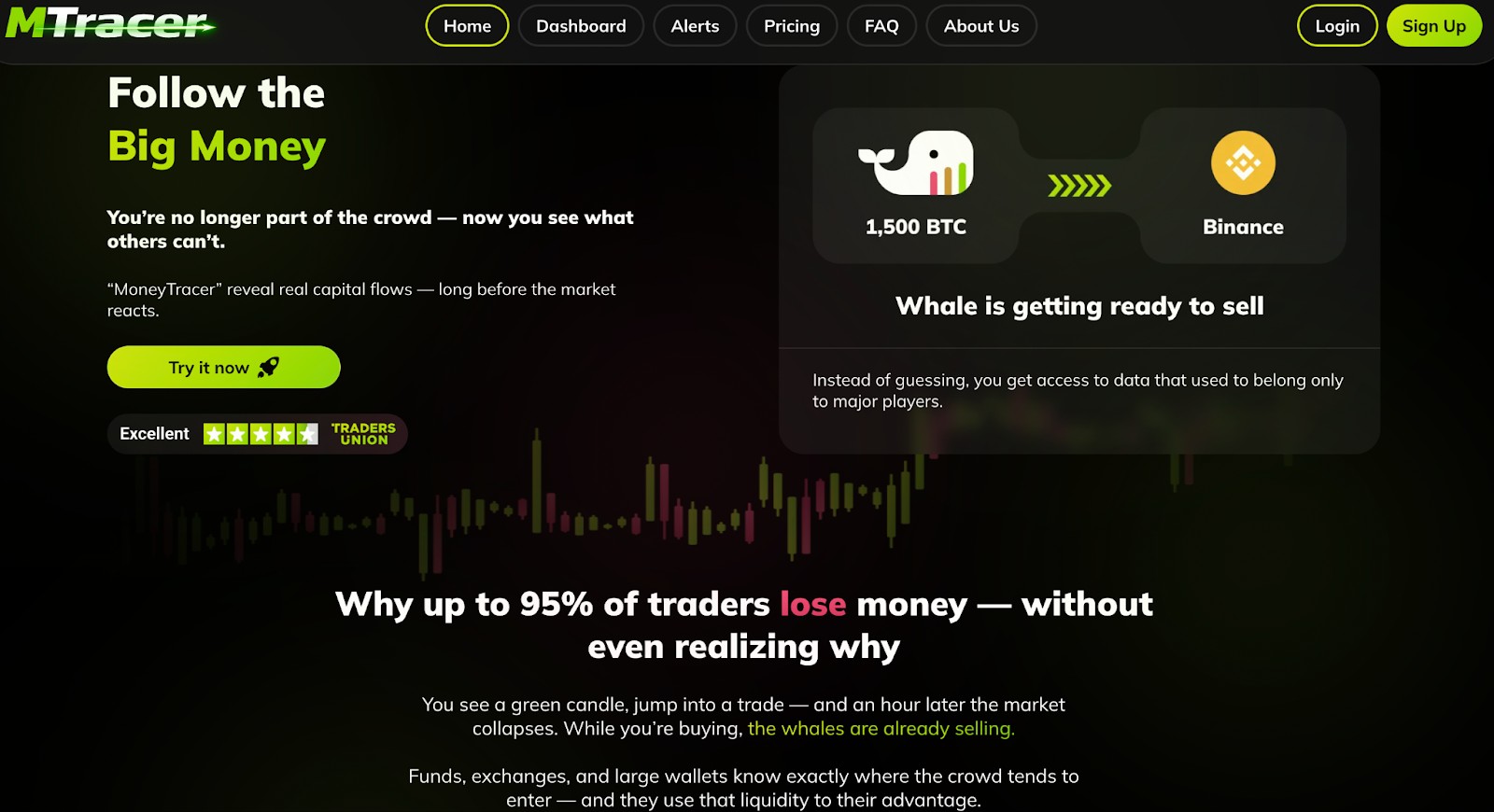
MTracer. This platform focuses on large capital movement and aggregation rather than isolated transactions; it is widely used as a crypto whale wallet tracker by traders who want to follow accumulation and distribution trends across multiple wallets.
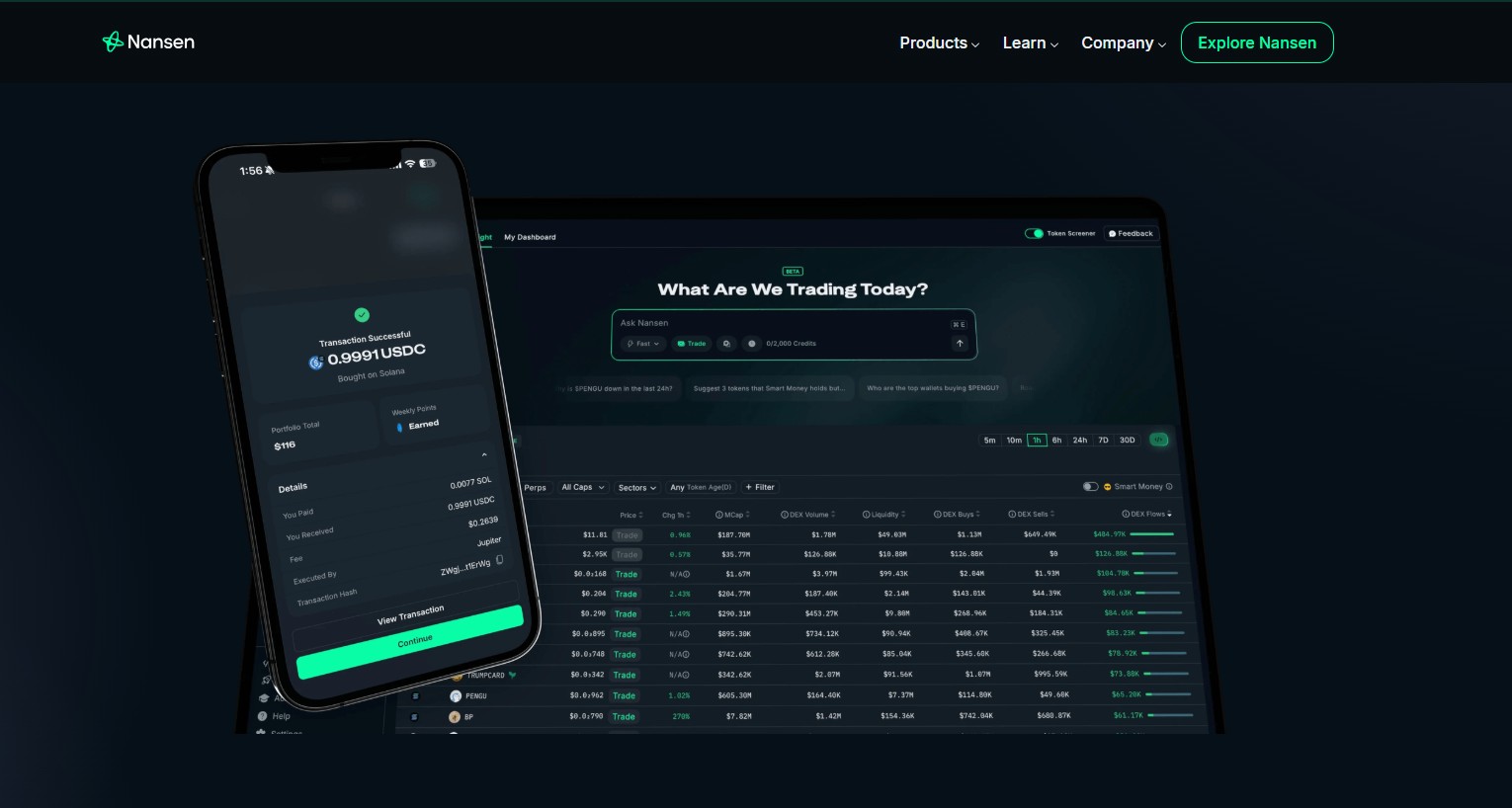
Nansen. Nansen labels large and high-performing wallets and groups them into categories; it is useful for traders looking to find whale wallets linked to long-term investors and active market participants.
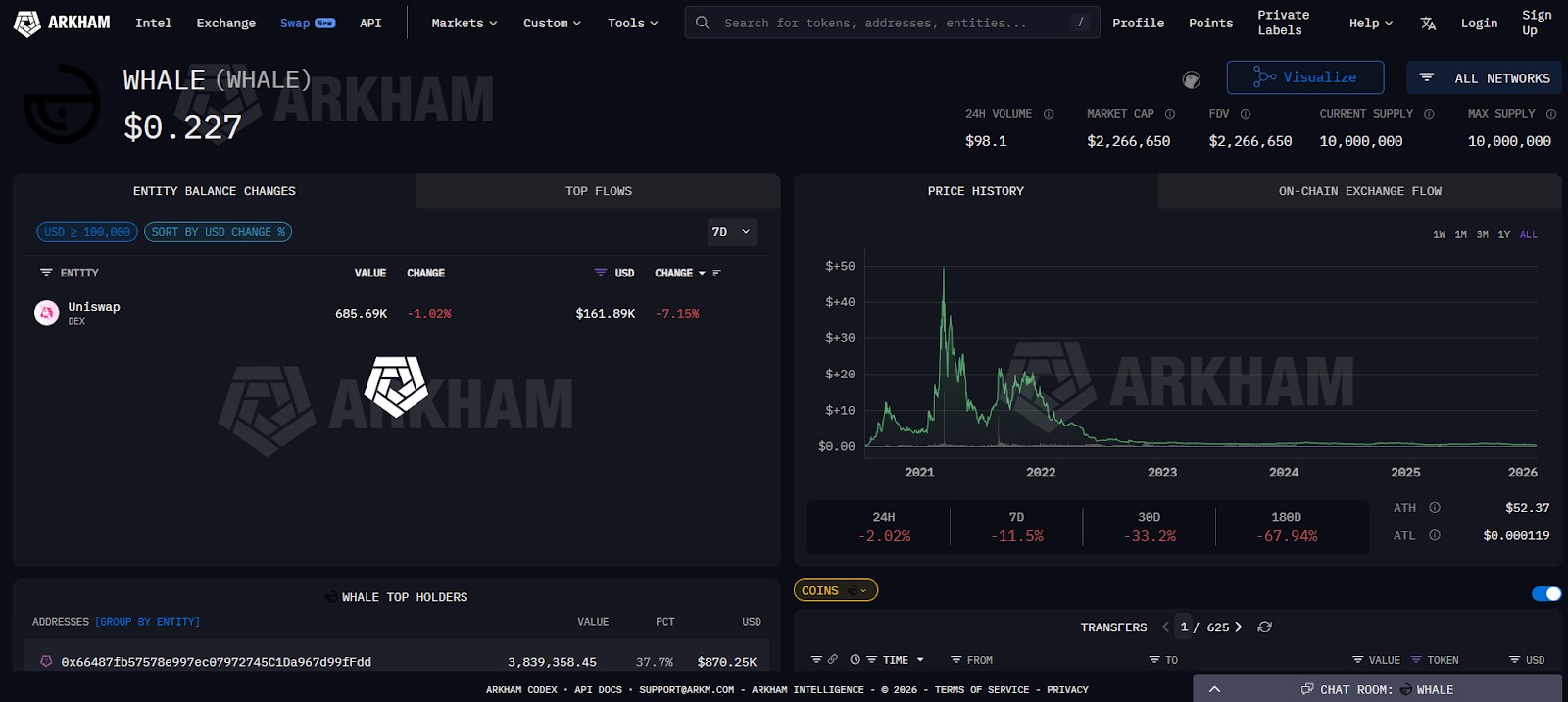
Arkham Intelligence. Arkham specializes in mapping wallet relationships and visualizing fund flows; traders use it to explore top crypto whale wallets and monitor connections between wallets, exchanges, and protocols.
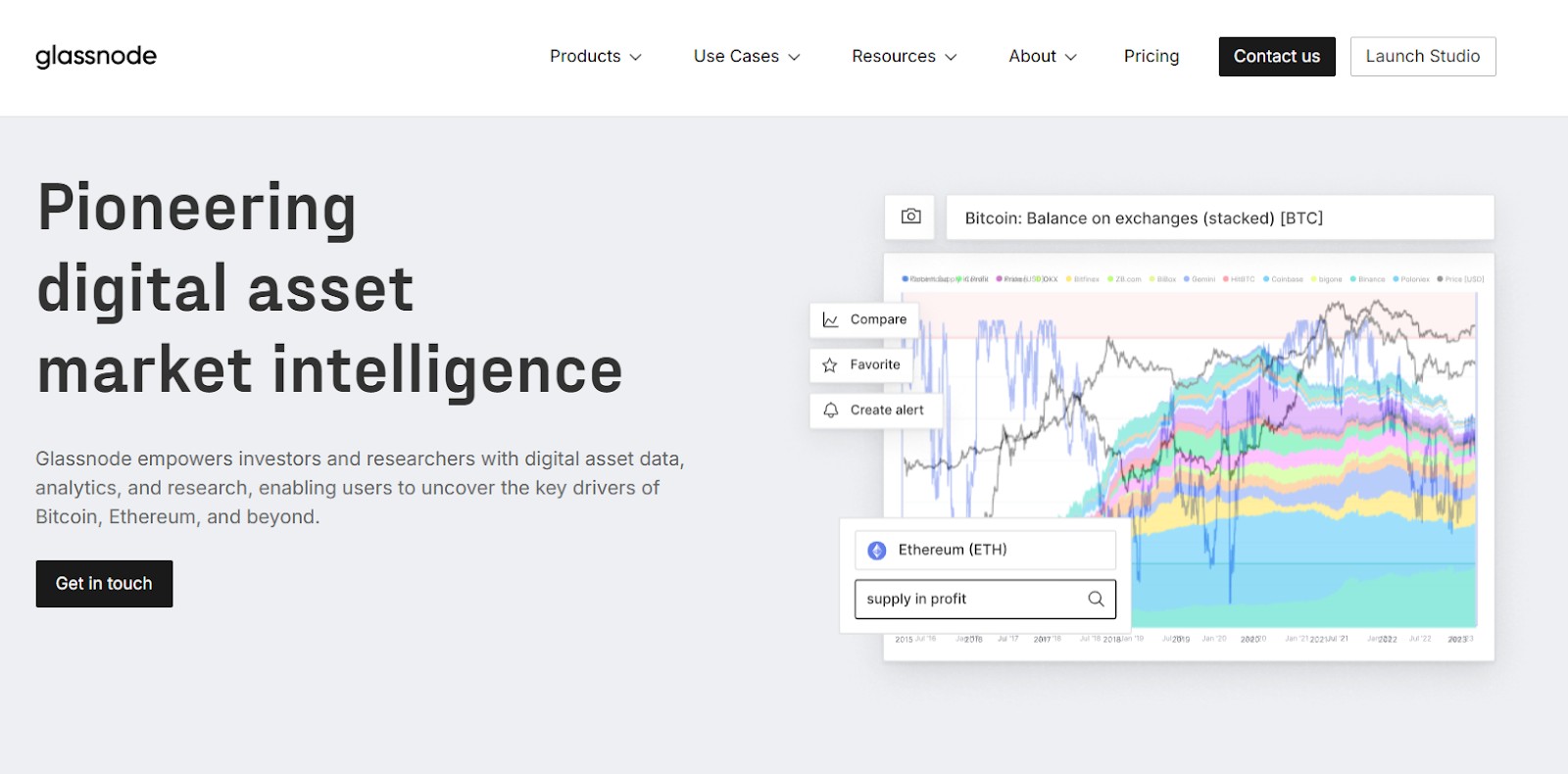
Glassnode. Glassnode provides macro-level metrics based on aggregated wallet behavior; it is often used to analyze broader whale wallet activity rather than tracking individual transfers.
Whale Alert. This alert-based service reports large transactions as they happen; it is commonly used by traders who want a simple way to check whale wallets and spot unusual movements in real time.
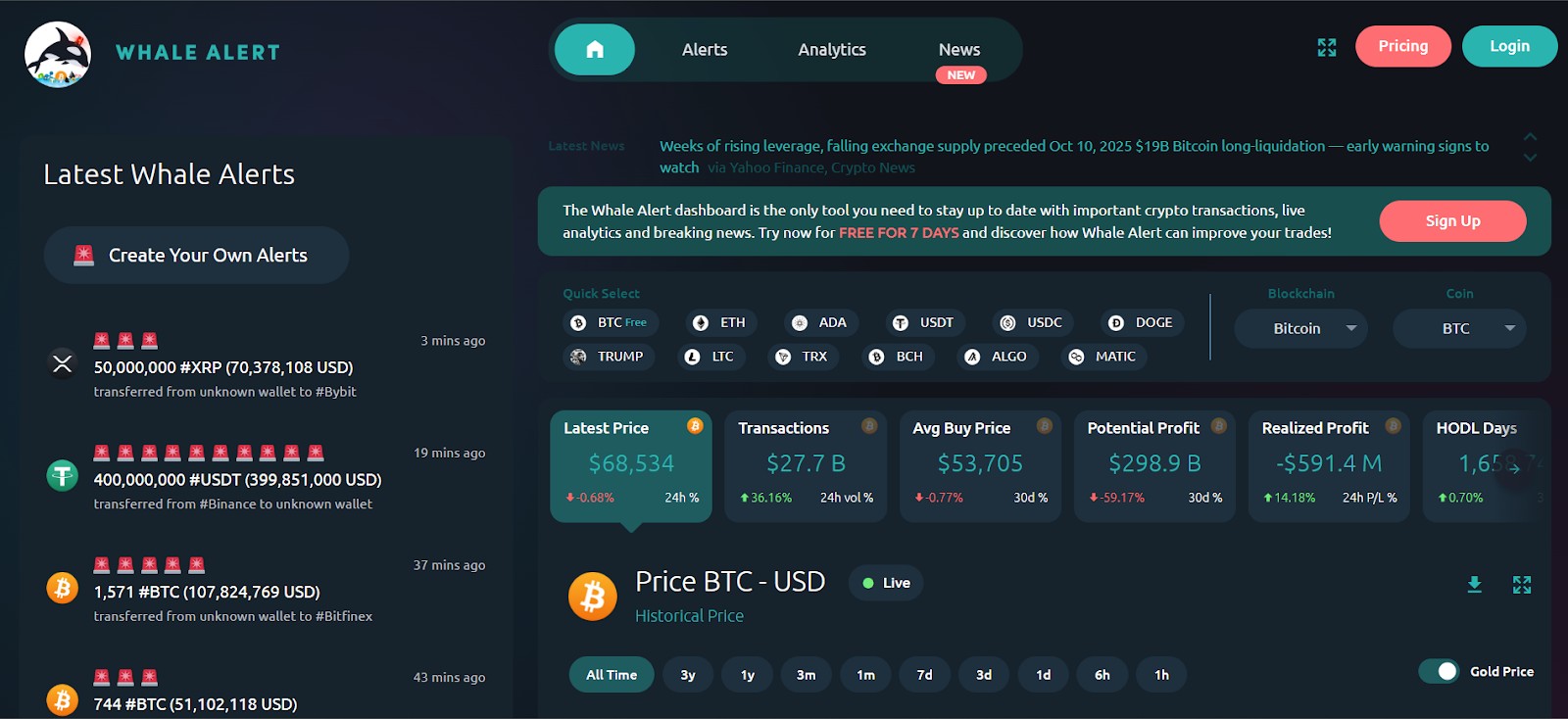
No single tool covers everything. Most experienced traders use more than one whale wallet tracker to cross-check signals. By combining real-time alerts with deeper analytics, traders can better understand whether movements from large holders represent short-term noise or meaningful shifts in market positioning.
How whale wallet tracking works in practice: MTracer example
Tracking whale wallets manually through blockchain explorers can be slow and confusing, especially for traders without deep on-chain experience. This is why many traders rely on platforms built specifically for whale wallet tracking that translate raw blockchain data into clear, visual signals.
One such platform is MTracer, a crypto monitoring tool designed to follow large capital movements across the blockchain. Instead of focusing only on price, MTracer tracks how funds move between crypto whale wallets, exchanges, and long-term storage, helping traders understand what is driving market behavior.
MTracer operates through two main analytical layers that traders can follow directly on the dashboard.
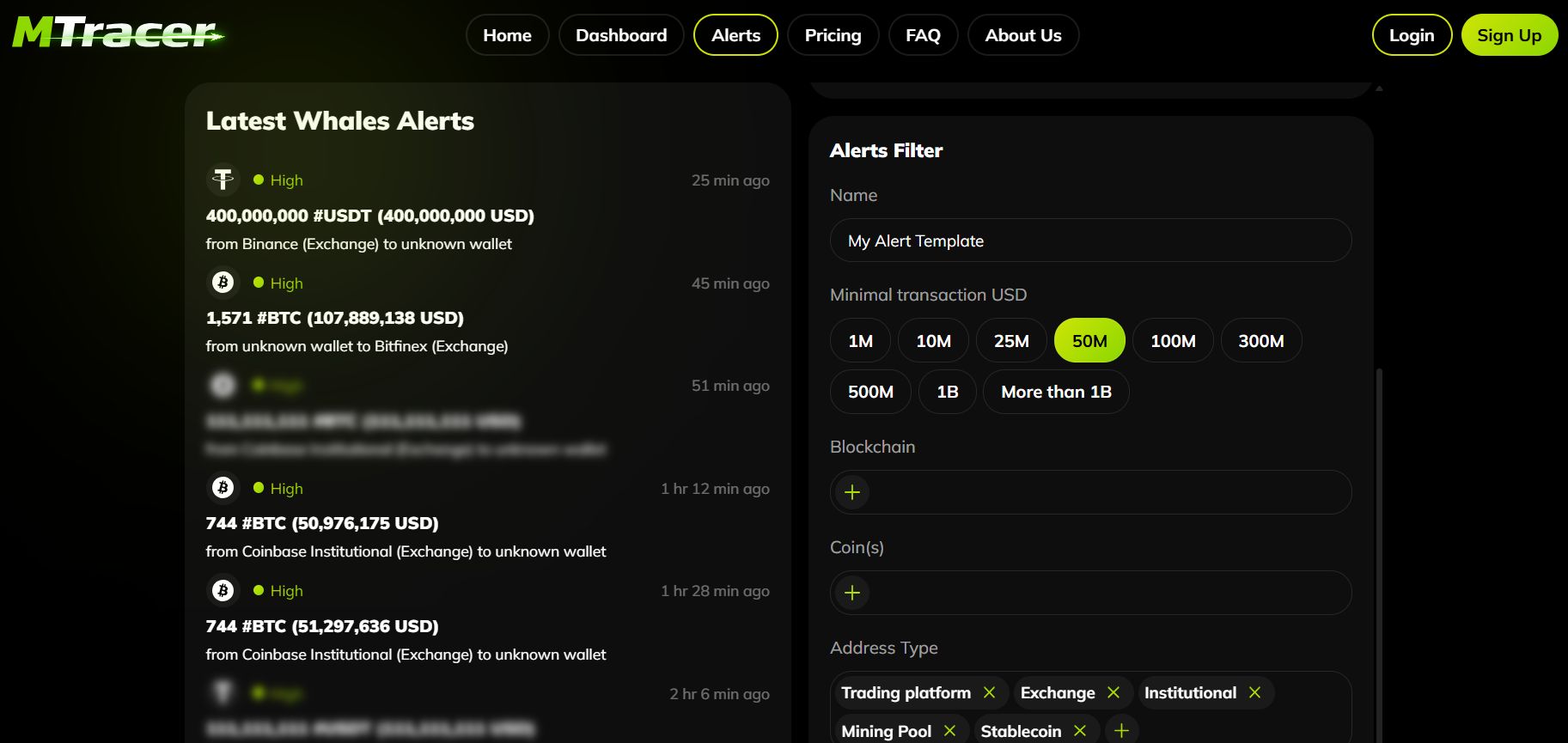
Real-time whale alerts. MTracer monitors large transactions in real time, including major transfers from a crypto whale wallet address to exchanges, withdrawals into cold storage, and significant stablecoin movements; these alerts help traders check whale wallets and spot potential selling pressure or accumulation before it becomes obvious on price charts.
Aggregated whale behavior analysis. Rather than treating each transfer as a separate signal, MTracer combines activity from multiple large holders into a single framework using its Whale Accumulation Distribution Index; this helps traders understand whether whales are broadly accumulating, distributing, or remaining neutral over time.
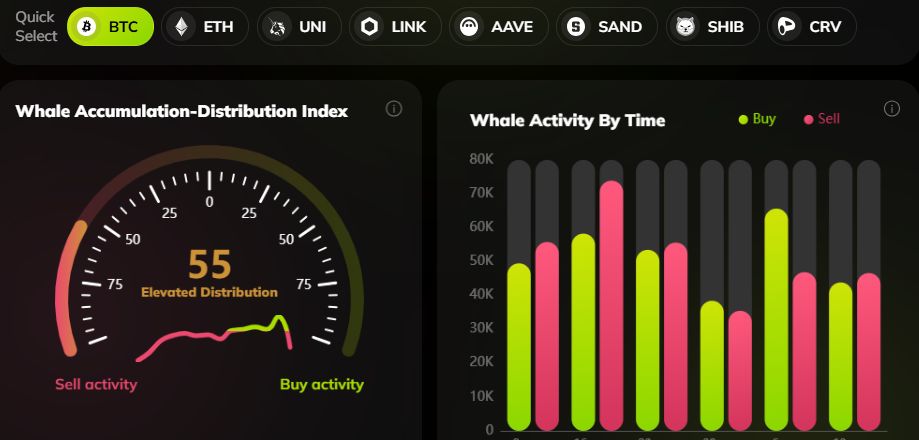
This approach is especially useful because isolated transactions can be misleading. By aggregating data from many large holders, MTracer allows traders to track whale wallets in crypto without overreacting to one-off movements or internal wallet reshuffles.
Whale wallets by cryptocurrency
Whale behavior varies by network. Differences in liquidity, user base, and use cases mean that whale wallet activity does not look the same across blockchains. Below is how traders typically track whale wallets by major cryptocurrency.
Bitcoin whale wallets
Bitcoin whale wallets are usually defined as wallets holding tens of thousands of BTC. Because Bitcoin has the deepest liquidity, movements from these wallets often affect overall market sentiment rather than short-term price alone. Traders use a Bitcoin whale wallet tracker to monitor large transfers, especially when coins move to or from exchanges, as these events often precede volatility. Watching long-dormant Bitcoin wallets is also important, as reactivation can attract strong market attention.
Ethereum whale wallets
Ethereum whale wallets behave differently due to staking and decentralized finance activity. Large ETH holders frequently move funds between staking contracts, DeFi protocols, and exchanges. This means traders who track Ethereum whale wallets focus less on single transfers and more on patterns. Monitoring Ethereum wallet activity helps identify whether whales are increasing exposure, locking funds for yield, or preparing to reduce risk.
Solana whale wallets
Solana whale wallets tend to be more concentrated compared to Bitcoin and Ethereum. Because overall liquidity is lower, large transfers can influence price more quickly. Traders who use a Solana whale wallet tracker often pay close attention to rapid inflows and outflows, as these moves can trigger sharp short-term reactions. Tracking Solana wallet activity is especially important during periods of high network usage or ecosystem news.
XRP whale wallets
XRP whale wallets are often linked to institutional flows and liquidity management rather than speculative trading. Large transfers may reflect operational needs rather than market intent. When traders track XRP whale wallets, they usually look for sustained changes in behavior rather than isolated movements. Monitoring XRP wallet activity can provide insight into broader adoption trends and institutional usage.
Cardano whale wallets
Cardano whale wallets are commonly associated with long-term holders and staking participants. Large ADA holders tend to move funds less frequently, making changes in behavior more meaningful when they occur. Traders who track Cardano whale wallets focus on long-term accumulation or distribution trends rather than short-term signals. Studying Cardano wallet activity helps assess confidence in the network over time.
How to find whale wallet addresses
Finding whale wallet addresses does not require insider access. Because blockchains are public, traders can find whale wallets by using a few reliable, repeatable methods.
Top holder lists on blockchain explorers. Most explorers publish lists of the largest wallets for each network; traders can use these lists to find whale wallet address data and review historical transactions directly on-chain.
On-chain analytics platforms. Analytics tools aggregate large holders and label behavior patterns; these platforms help traders find crypto whale wallets without manually scanning thousands of addresses.
Wallet alert and monitoring services. Alert-based tools highlight unusually large transactions as they happen; this allows traders to quickly identify a new crypto whale wallet address and begin monitoring its activity.
Exchange flow tracking. Large transfers moving into or out of exchanges often originate from major holders; by following these flows, traders can find whale wallets crypto users that actively influence liquidity.
Historical transaction analysis. Reviewing past market events and tracing large transfers backward helps traders identify recurring addresses; this method is commonly used by those learning how to find whale wallets through behavior rather than balance size alone.
Research and real-world insights
Whale wallet behavior is not just a theory discussed by traders. Multiple research efforts and real market events show that activity from large holders often appears before broader price changes.
Recent market studies continue to confirm that large transfers from crypto whale wallets are closely linked to short-term volatility, especially when those transfers involve exchanges. When researchers include whale wallet activity data in market models, price swings are explained more accurately than when using price and volume alone. This supports why professional traders pay attention to tracking whale wallets as part of risk analysis.
Real-world market behavior reinforces these findings. During several consolidation phases between 2023 and 2025, large holders quietly accumulated assets while prices remained flat. In many cases, wallets that showed consistent accumulation later reduced exposure near local market tops. Traders who checked whale wallets during these periods often had earlier warnings than those relying only on technical indicators.
As traders learn to interpret whale wallet activity, the next practical step is acting on that information. Since large transfers often involve major trading venues, many readers also look for crypto exchanges that operate reliably in their region. The exchange comparison below fits naturally into this context, showing where whale-driven market moves typically play out in real trading environments.
| Coinbase | OKX | BTCC | Cryptohopper | Crypto.com | |
|---|---|---|---|---|---|
|
Min. Deposit, $ |
10 | 10 | 10 | No | 1 |
|
Coins Supported |
400+ | 600+ | 399 | 1000 | 400+ |
|
Spot Taker fee, % |
0.5 | 0.1 | 0.3 | 0 | 0.5 |
|
Spot Maker Fee, % |
0.5 | 0.08 | 0.2 | 0 | 0.25 |
|
Alerts |
Yes | Yes | No | Yes | Yes |
|
Copy trading |
No | Yes | Yes | Yes | No |
|
TU overall score |
8.5 | 8.46 | 8.08 | 7.8 | 7.76 |
|
Open an account |
Go to broker Your capital is at risk. |
Go to broker Your capital is at risk. |
Go to broker Your capital is at risk.
|
Go to broker Your capital is at risk. |
Go to broker Your capital is at risk. |
Whale activity shows intent before price reacts

I track whale wallet behavior daily, and the biggest insight it gives me is timing. Large holders usually move before price reacts. When I see steady accumulation while the market is quiet, it often signals long-term positioning. When repeated transfers flow into exchanges during rallies, it usually increases short-term risk.
Whale tracking does not predict exact price levels, but it adds context. Combined with exchange flow data, it helps me avoid chasing late moves and stay patient during consolidation. For me, its value is not in copying whales, but in understanding what serious capital is doing before sentiment shifts.
Conclusion
Understanding whale wallets is crucial for anyone looking to anticipate major market movements in the crypto space. By diligently tracking whale wallet activity using leading tools like Whale Alert and Nansen, investors can glean valuable insights into the strategies of top holders. For example, a sizable bitcoin transfer by a whale often foreshadows a significant price shift, while sudden token accumulation may signal upcoming bullish trends. Ultimately, staying attuned to whale wallet movements empowers traders and enthusiasts to act with greater foresight—because in crypto, following the smart money isn’t just smart; it’s essential.
FAQs
What risks are associated with relying solely on whale wallet movements for trading decisions?
How does whale wallet activity differ between proof-of-stake and proof-of-work cryptocurrencies?
Can individual traders reliably identify new whale wallets as they emerge?
What are some limitations of current whale wallet tracking tools?
Editors' Top Picks and Insights






Related Articles
Team that worked on the article
Dan Blystone began his trading career in 1998 as an arbitrage clerk on the floor of the Chicago Mercantile Exchange (CME). He later traded bond and Eurex futures at proprietary firms such as Altea Trading, gaining valuable experience in high-frequency trading and risk management.
Chinmay Soni is a financial analyst with more than 5 years of experience in working with stocks, Forex, derivatives, and other assets. As a founder of a boutique research firm and an active researcher, he covers various industries and fields, providing insights backed by statistical data.
CFD is a contract between an investor/trader and seller that demonstrates that the trader will need to pay the price difference between the current value of the asset and its value at the time of contract to the seller.
Copy trading is an investing tactic where traders replicate the trading strategies of more experienced traders, automatically mirroring their trades in their own accounts to potentially achieve similar results.
Yield refers to the earnings or income derived from an investment. It mirrors the returns generated by owning assets such as stocks, bonds, or other financial instruments.
Risk management is a risk management model that involves controlling potential losses while maximizing profits. The main risk management tools are stop loss, take profit, calculation of position volume taking into account leverage and pip value.
Volatility refers to the degree of variation or fluctuation in the price or value of a financial asset, such as stocks, bonds, or cryptocurrencies, over a period of time. Higher volatility indicates that an asset's price is experiencing more significant and rapid price swings, while lower volatility suggests relatively stable and gradual price movements.

-
 Afghanistan
-
 Albania
-
 Algeria
-
 Angola
-
 Argentina
-
 Armenia
-
 Australia
-
 Austria
-
 Azerbaijan
-
 Bahamas
-
 Bahrain
-
 Bangladesh
-
 Belarus
-
 Belgium
-
 Bolivia
-
 Botswana
-
 Brazil
-
 Brunei
-
 Bulgaria
-
 Cambodia
-
 Cameroon
-
 Canada
-
 Chile
Chile
-
 China
China
-
 Colombia
-
 Congo
Congo
-
 Costa Rica
-
 Cote d'Ivoire
-
 Croatia
-
 Cuba
Cuba
-
 Cyprus
-
 Czechia
-
 DR Congo
-
 Denmark
-
 Dominican Republic
-
 Ecuador
-
 Egypt
Egypt
-
 El Salvador
-
 Estonia
-
 Eswatini
-
 Ethiopia
-
 Finland
-
 France
-
 Georgia
-
 Germany
-
 Ghana
Ghana
-
 Greece
-
 Haiti
Haiti
-
 Hong Kong
-
 Hungary
-
 India
India
-
 Indonesia
-
 Iran, Islamic republic
-
 Iraq
Iraq
-
 Ireland
-
 Israel
-
 Italy
Italy
-
 Jamaica
-
 Japan
Japan
-
 Jordan
-
 Kazakhstan
-
 Kenya
Kenya
-
 Korea
Korea
-
 Kuwait
-
 Kyrgyzstan
-
 Laos
Laos
-
 Latvia
-
 Lebanon
-
 Lesotho
-
 Libya
Libya
-
 Lithuania
-
 Luxembourg
-
 Madagascar
-
 Malaysia
-
 Malta
Malta
-
 Mauritius
-
 Mexico
-
 Moldova
-
 Mongolia
-
 Montenegro
-
 Morocco
-
 Mozambique
-
 Myanmar
-
 Namibia
-
 Nepal
Nepal
-
 Netherlands
-
 New Zealand
-
 Nigeria
-
 North Macedonia
-
 Norway
-
 Oman
Oman
-
 Pakistan
-
 Palestine
-
 Panama
-
 Papua New Guinea
-
 Paraguay
-
 Peru
Peru
-
 Philippines
-
 Poland
-
 Portugal
-
 Puerto Rico
-
 Qatar
Qatar
-
 Reunion
-
 Romania
-
 Rwanda
-
 Saudi Arabia
-
 Serbia
-
 Singapore
-
 Slovakia
-
 Slovenia
-
 Somalia
-
 South Africa
-
 Spain
Spain
-
 Sri Lanka
-
 Sweden
-
 Switzerland
-
 Syria
Syria
-
 Taiwan
-
 Tajikistan
-
 Tanzania
-
 Thailand
-
 Trinidad and Tobago
-
 Tunisia
-
 Turkey
-
 UAE
UAE
-
 Uganda
-
 Ukraine
-
 United Kingdom
-
United States
-
 Uruguay
-
 Uzbekistan
-
 Venezuela
-
 Vietnam
-
 Yemen
Yemen
-
 Zambia
-
 Zimbabwe
- Forex
- Crypto










- What is a whale wallet?
- How whale wallets work and why tracking them matters
- Ways to track whale wallets
- Best whale wallet trackers
- How whale wallet tracking works in practice: MTracer example
- Whale wallets by cryptocurrency
- How to find whale wallet addresses
- Research and real-world insights
- Expert opinion
- Conclusion
- FAQs


