Who Are Whales in Crypto And How to Recognize Them?


Editorial Note: While we adhere to strict Editorial Integrity, this post may contain references to products from our partners. Here's an explanation for How We Make Money. None of the data and information on this webpage constitutes investment advice according to our Disclaimer.
Crypto whales are large holders of cryptocurrencies who own significant amounts of coins and can influence prices through their trading activity. Their transactions may trigger sharp market movements and increase volatility, which is why traders closely monitor the activity of large wallets.
In 2026, crypto whales are no longer just anonymous early adopters sitting on dormant wallets. The category now includes regulated institutions, ETF custodians, corporate treasuries, and long-term strategic holders with billions in exposure. Whale crypto activity has moved from fringe speculation into mainstream market analysis, and understanding it gives traders a measurable edge. This guide breaks down who the biggest cryptocurrency whales are, how their transactions move prices, and which tools actually help you track them.
Risk warning: Cryptocurrency markets are highly volatile, with sharp price swings and regulatory uncertainties. Research indicates that 75-90% of traders face losses. Only invest discretionary funds and consult an experienced financial advisor.
What is a crypto whale?
A crypto whale is any individual or entity holding enough cryptocurrency to influence market prices through their transactions. For Bitcoin, the most widely used threshold is 1,000 BTC. For altcoins, the bar is relative to each token's circulating supply and liquidity depth. Most analysts break holders down into tiers:
Whales hold 1,000+ BTC or the altcoin equivalent and can move markets with a single transaction.
Sharks hold 100 to 1,000 BTC and can amplify trends but rarely drive them alone.
Dolphins hold 10 to 100 BTC and represent mid-size retail or early-stage institutional positions.
Fish hold under 10 BTC and have no measurable impact on price individually.

Though broadly, the term whale in crypto goes beyond just holding large amounts. Real influence comes from the ability to move prices, whether by placing a large market order, shifting coins to an exchange, or signaling intent that other traders react to.
Historical examples of whale influence
The history of cryptocurrencies shows that whales can significantly change market dynamics. Large sell-offs and major purchases are capable of shaping sharp trends and often become turning points for the market.
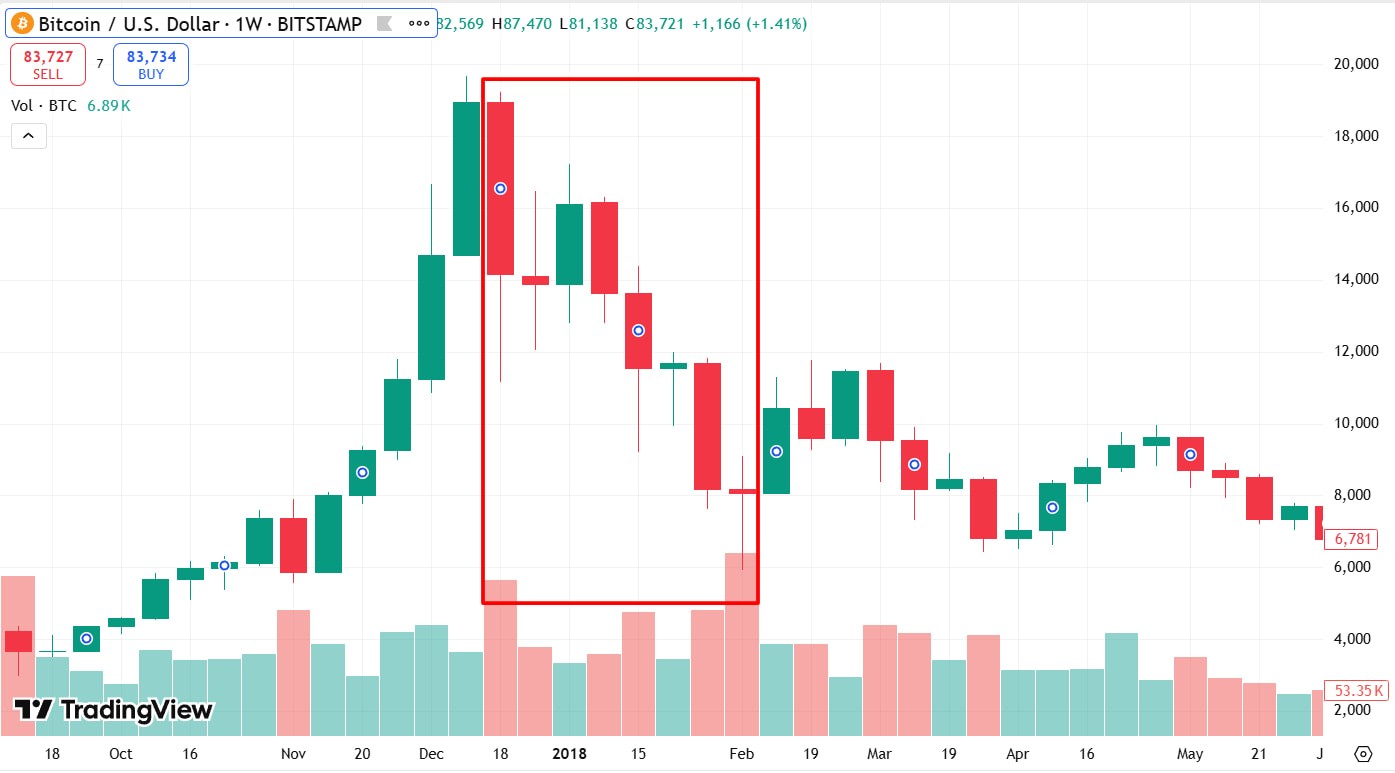
December 2017: Massive profit-taking at BTC price peak
In December 2017, the price of Bitcoin reached a record high of about $19,000. After that, crypto whales began selling large amounts of BTC, triggering a cascading price decline. The profit-taking was accompanied by panic among retail investors, and the price dropped to around $6,000 within just a few months. This episode became a symbol of the end of the 2017 bull cycle.
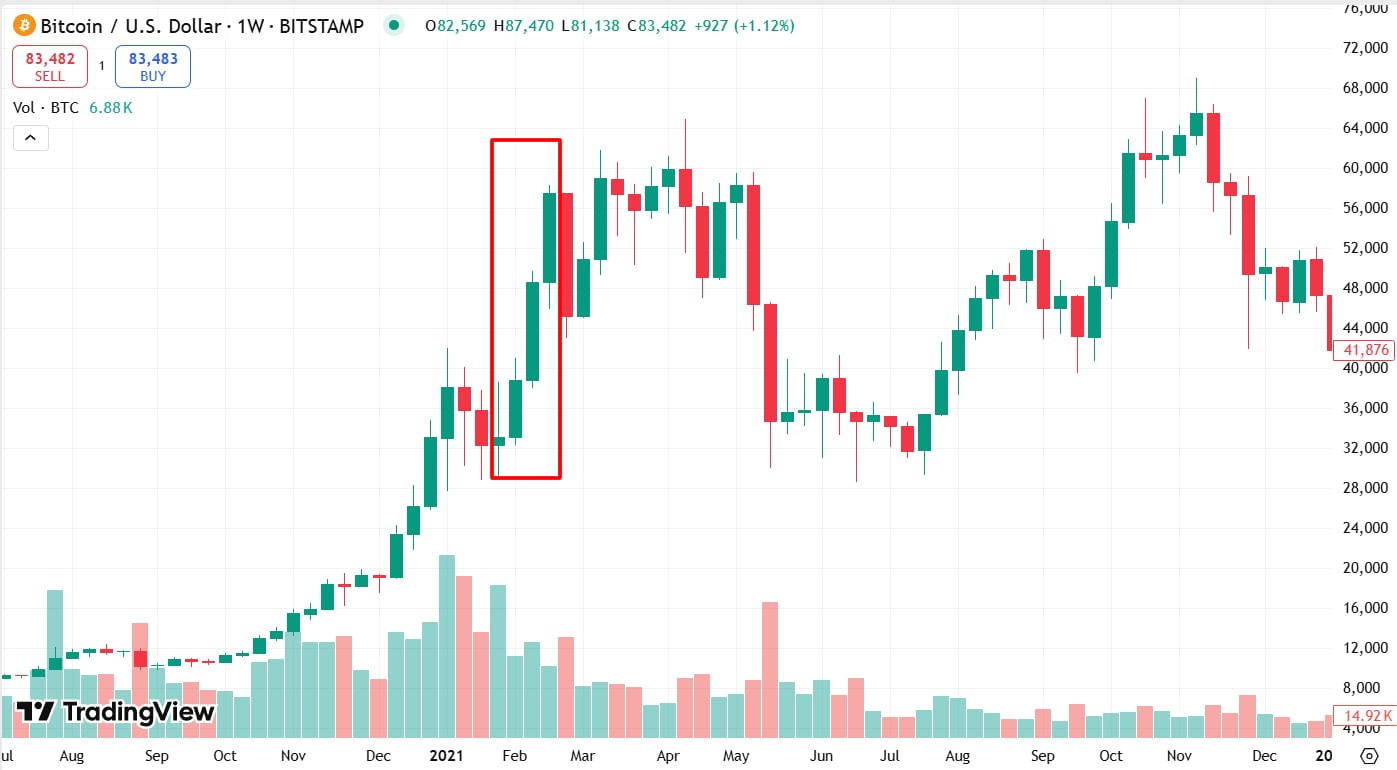
February 2021: MicroStrategy and institutional momentum
Strategy (formerly MicroStrategy), led by Michael Saylor, purchased a significant amount of BTC, demonstrating strong confidence in the asset. These actions attracted the attention of other institutional investors and increased demand. As a result, by spring 2021 Bitcoin’s price rose from around $30,000 to over $60,000. This example shows how a crypto whale can influence a long-term market trend.
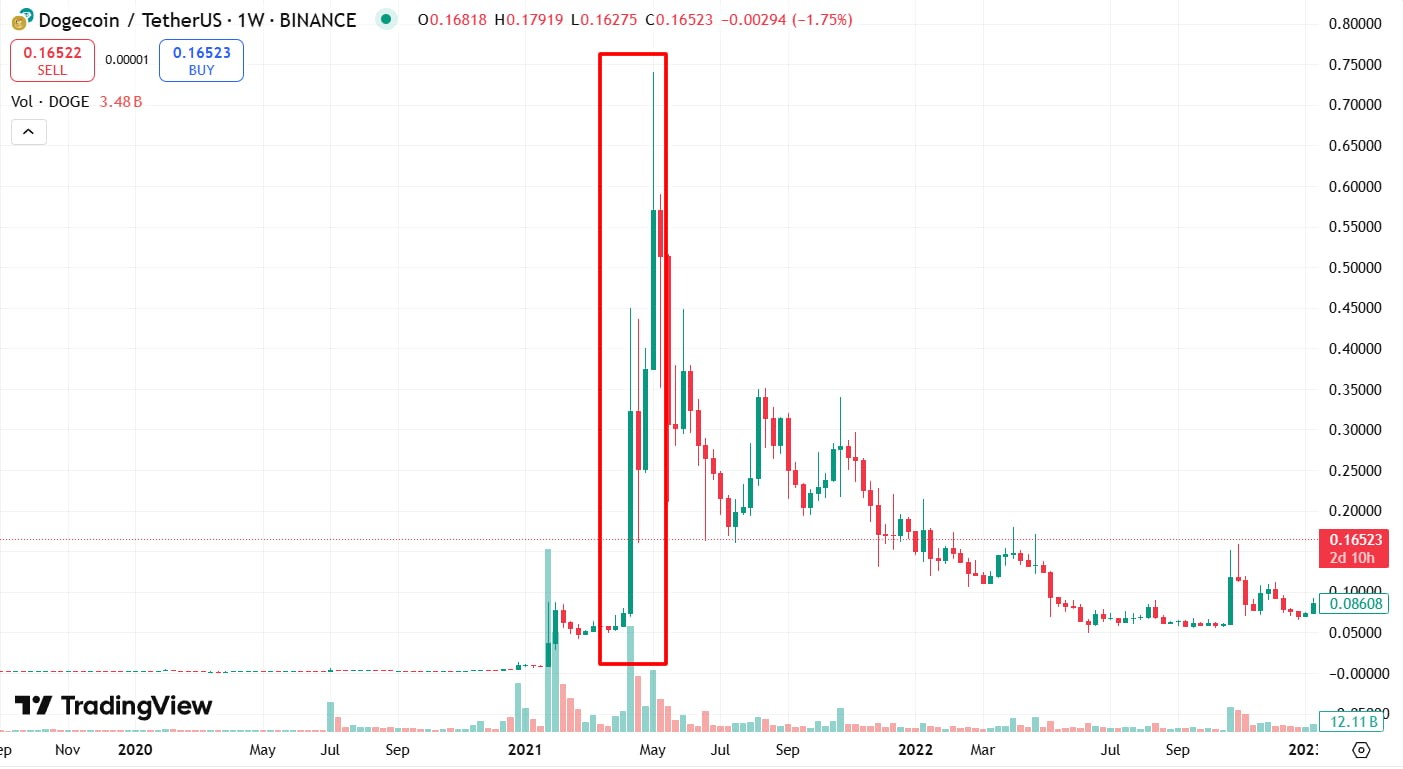
April 2021: Dogecoin rally driven by whale activity
Dogecoin became one of the most striking examples of speculative movement in the market. Following tweets from Elon Musk and activity from large wallets, the price of DOGE increased by more than 500% within a few weeks. One wallet controlled a significant portion of the supply, raising concerns about a centralized pump (an artificial price surge driven by large-scale buying). After reaching $0.73, the price quickly crashed, once again demonstrating how crypto whales can amplify market volatility.
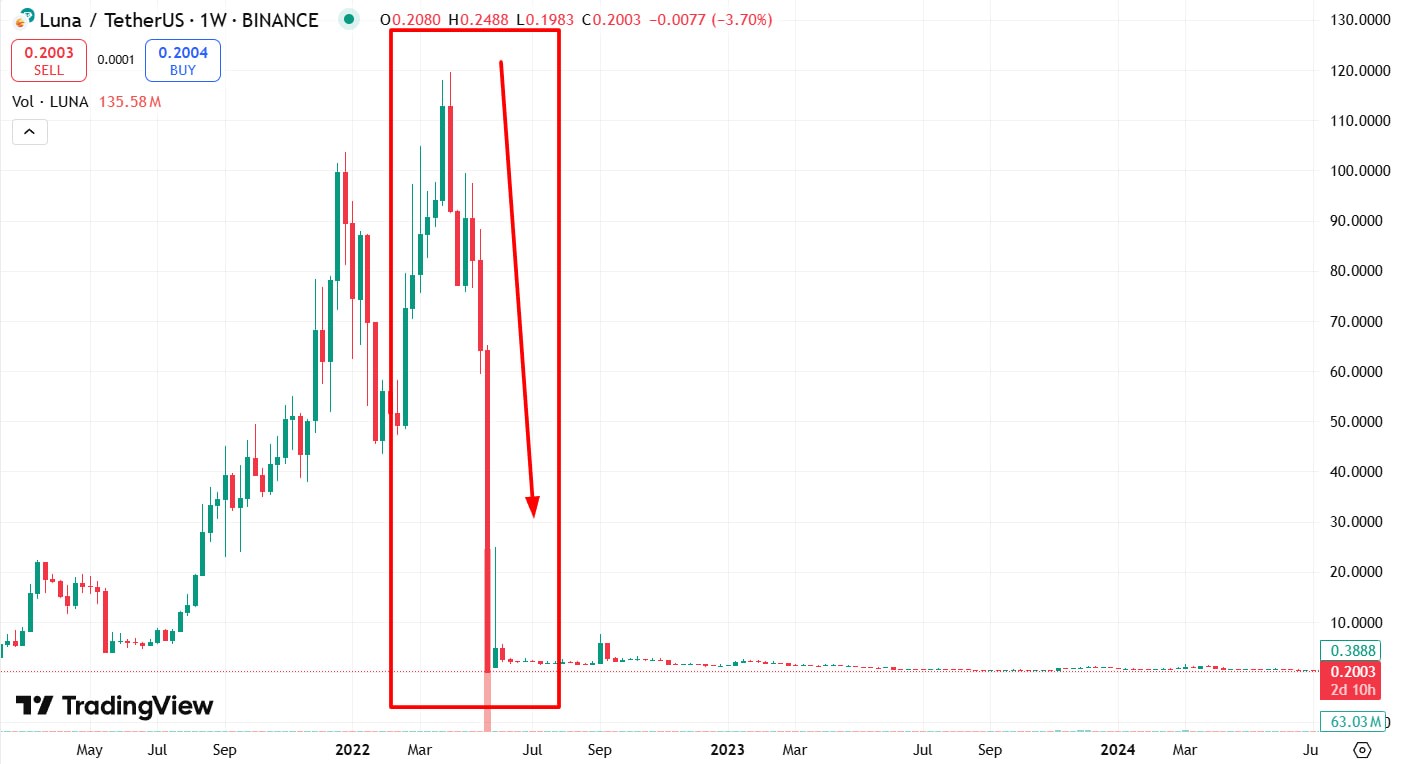
May 2022: The LUNA collapse after the UST stablecoin failure
The collapse of the Terra ecosystem became one of the largest crises in the crypto industry. When UST lost its dollar peg, large holders began withdrawing liquidity on a massive scale. Since crypto whales can trigger chain reactions of liquidations, the withdrawal of about $2 billion accelerated the collapse and led to the rapid devaluation of the LUNA token. This event became one of the key factors that initiated the crypto winter.
Who are the biggest crypto whales in 2026?
Cryptocurrency whales today fall into four main categories. Each plays a different role in how supply is held and how it affects market behavior.
Exchange wallets. Platforms like Binance and Coinbase hold massive reserves on behalf of their users. Their sheer size makes them whales in crypto market structure, even though the coins belong to millions of individual clients.
ETF custodians. Since the approval of U.S. spot Bitcoin ETFs in 2024, custodians have accumulated supply at scale. Institutional inflows continued through 2025 and into 2026, making ETF custodians one of the most structurally significant whale segments of cryptocurrency today.
Corporate treasuries. Public companies holding Bitcoin on their balance sheets, most notably Strategy (formerly MicroStrategy), represent a new class of crypto whales. Their trading frequency is low, but their holdings are large enough to affect perceived supply scarcity.
Early adopters. Dormant wallets from 2010 to 2013 still hold some of the largest individual Bitcoin balances in existence. When coins from these addresses move after years of inactivity, markets treat it as a potential distribution signal and volatility often follows.
Understanding who are the crypto whales in each category matters because their motivations differ sharply.
Top 5 Bitcoin whales by holdings
Rankings reflect structural influence, not personal wealth:
Satoshi Nakamoto. Holdings estimated at approximately 1.1 million BTC, this remains the largest identifiable individual cluster in Bitcoin history, representing over 5% of circulating supply. The wallet has never moved. Its dormancy is the only reason it does not dominate market sentiment daily.
Coinbase Custody. One of the largest custodians of Bitcoin. Coinbase serves as primary custodian for multiple ETF issuers and large institutional clients, making it the largest active whale in crypto market terms after Satoshi.
Binance. It operates the single largest active exchange wallet cluster globally, giving it outsized short-term influence over liquidity conditions.
| Entity | % of Supply | Type |
|---|---|---|
| Satoshi Nakamoto | ~5.6% | Early individual holder |
| Coinbase Custody | ~12.0% | ETF and institutional custodian |
| Binance | ~3.2% | Exchange custody |
How whale activity moves crypto prices
Whale activity in crypto works through three main channels: liquidity impact, on-chain signaling, and derivatives positioning. Understanding all three is what separates useful analysis from noise.

Liquidity impact is the most direct mechanism. A large market order consumes available bids or asks, increasing slippage and moving price. In smaller-cap tokens, even a moderate transaction from a whale in crypto can trigger double-digit percentage moves within minutes.
On-chain signaling is subtler but equally powerful. Because blockchain data is public, large transfers are visible to anyone monitoring the network. When significant balances move from cold storage to exchange wallets, traders widely interpret this as potential selling pressure. The reverse, coins moving off exchanges into cold storage, is read as accumulation.
Derivatives positioning is the third layer. In 2026, the futures and options markets are large enough that whale crypto activity in derivatives can amplify or dampen spot price moves. Monitoring funding rates and open interest alongside on-chain transfers gives a much clearer picture than either dataset alone.
One important caution: traders often misread crypto whale signals by reacting to single transactions rather than trends. A single large transfer may reflect internal wallet reorganization, not a sell decision. Always compare exchange inflow spikes against rolling 30-day baselines before drawing conclusions.
How to track crypto whale activity
Tracking crypto whales effectively means combining multiple data sources. No single tool gives the full picture, but the platforms below cover the most important signals.
MTracer. A crypto monitoring tool built specifically around whale activity crypto and exchange flows. Unlike traditional screeners that focus on price or volume, MTracer analyzes whale activity, exchange inflows and outflows, and broader capital behavior to explain why markets move. It aggregates signals using the WADI (Whale Accumulation Distribution Index), a score that helps traders identify accumulation and distribution phases without needing deep on-chain expertise.
Whale Alert. The most widely used tool for real-time large transfer notifications. It sends instant alerts when significant transactions occur across major blockchains, making it a go-to for traders who want immediate awareness of whales in crypto moving funds.
Arkham Intelligence. Arkham uses an AI engine with over 800 million wallet labels and entity identification, supporting multi-chain wallet tracking across Bitcoin, Ethereum, Solana, and more. Its entity pages show portfolio holdings, transaction history, and balance changes, making it one of the most detailed tools for identifying who is behind a large transfer.
Risks of following whale signals blindly
Tracking crypto whale activity adds real value, but copying moves without context introduces serious risk. Large holders operate on timescales, position sizes, and risk tolerances that are completely different from retail traders.
A few structural reasons why blind imitation fails:
Transfers are not trades. A large on-chain transfer often reflects internal wallet reorganization, custody migration, or collateral movement, not a buy or sell decision. Reacting to every large crypto transfer by a whale as a directional signal leads to frequent false entries.
Whales scale in and out gradually. A cryptocurrency whale rarely enters or exits in a single transaction. By the time a move is visible on-chain, the whale may already be halfway through an exit, leaving retail followers buying into distribution.
Hedging is invisible on-chain. Large holders routinely hedge spot positions through derivatives. An address accumulating Bitcoin on-chain may simultaneously be short in the futures market. On-chain data alone does not show the full picture of the positioning done by a crypto whale.
Timing gaps create slippage risk. Even when a whale signal is genuine, the delay between detection and execution means retail traders often enter at worse prices, reducing or eliminating any edge.
If reading about whale activity has made you more curious about where people actually buy, sell, and hold crypto, the next step is choosing the right exchange for your region. The table below gives a simple starting point for comparing some of the best crypto exchanges available to you. It can help you find a platform that fits your location before you take part in the market yourself.
| Coinbase | OKX | BTCC | Cryptohopper | Crypto.com | |
|---|---|---|---|---|---|
|
Min. Deposit, $ |
10 | 10 | 10 | No | 1 |
|
Coins Supported |
400+ | 600+ | 399 | 1000 | 400+ |
|
Spot Taker fee, % |
0.5 | 0.1 | 0.3 | 0 | 0.5 |
|
Spot Maker Fee, % |
0.5 | 0.08 | 0.2 | 0 | 0.25 |
|
Alerts |
Yes | Yes | No | Yes | Yes |
|
Copy trading |
No | Yes | Yes | Yes | No |
|
TU overall score |
8.5 | 8.46 | 8.08 | 7.8 | 7.76 |
|
Open an account |
Go to broker Your capital is at risk. |
Go to broker Your capital is at risk. |
Go to broker Your capital is at risk.
|
Go to broker Your capital is at risk. |
Go to broker Your capital is at risk. |
Track trends, not transfers, to trade alongside whales

The strongest results I have seen come from traders who use whale data to confirm a thesis, not build one from scratch. Before I act on any large holder signal, I check whether 1,000+ BTC addresses have been consistently growing their balances over a rolling three-week window. If accumulation is steady and exchange inflows are sitting below the 30-day average at the same time, upward pressure tends to build quietly before it becomes visible in price.
Single large transfers rarely tell the full story. What matters more is the pattern behind them. When a transfer above $100 million hits and order book absorption starts thinning out on both sides, I treat that as a volatility warning and reduce leverage by 30 to 50%. Widening stops relative to the recent average true range at that point is not optional, it is the only responsible adjustment. Chasing a whale move without accounting for how fast liquidity can disappear is one of the most common and costly mistakes I see retail traders make.
Conclusion
In 2026, crypto whales continue to wield significant power, shaping markets through massive transactions and strategic moves. Their ability to cause sharp price swings with mere transfers, as seen with entities like government-linked wallets and early adopters such as the Winklevoss twins, highlights the outsized impact that a few players maintain. Understanding whale behavior is no longer optional for serious investors; it is a necessity for navigating the volatile crypto landscape. Sophisticated tools now allow retail traders to track on-chain activity, narrowing the information gap. In a market ruled by giants, vigilance and informed analysis are the keys to riding the waves rather than being swept away.
FAQs
How do crypto whales impact market liquidity and price volatility?
What types of entities are considered crypto whales in today’s market?
Which methods are most effective for tracking crypto whale activity?
Why is it important to analyze whale activity trends rather than single transactions?
Editors' Top Picks and Insights





Related Articles
Team that worked on the article
Aleksandra Chaikina has been a contributor to Traders Union since 2021. With over 15 years of experience in copywriting and more than 5 years focused on financial content, she specializes in producing detailed guides, analytics, and comparative reviews across various sectors, including cryptocurrencies, Forex, investment strategies, and financial technologies.
Dan Blystone began his trading career in 1998 as an arbitrage clerk on the floor of the Chicago Mercantile Exchange (CME). He later traded bond and Eurex futures at proprietary firms such as Altea Trading, gaining valuable experience in high-frequency trading and risk management.
Chinmay Soni is a financial analyst with more than 5 years of experience in working with stocks, Forex, derivatives, and other assets. As a founder of a boutique research firm and an active researcher, he covers various industries and fields, providing insights backed by statistical data.
Ethereum is a decentralized blockchain platform and cryptocurrency that was proposed by Vitalik Buterin in late 2013 and development began in early 2014. It was designed as a versatile platform for creating decentralized applications (DApps) and smart contracts.
Bitcoin is a decentralized digital cryptocurrency that was created in 2009 by an anonymous individual or group using the pseudonym Satoshi Nakamoto. It operates on a technology called blockchain, which is a distributed ledger that records all transactions across a network of computers.
Cryptocurrency is a type of digital or virtual currency that relies on cryptography for security. Unlike traditional currencies issued by governments (fiat currencies), cryptocurrencies operate on decentralized networks, typically based on blockchain technology.
Copy trading is an investing tactic where traders replicate the trading strategies of more experienced traders, automatically mirroring their trades in their own accounts to potentially achieve similar results.
Forex leverage is a tool enabling traders to control larger positions with a relatively small amount of capital, amplifying potential profits and losses based on the chosen leverage ratio.

-
 Afghanistan
-
 Albania
-
 Algeria
-
 Angola
-
 Argentina
-
 Armenia
-
 Australia
-
 Austria
-
 Azerbaijan
-
 Bahamas
-
 Bahrain
-
 Bangladesh
-
 Belarus
-
 Belgium
-
 Bolivia
-
 Botswana
-
 Brazil
-
 Brunei
-
 Bulgaria
-
 Cambodia
-
 Cameroon
-
 Canada
-
 Chile
Chile
-
 China
China
-
 Colombia
-
 Congo
Congo
-
 Costa Rica
-
 Cote d'Ivoire
-
 Croatia
-
 Cuba
Cuba
-
 Cyprus
-
 Czechia
-
 DR Congo
-
 Denmark
-
 Dominican Republic
-
 Ecuador
-
 Egypt
Egypt
-
 El Salvador
-
 Estonia
-
 Eswatini
-
 Ethiopia
-
 Finland
-
 France
-
 Georgia
-
 Germany
-
 Ghana
Ghana
-
 Greece
-
 Haiti
Haiti
-
 Hong Kong
-
 Hungary
-
 India
India
-
 Indonesia
-
 Iran, Islamic republic
-
 Iraq
Iraq
-
 Ireland
-
 Israel
-
 Italy
Italy
-
 Jamaica
-
 Japan
Japan
-
 Jordan
-
 Kazakhstan
-
 Kenya
Kenya
-
 Korea
Korea
-
 Kuwait
-
 Kyrgyzstan
-
 Laos
Laos
-
 Latvia
-
 Lebanon
-
 Lesotho
-
 Libya
Libya
-
 Lithuania
-
 Luxembourg
-
 Madagascar
-
 Malaysia
-
 Malta
Malta
-
 Mauritius
-
 Mexico
-
 Moldova
-
 Mongolia
-
 Montenegro
-
 Morocco
-
 Mozambique
-
 Myanmar
-
 Namibia
-
 Nepal
Nepal
-
 Netherlands
-
 New Zealand
-
 Nigeria
-
 North Macedonia
-
 Norway
-
 Oman
Oman
-
 Pakistan
-
 Palestine
-
 Panama
-
 Papua New Guinea
-
 Paraguay
-
 Peru
Peru
-
 Philippines
-
 Poland
-
 Portugal
-
 Puerto Rico
-
 Qatar
Qatar
-
 Reunion
-
 Romania
-
 Rwanda
-
 Saudi Arabia
-
 Serbia
-
 Singapore
-
 Slovakia
-
 Slovenia
-
 Somalia
-
 South Africa
-
 Spain
Spain
-
 Sri Lanka
-
 Sweden
-
 Switzerland
-
 Syria
Syria
-
 Taiwan
-
 Tajikistan
-
 Tanzania
-
 Thailand
-
 Trinidad and Tobago
-
 Tunisia
-
 Turkey
-
 UAE
UAE
-
 Uganda
-
 Ukraine
-
 United Kingdom
-
United States
-
 Uruguay
-
 Uzbekistan
-
 Venezuela
-
 Vietnam
-
 Yemen
Yemen
-
 Zambia
-
 Zimbabwe
- Forex
- Crypto