
Is USD Stronger Than AUD: A Complete Guide


Editorial Note: While we adhere to strict Editorial Integrity, this post may contain references to products from our partners. Here's an explanation for How We Make Money. None of the data and information on this webpage constitutes investment advice according to our Disclaimer.
Is USD stronger than AUD:
The US dollar is currently stronger than the Australian dollar in nominal exchange-rate terms. However, nominal value alone does not determine currency strength. For traders, the more important question is whether AUD is strengthening or weakening against USD and how relative interest rates, economic growth, commodity prices, monetary policy expectations and global risk sentiment are affecting AUD/USD.
Risk warning: Forex trading carries high risks, with potential losses including your entire deposit. Market fluctuations, economic instability, and geopolitical factors impact outcomes. Studies show that 70-80% of traders lose money. Consult a financial advisor before trading.
Is USD stronger than AUD?
Yes, USD is stronger than AUD in nominal exchange-rate terms. With AUD/USD trading below parity, A$1 buys less than US$1. The same answer applies to closely related questions such as is AUD stronger than USD, is Australian dollar stronger than USD, and is the Australian dollar stronger than the US dollar: at the current exchange rate, no.
But this distinction needs to be interpreted carefully. AUD/USD at 0.7183 does not mean the Australian economy is 28% "weaker" than the US economy. Exchange rates are relative market prices, not direct rankings of economic strength.
The relative positions of the two central banks are particularly important for the AUD/USD exchange rate:
Reserve Bank of Australia. The RBA sets monetary policy in response to inflation, employment and broader economic conditions in Australia. Expectations of tighter RBA policy or higher Australian interest rates relative to the US can support AUD, while expectations of monetary easing can put pressure on the currency.
Federal Reserve. The Fed's policy decisions are a major driver of USD. Expectations of higher US interest rates can increase the relative appeal of dollar-denominated assets, while expectations of lower rates can reduce that advantage.
For AUD/USD, the key factor is not simply which central bank has the higher policy rate, but how the expected RBA-Fed rate differential is changing. Because currency markets are forward-looking, shifts in expectations can move AUD/USD before either central bank actually changes rates.
| Month | Minimum Price, $ | Average Price, $ | Maximum Price, $ |
|---|---|---|---|
| November 2026 | 0.68 | 0.7 | 0.71 |
| December 2026 | 0.68 | 0.69 | 0.7 |
What does "currency strength" actually mean?
Currency strength can be measured in several ways:
Exchange rate. AUD/USD below 1.00 means A$1 buys less than US$1. By this definition, USD has the higher nominal value.
Relative performance. AUD can strengthen against USD while remaining below parity. If AUD/USD rises from 0.65 to 0.72, the Australian dollar has appreciated significantly even though it is still worth less than one US dollar.
Interest-rate appeal. Expected yields can influence international demand for Australian and US assets. What matters most is how the expected RBA-Fed rate differential changes.
Economic performance. Inflation, employment, GDP growth, productivity and investment influence monetary-policy expectations and capital flows.
Commodity exposure. AUD is particularly sensitive to Australia's commodity exports and terms of trade.
Global demand for USD. The US dollar plays a much larger role in international funding, reserves and financial transactions, giving it structural sources of demand that AUD does not have on the same scale.
Therefore, the answer to whether the AUD is stronger than USD depends on what "stronger" means. USD currently has the higher nominal value, while AUD can still be in an appreciating trend against it.
Why is USD stronger than AUD?
The fact that USD has a higher nominal value than AUD does not mean that the US economy is proportionally stronger than Australia's. Exchange rates are relative market prices, and there is no economic rule requiring AUD/USD to trade at or return to parity.
Several structural and cyclical factors help explain why USD is stronger than AUD during many periods:
USD's role in the global financial system. The US dollar is the dominant international reserve, funding and transaction currency. It is widely used in cross-border trade, debt issuance and financial markets, creating structural demand for USD that extends well beyond the US economy itself. Demand for dollar liquidity can also increase during periods of financial stress.
Different sensitivity to global risk. USD can benefit when investors reduce risk and move toward highly liquid dollar-denominated assets. AUD is generally more sensitive to global growth expectations and risk appetite, which can make it more vulnerable during periods of economic uncertainty or market stress.
Australia's commodity exposure. Australia is a major exporter of iron ore, coal, liquefied natural gas and other commodities. Higher export prices can improve Australia's terms of trade, national income and demand for AUD, while weaker commodity markets can remove an important source of currency support.
China and Asian growth. Australia's close trade links with Asia make AUD particularly sensitive to the Chinese economic cycle. Stronger Chinese industrial activity and commodity demand can improve Australia's export outlook and support AUD, while a slowdown can weigh on the currency.
RBA-Fed interest-rate expectations. AUD/USD responds not simply to which central bank has the higher policy rate, but to changes in the expected interest-rate differential. A shift toward relatively tighter RBA policy can support AUD, while higher expected US rates can strengthen USD. Because FX markets are forward-looking, these expectations can affect the pair well before either central bank changes its official rate.
Relative economic performance. Differences in growth, inflation, employment and investment influence expected monetary policy and international capital flows. AUD/USD therefore tends to respond to changes in the outlook for Australia relative to the United States rather than to economic data from either country in isolation.
For traders, AUD/USD below parity reflects relative market valuation rather than the inherent superiority of one economy over another. The level of the pair is less informative than changes in the forces behind it: monetary-policy expectations, relative growth, commodity conditions, capital flows and global risk sentiment.
Historical relationship between AUD and USD
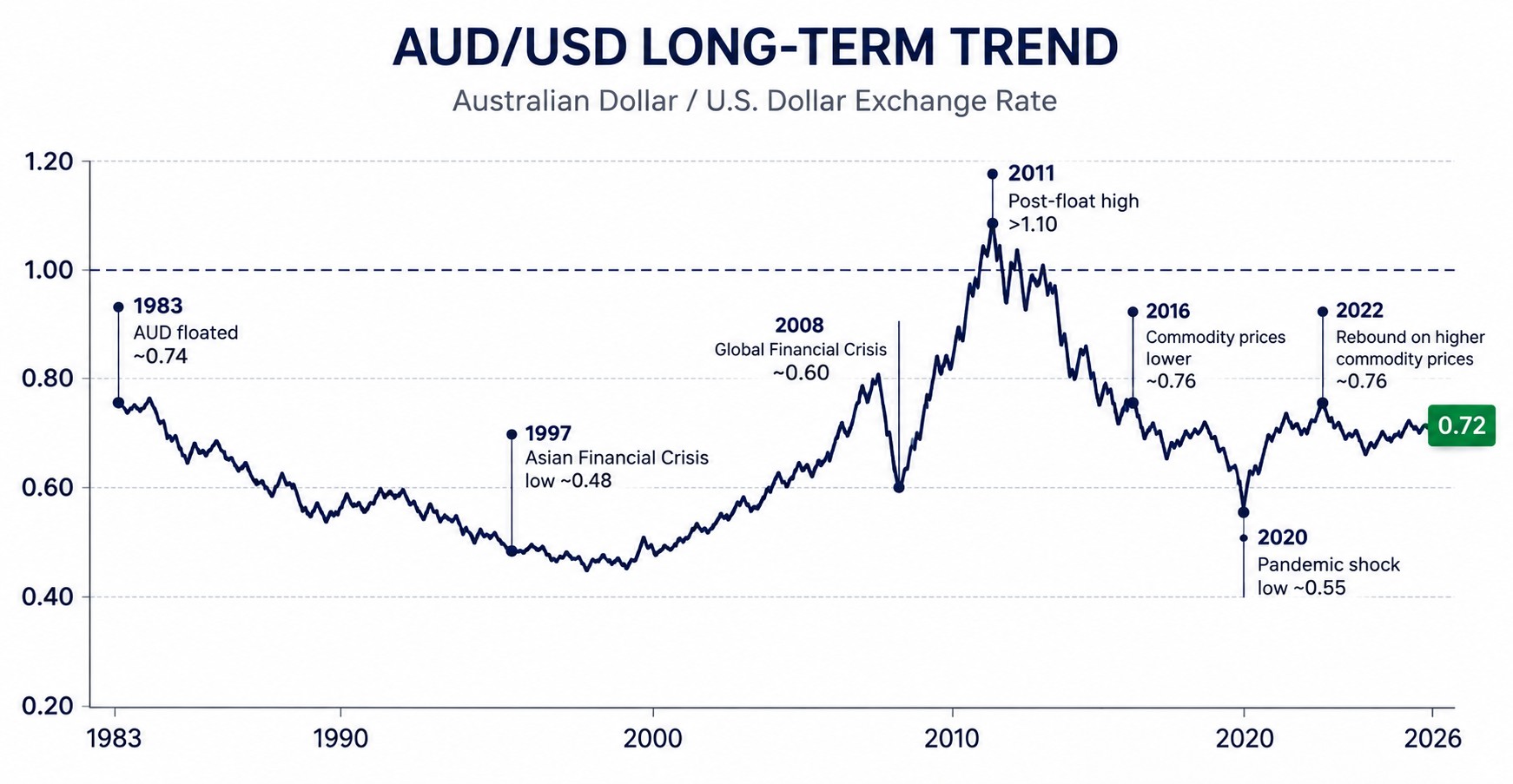
The historical relationship between AUD and USD shows why current nominal values should not be treated as permanent. Since the Australian dollar was floated in 1983, AUD/USD has experienced major cycles driven by commodity prices, global growth, interest-rate differentials and investor risk appetite.
Several periods are especially important:
The global financial crisis. AUD weakened sharply during the 2008 financial shock as investors reduced exposure to growth-sensitive assets and demand for US dollar liquidity increased.
The 2009-2011 recovery. Improving global growth, rising commodity prices and Australia's relatively strong economic outlook produced a major AUD appreciation. By early 2010, the RBA reported that stronger commodity prices and widening interest-rate differentials were supporting the currency.
The move above parity. AUD eventually moved above US$1 and reached above US$1.10 in 2011. The RBA linked the appreciation to high international prices for Australian commodities and strong demand for Australian dollars.
The post-mining-boom adjustment. As Australia's terms-of-trade boom faded and relative monetary-policy conditions changed, AUD moved back below parity.
The pandemic shock and recovery. AUD fell sharply during the initial 2020 global risk-off period before recovering alongside commodity markets and global economic activity.
The post-pandemic inflation cycle. Relative RBA and Fed policy became an increasingly important driver as both central banks responded to high inflation.
When was AUD stronger than USD?
The most important modern period when AUD was higher than USD came during the commodity and mining boom of the early 2010s. The Australian dollar moved through parity against the US dollar in 2010, and its appreciation accelerated during 2011.
In May 2011, the RBA reported that AUD had reached a new post-float high above US$1.10 and was around 8% higher against USD than its average January level, when the pair had been trading close to parity. High international prices for Australian commodities were an important source of support.
This period also answers the question: was AUD ever stronger than USD. One Australian dollar was worth more than one US dollar during significant periods of the early 2010s.
Current AUD/USD levels and what they mean for traders
Current AUD/USD levels remain well below parity, meaning the US dollar continues to trade at a higher nominal value than the Australian dollar.
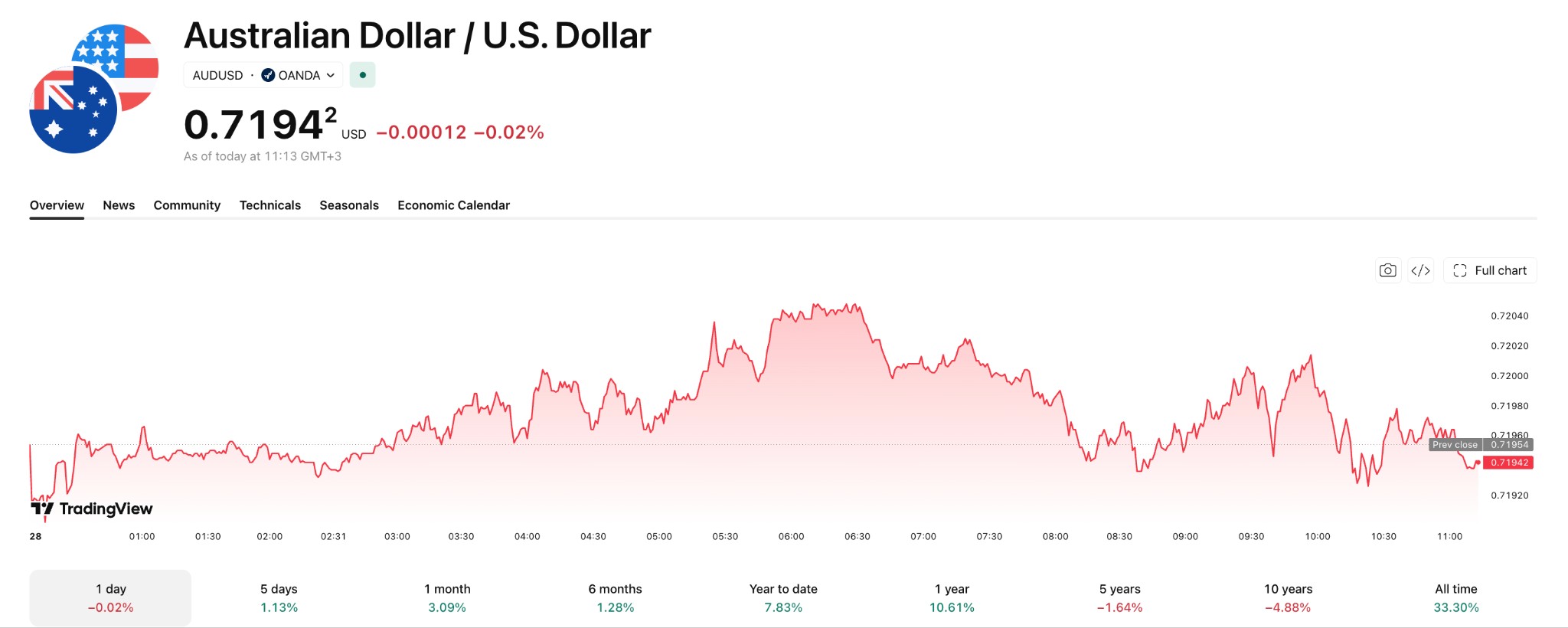
Here is what the current setup means in practical terms:
USD retains the nominal advantage. Because AUD/USD is below 1.00, one US dollar is currently worth more than one Australian dollar.
The RBA has the higher policy rate. Australia's 4.35% cash rate is above the Fed's 3.50%-3.75% target range. That does not automatically make AUD stronger because markets focus on the future path of the rate differential.
Australian inflation remains an important catalyst. The RBA says inflation remains too high and has raised rates three times in 2026. Persistently high inflation can keep Australian monetary-policy expectations relatively hawkish.
US economic resilience matters for USD. The Fed continues to describe economic activity as expanding at a solid pace, which can influence expectations about how long US rates remain restrictive.
Commodity and global-risk conditions remain important for AUD. Changes in commodity prices, Asian growth and market risk appetite can alter the outlook even when Australian domestic data are relatively stable.
| Year | Price in the middle of the year | Price at the end of the year |
|---|---|---|
| 2026 | $0.69 | $0.69 |
| 2027 | $0.68 | $0.68 |
| 2028 | $0.67 | $0.75 |
| 2029 | $0.73 | $0.71 |
| 2030 | $0.66 | $0.66 |
When the Australian dollar can become stronger than USD
For the Australian dollar to become nominally higher than USD, AUD/USD would need to rise above 1.00. That is a much larger move from current levels and would likely require a substantial shift in the relative macroeconomic environment.
Several developments could support sustained AUD appreciation:
A wider expected RBA-Fed rate advantage. If markets expect Australian rates to remain higher for longer while the Fed moves toward easier policy, AUD's relative yield appeal could improve.
Stronger Australian commodity prices. Rising prices for major exports such as iron ore can improve Australia's terms of trade and support the currency.
Stronger Chinese and Asian demand. Faster regional growth can improve expectations for Australian exports.
A weaker US growth outlook. A material deterioration in US economic conditions could increase expectations for Fed easing.
A broader decline in the US dollar. USD can weaken across multiple currency pairs when US yield advantages narrow.
Improving global risk appetite. AUD often performs better when investors become more comfortable with growth-sensitive assets.
Even under these conditions, AUD would not need to reach parity to be considered stronger in market-performance terms. A sustained rise from 0.70 to 0.80, for example, would already represent significant Australian-dollar appreciation.
Trading AUD/USD: Practical strategies
Traders who handle AUD/USD consistently do not simply decide whether USD or AUD is "stronger." They identify which relative driver is changing and whether that change is already reflected in the price.
A disciplined approach includes:
Start with the RBA-Fed policy gap. Compare current rates, but focus more heavily on changes in expectations for the next six to twelve months.
Track Australian and US inflation. Inflation surprises can quickly alter central-bank expectations and therefore the relative appeal of AUD and USD.
Watch employment data in both countries. Labour-market strength can influence how long restrictive policy remains necessary.
Follow Chinese economic conditions. Industrial activity and commodity demand can have major implications for Australia.
Monitor iron ore and Australia's terms of trade. Calling AUD a commodity currency is not enough; traders need to know which export markets are actually driving the change.
Watch global risk sentiment. AUD can be more sensitive than USD to shifts in global growth expectations and market risk appetite.
Treat parity as a reference point, not a target. There is no economic mechanism forcing AUD/USD toward 1.00.
Let price confirm the macro thesis. Strong Australian fundamentals do not guarantee AUD/USD will rise if those expectations are already priced in.
| Plus500 | Trading.com USA | OANDA | FOREX.com | IG Markets | Interactive Brokers | |
|---|---|---|---|---|---|---|
|
Tradable assets |
2800 | 69 | 129 | 5500 | 20000 | 30000 |
|
Currency pairs |
60 | 69 | 68 | 80 | 80 | 100 |
|
Demo |
Yes | Yes | Yes | Yes | Yes | Yes |
|
Min. deposit, $ |
100 | 50 | No | 100 | 1 | No |
|
Max. leverage |
1:300 | 1:50 | 1:200 | 1:50 | 1:200 | 1:30 |
|
Copy trading |
No | No | Yes | Yes | Yes | No |
|
TU overall score |
7.7 | 6.88 | 6.63 | 6.47 | 6.38 | 6.37 |
|
Open an account |
Go to broker 81% of retail CFD accounts lose money. |
Go to broker Your capital is at risk. |
Go to broker Your capital is at risk. |
Study review | Study review | Study review |
AUD/USD News

Australian Dollar vs US Dollar trades up after surprise rise in Australian unemployment

Australian dollar to US dollar rate pressured by weak jobs data: Can AUD/USD hold recent gains?

Australian markets set to open higher as Wall Street rotation weighs on tech and the Australian dollar slides

Why is AUD/USD down 0.7% today?

AUD/USD technical analysis: Range-bound trading continues below $0.6986 resistance

Binasat Communications proposes private placement to fund contracts
I would focus on the change in the RBA-Fed outlook rather than parity

I would not use the fact that USD is stronger than AUD in nominal terms as a trading signal by itself. AUD/USD below 1.00 contains very little information about where the pair should move next.
For this pair, I would focus first on whether the expected RBA-Fed policy differential is widening or narrowing. Australia's current headline rate advantage is significant, but that advantage only supports AUD if the market expects it to persist or increase. If traders begin pricing earlier Australian easing or higher US rates, AUD/USD can fall even while the RBA's current policy rate remains above the Fed's.
I would also treat commodity conditions as a confirmation signal rather than an isolated reason to trade AUD. Stronger iron ore prices and improving Chinese demand can support the Australian dollar, but AUD/USD still reflects the US side of the equation. A simultaneous rise in US yields or stronger defensive demand for USD can offset positive Australian developments.
For that reason, I prefer to combine the relative macro view with price confirmation. A good AUD/USD thesis should explain not only why AUD could strengthen or weaken, but also why that change has not already been fully priced by the market.
Conclusion
The central takeaway is that nominal exchange rates alone do not determine a currency’s true strength or trading outlook. While the US dollar is currently worth more than the Australian dollar, real opportunity lies in understanding the changing dynamics between the Federal Reserve and Reserve Bank of Australia, as well as shifts in commodity prices and global risk sentiment. For instance, during the early 2010s, strong Australian exports pushed AUD above parity with USD, demonstrating how quickly circumstances can shift. Ultimately, currency traders should look beyond surface comparisons and focus on the deeper forces that shape AUD/USD’s direction for lasting success.
FAQs
What factors besides exchange rates influence the strength of the US dollar compared to the Australian dollar?
How do changes in commodity prices impact the AUD/USD currency pair?
Can the Australian dollar appreciate against the US dollar even if it remains below parity?
Why is the US dollar often more resilient during periods of global financial uncertainty?
Editors' Top Picks and Insights






Related Articles
Team that worked on the article
Aleksandra Chaikina has been a contributor to Traders Union since 2021. With over 15 years of experience in copywriting and more than 5 years focused on financial content, she specializes in producing detailed guides, analytics, and comparative reviews across various sectors, including cryptocurrencies, Forex, investment strategies, and financial technologies.
Ciaran Ryan is a veteran financial journalist based in South Africa, where he covers cryptocurrency, mining, stock markets, and governance for Moneyweb. He also hosts the weekly Moneyweb Crypto Podcast.
Chinmay Soni is a financial analyst with more than 5 years of experience in working with stocks, Forex, derivatives, and other assets. As a founder of a boutique research firm and an active researcher, he covers various industries and fields, providing insights backed by statistical data.
Index in trading is the measure of the performance of a group of stocks, which can include the assets and securities in it.
Forex leverage is a tool enabling traders to control larger positions with a relatively small amount of capital, amplifying potential profits and losses based on the chosen leverage ratio.
CFD is a contract between an investor/trader and seller that demonstrates that the trader will need to pay the price difference between the current value of the asset and its value at the time of contract to the seller.
Bitcoin is a decentralized digital cryptocurrency that was created in 2009 by an anonymous individual or group using the pseudonym Satoshi Nakamoto. It operates on a technology called blockchain, which is a distributed ledger that records all transactions across a network of computers.
Yield refers to the earnings or income derived from an investment. It mirrors the returns generated by owning assets such as stocks, bonds, or other financial instruments.

-
 Afghanistan
-
 Albania
-
 Algeria
-
 Angola
-
 Argentina
-
 Armenia
-
 Australia
-
 Austria
-
 Azerbaijan
-
 Bahamas
-
 Bahrain
-
 Bangladesh
-
 Belarus
-
 Belgium
-
 Bolivia
-
 Botswana
-
 Brazil
-
 Brunei
-
 Bulgaria
-
 Cambodia
-
 Cameroon
-
 Canada
-
 Chile
-
 China
-
 Colombia
-
 Congo
-
 Costa Rica
-
 Cote d'Ivoire
-
 Croatia
-
 Cuba
-
 Cyprus
-
 Czechia
-
 DR Congo
-
 Denmark
-
 Dominican Republic
-
 Ecuador
-
 Egypt
-
 El Salvador
-
 Estonia
-
 Eswatini
-
 Ethiopia
-
 Finland
-
 France
-
 Georgia
-
 Germany
-
 Ghana
-
 Greece
-
 Haiti
-
 Hong Kong
-
 Hungary
-
 India
-
 Indonesia
-
 Iran, Islamic republic
-
 Iraq
-
 Ireland
-
 Israel
-
 Italy
-
 Jamaica
-
 Japan
-
 Jordan
-
 Kazakhstan
-
 Kenya
-
 Korea
-
 Kuwait
-
 Kyrgyzstan
-
 Laos
-
 Latvia
-
 Lebanon
-
 Lesotho
-
 Libya
-
 Lithuania
-
 Luxembourg
-
 Madagascar
-
 Malaysia
-
 Malta
-
 Mauritius
-
 Mexico
-
 Moldova
-
 Mongolia
-
 Montenegro
-
 Morocco
-
 Mozambique
-
 Myanmar
-
 Namibia
-
 Nepal
-
 Netherlands
-
 New Zealand
-
 Nigeria
-
 North Macedonia
-
 Norway
-
 Oman
-
 Pakistan
-
 Palestine
-
 Panama
-
 Papua New Guinea
-
 Paraguay
-
 Peru
-
 Philippines
-
 Poland
-
 Portugal
-
 Puerto Rico
-
 Qatar
-
 Reunion
-
 Romania
-
 Rwanda
-
 Saudi Arabia
-
 Serbia
-
 Singapore
-
 Slovakia
-
 Slovenia
-
 Somalia
-
 South Africa
-
 Spain
-
 Sri Lanka
-
 Sweden
-
 Switzerland
-
 Syria
-
 Taiwan
-
 Tajikistan
-
 Tanzania
-
 Thailand
-
 Trinidad and Tobago
-
 Tunisia
-
 Turkey
-
 UAE
-
 Uganda
-
 Ukraine
-
 United Kingdom
-
United States
-
 Uruguay
-
 Uzbekistan
-
 Venezuela
-
 Vietnam
-
 Yemen
-
 Zambia
-
 Zimbabwe
- Forex
- Crypto










- Is USD stronger than AUD?
- Why is USD stronger than AUD?
- Historical relationship between AUD and USD
- When was AUD stronger than USD?
- Current AUD/USD levels and what they mean for traders
- When the Australian dollar can become stronger than USD
- Trading AUD/USD: Practical strategies
- Expert opinion
- Conclusion
- FAQs


