
Is the Pound Stronger Than the Canadian Dollar: A Complete Guide


Editorial Note: While we adhere to strict Editorial Integrity, this post may contain references to products from our partners. Here's an explanation for How We Make Money. None of the data and information on this webpage constitutes investment advice according to our Disclaimer.
Is the pound stronger than the Canadian dollar:
Comparing the British pound and the Canadian dollar is not as straightforward as looking at which currency has the higher exchange-rate value. For traders, what matters is how GBP and CAD perform relative to each other and which economic forces can shift that balance. This guide explains how to assess GBP versus CAD, what drives the GBP/CAD pair, and which factors traders should watch when evaluating its direction.
Is GBP stronger than CAD?
Yes, if strength means nominal value. GBP/CAD typically trades above 1.00, meaning £1 buys more than C$1. However, nominal value alone does not show which currency is performing better or is more attractive to traders.
Monetary policy is an important part of the comparison:
The Bank of England. Changes in UK interest rates and expectations for future BoE policy can affect demand for sterling.
The Bank of Canada. Canadian interest rates and expectations for future BoC decisions can similarly influence CAD.
The difference between expected UK and Canadian interest rates can be an important driver of GBP/CAD. If markets expect UK rates to be relatively higher, that can support GBP; if the expected rate advantage shifts toward Canada, CAD can strengthen against sterling.
So, GBP is generally the stronger currency in nominal terms, but that does not mean it will always outperform CAD. For traders, changes in relative monetary-policy expectations and economic conditions are more important than the currencies’ nominal values alone.
| Month | Minimum Price, $ | Average Price, $ | Maximum Price, $ |
|---|---|---|---|
| November 2026 | 1.8 | 1.8 | 1.9 |
| December 2026 | 1.7 | 1.8 | 1.8 |
What does "currency strength" actually mean?
Currency strength has several meanings:
Nominal value. GBP/CAD above 1.00 means one pound buys more than one Canadian dollar.
Relative performance. If GBP/CAD falls from 1.95 to 1.85, CAD has strengthened substantially against GBP even though £1 is still worth more than C$1.
Interest-rate appeal. Higher expected rates can make assets denominated in a currency more attractive. The UK's current policy rate is considerably higher than Canada's.
Economic momentum. Growth, employment, wages and inflation influence expectations for central-bank policy and international capital flows.
External exposure. Sterling is primarily driven by UK conditions and global capital flows. CAD has unusually strong exposure to the US economy and Canada's commodity exports.
For traders, relative performance is usually more important than nominal value.
What actually moves GBP/CAD?
GBP/CAD is a cross-currency pair, so neither side is the US dollar. Nevertheless, several of its most important drivers extend beyond Britain and Canada.
Bank of England vs Bank of Canada
The relative monetary-policy outlook is one of the clearest GBP/CAD drivers. With Bank Rate at 3.75% and Canada's overnight rate at 2.25%, the UK currently has a 150-basis-point policy-rate advantage. If markets expect that advantage to persist or widen, GBP can receive support. If traders expect the BoE to cut rates while Canadian policy remains unchanged or becomes tighter, the expected differential narrows and CAD can benefit.
The direction of expectations matters more than the absolute rates. GBP/CAD can therefore fall even while UK rates remain higher if markets suddenly price a faster path of future BoE easing.
Canada-US economic and trade relationship
The US is Canada's dominant trading partner, making American economic conditions unusually important for CAD.
Strong US demand can support Canadian exports, investment and growth. Conversely, weaker US activity can weigh on Canada's outlook. Trade policy can be equally important: tariffs or uncertainty surrounding cross-border trade can affect investment and expectations for Canadian growth. This means GBP/CAD traders need to monitor major US developments even though USD is absent from the pair.
Oil and commodity prices
Canada is a major energy exporter, so oil can influence its terms of trade, corporate income, investment and government revenues. Historically, rising oil prices have often been associated with a stronger Canadian dollar. But this relationship is not mechanical. The source of an oil-price move matters, as do broader financial conditions and the response of Canada's economy.
Global risk sentiment
CAD can also respond to changes in expectations for global growth. Stronger global activity can improve the outlook for commodity demand and Canadian exports, while severe risk aversion can create pressure on growth-sensitive currencies.
Sterling has its own exposure to global sentiment, however, so risk-on or risk-off conditions do not produce a guaranteed GBP/CAD direction.
Historical relationship between GBP and CAD
GBP/CAD has historically traded comfortably above parity but has experienced substantial cycles.
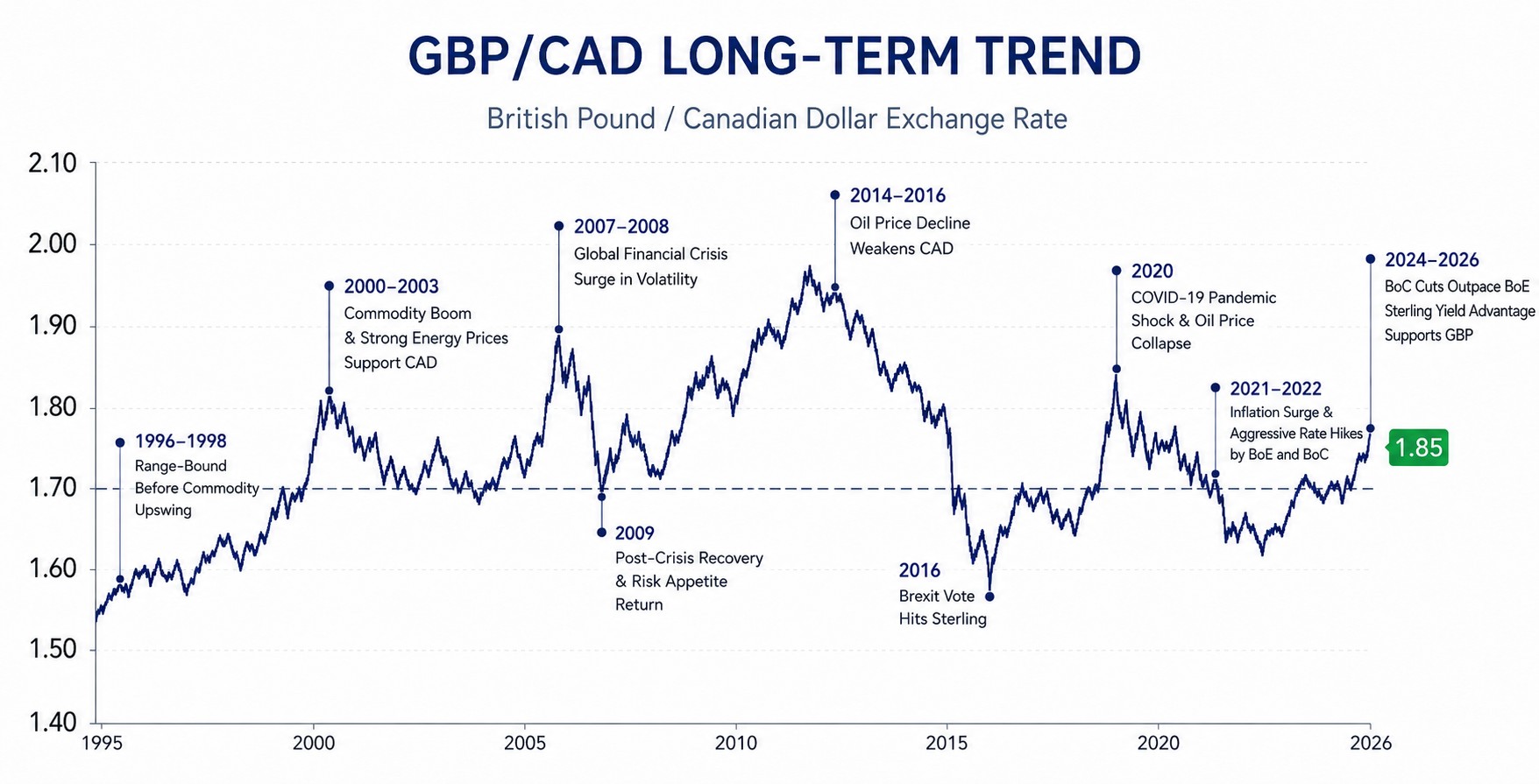
Several episodes illustrate the different forces affecting the pair:
The 2000s commodity boom. Strong global commodity demand and high energy prices improved Canada's terms of trade and supported CAD.
The global financial crisis. Both currencies experienced exceptional volatility. Sterling faced severe pressure because of the UK's exposure to the banking crisis, while Canada was affected by collapsing global growth and commodity demand.
The oil downturn of 2014–2016. Falling crude prices weakened Canada's economic outlook and contributed to CAD pressure.
Brexit. The UK's 2016 referendum created a major sterling-specific shock as investors reassessed Britain's future relationship with the European Union.
The pandemic shock. GBP and CAD both experienced sharp volatility in 2020. CAD was hit by the combination of global risk aversion and collapsing energy demand before recovering as economic activity and commodity markets normalized.
The post-pandemic inflation cycle. Aggressive monetary tightening in both countries made relative BoE-BoC expectations increasingly important.
The subsequent policy divergence. Canadian rates eventually fell considerably below UK rates, creating a significant yield advantage for sterling.
The lesson is that GBP's higher nominal unit value has not prevented CAD from outperforming it during particular economic cycles. GBP/CAD is better understood as a relative macroeconomic trade than as a comparison of two fixed currency values.
Current GBP/CAD levels and what they mean for traders
GBP/CAD currently remains well above parity, confirming sterling's higher nominal value. But the absolute exchange rate is less important for traders than the forces behind its next move.
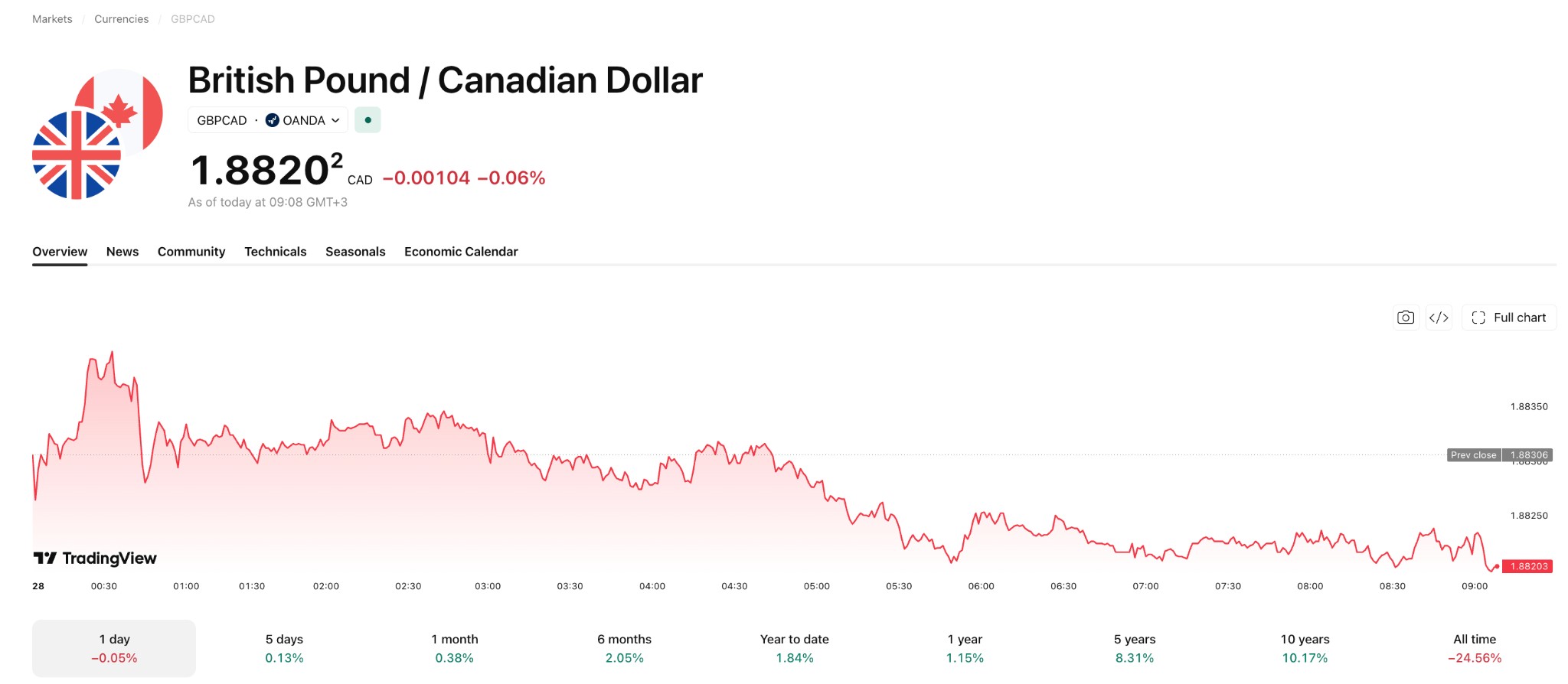
Several features of the current setup deserve attention:
The UK has a substantial yield advantage. Bank Rate at 3.75% is 150 basis points above Canada's 2.25% overnight rate. This can support GBP as long as markets expect the gap to persist.
Inflation remains relevant in both countries. UK CPI inflation reached 2.9% in July, while Canadian CPI was 3.0%. The numbers themselves are less important for GBP/CAD than how they alter BoE and BoC policy expectations.
The Canadian rate outlook is no longer simply about easing. The Bank of Canada's second-quarter Market Participants Survey showed a median expectation for the policy rate to remain at 2.25% through the end of 2026, before rising later in 2027.
External risks are unusually important for CAD. US trade policy, oil prices and geopolitical developments can change the Canadian outlook independently of domestic data.
Nominal strength should not be confused with momentum. A declining GBP/CAD rate means CAD is outperforming GBP regardless of how far the pair remains above 1.00.
For traders, the key question is therefore whether the UK yield advantage will remain dominant or whether improving Canadian fundamentals and changing BoC expectations can narrow sterling's relative advantage.
| Year | Price in the middle of the year | Price at the end of the year |
|---|---|---|
| 2026 | $1.8 | $1.8 |
| 2027 | $1.7 | $1.8 |
| 2028 | $1.8 | $1.8 |
| 2029 | $1.8 | $1.8 |
| 2030 | $1.6 | $1.7 |
When can CAD be stronger than GBP?
CAD does not need to become nominally more valuable than GBP to outperform sterling. Any sustained decline in GBP/CAD means the Canadian dollar is strengthening relative to the pound.
For one Canadian dollar to become nominally worth more than one pound, GBP/CAD would need to fall below 1.00. From current levels, that would represent an extraordinary move and is not a realistic baseline for ordinary medium-term analysis.
Several developments could create this environment:
The BoE-BoC rate gap narrows. Faster-than-expected UK rate cuts or a more restrictive Canadian policy path would reduce sterling's current yield advantage.
Canadian growth improves. Stronger consumption, investment or employment could increase expectations for tighter future BoC policy.
Canadian inflation remains persistent. If underlying inflation proves stronger than expected, markets could price higher Canadian rates.
US demand strengthens. A robust US economy can improve the outlook for Canadian exports.
Trade uncertainty declines. Greater clarity around Canada-US trade relations could support business investment and CAD sentiment.
Commodity conditions improve. Strong oil prices accompanied by healthy global demand can improve Canada's external position.
UK activity weakens. Poorer UK growth or labor-market data could increase expectations for BoE easing.
No single factor guarantees CAD appreciation. The strongest GBP/CAD trends usually emerge when several relative drivers point in the same direction.
Trading GBP/CAD: Practical strategies
GBP/CAD traders should focus on relative changes rather than deciding that sterling is "stronger" simply because one pound buys more Canadian dollars.
A practical framework includes:
Track the expected BoE-BoC rate differential. Current policy rates provide context, but changes in expectations for the next six to twelve months can move GBP/CAD before either central bank acts.
Build a two-country economic calendar. UK and Canadian inflation, employment, GDP, wages and business surveys can rapidly alter rate expectations.
Add major US events to the calendar. US growth and trade developments can materially affect CAD even though GBP/CAD contains no US dollar.
Monitor central-bank communication. Voting patterns, inflation projections and forward guidance can be more informative than the headline rate decision.
Treat oil as confirmation, not an automatic signal. A crude rally is more useful when it aligns with improving Canadian growth expectations and stronger CAD price action.
Compare the reaction with the news. If strong Canadian data fail to push GBP/CAD lower, the information may already be priced in or another driver may dominate.
Watch liquidity. GBP/CAD is an actively traded cross but is generally less liquid than GBP/USD or USD/CAD. Spreads can widen outside active London and North American trading periods.
Use price to validate the macro view. Fundamentals can establish directional bias, but technical structure can help determine whether the market is actually confirming it.
Define invalidation before entry. Central-bank surprises, oil shocks and unexpected US trade developments can quickly overturn an otherwise convincing thesis.
GBP/CAD is fundamentally a relative-value trade. A strong setup usually requires agreement between macroeconomic expectations and price action rather than a conclusion based on the nominal exchange rate alone.
Risk management remains essential because the pair combines several independent sources of volatility: UK data, Canadian data, two central banks, energy markets, US developments and global risk sentiment.
Execution conditions also matter. Because GBP/CAD is a cross rather than one of the most liquid major currency pairs, broker spreads and slippage can have a larger effect on short-term strategies.
| Plus500 | Trading.com USA | OANDA | FOREX.com | IG Markets | Interactive Brokers | |
|---|---|---|---|---|---|---|
|
Tradable assets |
2800 | 69 | 129 | 5500 | 20000 | 30000 |
|
Currency pairs |
60 | 69 | 68 | 80 | 80 | 100 |
|
Demo |
Yes | Yes | Yes | Yes | Yes | Yes |
|
Min. deposit, $ |
100 | 50 | No | 100 | 1 | No |
|
Max. leverage |
1:300 | 1:50 | 1:200 | 1:50 | 1:200 | 1:30 |
|
Copy trading |
No | No | Yes | Yes | Yes | No |
|
TU overall score |
7.7 | 6.88 | 6.63 | 6.47 | 6.38 | 6.37 |
|
Open an account |
Go to broker 81% of retail CFD accounts lose money. |
Go to broker Your capital is at risk. |
Go to broker Your capital is at risk. |
Study review | Study review | Study review |
I would focus on the BoE-BoC policy gap before assuming oil will determine the next GBP/CAD move

I would not use GBP/CAD trading well above 1.00 as evidence that sterling necessarily has the stronger outlook. The nominal comparison is straightforward, but the direction of the pair depends much more on changes in relative monetary-policy expectations.
The UK's 3.75% Bank Rate currently stands considerably above the Bank of Canada's 2.25% overnight rate. I would therefore watch whether markets continue to expect that gap to persist. If UK inflation remains sticky and the BoE stays restrictive, sterling can retain an important source of support. If the market instead starts pricing faster UK easing while expectations for Canadian rates move higher, GBP/CAD could fall even before either central bank changes policy.
I would also avoid treating oil as a mechanical CAD signal. Higher crude prices can improve Canada's terms of trade, but the effect depends on why oil is rising and what the move means for inflation, growth and monetary policy. US economic and trade developments can sometimes be more important for CAD than oil itself.
For a trade, I would want price action to confirm the macro thesis. If favorable Canadian developments repeatedly fail to push GBP/CAD lower, that tells me the market may already have priced them in or that sterling's rate advantage remains dominant.
Finally, I would determine the invalidation level before sizing a position. GBP/CAD is exposed to independent shocks from UK data, Canadian data, central banks, energy markets and US trade policy. A strong fundamental argument does not eliminate the need for controlled risk.
Conclusion
The British pound is nominally stronger than the Canadian dollar, as GBP/CAD consistently trades above 1.00, yet the true driver for traders is the dynamic interplay of relative economic fundamentals and monetary policy between the UK and Canada. Evaluating currency strength through mere nominal value can be misleading; for instance, CAD outperformed GBP during periods like the 2000s commodity boom or when the UK faced Brexit-induced shocks. In practice, following the expected interest rate gap between the Bank of England and the Bank of Canada is usually more pivotal than tracking oil prices alone. Above all, real opportunity lies not in assuming sterling's superiority, but in understanding how shifting rate expectations and macro momentum can rapidly change the tide in this cross-currency pair.
FAQs
How do interest rate expectations impact the GBP/CAD exchange rate?
What external factors besides oil prices affect the Canadian dollar in GBP/CAD trading?
Is the higher nominal value of GBP over CAD a reliable indicator of economic strength?
Why can CAD outperform GBP even if GBP/CAD remains above 1.00?
Editors' Top Picks and Insights






Related Articles
Team that worked on the article
Aleksandra Chaikina has been a contributor to Traders Union since 2021. With over 15 years of experience in copywriting and more than 5 years focused on financial content, she specializes in producing detailed guides, analytics, and comparative reviews across various sectors, including cryptocurrencies, Forex, investment strategies, and financial technologies.
Ciaran Ryan is a veteran financial journalist based in South Africa, where he covers cryptocurrency, mining, stock markets, and governance for Moneyweb. He also hosts the weekly Moneyweb Crypto Podcast.
Chinmay Soni is a financial analyst with more than 5 years of experience in working with stocks, Forex, derivatives, and other assets. As a founder of a boutique research firm and an active researcher, he covers various industries and fields, providing insights backed by statistical data.
An investor is an individual, who invests money in an asset with the expectation that its value would appreciate in the future. The asset can be anything, including a bond, debenture, mutual fund, equity, gold, silver, exchange-traded funds (ETFs), and real-estate property.
Volatility refers to the degree of variation or fluctuation in the price or value of a financial asset, such as stocks, bonds, or cryptocurrencies, over a period of time. Higher volatility indicates that an asset's price is experiencing more significant and rapid price swings, while lower volatility suggests relatively stable and gradual price movements.
Forex leverage is a tool enabling traders to control larger positions with a relatively small amount of capital, amplifying potential profits and losses based on the chosen leverage ratio.
CFD is a contract between an investor/trader and seller that demonstrates that the trader will need to pay the price difference between the current value of the asset and its value at the time of contract to the seller.
Yield refers to the earnings or income derived from an investment. It mirrors the returns generated by owning assets such as stocks, bonds, or other financial instruments.

-
 Afghanistan
-
 Albania
-
 Algeria
-
 Angola
-
 Argentina
-
 Armenia
-
 Australia
-
 Austria
-
 Azerbaijan
-
 Bahamas
-
 Bahrain
-
 Bangladesh
-
 Belarus
-
 Belgium
-
 Bolivia
-
 Botswana
-
 Brazil
-
 Brunei
-
 Bulgaria
-
 Cambodia
-
 Cameroon
-
 Canada
-
 Chile
-
 China
-
 Colombia
-
 Congo
-
 Costa Rica
-
 Cote d'Ivoire
-
 Croatia
-
 Cuba
-
 Cyprus
-
 Czechia
-
 DR Congo
-
 Denmark
-
 Dominican Republic
-
 Ecuador
-
 Egypt
-
 El Salvador
-
 Estonia
-
 Eswatini
-
 Ethiopia
-
 Finland
-
 France
-
 Georgia
-
 Germany
-
 Ghana
-
 Greece
-
 Haiti
-
 Hong Kong
-
 Hungary
-
 India
-
 Indonesia
-
 Iran, Islamic republic
-
 Iraq
-
 Ireland
-
 Israel
-
 Italy
-
 Jamaica
-
 Japan
-
 Jordan
-
 Kazakhstan
-
 Kenya
-
 Korea
-
 Kuwait
-
 Kyrgyzstan
-
 Laos
-
 Latvia
-
 Lebanon
-
 Lesotho
-
 Libya
-
 Lithuania
-
 Luxembourg
-
 Madagascar
-
 Malaysia
-
 Malta
-
 Mauritius
-
 Mexico
-
 Moldova
-
 Mongolia
-
 Montenegro
-
 Morocco
-
 Mozambique
-
 Myanmar
-
 Namibia
-
 Nepal
-
 Netherlands
-
 New Zealand
-
 Nigeria
-
 North Macedonia
-
 Norway
-
 Oman
-
 Pakistan
-
 Palestine
-
 Panama
-
 Papua New Guinea
-
 Paraguay
-
 Peru
-
 Philippines
-
 Poland
-
 Portugal
-
 Puerto Rico
-
 Qatar
-
 Reunion
-
 Romania
-
 Rwanda
-
 Saudi Arabia
-
 Serbia
-
 Singapore
-
 Slovakia
-
 Slovenia
-
 Somalia
-
 South Africa
-
 Spain
-
 Sri Lanka
-
 Sweden
-
 Switzerland
-
 Syria
-
 Taiwan
-
 Tajikistan
-
 Tanzania
-
 Thailand
-
 Trinidad and Tobago
-
 Tunisia
-
 Turkey
-
 UAE
-
 Uganda
-
 Ukraine
-
 United Kingdom
-
United States
-
 Uruguay
-
 Uzbekistan
-
 Venezuela
-
 Vietnam
-
 Yemen
-
 Zambia
-
 Zimbabwe
- Forex
- Crypto












