
BitPay Card In 2026 | Full Review



Editorial Note: While we adhere to strict Editorial Integrity, this post may contain references to products from our partners. Here's an explanation for How We Make Money. None of the data and information on this webpage constitutes investment advice according to our Disclaimer.
The BitPay card is a prepaid crypto debit card that instantly converts Bitcoin and other digital assets into fiat for real-world use. It works like a standard Visa card, letting you shop online, withdraw cash, or make contactless payments through Apple Pay and Google Pay. Currently, it remains one of the most reliable and regulation-compliant ways to spend cryptocurrency with transparent fees and global expansion underway.
The BitPay card has established itself as a secure and convenient way to spend cryptocurrency anywhere Visa is accepted. In this comprehensive review, we explore what the card is, how it works, its fees and limits, and whether it’s still one of the best crypto debit cards in 2026. Read our Bitpay card FAQ to know all about its features.
What is the BitPay card?
Before applying for one, it’s important to understand what the BitPay card actually offers. This prepaid crypto debit card allows users to convert Bitcoin, Ethereum, or stablecoins into fiat currency instantly. Funds can then be spent online, in stores, or withdrawn from ATMs, making it function much like a traditional debit card. Both a physical and virtual BitPay card are available, with integration inside the BitPay Wallet app.

Key facts
Backed by regulated U.S. financial partners.
Integrates with BitPay Wallet for fast funding.
Offers a prepaid crypto-debit card, not a traditional BitPay credit card.
Offers both BitPay virtual card and BitPay prepaid card options.
Fully supports BitPay gift cards within the same app.
How does the BitPay card work
Let’s look at how the system operates and why it’s popular among crypto holders.
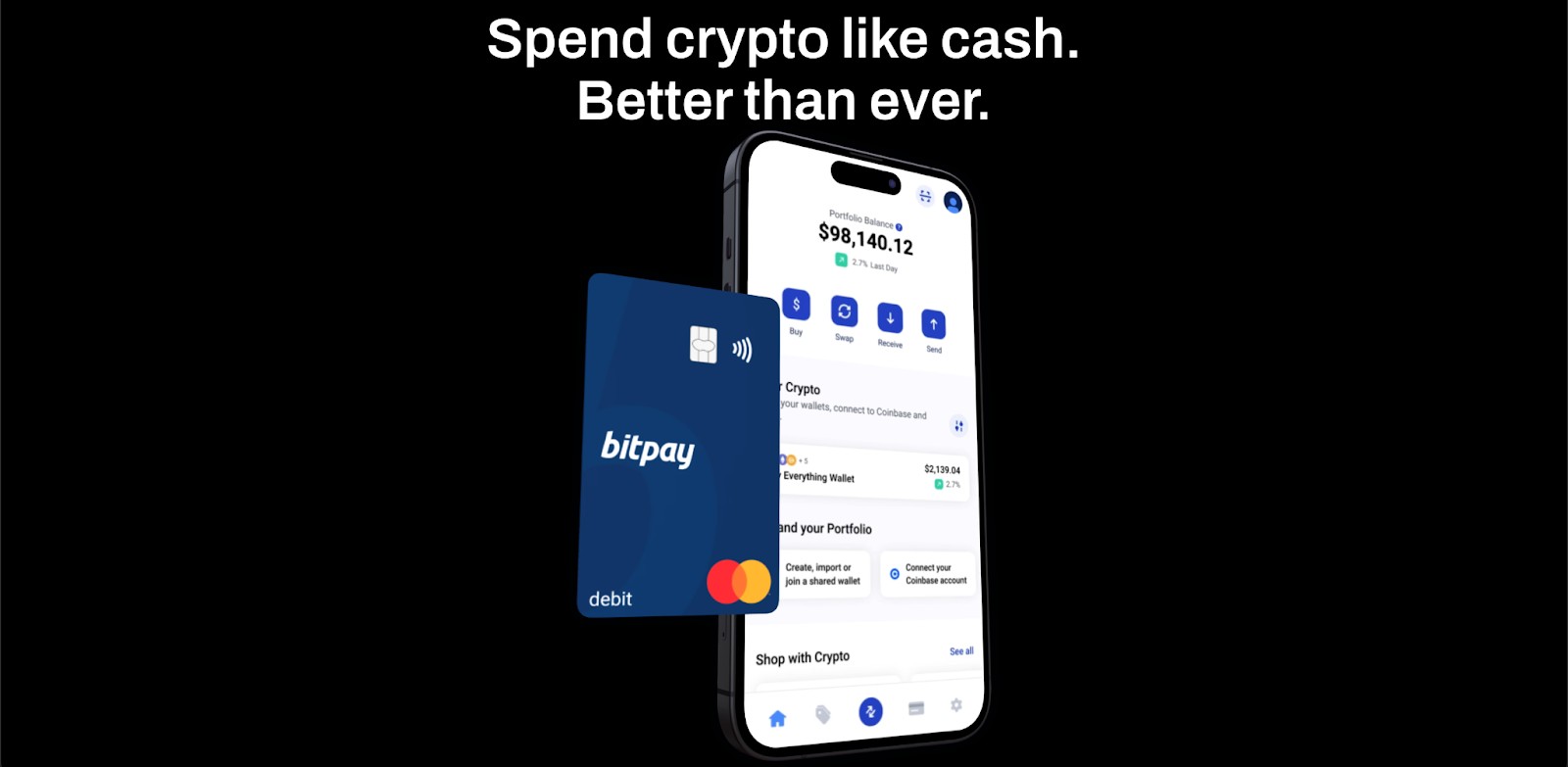
When you make a purchase, your crypto balance is automatically converted to fiat at the moment of payment. The BitPay crypto card uses the Visa network, so it’s accepted almost everywhere worldwide.
How to add funds to the BitPay card
Addressing common queries such as how to add funds to the BitPay card or how to load a BitPay card, we assure you that adding money to the BitPay card is easy. Just open the BitPay Wallet, tap “Load card,” choose the currency, and confirm. The transfer appears on your balance within minutes.
How to use the BitPay card
The card works like any debit product. You can shop online, pay in-store with tap-to-pay, or withdraw cash at ATMs. Integration with Apple Pay and Google Pay means your BitPay card also supports contactless payments on mobile.
How to get BitPay card
Let’s understand how to get a BitPay card and the KYC process you must complete before using it.
To apply, visit the BitPay card official site, sign up through the BitPay app, and complete the key application requirements for the BitPay card. Once verified, you can get a BitPay virtual card and physical BitPay prepaid card and start using it right away.
Activation process
After approval, go to BitPay.com/card/activate, click activate BitPay card, and set your BitPay card pin. Your card will be ready for spending, online shopping, or cash withdrawal (subject to BitPay card terms) within minutes.
BitPay card fees 2026
Every financial product has costs. This section covers all BitPay debit card limits and fees in 2026.
| Fee/limit type | Amount/note |
|---|---|
| Virtual card issuance | Free |
| Physical card | $10 |
| Bitpay ATM card withdrawal fee | $2.50 per transaction |
| Foreign transaction fee | 3% |
| Reload/Load BitPay card limit | Up to $10,000/day |
| Bitpay card ATM limit | $2,000/day |
| Purchase limit | $10,000/day |
Overall, BitPay debit card fees are competitive, though travelers should note that foreign transaction fees may add up when using the BitPay visa card abroad.
Note! If your BitPay card is not working at an ATM, check that your balance is loaded in USD (not just crypto), your KYC verification is complete, and the ATM supports Mastercard withdrawals. Try withdrawing a small amount ($20–$30) from a different ATM.
BitPay card supported countries
Availability remains a crucial factor for crypto users. This section talks about BitPay card available countries.
The BitPay card is available primarily in the U.S., with gradual expansion into Canada, Europe, and the U.K.
According to BitPay card availability countries 2026, more regions may be added, including support for the BitPay card in Australia and France.
Users outside these regions can still join the waitlist and monitor the availability for BitPay card in Europe and Canada.
BitPay card taxes, security, and compliance
Security and regulation determine the reliability of any crypto debit card. The BitPay card follows strict KYC requirements (in line with user preferences in 2026), ensuring safety and compliance.
BitPay card KYC requirements:
Users must provide a valid government-issued identity document (passport, driver’s license, national ID) for verification via BitPay ID/Onfido.
A selfie/photo for facial verification is required in many cases (to match the ID document).
Proof of residential address (for example utility bill, bank statement) may be required depending on region and usage.
Must be 18 years or older to apply for the BitPay free card.
Security features
EMV chip and BitPay card pin protection.
Two-factor authentication via the app.
Option to freeze or cancel your BitPay card if lost.
Does BitPay card report to the IRS? Taxes and reporting explained
Yes, large transactions and crypto-to-fiat conversions may be reported. According to the OECD’s 2023 Crypto-Asset Reporting Framework, card issuers must disclose certain crypto-fiat conversions to tax authorities to improve transparency and cross-border tax compliance.
Advanced features and integrations
The BitPay card ecosystem includes several advanced options designed to enhance usability and accessibility.
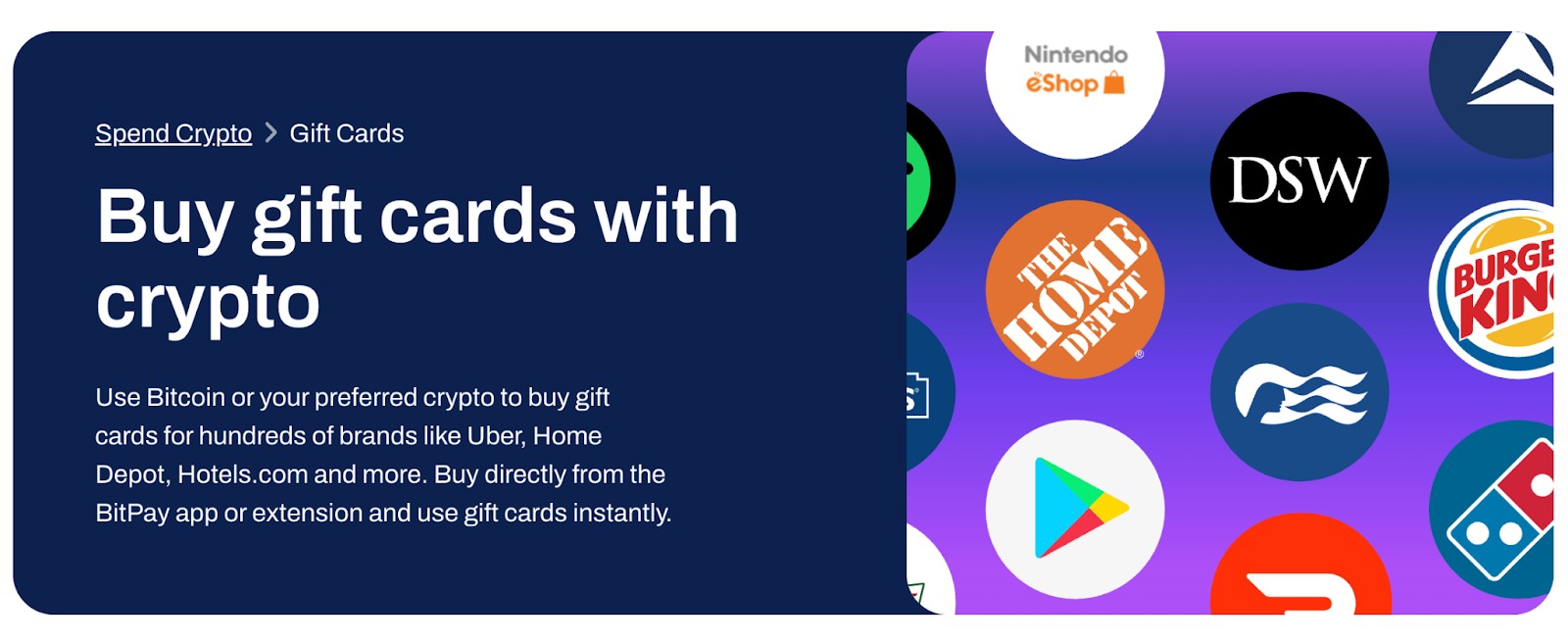
You can purchase BitPay gift cards, check BitPay card tracking, and use BitPay card’s Apple pay support functionality for contactless payments. For help, contact the BitPay card customer service number or chat through the app.
Occasionally, users can also enjoy bonuses via BitPay promo code for card transactions.
Pros and cons of BitPay card
Before applying, consider the advantages and drawbacks of using a BitPay card in 2026.
- Pros
- Cons
instant crypto-to-fiat conversion;
no monthly maintenance fee;
integration with Apple Pay and Google Pay;
compatible with BitPay gift cards;
high debit card purchase limit;
transparent fees;
virtual and physical card options offered by BitPay.
limited card availability countries offered by BitPay;
3% foreign transaction fee on cross-currency purchases;
users occasionally reporting that their BitPay cards are not working at ATM for cash withdrawal;
no cashback or reward program;
some regions still show that the BitPay card has been discontinued / new applications have been halted.

If you’re exploring the BitPay card to manage and spend your crypto, it’s also worth checking where you trade. Our guide to the best crypto exchanges in your region can help you find reliable platforms for buying, selling, or topping up your wallet safely before loading your BitPay card.
| Crypto | Foundation year | Min. Deposit, $ | Coins Supported | Spot Taker fee, % | Spot Maker Fee, % | Alerts | Copy trading | Tier-1 regulation | TU overall score | Open an account | |
|---|---|---|---|---|---|---|---|---|---|---|---|
| Yes | 2011 | 10 | 278 | 0.4 | 0.25 | Yes | Yes | Yes | 9.2 | Go to broker Your capital is at risk. |
|
| Yes | 2017 | 10 | 329 | 0.1 | 0.08 | Yes | Yes | No | 8.9 | Go to broker Your capital is at risk. |
|
| Yes | 2011 | 10 | 399 | 0.3 | 0.2 | No | Yes | Yes | 7.84 | Go to broker Your capital is at risk.
|
|
| Yes | 2012 | 10 | 249 | 0.5 | 0.5 | Yes | No | Yes | 7.68 | Go to broker Your capital is at risk. |
|
| Yes | 2014 | 5 | 30 | Not available | Not available | No | No | Yes | 7.6 | Go to broker Your capital is at risk.
|
The BitPay card taught me that simplicity often wins in crypto payments

I’ve been using the BitPay card for over a year, and what strikes me most is how seamlessly it fits into my daily routine. I don’t have to think about conversion rates or hidden fees each time I make a purchase; it simply works when I need it to. I’ve tried several crypto cards before, and most of them came with complex reward systems or confusing interfaces. BitPay’s approach feels refreshingly straightforward. It’s not about chasing cashback or token bonuses; it’s about reliability. Whenever I travel, I know exactly what to expect from the card, which makes it one of the few crypto tools I genuinely trust.
Conclusion
The BitPay Card stands out in 2026 as a versatile tool for bridging cryptocurrency and traditional finance, offering flexibility for global spending and efficient crypto-to-fiat conversion. While its broad acceptance and user-friendly interface make it appealing to both seasoned users and crypto newcomers, the outlined fees and regional restrictions are important considerations. For example, the ability to instantly load funds and access ATMs worldwide demonstrates its convenience, whereas foreign transaction fees might affect frequent travelers. Ultimately, the BitPay Card empowers individuals to spend their crypto confidently on everyday purchases, making digital assets more practical and accessible in daily life.
FAQs
What cryptocurrencies can be loaded onto the BitPay Card?
Is the BitPay Card available to residents outside the United States?
What security features are in place to protect BitPay Card users?
Does the BitPay Card offer any reward or cashback programs?
Editors' Top Picks and Insights

Mark Cuban's wealth philosophy: Why stocks matter more than salary or crypto

Dangerous but indispensable: Why the crypto market needs bridges

Markus Levin: DePIN could power the AI agent economy

Pokémon cards for $2,500: How collectibles became a new form of gambling

The privacy paradox: How the crypto mixer market has changed

Is Bitcoin right for you? Five traits shared by many cryptocurrency holders
Related Articles
Team that worked on the article
Emilio is a futures trader and financial writer who specializes in technical analysis, market news, and trading psychology. He began his career by completing the Cornerstone Traders Qualification under the mentorship of a gold futures veteran from Bank of America on Wall Street.
Dan Blystone began his trading career in 1998 as an arbitrage clerk on the floor of the Chicago Mercantile Exchange (CME). He later traded bond and Eurex futures at proprietary firms such as Altea Trading, gaining valuable experience in high-frequency trading and risk management.
Chinmay Soni is a financial analyst with more than 5 years of experience in working with stocks, Forex, derivatives, and other assets. As a founder of a boutique research firm and an active researcher, he covers various industries and fields, providing insights backed by statistical data.
CFD is a contract between an investor/trader and seller that demonstrates that the trader will need to pay the price difference between the current value of the asset and its value at the time of contract to the seller.
Bitcoin is a decentralized digital cryptocurrency that was created in 2009 by an anonymous individual or group using the pseudonym Satoshi Nakamoto. It operates on a technology called blockchain, which is a distributed ledger that records all transactions across a network of computers.
Risk management is a risk management model that involves controlling potential losses while maximizing profits. The main risk management tools are stop loss, take profit, calculation of position volume taking into account leverage and pip value.
Ethereum is a decentralized blockchain platform and cryptocurrency that was proposed by Vitalik Buterin in late 2013 and development began in early 2014. It was designed as a versatile platform for creating decentralized applications (DApps) and smart contracts.
Cryptocurrency is a type of digital or virtual currency that relies on cryptography for security. Unlike traditional currencies issued by governments (fiat currencies), cryptocurrencies operate on decentralized networks, typically based on blockchain technology.

-
 Afghanistan
-
 Albania
-
 Algeria
-
 Angola
-
 Argentina
-
 Armenia
-
 Australia
-
 Austria
-
 Azerbaijan
-
 Bahamas
-
 Bahrain
-
 Bangladesh
-
 Belarus
-
 Belgium
-
 Bolivia
-
 Botswana
-
 Brazil
-
 Brunei
-
 Bulgaria
-
 Cambodia
-
 Cameroon
-
 Canada
-
 Chile
Chile
-
 China
China
-
 Colombia
-
 Congo
Congo
-
 Costa Rica
-
 Cote d'Ivoire
-
 Croatia
-
 Cuba
Cuba
-
 Cyprus
-
 Czechia
-
 DR Congo
-
 Denmark
-
 Dominican Republic
-
 Ecuador
-
 Egypt
Egypt
-
 El Salvador
-
 Estonia
-
 Eswatini
-
 Ethiopia
-
 Finland
-
 France
-
 Georgia
-
 Germany
-
 Ghana
Ghana
-
 Greece
-
 Haiti
Haiti
-
 Hong Kong
-
 Hungary
-
 India
India
-
 Indonesia
-
 Iran, Islamic republic
-
 Iraq
Iraq
-
 Ireland
-
 Israel
-
 Italy
Italy
-
 Jamaica
-
 Japan
Japan
-
 Jordan
-
 Kazakhstan
-
 Kenya
Kenya
-
 Korea
Korea
-
 Kuwait
-
 Kyrgyzstan
-
 Laos
Laos
-
 Latvia
-
 Lebanon
-
 Lesotho
-
 Libya
Libya
-
 Lithuania
-
 Luxembourg
-
 Madagascar
-
 Malaysia
-
 Malta
Malta
-
 Mauritius
-
 Mexico
-
 Moldova
-
 Mongolia
-
 Montenegro
-
 Morocco
-
 Mozambique
-
 Myanmar
-
 Namibia
-
 Nepal
Nepal
-
 Netherlands
-
 New Zealand
-
 Nigeria
-
 North Macedonia
-
 Norway
-
 Oman
Oman
-
 Pakistan
-
 Palestine
-
 Panama
-
 Papua New Guinea
-
 Paraguay
-
 Peru
Peru
-
 Philippines
-
 Poland
-
 Portugal
-
 Puerto Rico
-
 Qatar
Qatar
-
 Reunion
-
 Romania
-
 Rwanda
-
 Saudi Arabia
-
 Serbia
-
 Singapore
-
 Slovakia
-
 Slovenia
-
 Somalia
-
 South Africa
-
 Spain
Spain
-
 Sri Lanka
-
 Sweden
-
 Switzerland
-
 Syria
Syria
-
 Taiwan
-
 Tajikistan
-
 Tanzania
-
 Thailand
-
 Trinidad and Tobago
-
 Tunisia
-
 Turkey
-
 UAE
UAE
-
 Uganda
-
 Ukraine
-
 United Kingdom
-
United States
-
 Uruguay
-
 Uzbekistan
-
 Venezuela
-
 Vietnam
-
 Yemen
Yemen
-
 Zambia
-
 Zimbabwe
- Forex
- Crypto











