
Best Crypto AI Bots For Automated Trading


Editorial Note: While we adhere to strict Editorial Integrity, this post may contain references to products from our partners. Here's an explanation for How We Make Money. None of the data and information on this webpage constitutes investment advice according to our Disclaimer.
Top AI crypto trading bots in 2026:
Bybit Aurora AI. Built-in AI trading bot with ready-made beginner strategies.
Cryptohopper. AI-assisted crypto bot with strategy customization and backtesting.
3Commas. Automated trading bots for DCA and grid strategies across exchanges.
Pionex. Free exchange-based crypto bots with AI grid and DCA automation.
TradeSanta. Simple automated crypto bot for grid and DCA trading.
Crypto trading in 2026 is faster, more competitive, and more data-driven than ever. As a result, many traders are turning to AI-based crypto trading bots to automate routine decisions, reduce emotional trading, and stay active in the market 24/7. These tools analyze price movements, indicators, and market signals, then execute trades automatically based on preset logic.
At the same time, not every automated tool qualifies as a true trading bot. Some platforms offer rule builders or analytics dashboards, while others provide fully automated systems that place and manage trades independently. This article focuses only on actual crypto trading bots that support automation and AI-style logic, not general trading platforms.
Below, we review the best AI-enabled crypto trading bots available in 2026, explain how they work, assess whether they are safe to use, and highlight which options are suitable for beginners, including tools that offer free plans or demo access.
Risk warning: Cryptocurrency markets are highly volatile, with sharp price swings and regulatory uncertainties. Research indicates that 75-90% of traders face losses. Only invest discretionary funds and consult an experienced financial advisor.
What is the best AI crypto trading bot
Our analysts present a list of AI crypto bots for beginners and talk about the nuances of how they work. This selection highlights tools built for automation, precision, and performance, especially relevant for those asking which AI crypto trading bot is the best in 2026 and how these bots compare in terms of accessibility, pricing, and features.
| Name | Supported assets | Pricing | Free plan | Supports custom strategies |
|---|---|---|---|---|
| Bybit Aurora AI | Spot, futures, options, crypto pairs | Free (built-in on Bybit) | Yes (built-in) | Yes |
| Cryptohopper | Spot, futures, options, crypto pairs | $19, $49, $99 per month | Yes (Pioneer plan) | Yes |
| 3Commas | Spot, futures, DCA, grid, options, crypto pairs | $14.5, $24.5, $49.5 per month | Yes | Yes |
| Pionex | Spot trading, grid and DCA bots | Free (trading fees only) | Yes (built-in bots) | Limited (preset logic) |
| TradeSanta | Spot and futures crypto pairs | $25, $45, $90 per month | Yes (limited trial) | Yes |
Bybit Aurora AI


Bybit Aurora AI is an innovative automated trading technology designed to improve and optimize trading strategies using AI. The bot uses advanced artificial intelligence algorithms to analyze market data and formulate optimal trading strategies. The platform offers different types of strategies including stable, high return and high frequency strategies.
The bot uses historical market data to generate strategy parameters and provide users with optimized configurations. Instead of relying on fixed templates, the system analyzes recent market behavior and suggests strategy adjustments based on volatility, trend strength, and risk tolerance.
Bybit Aurora AI has a simple interface, which makes it attractive to beginners and experienced traders. They can simply enter their desired investment amount and copy the intelligent parametric strategies formulated by the bot directly. Strategies are typically grouped by risk profile and trading style, allowing users to choose between more conservative setups and higher-volatility approaches depending on their objectives. For those wondering whether AI crypto trading bots are safe to use, Bybit enhances trust through transparent results, customizable risk levels, and full user control over strategy execution.
Cryptohopper

Cryptohopper is one of the leading crypto bots for automated trading using AI. It supports a wide range of cryptocurrencies and integrates with multiple major exchanges, allowing users to diversify their portfolios and access different market opportunities. Within the Backtesting section, users can assess strategy performance using historical data.
Users can create up to 20 bots simultaneously, customize their parameters through a user-friendly interface, and choose from four customizable strategies. Hopper trading bots are created based on three algorithms: automated trading (classic bot with the ability to customize parameters, sell, buy, Stop Loss and Take Profit), arbitrage and market maker.

Integration with 15 cryptocurrency exchanges via API keys allows users to quickly manage their assets on various platforms. In addition, additional tools such as account statistics, signal and strategy elaboration, as well as the ability to test in paper trading mode are available. Another feature of Cryptohopper is social trading, through which beginners can follow and copy other traders' strategies. It also serves as a prime example of how to use AI for crypto trading, by translating complex indicators and data into automated trading decisions that adapt in real time.
3Commas

3Commas is a widely used crypto trading bot platform that provides tools for automated execution and portfolio management across multiple major exchanges. The platform supports a wide range of cryptocurrencies and allows traders to automate strategies using DCA (Dollar Cost Averaging), Grid bots, and Options bots.
Trading parameters can be configured through a flexible interface using preset templates or manual settings. The DCA bot supports several modes, including conservative and advanced setups, with controls for entry conditions, safety orders, stop loss, and take profit. Integration with TradingView supports strategy execution based on custom technical signals.
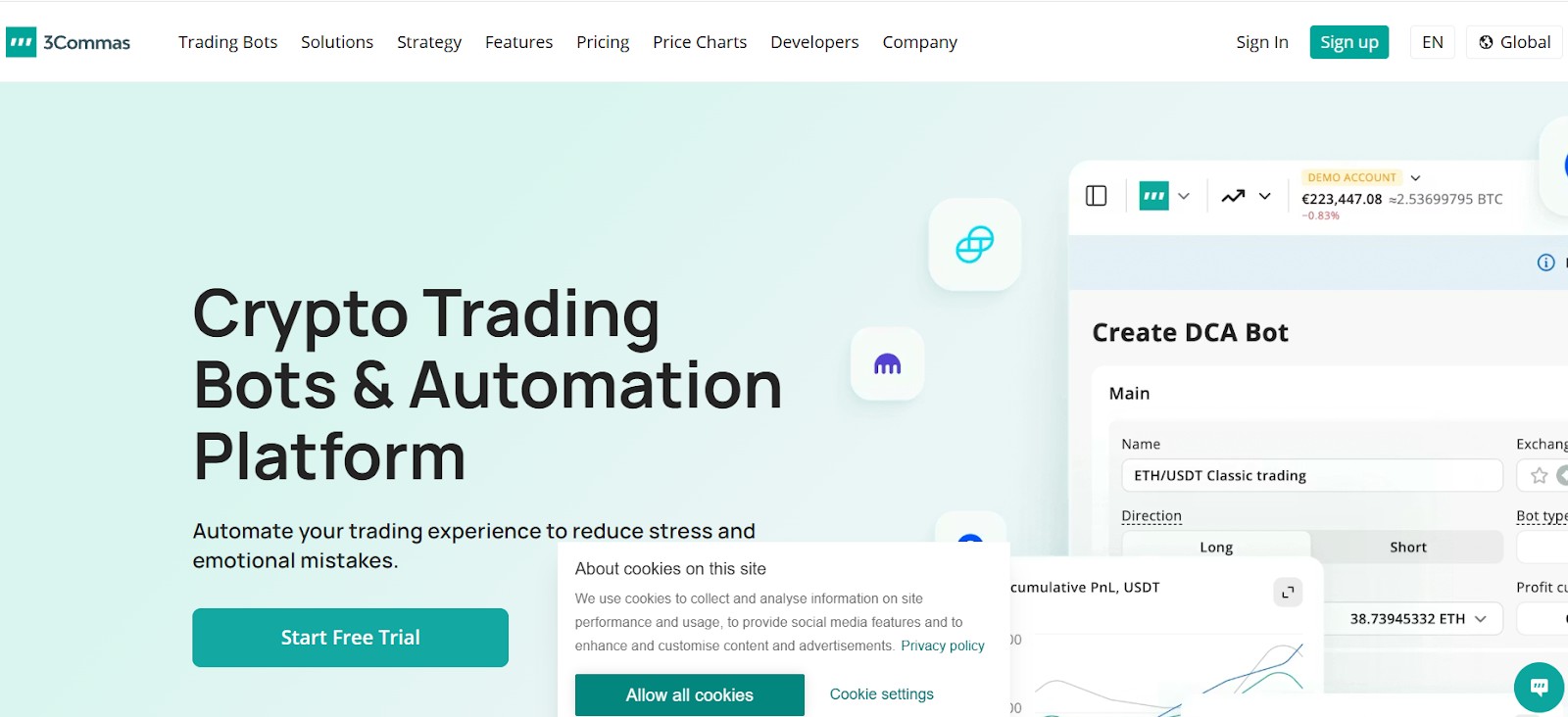
3Commas connects with 17 major cryptocurrency exchanges via secure API keys, including Binance, Bybit, Coinbase Pro, and Bitfinex. In addition to bots, the platform provides SmartTrade features, portfolio analytics, and backtesting tools. Traders can choose a free plan or one of three paid subscription tiers depending on their trading needs.
Pionex

Pionex is an exchange-based trading bot service that stands out in 2026 for offering built-in automation without subscription fees. Unlike third-party tools that require API connections, Pionex integrates trading bots directly into its exchange infrastructure, simplifying setup and reducing technical friction.

The platform provides multiple automated bots, including grid and DCA strategies, which run continuously once activated. Because these bots are available by default, Pionex is frequently used by traders looking for a free AI crypto trading bot without committing to paid subscriptions. The strategies rely on predefined rule-based logic rather than adaptive machine learning, making them straightforward automation tools rather than fully AI-driven systems.
Pionex suits users who want to test automation before moving to more complex systems. Its interface focuses on quick deployment rather than advanced configuration, which lowers the barrier for traders who are new to automated execution but still want consistent rule-based trading.
From a risk perspective, Pionex bots operate within the exchange environment, meaning users do not need to grant external API permissions. This setup appeals to traders who are cautious about security and prefer keeping automation and custody under a single platform.
TradeSanta

TradeSanta is an automated crypto trading bot focused on simple strategy execution rather than complex AI modeling. In 2026, it remains relevant for traders who want rule-based automation with minimal setup and clear logic behind every trade.
The bot supports grid and DCA strategies, which are commonly used to manage entries and exits over time instead of relying on single price points. Users can configure trading pairs, order size, take-profit levels, and stop conditions through a straightforward interface. This makes TradeSanta suitable for traders who want predictable automation without advanced technical configuration.

TradeSanta integrates with several major exchanges, including Binance, which keeps it practical for users who plan to automate trades across commonly used markets. TradeSanta operates using predefined rule-based strategies rather than adaptive AI models, focusing on structured and consistent execution.
For newer users, TradeSanta offers a limited free trial, allowing traders to test automation logic before committing to a paid plan. This approach appeals to those who want to explore automated trading gradually, without immediately relying on fully hands-off systems. When used correctly, TradeSanta demonstrates how automation can support disciplined trading rather than replace strategy planning entirely.
Understanding AI crypto trading bots
AI crypto trading bots are automated systems designed to execute trades based on predefined logic and real-time market data. Despite the AI label, not all bots rely on complex machine learning. In practice, most combine algorithmic rules with adaptive elements that respond to price movement, volume, and volatility.
The core purpose of these bots is automation. They remove the need for constant manual monitoring by executing trades according to preset conditions. This allows traders to stay active in the market around the clock, even when they are not logged in or watching charts.
What AI means in crypto trading bots
In most cases, artificial intelligence in crypto bots refers to the ability to process large datasets and adjust behavior based on changing conditions. This can include analyzing historical price patterns, reacting to volatility shifts, or optimizing parameters over time. It does not mean that bots can predict markets with certainty or trade independently without risk.
AI-assisted bots typically focus on:
Data analysis. Processing price history, indicators, and volume faster than a human trader.
Execution speed. Placing and managing orders instantly when conditions are met.
Consistency. Following strategy rules without emotional interference.
Do AI crypto trading bots actually work?
AI crypto trading bots can work as intended when they are configured correctly and used in suitable market conditions. They are effective at executing strategies consistently, managing repetitive tasks, and reducing emotional decision-making. However, they do not eliminate market risk and cannot guarantee profits.
Their performance depends on several factors, including strategy design, market environment, risk limits, and user oversight. Bots tend to perform better in structured or trending markets and struggle during erratic, news-driven volatility.
Are AI crypto trading bots safe to use?
Safety depends more on setup and platform choice than on the bot itself. Bots that operate within exchanges or use restricted API permissions reduce exposure to unauthorized actions. Users should always avoid granting withdrawal access, monitor bot activity regularly, and understand how strategies behave under stress.
When used responsibly, AI crypto trading bots function as tools for execution and discipline, not as autonomous profit machines.
Key benefits of AI crypto trading bots
AI crypto trading bots are primarily used to improve execution efficiency and reduce the impact of human error. While they do not remove market risk, they offer practical advantages when applied correctly and monitored regularly.

Key benefits:
Automated trading. Bots execute trades automatically based on predefined strategies, allowing traders to stay active in the market without constant manual involvement.
Round-the-clock operation. Automated systems work 24/7, reacting to market movements even when the trader is offline or inactive.
Fast reaction to market changes. Bots analyze price data and execute orders instantly when conditions are met, reducing delays caused by manual decision-making.
Reduced emotional influence. By following preset rules, bots help limit impulsive trades driven by fear or overconfidence.
Built-in risk controls. Many bots support stop-loss, take-profit, and position sizing tools that help manage downside exposure.
Scalability. Bots can monitor and trade multiple pairs or strategies simultaneously, which is difficult to achieve manually.
Used correctly, these benefits explain why many traders rely on automation as a support tool rather than a replacement for strategy planning.
How to choose the best AI crypto trading bots
Choosing an AI crypto trading bot is less about finding the most complex system and more about matching the tool to your experience level, risk tolerance, and trading goals. Even the best AI crypto trading bots can perform poorly if they are misconfigured or used in unsuitable market conditions.
When evaluating options, focus on the following factors:
Level of automation. A good bot should clearly define how much decision-making is automated and how much control remains with the user. This is especially important for traders assessing how to use AI for crypto trading without losing oversight.
Strategy flexibility. The bot should support multiple strategy types, such as grid, DCA, or trend-based logic, and allow parameter adjustments as market conditions change.
Exchange compatibility. Traders should confirm whether the bot works with their preferred platform. Support for major exchanges is essential for those looking for an AI crypto trading bot for Binance or similar high-liquidity venues.
Risk management tools. Features such as stop-losses, take-profit levels, and position sizing controls are critical for protecting capital during volatile periods.
Security and permissions. Bots that use API access should operate without withdrawal rights and offer clear permission settings, which directly affects whether AI crypto trading bots are safe to use in practice.
Testing options. Demo modes, paper trading, or limited free plans help users evaluate performance before committing funds. This is particularly valuable when starting with a free AI crypto trading bot.
Ease of use. Clear interfaces and guided setup matter for newcomers, while advanced users may prioritize deeper configuration over simplicity.
Cost transparency. Subscription fees, trading commissions, and feature limitations should be easy to understand and proportional to the bot’s functionality.
A well-chosen bot supports disciplined execution and consistency. It does not replace strategy thinking, but it can significantly improve how that strategy is applied over time.
How to trade cryptocurrency with an AI bot
Trading cryptocurrency with an AI bot follows a structured process. While the interface and features differ between platforms, the underlying workflow is generally the same across most automated systems.
Below is a practical example of how traders typically use AI bots for crypto trading.
Step 1: Choose a compatible exchange and bot
Start by selecting a crypto exchange supported by the bot you plan to use. Many traders prioritize platforms with high liquidity and strong API security. This step is especially important if you plan to automate trades on Binance or other major exchanges.
Once the exchange is chosen, connect the bot using API keys. These keys should allow trading only, without withdrawal permissions.
Step 2: Select a strategy
Most AI bots offer several strategy options, such as grid trading, DCA, or trend-following logic. Beginners usually start with predefined templates, while experienced traders may customize parameters manually.
At this stage, traders define:
trading pairs;
position size;
entry and exit conditions;
risk limits such as stop-loss or take-profit levels.
Step 3: Test the bot before live trading
Before committing real funds, it is recommended to test the bot using demo mode or paper trading. Some platforms also offer limited free plans, which allow users to observe bot behavior in real market conditions without financial risk.
Testing helps identify weaknesses in strategy logic and confirms whether the automation behaves as expected.
Step 4: Launch and monitor performance
After testing, the bot can be activated for live trading. Even after launch, regular monitoring remains essential. Traders should review execution history, adjust parameters when market conditions change, and pause the bot during abnormal volatility or major news events.
AI bots assist with execution, but decision-making responsibility always remains with the user.
Risks of using AI crypto trading bots
Despite their growing popularity, AI crypto trading bots are not risk-free tools. Automation can improve execution discipline, but it does not eliminate market uncertainty or poor strategy design.
Key risks:
Market mismatch risk. Bots perform based on predefined logic, which may stop working when market conditions change suddenly or behave unpredictably.
Strategy overfitting. Bots optimized for historical data may fail in live trading if the strategy is too narrowly tuned to past conditions.
Technical failures. API disruptions, exchange outages, or software bugs can lead to missed trades or unintended executions.
Capital drawdown risk. Bots may require additional funds for averaging or safety orders, increasing exposure during prolonged adverse trends.
Security exposure. Improper API permissions or weak account security can create vulnerabilities, especially when bots are connected to multiple platforms.
False expectations. Believing that automation guarantees profit often leads to excessive risk-taking and insufficient monitoring.
AI crypto trading bots should be treated as execution tools, not autonomous decision-makers. Regular supervision and realistic expectations remain essential.
Before choosing a trading bot, it also helps to review which exchanges in your region support automation, copy trading, and built-in alerts. Not every platform offers the same level of integration or access for bot-based strategies. The comparison below highlights crypto exchanges that work well with automated trading setups, making it easier to decide where to connect and run your bot safely.
| OKX | Cryptohopper | Kraken | Biconomy | CoinMetro | |
|---|---|---|---|---|---|
|
Coins Supported |
600+ | 1000 | 400+ | 268 | 72 |
|
Spot Taker fee, % |
0.1 | 0 | 0.4 | 0.2 | 0.2 |
|
Spot Maker Fee, % |
0.08 | 0 | 0.25 | 0.2 | 0.1 |
|
Alerts |
Yes | Yes | Yes | Yes | Yes |
|
Copy trading |
Yes | Yes | Yes | Yes | Yes |
|
TU overall score |
8.48 | 7.76 | 7.58 | 4.55 | 6.81 |
|
Open an account |
Go to broker Your capital is at risk. |
Go to broker Your capital is at risk. |
Go to broker Your capital is at risk. |
Go to broker Your capital is at risk.
|
Study review |
AI bots work best with active oversight and risk control

From my experience working with automated trading tools, AI crypto trading bots are most effective when they are treated as execution assistants, not profit generators. They help enforce discipline, remove emotional decisions, and execute strategies exactly as planned. The traders who get consistent results are usually those who spend time testing strategies, adjusting risk limits, and turning bots off when market conditions change instead of letting them run blindly.
I do not recommend relying on a single bot or strategy long term. Markets evolve, and automation must evolve with them. In practice, the safest approach is to start small, monitor performance regularly, and use bots as part of a broader trading plan rather than a replacement for market understanding. When used this way, AI bots can improve efficiency and consistency, but they still require human judgment.
Conclusion
AI crypto trading bots have become essential tools for traders seeking efficiency, discipline, and round-the-clock market access. While platforms like Bybit Aurora AI and Cryptohopper offer advanced automation and customization, success ultimately depends on using these bots as diligent execution assistants rather than set-and-forget profit machines. Responsible oversight, thorough testing, and ongoing strategy adjustments are crucial to harnessing their full potential in rapidly changing markets. The most powerful lesson is that automation can elevate trading consistency and remove emotional pitfalls, but real expertise comes from treating bots as partners in an actively managed trading plan.
FAQs
How do AI crypto trading bots handle market volatility differently from manual trading?
Are there limitations to using free AI crypto trading bots compared to paid versions?
Can AI crypto trading bots operate across multiple exchanges at once?
What kind of strategies can be automated with AI crypto trading bots?
Editors' Top Picks and Insights





Related Articles
Team that worked on the article
Aleksandra Chaikina has been a contributor to Traders Union since 2021. With over 15 years of experience in copywriting and more than 5 years focused on financial content, she specializes in producing detailed guides, analytics, and comparative reviews across various sectors, including cryptocurrencies, Forex, investment strategies, and financial technologies.
Dan Blystone began his trading career in 1998 as an arbitrage clerk on the floor of the Chicago Mercantile Exchange (CME). He later traded bond and Eurex futures at proprietary firms such as Altea Trading, gaining valuable experience in high-frequency trading and risk management.
Chinmay Soni is a financial analyst with more than 5 years of experience in working with stocks, Forex, derivatives, and other assets. As a founder of a boutique research firm and an active researcher, he covers various industries and fields, providing insights backed by statistical data.
Risk management is a risk management model that involves controlling potential losses while maximizing profits. The main risk management tools are stop loss, take profit, calculation of position volume taking into account leverage and pip value.
Take-Profit order is a type of trading order that instructs a broker to close a position once the market reaches a specified profit level.
Copy trading is an investing tactic where traders replicate the trading strategies of more experienced traders, automatically mirroring their trades in their own accounts to potentially achieve similar results.
Crypto trading involves the buying and selling of cryptocurrencies, such as Bitcoin, Ethereum, or other digital assets, with the aim of making a profit from price fluctuations.
Bitcoin is a decentralized digital cryptocurrency that was created in 2009 by an anonymous individual or group using the pseudonym Satoshi Nakamoto. It operates on a technology called blockchain, which is a distributed ledger that records all transactions across a network of computers.
-
 Afghanistan
-
 Albania
-
 Algeria
-
 Angola
-
 Argentina
-
 Armenia
-
 Australia
-
 Austria
-
 Azerbaijan
-
 Bahamas
-
 Bahrain
-
 Bangladesh
-
 Belarus
-
 Belgium
-
 Bolivia
-
 Botswana
-
 Brazil
-
 Brunei
-
 Bulgaria
-
 Cambodia
-
 Cameroon
-
 Canada
-
 Chile
Chile
-
 China
China
-
 Colombia
-
 Congo
Congo
-
 Costa Rica
-
 Cote d'Ivoire
-
 Croatia
-
 Cuba
Cuba
-
 Cyprus
-
 Czechia
-
 DR Congo
-
 Denmark
-
 Dominican Republic
-
 Ecuador
-
 Egypt
Egypt
-
 El Salvador
-
 Estonia
-
 Eswatini
-
 Ethiopia
-
 Finland
-
 France
-
 Georgia
-
 Germany
-
 Ghana
Ghana
-
 Greece
-
 Haiti
Haiti
-
 Hong Kong
-
 Hungary
-
 India
India
-
 Indonesia
-
 Iran, Islamic republic
-
 Iraq
Iraq
-
 Ireland
-
 Israel
-
 Italy
Italy
-
 Jamaica
-
 Japan
Japan
-
 Jordan
-
 Kazakhstan
-
 Kenya
Kenya
-
 Korea
Korea
-
 Kuwait
-
 Kyrgyzstan
-
 Laos
Laos
-
 Latvia
-
 Lebanon
-
 Lesotho
-
 Libya
Libya
-
 Lithuania
-
 Luxembourg
-
 Madagascar
-
 Malaysia
-
 Malta
Malta
-
 Mauritius
-
 Mexico
-
 Moldova
-
 Mongolia
-
 Montenegro
-
 Morocco
-
 Mozambique
-
 Myanmar
-
 Namibia
-
 Nepal
Nepal
-
 Netherlands
-
 New Zealand
-
 Nigeria
-
 North Macedonia
-
 Norway
-
 Oman
Oman
-
 Pakistan
-
 Palestine
-
 Panama
-
 Papua New Guinea
-
 Paraguay
-
 Peru
Peru
-
 Philippines
-
 Poland
-
 Portugal
-
 Puerto Rico
-
 Qatar
Qatar
-
 Reunion
-
 Romania
-
 Rwanda
-
 Saudi Arabia
-
 Serbia
-
 Singapore
-
 Slovakia
-
 Slovenia
-
 Somalia
-
 South Africa
-
 Spain
Spain
-
 Sri Lanka
-
 Sweden
-
 Switzerland
-
 Syria
Syria
-
 Taiwan
-
 Tajikistan
-
 Tanzania
-
 Thailand
-
 Trinidad and Tobago
-
 Tunisia
-
 Turkey
-
 UAE
UAE
-
 Uganda
-
 Ukraine
-
 United Kingdom
-
United States
-
 Uruguay
-
 Uzbekistan
-
 Venezuela
-
 Vietnam
-
 Yemen
Yemen
-
 Zambia
-
 Zimbabwe
- Forex
- Crypto











