
Is Render Token Related To AI?


Editorial Note: While we adhere to strict Editorial Integrity, this post may contain references to products from our partners. Here's an explanation for How We Make Money. None of the data and information on this webpage constitutes investment advice according to our Disclaimer.
Render Token AI integration allows developers to access decentralized GPU power for AI model training, deep learning, and machine learning tasks. Instead of relying on centralized cloud providers, AI projects use RENDER’s network to scale computing power affordably and efficiently.
The world is rapidly embracing AI-driven innovations, but there’s a major challenge — computing power. Training large AI models demands massive GPU resources, and traditional cloud services come with high costs. This is where Render Token (RENDER) steps in. It operates as a decentralized GPU network, providing on-demand computing power for AI, 3D rendering, and machine learning.
But is Render Token actually connected to AI? Many believe RENDER is only useful for 3D artists and animators, but it's true potential lies in powering AI development. The token isn’t just a digital asset — it’s a gateway to affordable and scalable GPU resources, making AI research and development more accessible than ever.
In this guide, we’ll break down what Render Token does, how it supports AI, and whether it has strong investment potential. We’ll also include a forecast board to provide insights into where RENDER might be headed.
Risk warning: Cryptocurrency markets are highly volatile, with sharp price swings and regulatory uncertainties. Research indicates that 75-90% of traders face losses. Only invest discretionary funds and consult an experienced financial advisor.
What is a Render token?
Imagine a world where digital artists and creators can access limitless rendering power without relying on centralized systems. Render token (RENDER) is revolutionizing the digital content creation space by providing a decentralized, blockchain-powered network for rendering services.
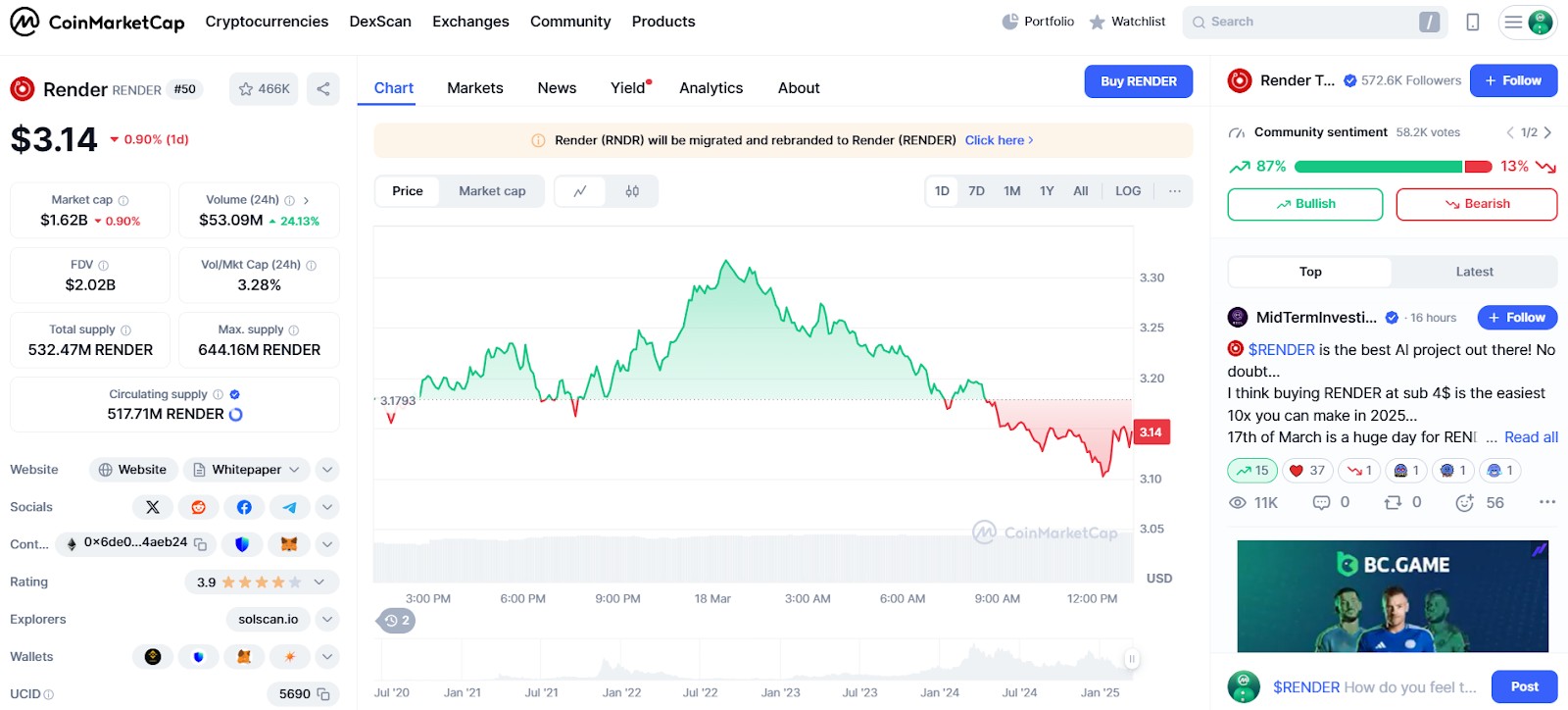
Decentralized rendering revolution
The Render Network connects creators needing high-performance rendering with individuals and businesses that have idle Graphics Processing Units (GPUs). By using blockchain technology, the network transforms unused computational power into a resource for rendering complex graphics and animations. This approach not only democratizes access to rendering services but also optimizes GPU utilization worldwide.
RENDER token as the fuel of the network
At the core of this system is RENDER, an ERC-20 utility token built on the Ethereum blockchain. Digital artists and creators use RENDER to pay for rendering tasks, while node operators — who contribute their GPU power — earn RENDER tokens in return. This structure creates an efficient, decentralized marketplace for rendering services.
Key features and benefits
Scalability. The decentralized network eliminates bottlenecks, allowing projects of any size to be processed efficiently.
Cost-effectiveness. By tapping into a global pool of idle GPUs, rendering costs are significantly reduced, making high-quality rendering more accessible.
Security and transparency. Blockchain ensures that all transactions and rendering processes are verifiable, secure, and tamper-proof.
| Month | Minimum Price, $ | Average Price, $ | Maximum Price, $ |
|---|---|---|---|
| November 2026 | 2.8 | 2.9 | 3 |
| December 2026 | 2.4 | 2.5 | 2.5 |
Render token’s connection to AI
The Render Network is transforming the relationship between blockchain technology and artificial intelligence by offering decentralized GPU rendering services. This platform connects creators who need high-performance rendering with individuals and organizations that have idle Graphics Processing Units (GPUs), turning unused computational power into a valuable resource for processing complex graphics and animations.
The Render token (RENDER) is the backbone of this ecosystem, enabling transactions within the network. Creators use RENDER tokens to pay for rendering tasks, while node operators — who provide their GPU power — earn RENDER in return. This system not only makes rendering services more accessible but also improves GPU utilization worldwide.
Recently, the Render Network has expanded its capabilities to support AI and machine learning tasks. It allows AI developers to leverage decentralized GPU power for training models and running inference tasks, offering a scalable and cost-effective alternative to expensive cloud-based AI computing.
The network has also integrated AI-based content generation tools, including advanced text-to-image generators and AI-driven 3D rendering applications. These enhancements provide creators with efficient tools to develop AI-generated content, reinforcing the platform’s commitment to innovation in artificial intelligence.
By merging decentralized GPU rendering with AI, the Render Network is making high-performance computing more accessible and efficient. This shift is helping to accelerate AI research, development, and content creation on a global scale.
How does Render token work?
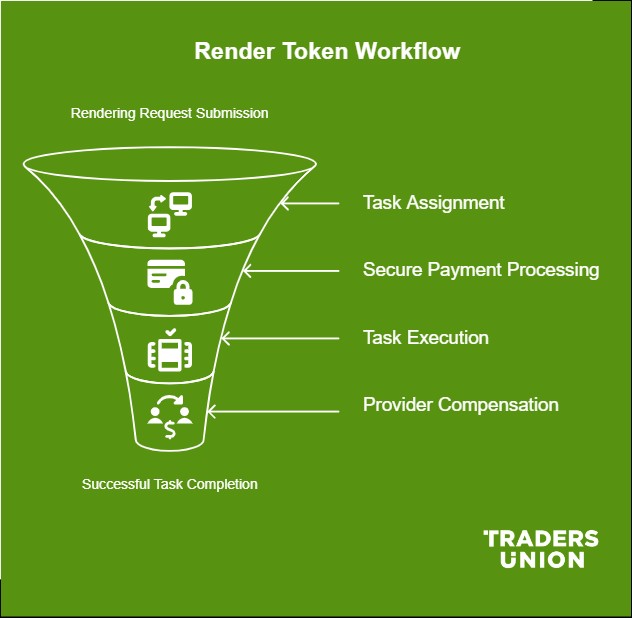
The Render Network is transforming digital content creation by offering decentralized GPU rendering services. It connects creators needing high-performance rendering with individuals and organizations that have idle Graphics Processing Units (GPUs), turning unused computational power into a valuable resource for tasks like AI training, 3D rendering, and machine learning.
How Render token (RENDER) works:
Submission of rendering request. A user submits a task, such as AI model training, 3D rendering, or other GPU-intensive computations, through the Render Network.
Assignment to GPU providers. The network finds available GPU providers and assigns the task based on efficiency and speed.
Secure payment via smart contracts. Payments are processed using RENDER tokens through smart contracts, ensuring transparency and trust.
Processing and completion. GPU providers execute the task and return the completed work to the user.
Compensation. Once the task is successfully completed, GPU providers receive RENDER tokens as payment.
This decentralized approach offers significant advantages over traditional cloud services. It is more cost-effective, secure, and scalable. By leveraging a global network of GPU providers, Render Network allows AI developers, 3D artists, and machine learning engineers to access powerful computing resources without the high costs and limitations of centralized services.
Recent developments have enhanced Render Network’s AI capabilities. New tools now allow for real-time AI rendering, advanced text-to-image generation, and in-browser editing. This makes it even more valuable for AI-driven content creation.
As demand for AI and high-quality digital assets grows, Render Network’s decentralized model provides a scalable and affordable solution for creators, helping them push the boundaries of innovation.
Is Render token a good investment?
The Render Token (RENDER) operates within the Render Network, a decentralized platform that utilizes idle GPU power for rendering tasks and AI computations. This innovative approach offers cost-effective and scalable solutions for industries requiring substantial computational resources.
AI and GPU demand are rising
As artificial intelligence continues to expand, the demand for GPU power has surged. The Render Network addresses this need by providing decentralized GPU access, positioning RENDER as a pivotal player in the AI sector. This integration not only supports AI development but also enhances the utility and adoption of RENDER tokens.
Strong partnerships and real-world use cases
The Render Network has established significant partnerships, notably with Stability AI and Endeavor, to develop next-generation AI models and open standards powered by decentralized GPU resources. These collaborations demonstrate the platform's real-world utility and potential for widespread adoption.
Risks to consider
Competition from centralized giants like NVIDIA and AWS.
Crypto market volatility.
Regulatory uncertainty in blockchain-based AI services.
If AI and GPU demand keep growing, Render Token AI integration could push RENDER’s value even higher. However, like all crypto investments, it carries risks. DYOR (Do Your Own Research) before investing!
Best platforms to trade Render Token (RENDER)
To trade RENDER and other cryptos efficiently, it is essential to choose a platform that offers high liquidity, low fees, secure transactions, and multiple trading pairs. Below, we compare the best platforms for trading RENDER, highlighting their key features to help you find the most suitable exchange.
| Demo account | Min. Deposit, $ | Coins Supported | Spot Taker fee, % | Spot Maker Fee, % | Tier-1 regulation | TU overall score | Open an account | |
|---|---|---|---|---|---|---|---|---|
| No | 10 | 400+ | 0.5 | 0.5 | Yes | 8.5 | Go to broker Your capital is at risk. |
|
| Yes | 10 | 600+ | 0.1 | 0.08 | No | 8.46 | Go to broker Your capital is at risk. |
|
| Yes | 10 | 399 | 0.3 | 0.2 | Yes | 8.08 | Go to broker Your capital is at risk.
|
|
| No | No | 1000 | 0 | 0 | No | 7.8 | Go to broker Your capital is at risk. |
|
| No | 1 | 400+ | 0.5 | 0.25 | Yes | 7.76 | Go to broker Your capital is at risk. |
|
| No | 10 | 400+ | 0.4 | 0.25 | Yes | 7.68 | Go to broker Your capital is at risk. |
Why trust us
15+ years of independent market analysis
140+ evaluation criteria, reviewed by 50+ experts
Data-driven reviews of 200+ platforms, updated regularly
20+ industry awards & a wide network of global media partners
Learn more about our methodology and editorial policies.


Real edge lies in how RENDER flips the traditional computing model on its head

Most people looking into Render Token (RENDER) get caught up in its AI and GPU rendering potential, but the real edge lies in how it flips the traditional computing model on its head. Instead of relying on massive data centers like AWS or Google Cloud, RENDER turns thousands of idle GPUs into a global supercomputer. This makes it far more flexible and resistant to price spikes in the GPU market. If AI demand keeps growing, centralized providers could struggle to scale fast enough, while RENDER’s network can grow anytime someone plugs in a new GPU. That’s the real opportunity here — it’s not just another crypto token, it’s a shift in how computing power is supplied.
There’s also a compounding effect that most investors miss. GPU providers on the network aren’t just cashing out their RENDER rewards — they’re reinvesting in better hardware. That means every year, the network gets more powerful, without needing outside capital. Instead of just tracking RENDER’s price, keep an eye on how much computing power is being added to the network. If GPU capacity keeps climbing, the token’s real value will follow, no matter what happens in the short term.
Conclusion
Render Token is more than just a crypto project — it’s a key player in the AI revolution, providing decentralized GPU power for AI training, 3D rendering, and deep learning. With major partnerships and growing demand for affordable computing power, RENDER is positioned as a critical infrastructure project for AI startups and developers.
While it’s not an AI coin in the traditional sense, its utility in AI model training makes it a highly relevant blockchain asset. If AI adoption continues to rise, Render Token AI solutions could see massive demand, pushing RENDER’s value even higher. Still, like all crypto investments, it comes with risks, including competition from centralized providers and market volatility.
For those who believe in AI’s future, Render Token AI integration is worth watching. Whether you’re a developer, investor, or enthusiast, RENDER is shaping up to be a key crypto project in the AI-driven world.
FAQs
Is the Render token an AI coin?
Not exactly. Render Token AI integration makes it crucial for AI model training, but it’s not an AI-specific cryptocurrency. Instead, it’s a decentralized GPU network that powers AI, 3D rendering, and machine learning.
How does Render token support AI development?
RENDER connects AI developers with GPU providers, allowing them to train AI models affordably. Instead of using expensive cloud computing, AI teams can access decentralized GPU resources, cutting costs and boosting efficiency.
Can Render token’s price increase due to AI adoption?
Yes. As more AI projects demand affordable GPU power, the need for Render Token AI services could drive higher adoption, increasing RENDER’s value. However, market risks and competition still exist.
Where can I buy and store Render token?
You can buy RENDER on major exchanges like Binance, Coinbase, and Kraken. To store it, use secure crypto wallets like MetaMask, Trust Wallet, or Ledger for long-term safety.
Editors' Top Picks and Insights



Related Articles
Team that worked on the article
Peter Emmanuel Chijioke is a professional personal finance, Forex, crypto, blockchain, NFT, and Web3 writer and a contributor to the Traders Union website. As a computer science graduate with a robust background in programming, machine learning, and blockchain technology, he possesses a comprehensive understanding of software, technologies, cryptocurrency, and Forex trading.
Chinmay Soni is a financial analyst with more than 5 years of experience in working with stocks, Forex, derivatives, and other assets. As a founder of a boutique research firm and an active researcher, he covers various industries and fields, providing insights backed by statistical data.
Mirjan Hipolito is a journalist and news editor at Traders Union. She is an expert crypto writer with five years of experience in the financial markets.
An investor is an individual, who invests money in an asset with the expectation that its value would appreciate in the future. The asset can be anything, including a bond, debenture, mutual fund, equity, gold, silver, exchange-traded funds (ETFs), and real-estate property.
Index in trading is the measure of the performance of a group of stocks, which can include the assets and securities in it.
CFD is a contract between an investor/trader and seller that demonstrates that the trader will need to pay the price difference between the current value of the asset and its value at the time of contract to the seller.
Forex trading, short for foreign exchange trading, is the practice of buying and selling currencies in the global foreign exchange market with the aim of profiting from fluctuations in exchange rates. Traders speculate on whether one currency will rise or fall in value relative to another currency and make trading decisions accordingly. However, beware that trading carries risks, and you can lose your whole capital.
Volatility refers to the degree of variation or fluctuation in the price or value of a financial asset, such as stocks, bonds, or cryptocurrencies, over a period of time. Higher volatility indicates that an asset's price is experiencing more significant and rapid price swings, while lower volatility suggests relatively stable and gradual price movements.

-
 Afghanistan
-
 Albania
-
 Algeria
-
 Angola
-
 Argentina
-
 Armenia
-
 Australia
-
 Austria
-
 Azerbaijan
-
 Bahamas
-
 Bahrain
-
 Bangladesh
-
 Belarus
-
 Belgium
-
 Bolivia
-
 Botswana
-
 Brazil
-
 Brunei
-
 Bulgaria
-
 Cambodia
-
 Cameroon
-
 Canada
-
 Chile
Chile
-
 China
China
-
 Colombia
-
 Congo
Congo
-
 Costa Rica
-
 Cote d'Ivoire
-
 Croatia
-
 Cuba
Cuba
-
 Cyprus
-
 Czechia
-
 DR Congo
-
 Denmark
-
 Dominican Republic
-
 Ecuador
-
 Egypt
Egypt
-
 El Salvador
-
 Estonia
-
 Eswatini
-
 Ethiopia
-
 Finland
-
 France
-
 Georgia
-
 Germany
-
 Ghana
Ghana
-
 Greece
-
 Haiti
Haiti
-
 Hong Kong
-
 Hungary
-
 India
India
-
 Indonesia
-
 Iran, Islamic republic
-
 Iraq
Iraq
-
 Ireland
-
 Israel
-
 Italy
Italy
-
 Jamaica
-
 Japan
Japan
-
 Jordan
-
 Kazakhstan
-
 Kenya
Kenya
-
 Korea
Korea
-
 Kuwait
-
 Kyrgyzstan
-
 Laos
Laos
-
 Latvia
-
 Lebanon
-
 Lesotho
-
 Libya
Libya
-
 Lithuania
-
 Luxembourg
-
 Madagascar
-
 Malaysia
-
 Malta
Malta
-
 Mauritius
-
 Mexico
-
 Moldova
-
 Mongolia
-
 Montenegro
-
 Morocco
-
 Mozambique
-
 Myanmar
-
 Namibia
-
 Nepal
Nepal
-
 Netherlands
-
 New Zealand
-
 Nigeria
-
 North Macedonia
-
 Norway
-
 Oman
Oman
-
 Pakistan
-
 Palestine
-
 Panama
-
 Papua New Guinea
-
 Paraguay
-
 Peru
Peru
-
 Philippines
-
 Poland
-
 Portugal
-
 Puerto Rico
-
 Qatar
Qatar
-
 Reunion
-
 Romania
-
 Rwanda
-
 Saudi Arabia
-
 Serbia
-
 Singapore
-
 Slovakia
-
 Slovenia
-
 Somalia
-
 South Africa
-
 Spain
Spain
-
 Sri Lanka
-
 Sweden
-
 Switzerland
-
 Syria
Syria
-
 Taiwan
-
 Tajikistan
-
 Tanzania
-
 Thailand
-
 Trinidad and Tobago
-
 Tunisia
-
 Turkey
-
 UAE
UAE
-
 Uganda
-
 Ukraine
-
 United Kingdom
-
United States
-
 Uruguay
-
 Uzbekistan
-
 Venezuela
-
 Vietnam
-
 Yemen
Yemen
-
 Zambia
-
 Zimbabwe
- Forex
- Crypto












