
Michael Saylor’s Crypto Investments: An Overview



Editorial Note: While we adhere to strict Editorial Integrity, this post may contain references to products from our partners. Here's an explanation for How We Make Money. None of the data and information on this webpage constitutes investment advice according to our Disclaimer.
Michael Saylor, who started MicroStrategy (now Strategy) and serves as its executive chairman, has heavily invested in Bitcoin personally and through his company. Strategy owned around 499.096 bitcoins, totaling roughly $33.1 billion. Back in October 2020, Saylor shared that he personally held 17,732 bitcoins. He believes strongly in Bitcoin as protection against inflation and chooses not to invest in other cryptocurrencies.
Michael Saylor, co-founder and executive chairman of Strategy, has played a major role in shaping Bitcoin’s mainstream adoption. Since 2020, he has consistently pushed the idea that Bitcoin outperforms traditional assets as a long-term investment. His aggressive accumulation strategy, both personally and through Strategy, has had a ripple effect on the crypto market. Saylor’s unwavering confidence in Bitcoin has kept him in the spotlight, with many likening Strategy’s holdings to a corporate treasury securing its financial future.
Breakdown of Michael Saylor’s cryptocurrency holdings
Michael Saylor, who co-founded Strategy (the company formerly known as MicroStrategy), has heavily invested in Bitcoin both through his company and personally.

Saylor's personal holdings. Saylor has shared that he personally holds 17.732 bitcoins, which he bought for around $175 million, averaging $9,882 per coin.
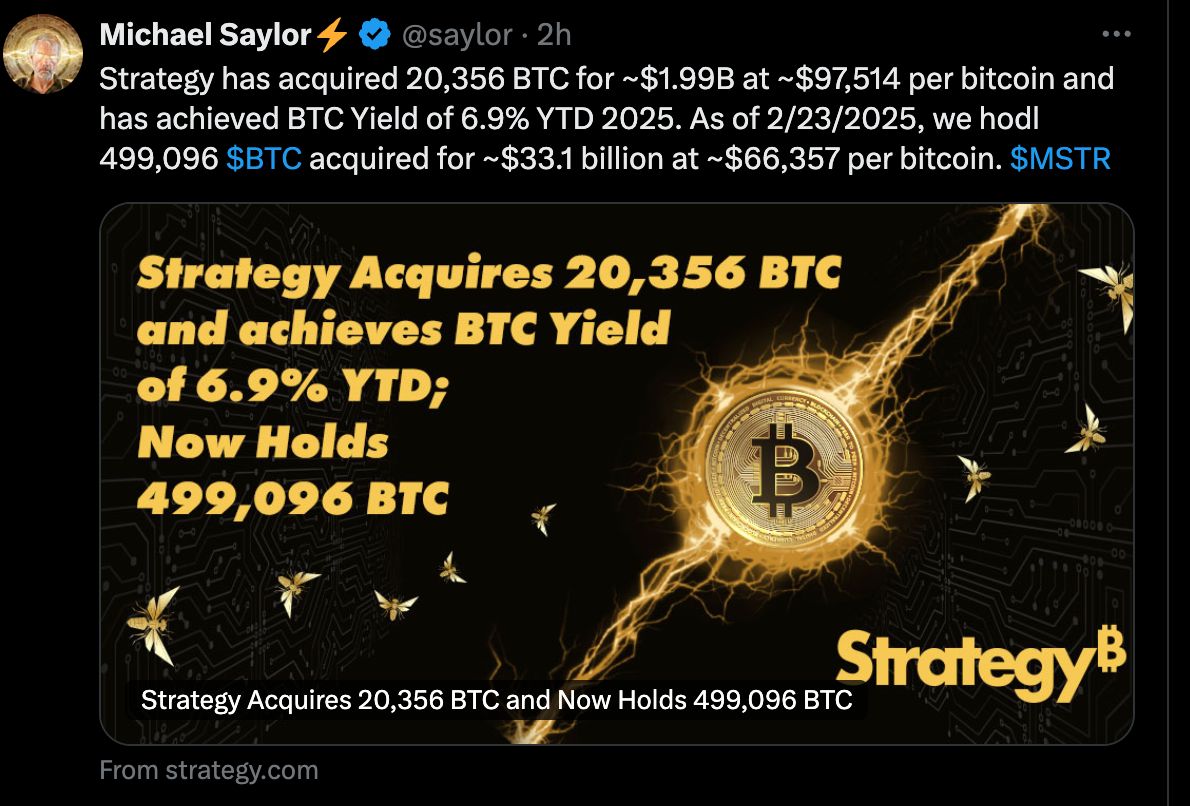
Strategy's Bitcoin holdings. The company owns about 499.096 bitcoins, totaling roughly $33.1 billion. This already includes 20,056 BTC that the company acquired from February 17 to 23, 2025.
Strategy’s Bitcoin strategy

Strategy’s Bitcoin approach isn’t just about buying and holding — it’s a calculated strategy that challenges traditional corporate finance. Here’s what makes it stand out.
Debt is a weapon, not a burden. Instead of using company cash, Strategy raises debt through convertible notes to buy Bitcoin. This lets them acquire BTC without sacrificing cash flow, betting that Bitcoin’s value will outgrow the debt’s interest.
Corporate treasury has been redefined. Unlike most companies that keep reserves in cash or bonds, Strategy treats Bitcoin as a primary asset, arguing that fiat depreciates while BTC appreciates long-term.
Strategic timing beats dollar-cost averaging. While many investors use dollar-cost averaging, Strategy buys Bitcoin aggressively after price drops or major market corrections, securing a lower cost basis over time.
Bitcoin holdings create financial leverage. Holding a massive Bitcoin reserve lets Strategy tap into its balance sheet strength for further funding, as investors view BTC as a valuable backing asset.
Stockholders indirectly own Bitcoin.Strategy’s stock acts as a Bitcoin proxy, meaning shareholders gain exposure to BTC’s price movements without directly buying crypto. This attracts institutional investors who can’t hold Bitcoin directly.
Ethical considerations and regulatory scrutiny
Strategy’s deep dive into Bitcoin has put it in a unique spot, bringing up questions about ethics, risks, and future regulations.
Bitcoin strategy shifts company focus.Strategy started as a software firm, but its massive Bitcoin buys make it look more like a crypto fund, leaving investors wondering about its true identity.
Regulators might step in fast. The company uses creative financial moves, like issuing debt to buy Bitcoin, but if rules change, these strategies could be shut down overnight.
Stockholders might not be ready. Many bought shares expecting software growth, not a bet on Bitcoin. A crackdown on crypto could leave these investors in a risky position.
Saylor’s influence is hard to ignore. As a major Bitcoin advocate, his vision shapes Strategy’s choices, making it unclear whether decisions serve the company or his own Bitcoin beliefs.
Crypto tax rules could change everything. Holding Bitcoin under a company brings tax challenges, and if governments tighten policies, Strategy could face big financial shifts.
Reputation affects future regulations. If Bitcoin takes a huge hit, authorities might view Strategy’s strategy as reckless, pushing for new restrictions on corporate crypto holdings.
Future outlook: What’s next for Michael Saylor in crypto?
Michael Saylor’s Bitcoin strategy has already reshaped corporate investment, but his next moves could push crypto adoption even further.
Expanding Bitcoin-backed loans. Strategy might leverage its massive Bitcoin holdings to secure loans for new acquisitions, creating a new model for corporate finance.
Spearheading Bitcoin accounting reforms. Saylor is vocal about outdated financial reporting rules for crypto and may push for new standards that better reflect Bitcoin’s market value.
Developing a Bitcoin-powered economy. Expect Saylor to back businesses or ecosystems built entirely on Bitcoin, from payment networks to corporate treasury tools.
Strengthening Bitcoin’s institutional adoption. He could work with major financial institutions to drive Bitcoin-backed products like ETFs, bonds, or interest-bearing accounts.
Shifting into Bitcoin governance. While he isn’t a Bitcoin developer, Saylor’s influence could shape how corporations interact with Bitcoin’s evolving technology, including Layer 2 solutions.
Advocating for pro-Bitcoin policies. With growing regulatory scrutiny, he might take on a more active role in shaping legislation that protects Bitcoin ownership and innovation.
Michael Saylor’s strategy shows how institutional players accumulate Bitcoin at scale, but retail investors operate in a very different environment. For individuals, the first practical step is choosing a reliable cryptocurrency exchange with transparent fees, strong liquidity, and secure custody options. The table below highlights several well-known crypto exchanges that investors commonly use to buy and manage Bitcoin and other digital assets.
| Kraken | OKX | BTCC | Coinbase | Nebeus | |
|---|---|---|---|---|---|
|
Demo account |
No | Yes | Yes | No | No |
|
Coins Supported |
278 | 329 | 399 | 249 | 30 |
|
Min. Deposit, $ |
10 | 10 | 10 | 10 | 5 |
|
Spot leverage |
1:5 | 1:10 | 1:1 | 1:3 | 1:Not available |
|
Spot Maker Fee, % |
0.25 | 0.08 | 0.2 | 0.5 | Not available |
|
Spot Taker fee, % |
0.4 | 0.1 | 0.3 | 0.5 | Not available |
|
TU overall score |
9.2 | 8.9 | 7.84 | 7.68 | 7.6 |
|
Open an account |
Go to broker Your capital is at risk. |
Go to broker Your capital is at risk. |
Go to broker Your capital is at risk.
|
Go to broker Your capital is at risk. |
Go to broker Your capital is at risk.
|
Risks and warnings
While Saylor’s Bitcoin strategy has been highly profitable, it comes with risks:
High volatility. Bitcoin remains a highly volatile asset, which can lead to significant financial fluctuations.
Regulatory changes. Governments worldwide are exploring cryptocurrency regulations, which could impact Strategy’s holdings.
Liquidity concerns. Converting large Bitcoin holdings into fiat currency without impacting the market could be challenging.
The key is to focus on acquiring Bitcoin during market corrections

Michael Saylor’s approach to Bitcoin isn’t just about buying and holding — it’s about structured accumulation with strategic leverage. Instead of dollar-cost averaging like most retail investors, Saylor uses corporate debt and convertible notes to acquire Bitcoin in massive tranches. Beginners can take a cue from this by leveraging safe, long-term loans with low interest rates to scale their crypto holdings, but only in an environment where debt servicing remains manageable.
The key is to focus on acquiring Bitcoin during market corrections when fear dominates the market, rather than blindly buying at all-time highs. This method requires patience, but it’s how institutional players like Saylor optimize their cost basis without taking excessive short-term risks.
Another overlooked aspect of Saylor’s strategy is his use of tax-efficient corporate structures. He leverages Strategy’s status as a publicly traded company to avoid direct capital gains taxation on Bitcoin holdings. While the average investor doesn’t have a corporation at their disposal, they can still utilize tax-advantaged retirement accounts or crypto-friendly jurisdictions to minimize tax liabilities.
Conclusion
Michael Saylor’s relentless focus on Bitcoin as the cornerstone of his crypto portfolio underscores his unwavering belief in its long-term value and resilience. By methodically acquiring billions of dollars’ worth of Bitcoin through both personal and corporate channels, Saylor has set a bold precedent for institutional involvement in the crypto space. His strategy exemplifies the conviction necessary to withstand volatility and frames Bitcoin as a vital hedge against inflation. Ultimately, Saylor’s approach challenges both investors and corporations to reconsider their treasury policies, revealing that bold conviction paired with strategic accumulation can redefine market leadership.
FAQs
How does Michael Saylor’s Bitcoin investment approach differ from typical corporate treasury strategies?
What financial risks are associated with using debt to purchase large amounts of Bitcoin?
What potential effects could Michael Saylor’s Bitcoin-centric strategy have on shareholders?
In what ways might future developments in crypto taxation impact corporate Bitcoin holdings like Michael Saylor’s?
Editors' Top Picks and Insights

Dangerous but indispensable: Why the crypto market needs bridges

Markus Levin: DePIN could power the AI agent economy

Pokémon cards for $2,500: How collectibles became a new form of gambling

The privacy paradox: How the crypto mixer market has changed

Is Bitcoin right for you? Five traits shared by many cryptocurrency holders

Chasing hits: Why investors are losing interest in Netflix
Related Articles
Team that worked on the article
Parshwa is a content expert and finance professional possessing deep knowledge of stock and options trading, technical and fundamental analysis, and equity research. As a Chartered Accountant Finalist, Parshwa also has expertise in Forex, crypto trading, and personal taxation.
Dan Blystone began his trading career in 1998 as an arbitrage clerk on the floor of the Chicago Mercantile Exchange (CME). He later traded bond and Eurex futures at proprietary firms such as Altea Trading, gaining valuable experience in high-frequency trading and risk management.
Chinmay Soni is a financial analyst with more than 5 years of experience in working with stocks, Forex, derivatives, and other assets. As a founder of a boutique research firm and an active researcher, he covers various industries and fields, providing insights backed by statistical data.
Ethereum is a decentralized blockchain platform and cryptocurrency that was proposed by Vitalik Buterin in late 2013 and development began in early 2014. It was designed as a versatile platform for creating decentralized applications (DApps) and smart contracts.
Bitcoin is a decentralized digital cryptocurrency that was created in 2009 by an anonymous individual or group using the pseudonym Satoshi Nakamoto. It operates on a technology called blockchain, which is a distributed ledger that records all transactions across a network of computers.
Fundamental analysis is a method or tool that investors use that seeks to determine the intrinsic value of a security by examining economic and financial factors. It considers macroeconomic factors such as the state of the economy and industry conditions.
Volatility refers to the degree of variation or fluctuation in the price or value of a financial asset, such as stocks, bonds, or cryptocurrencies, over a period of time. Higher volatility indicates that an asset's price is experiencing more significant and rapid price swings, while lower volatility suggests relatively stable and gradual price movements.
CFD is a contract between an investor/trader and seller that demonstrates that the trader will need to pay the price difference between the current value of the asset and its value at the time of contract to the seller.

-
 Afghanistan
-
 Albania
-
 Algeria
-
 Angola
-
 Argentina
-
 Armenia
-
 Australia
-
 Austria
-
 Azerbaijan
-
 Bahamas
-
 Bahrain
-
 Bangladesh
-
 Belarus
-
 Belgium
-
 Bolivia
-
 Botswana
-
 Brazil
-
 Brunei
-
 Bulgaria
-
 Cambodia
-
 Cameroon
-
 Canada
-
 Chile
Chile
-
 China
China
-
 Colombia
-
 Congo
Congo
-
 Costa Rica
-
 Cote d'Ivoire
-
 Croatia
-
 Cuba
Cuba
-
 Cyprus
-
 Czechia
-
 DR Congo
-
 Denmark
-
 Dominican Republic
-
 Ecuador
-
 Egypt
Egypt
-
 El Salvador
-
 Estonia
-
 Eswatini
-
 Ethiopia
-
 Finland
-
 France
-
 Georgia
-
 Germany
-
 Ghana
Ghana
-
 Greece
-
 Haiti
Haiti
-
 Hong Kong
-
 Hungary
-
 India
India
-
 Indonesia
-
 Iran, Islamic republic
-
 Iraq
Iraq
-
 Ireland
-
 Israel
-
 Italy
Italy
-
 Jamaica
-
 Japan
Japan
-
 Jordan
-
 Kazakhstan
-
 Kenya
Kenya
-
 Korea
Korea
-
 Kuwait
-
 Kyrgyzstan
-
 Laos
Laos
-
 Latvia
-
 Lebanon
-
 Lesotho
-
 Libya
Libya
-
 Lithuania
-
 Luxembourg
-
 Madagascar
-
 Malaysia
-
 Malta
Malta
-
 Mauritius
-
 Mexico
-
 Moldova
-
 Mongolia
-
 Montenegro
-
 Morocco
-
 Mozambique
-
 Myanmar
-
 Namibia
-
 Nepal
Nepal
-
 Netherlands
-
 New Zealand
-
 Nigeria
-
 North Macedonia
-
 Norway
-
 Oman
Oman
-
 Pakistan
-
 Palestine
-
 Panama
-
 Papua New Guinea
-
 Paraguay
-
 Peru
Peru
-
 Philippines
-
 Poland
-
 Portugal
-
 Puerto Rico
-
 Qatar
Qatar
-
 Reunion
-
 Romania
-
 Rwanda
-
 Saudi Arabia
-
 Serbia
-
 Singapore
-
 Slovakia
-
 Slovenia
-
 Somalia
-
 South Africa
-
 Spain
Spain
-
 Sri Lanka
-
 Sweden
-
 Switzerland
-
 Syria
Syria
-
 Taiwan
-
 Tajikistan
-
 Tanzania
-
 Thailand
-
 Trinidad and Tobago
-
 Tunisia
-
 Turkey
-
 UAE
UAE
-
 Uganda
-
 Ukraine
-
 United Kingdom
-
United States
-
 Uruguay
-
 Uzbekistan
-
 Venezuela
-
 Vietnam
-
 Yemen
Yemen
-
 Zambia
-
 Zimbabwe
- Forex
- Crypto











