
Elon Musk’s Crypto Portfolio Overview



Editorial Note: While we adhere to strict Editorial Integrity, this post may contain references to products from our partners. Here's an explanation for How We Make Money. None of the data and information on this webpage constitutes investment advice according to our Disclaimer.
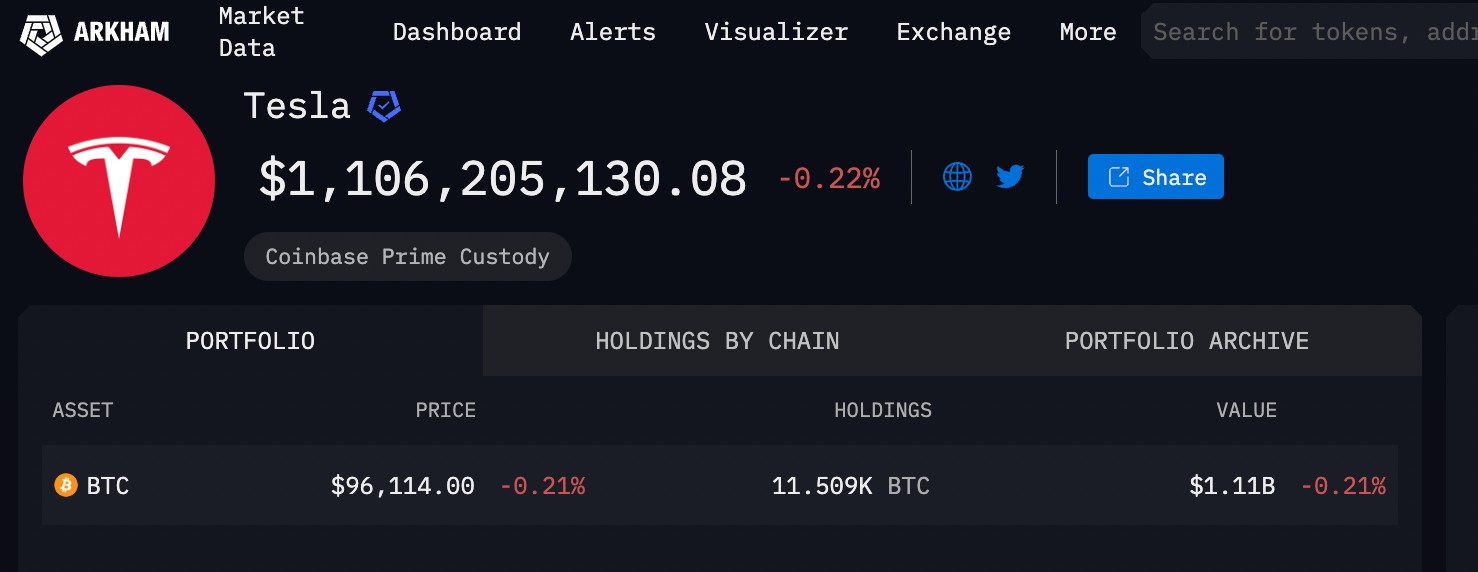
Elon Musk's crypto portfolio includes Bitcoin, Ethereum, and Dogecoin. In 2021, Tesla bought $1.5B in BTC and still holds 11.5K BTC (~$1.11B) in 2025. Musk frequently promotes Dogecoin, even allowing it for Tesla merch purchases, often driving its price up. While he hasn’t disclosed his Ethereum holdings, he admits to owning some. His crypto assets exceed $1B, and his influence continues to impact the market.
Elon Musk’s involvement in crypto has made waves, from backing Dogecoin to Tesla’s Bitcoin investments. His tweets alone have sent prices soaring or crashing, proving how much influence he holds in the space.
Musk hasn’t shared exactly how much crypto he owns, but reports and blockchain data hint at holdings in Bitcoin, Dogecoin, and Ethereum. Tesla and SpaceX have also made big crypto moves, fueling speculation about how he’s positioning himself in the market.
In this article, we explore what cryptocurrency does Elon Musk own, his strategic investments, and the broader impact of his ventures on the crypto market.
Exploring Elon Musk crypto portfolio

Elon Musk’s crypto portfolio isn’t just about what he holds — it’s about how he moves markets and shapes the industry.
Tesla’s Bitcoin stash is key. Tesla still owns a massive amount of BTC, and when it buys or sells, the market reacts. Check earnings reports, not just Musk’s tweets.
Dogecoin is more than hype. Musk keeps pushing Dogecoin, and it’s now accepted for payments by some big companies. Watch who’s adding it next.
Ethereum is in the background. Musk owns ETH, but he doesn’t talk about it much. Pay attention to any Ethereum projects he quietly supports.
Regulations shape his moves. Musk doesn’t operate in a vacuum — his crypto plays often align with changing U.S. laws. His actions hint at what’s coming.
SpaceX could make crypto history. SpaceX has teased crypto use for space payments. If it happens, it could open up an entirely new market.
Elon Musk's crypto investments: An overview
Elon Musk’s engagement with cryptocurrencies started with Tesla’s BTC purchase but has expanded over time, encompassing various coins and blockchain projects.
How Elon Musk’s Crypto portfolio evolved over time:
By early 2025, Elon Musk's journey with cryptocurrencies has seen notable changes:
2019. Musk shared that he owned a small amount of Bitcoin, about 0.25 BTC, gifted by a friend.
2021. Tesla bought $1.5 billion in Bitcoin and started accepting it for car purchases but stopped due to environmental worries.
2021. Musk mentioned he personally holds Bitcoin, Ethereum, and Dogecoin.
2022. Tesla sold most of its Bitcoin holdings, saying they needed cash during uncertain times.
2023-2024. Musk kept engaging with the Dogecoin community, leading many to wonder how much he owns.
2025. In January, Tesla reported it still holds about 9,720 Bitcoins, worth around $1.076 billion.
X Money Initiative. In 2025, Musk announced the upcoming launch of "X Money," a payment system integrated into the X platform (formerly Twitter). This system aims to merge social media, payments, and cryptocurrency, potentially supporting transactions in Bitcoin and Dogecoin. Department of Government efficiency (DOGE). Musk's involvement in the Department of Government Efficiency (DOGE), a government initiative aimed at reducing federal spending, has garnered attention. Notably, he offered a position to Dogecoin founder Shibetoshi Nakamoto, highlighting his continued support for the cryptocurrency.
Influence on XRP. A recent tweet by Musk regarding XRP has ignited widespread speculation about its potential impact on the cryptocurrency market and investors.
Breakdown of Elon Musk’s cryptocurrency holdings
Elon Musk Bitcoin holdings (BTC)
Total holdings. As of early 2025, Tesla holds approximately 11.509K bitcoins, valued at around $1.11 billion.
Accumulation strategy. Tesla initially acquired Bitcoin in early 2021 as part of its corporate treasury strategy.
Projected growth. Despite selling a portion of its holdings, Tesla continues to hold a significant amount of Bitcoin, reflecting its belief in the cryptocurrency's long-term value.
Market influence. Tesla's initial investment in Bitcoin contributed to a significant increase in the cryptocurrency's price.
Elon Musk Dogecoin holdings (DOGE)
Elon Musk's public endorsements have significantly influenced Dogecoin's price movements. His tweets and public statements have often led to notable fluctuations in DOGE's value.
Integration into Tesla merchandise. Tesla has accepted Dogecoin as payment for merchandise, reflecting Musk's support for the cryptocurrency.
Potential use in X payments. Musk has suggested that Dogecoin could be utilized for transactions on X (formerly Twitter), indicating a possible future application.
Significant market impact. Following Musk's appearance on Saturday Night Live in 2021, Dogecoin experienced a substantial price surge, highlighting his influence on the market.
Speculative holdings. While exact figures are unknown, Musk has indicated that he owns a considerable amount of Dogecoin.
Elon Musk Ethereum (ETH)
Total holdings. Exact amount is unknown, but Elon Musk confirmed he owns Ethereum.
Accumulation strategy. Likely acquired during the DeFi boom of 2020-2021.
Projected growth. Elon Musk has praised Ethereum’s smart contract capabilities, but his involvement remains indirect.
Influence on DeFi. Elon Musk’s comments have historically influenced Ethereum’s price trends.
Elon Musk's business ventures and crypto connections
Tesla’s role in crypto
Tesla initially accepted BTC for payments, then reversed its decision, citing environmental concerns.
Tesla still holds a small portion of BTC on its balance sheet.
SpaceX and crypto
SpaceX also purchased Bitcoin, though details remain scarce.
The company planned the DOGE-1 mission to the Moon, fully funded in Dogecoin.
Twitter (X) and crypto integration
Since acquiring Twitter (now X), Elon Musk has hinted at potential crypto payment integrations.
Dogecoin remains a speculative candidate for transactions on the platform.
Challenges: Potential legal and regulatory barriers to integrating crypto payments on X.
Future outlook: What’s next for Elon Musk in crypto?
Dogecoin’s future looks bigger than memes. Musk’s constant backing keeps Dogecoin in the spotlight, and his role in the Department of Government Efficiency (DOGE) only strengthens the connection. Traders are speculating whether Dogecoin will get real-world use cases beyond just internet jokes.
Big companies might follow Musk’s crypto experiments. Tesla isn’t the only one testing crypto — SpaceX’s DOGE-1 Moon mission, funded entirely in Dogecoin, shows that Musk isn’t done pushing crypto into corporate projects. If this succeeds, other companies might start looking at crypto for funding and payments.
X Money could bring a Musk-backed stablecoin. There’s talk that Musk might launch his own stablecoin through X Money. If that happens, it could make crypto payments easier within the X platform, bringing digital currency into everyday transactions.
Musk’s moves keep investors on edge. Crypto prices often jump or crash based on Musk’s tweets and business decisions. Traders constantly watch his next steps, knowing that a single comment from him can shake the entire market.
Risks and warnings
Market volatility. Cryptocurrencies associated with Elon Musk, especially Dogecoin and Bitcoin, are highly volatile. His social media activity often causes abrupt price fluctuations, which may lead to significant gains or losses for investors.
Regulatory uncertainty. Governments worldwide are tightening regulations of cryptocurrencies, and any new policies could impact Musk’s holdings or the usability of digital assets. Potential SEC scrutiny over Musk’s influence on crypto markets remains a key risk.
Liquidity risks. Assets like Dogecoin may experience liquidity issues, particularly during market downturns. This could make it difficult for investors to execute large trades without experiencing significant price slippage.
Market manipulation concerns. Musk’s ability to influence the market through his endorsements raises concerns about price manipulation. His tweets and public statements have historically led to speculative trading, which may not always align with long-term market fundamentals.
Cybersecurity threats. The risk of hacking and cybersecurity breaches remains high in the cryptocurrency space. Given Musk’s involvement in crypto transactions, any potential breach in Tesla, SpaceX, or X’s crypto-related infrastructure could result in substantial financial and reputational damage.
Environmental concerns. Musk has previously criticized Bitcoin mining’s environmental impact, leading Tesla to halt Bitcoin payments. Future sustainability concerns could further shape his crypto stance, influencing investor sentiment and adoption trends.
Given the volatility and regulatory uncertainties surrounding assets frequently associated with Elon Musk, choosing the right exchange is critical. Liquidity depth, fee structure, security standards, and compliance framework can significantly affect execution quality and risk exposure. Below is a comparison of major exchanges that provide access to Bitcoin, Ethereum, and Dogecoin.
| Kraken | Coinbase | OKX | Nebeus | Crypto.com | |
|---|---|---|---|---|---|
|
Min. Deposit, $ |
10 | 10 | 10 | 5 | 1 |
|
Coins Supported |
278 | 249 | 329 | 30 | 250 |
|
Spot Taker fee, % |
0.4 | 0.5 | 0.1 | Not available | 0.5 |
|
Spot Maker Fee, % |
0.25 | 0.5 | 0.08 | Not available | 0.25 |
|
Alerts |
Yes | Yes | Yes | No | Yes |
|
Copy trading |
Yes | No | Yes | No | No |
|
TU overall score |
8.7 | 8.46 | 8.44 | 7.84 | 7.24 |
|
Open an account |
Go to broker Your capital is at risk. |
Go to broker Your capital is at risk. |
Go to broker Your capital is at risk. |
Go to broker Your capital is at risk.
|
Go to broker Your capital is at risk. |
Elon Musk’s 2026 crypto portfolio signals where smart money is going

Most people assume Musk only holds Bitcoin, Dogecoin, and Ethereum, but his investment patterns hint at deeper plays. His continued backing of Dogecoin isn’t just meme hype — it’s strategic. Musk’s influence over X (formerly Twitter) and his push toward integrating digital payments mean Dogecoin could evolve into a real utility token. If X enables DOGE payments for tipping, subscriptions, or even business transactions, its use case will skyrocket. Tracking X’s upcoming financial features can give a head start on potential DOGE rallies.
Another overlooked angle is Musk’s quiet interest in AI and Web3 infrastructure tokens. With Tesla, SpaceX, and Neuralink all advancing AI-driven technologies, crypto projects focusing on decentralized AI computing, such as Render (RNDR) or Fetch.ai (FET), might align with his long-term vision. If Musk ever backs or funds an AI-based blockchain initiative, expect a surge in demand for these tokens. Following his AI ventures and partnerships could help spot the next major crypto breakout before the hype begins.
Conclusion
Elon Musk’s crypto portfolio in 2026 stands as a testament to his enduring impact on digital finance, with significant holdings in Bitcoin and select altcoins driving widespread market trends. Musk’s strategic choices, such as doubling down on Bitcoin and adopting rising stars like Dogecoin, underscore his belief in both established and experimental blockchain technologies. His influence not only steers investor sentiment but also accelerates innovation within the crypto space. Ultimately, Musk’s portfolio reminds us that when visionaries embrace disruptive assets, they don’t just participate—they set the pace for the future.
FAQs
What risks should investors consider when following Elon Musk’s crypto moves?
How has Elon Musk’s approach to Bitcoin evolved since his initial investment?
What role does Dogecoin play in Elon Musk’s crypto portfolio and business strategy?
Are there indications that Elon Musk is interested in cryptocurrencies beyond Bitcoin, Ethereum, and Dogecoin?
Editors' Top Picks and Insights

From “Holy Trinity” to WLD crash: How Arthur Hayes became a market-moving seller
The world's first trillionaire: How Musk built his fortune on electric cars, space and AI
How precious-metals mining revival is reshaping portfolios in 2026
Bitcoin price prediction after CPI rise: Is BTC headed for deeper losses?

Five years with Bitcoin: How El Salvador changed after legalizing BTC

Crypto on the court: How NBA Finals became a showcase for Ledger
Related Articles
Team that worked on the article
Parshwa is a content expert and finance professional possessing deep knowledge of stock and options trading, technical and fundamental analysis, and equity research. As a Chartered Accountant Finalist, Parshwa also has expertise in Forex, crypto trading, and personal taxation.
Dan Blystone began his trading career in 1998 as an arbitrage clerk on the floor of the Chicago Mercantile Exchange (CME). He later traded bond and Eurex futures at proprietary firms such as Altea Trading, gaining valuable experience in high-frequency trading and risk management.
Chinmay Soni is a financial analyst with more than 5 years of experience in working with stocks, Forex, derivatives, and other assets. As a founder of a boutique research firm and an active researcher, he covers various industries and fields, providing insights backed by statistical data.
CFD is a contract between an investor/trader and seller that demonstrates that the trader will need to pay the price difference between the current value of the asset and its value at the time of contract to the seller.
Risk management is a risk management model that involves controlling potential losses while maximizing profits. The main risk management tools are stop loss, take profit, calculation of position volume taking into account leverage and pip value.
Volatility refers to the degree of variation or fluctuation in the price or value of a financial asset, such as stocks, bonds, or cryptocurrencies, over a period of time. Higher volatility indicates that an asset's price is experiencing more significant and rapid price swings, while lower volatility suggests relatively stable and gradual price movements.
Options trading is a financial derivative strategy that involves the buying and selling of options contracts, which give traders the right (but not the obligation) to buy or sell an underlying asset at a specified price, known as the strike price, before or on a predetermined expiration date. There are two main types of options: call options, which allow the holder to buy the underlying asset, and put options, which allow the holder to sell the underlying asset.
Index in trading is the measure of the performance of a group of stocks, which can include the assets and securities in it.

-
 Afghanistan
-
 Albania
-
 Algeria
-
 Angola
-
 Argentina
-
 Armenia
-
 Australia
-
 Austria
-
 Azerbaijan
-
 Bahamas
-
 Bahrain
-
 Bangladesh
-
 Belarus
-
 Belgium
-
 Bolivia
-
 Botswana
-
 Brazil
-
 Brunei
-
 Bulgaria
-
 Cambodia
-
 Cameroon
-
 Canada
-
 Chile
Chile
-
 China
China
-
 Colombia
-
 Congo
Congo
-
 Costa Rica
-
 Cote d'Ivoire
-
 Croatia
-
 Cuba
Cuba
-
 Cyprus
-
 Czechia
-
 DR Congo
-
 Denmark
-
 Dominican Republic
-
 Ecuador
-
 Egypt
Egypt
-
 El Salvador
-
 Estonia
-
 Eswatini
-
 Ethiopia
-
 Finland
-
 France
-
 Georgia
-
 Germany
-
 Ghana
Ghana
-
 Greece
-
 Haiti
Haiti
-
 Hong Kong
-
 Hungary
-
 India
India
-
 Indonesia
-
 Iran, Islamic republic
-
 Iraq
Iraq
-
 Ireland
-
 Israel
-
 Italy
Italy
-
 Jamaica
-
 Japan
Japan
-
 Jordan
-
 Kazakhstan
-
 Kenya
Kenya
-
 Korea
Korea
-
 Kuwait
-
 Kyrgyzstan
-
 Laos
Laos
-
 Latvia
-
 Lebanon
-
 Lesotho
-
 Libya
Libya
-
 Lithuania
-
 Luxembourg
-
 Madagascar
-
 Malaysia
-
 Malta
Malta
-
 Mauritius
-
 Mexico
-
 Moldova
-
 Mongolia
-
 Montenegro
-
 Morocco
-
 Mozambique
-
 Myanmar
-
 Namibia
-
 Nepal
Nepal
-
 Netherlands
-
 New Zealand
-
 Nigeria
-
 North Macedonia
-
 Norway
-
 Oman
Oman
-
 Pakistan
-
 Palestine
-
 Panama
-
 Papua New Guinea
-
 Paraguay
-
 Peru
Peru
-
 Philippines
-
 Poland
-
 Portugal
-
 Puerto Rico
-
 Qatar
Qatar
-
 Reunion
-
 Romania
-
 Rwanda
-
 Saudi Arabia
-
 Serbia
-
 Singapore
-
 Slovakia
-
 Slovenia
-
 Somalia
-
 South Africa
-
 Spain
Spain
-
 Sri Lanka
-
 Sweden
-
 Switzerland
-
 Syria
Syria
-
 Taiwan
-
 Tajikistan
-
 Tanzania
-
 Thailand
-
 Trinidad and Tobago
-
 Tunisia
-
 Turkey
-
 UAE
UAE
-
 Uganda
-
 Ukraine
-
 United Kingdom
-
United States
-
 Uruguay
-
 Uzbekistan
-
 Venezuela
-
 Vietnam
-
 Yemen
Yemen
-
 Zambia
-
 Zimbabwe
- Forex
- Crypto












