The tweet was deleted by the author.
But we saved everything 🙂.
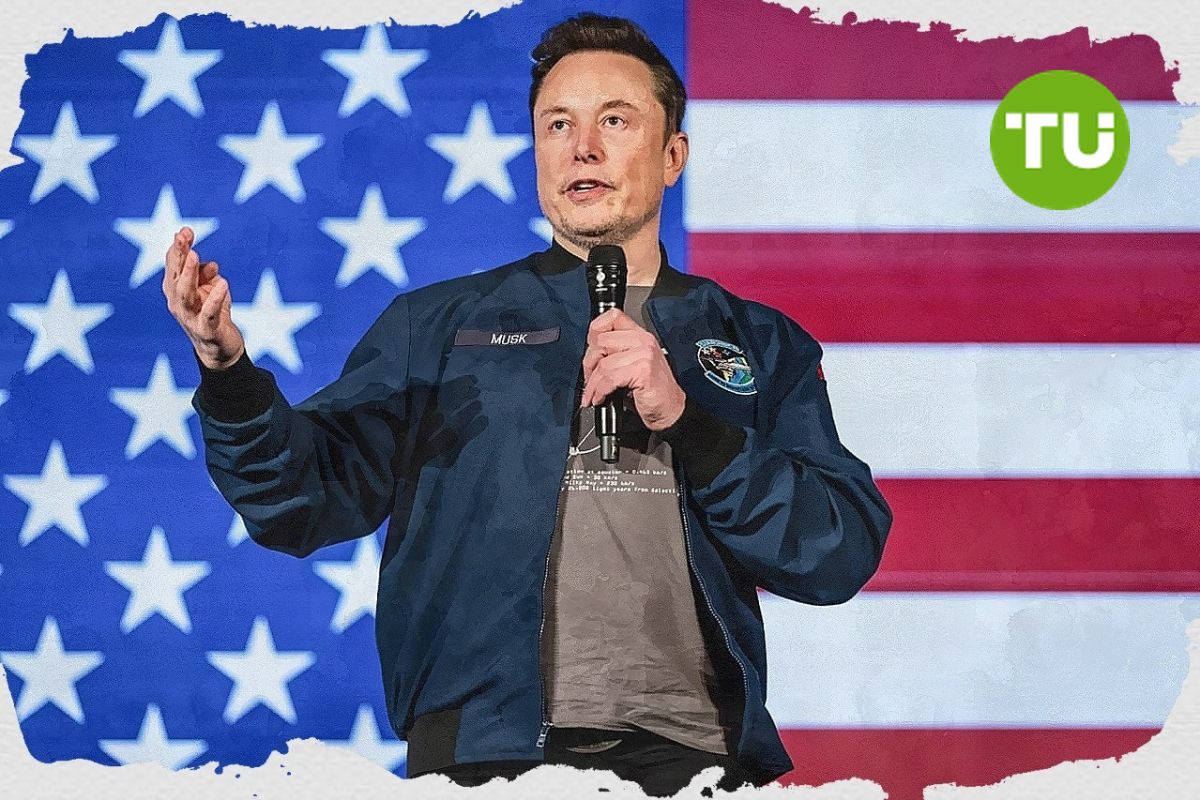
Elon Musk is on the verge of becoming the world’s first trillionaire. This is thanks to SpaceX’s record-breaking IPO, which valued the company at nearly $1.8 trillion. His path to this fortune is not only the story of Tesla and the space business, but also his ability to repeatedly place himself at the forefront of major technological trends.
SpaceX raised $75 billion by selling 555.6 million shares at $135 each. It was the largest IPO in market history: by comparison, Saudi Aramco raised less than half that amount — $29.4 billion — in 2019. And this may not be the end, as SpaceX’s total offering could rise to $86 billion.
At the IPO price of $135 per share, SpaceX’s market value stood at $1.77 trillion. Including employee stock options and restricted shares, the company’s fully diluted valuation reaches about $1.8 trillion. This puts SpaceX among the world’s largest public companies and makes it more valuable than Tesla, Musk’s other key company.
For Musk himself, the IPO became the main step toward a trillion-dollar fortune. According to Bloomberg estimates, after the listing, his paper wealth increased by roughly $275 billion to $971 billion. His stake in SpaceX, including options, is valued at about $688 billion.
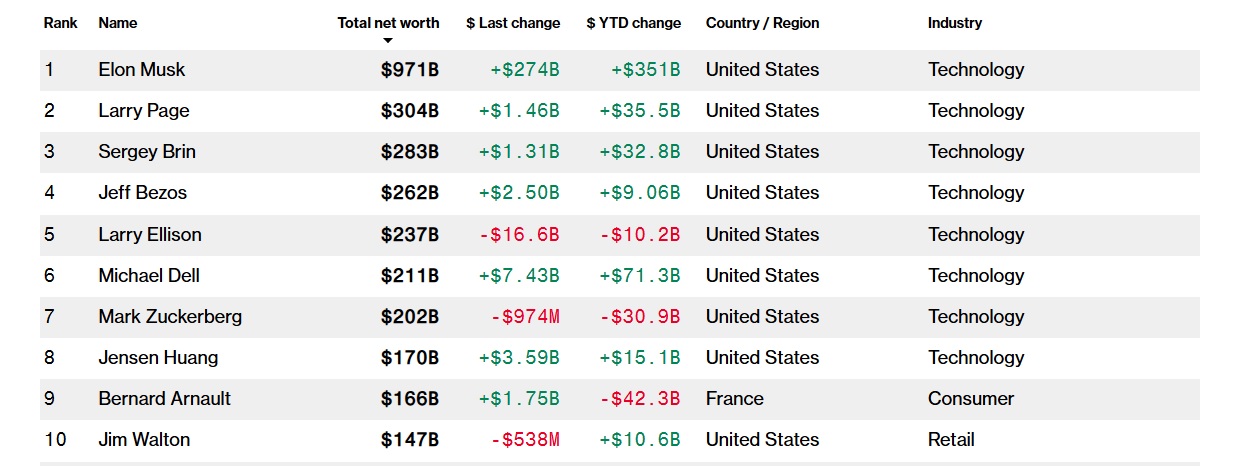
Ranking of the world’s richest people. Source: Bloomberg Billionaires Index
There is also a higher estimate. According to Forbes and Reuters calculations based on company filings, Musk’s wealth could exceed $1.1 trillion after trading begins, taking into account his stakes in SpaceX and Tesla.
Musk’s main asset is not only his stakes in companies, but also his ability to enter markets at the moment when they attract strong investor interest. This was the case with electric cars, space, cryptocurrencies, social media and now artificial intelligence. In each case, Musk did not simply launch a product or buy an asset — he turned the topic into a market event.
The first such story was Tesla. Musk became CEO in 2008, when electric cars were not yet a mass market and major automakers treated them with caution. Tesla turned EVs into expensive, fast and technologically advanced products, rather than just an eco-friendly alternative to gasoline cars. As a result, the company became the world’s most valuable automaker, and in recent years its market capitalization has steadily exceeded $1 trillion.
Cryptocurrencies did not become the foundation of Musk’s fortune, but they demonstrated the scale of his influence over retail investors. Tesla bought bitcoin, while Musk actively commented on the market, especially Dogecoin. His posts on Twitter could sharply move the price of DOGE, and his later $44 billion purchase of the platform gave him a direct channel to a global audience. After Twitter was renamed X, the social network became part of his personal infrastructure of influence: he uses it to comment on markets, argue with regulators and promote his own projects.
Space became the most valuable part of this strategy. SpaceX began as a risky rocket-launch project, but over time it turned into a company that combines reusable rockets, Starlink satellite internet, government contracts and plans in AI infrastructure.
Musk’s new bet is artificial intelligence. After buying Twitter, he created xAI and launched the Grok chatbot, which became one of ChatGPT’s main competitors. For Musk, this is not just another product: AI is meant to become part of a broader ecosystem in which X provides data and audience, xAI develops models, and SpaceX and Starlink provide infrastructure.
It was the AI story that helped SpaceX sharply increase its valuation ahead of the IPO. Within a few months, the company was no longer seen only as a rocket and satellite internet business. In investor materials, it was already described as a future player in the computing infrastructure market, with data centers in space, new satellites and the ability to serve growing demand for AI computing power.
According to the Financial Times, at a valuation of $1.78 trillion, SpaceX is trading at about 92 times its revenue over the past 12 months, which totaled around $19 billion. A significant part of its future valuation depends on technologies that have not yet proven their effectiveness at scale: orbital data centers, satellites for AI computing and new infrastructure beyond Earth.
SpaceX’s record valuation is not based only on its current business. The company has raised a huge amount of money, but its most expensive plans — data centers in space, AI satellites and a colony on Mars — still have to be implemented in practice. Investors are paying upfront for a scenario in which Musk once again creates a market before everyone else.
The main risk is that everything is tied to one person. After the IPO, Musk retains control of 84% of the voting power in SpaceX and can effectively determine the composition of the board of directors. For the market, this is both an advantage and a weakness: his name helps sell the future, but any conflict, political statement or missed deadline could quickly damage confidence in the company.
Skeptics are already calling the SpaceX IPO a bet on “hopes and dreams” rather than profit. The company will have to prove that its new projects can become real businesses, not just a compelling story for investors.
Musk’s path to trillionaire status shows how much the logic of valuing technology companies has changed. His wealth has not grown only on cars sold, rockets launched or satellite internet subscriptions. It has grown on expectations that Tesla, SpaceX, Starlink, xAI and X can take key positions in markets that are still being formed.
Now Musk needs to back up that valuation with results. SpaceX must turn its record IPO, AI infrastructure and plans for space-based data centers into a sustainable business, while Tesla must hold its ground in an increasingly competitive EV market. If that happens, the status of the first trillionaire will become not only a paper record, but also a symbol of how belief in a technological future turned into the largest personal fortune in history.

 Afghanistan
 Albania
 Algeria
 Angola
 Argentina
 Armenia
 Australia
 Austria
 Azerbaijan
 Bahamas
 Bahrain
 Bangladesh
 Belarus
 Belgium
 Bolivia
 Botswana
 Brazil
 Brunei
 Bulgaria
 Cambodia
 Cameroon
 Canada
 Chile
Chile
 China
China
 Colombia
 Congo
Congo
 Costa Rica
 Cote d'Ivoire
 Croatia
 Cuba
Cuba
 Cyprus
 Czechia
 DR Congo
 Denmark
 Dominican Republic
 Ecuador
 Egypt
Egypt
 El Salvador
 Estonia
 Eswatini
 Ethiopia
 Finland
 France
 Georgia
 Germany
 Ghana
Ghana
 Greece
 Haiti
Haiti
 Hong Kong
 Hungary
 India
India
 Indonesia
 Iran, Islamic republic
 Iraq
Iraq
 Ireland
 Israel
 Italy
Italy
 Jamaica
 Japan
Japan
 Jordan
 Kazakhstan
 Kenya
Kenya
 Korea
Korea
 Kuwait
 Kyrgyzstan
 Laos
Laos
 Latvia
 Lebanon
 Lesotho
 Libya
Libya
 Lithuania
 Luxembourg
 Madagascar
 Malaysia
 Malta
Malta
 Mauritius
 Mexico
 Moldova
 Mongolia
 Montenegro
 Morocco
 Mozambique
 Myanmar
 Namibia
 Nepal
Nepal
 Netherlands
 New Zealand
 Nigeria
 North Macedonia
 Norway
 Oman
Oman
 Pakistan
 Palestine
 Panama
 Papua New Guinea
 Paraguay
 Peru
Peru
 Philippines
 Poland
 Portugal
 Puerto Rico
 Qatar
Qatar
 Reunion
 Romania
 Rwanda
 Saudi Arabia
 Serbia
 Singapore
 Slovakia
 Slovenia
 Somalia
 South Africa
 Spain
Spain
 Sri Lanka
 Sweden
 Switzerland
 Syria
Syria
 Taiwan
 Tajikistan
 Tanzania
 Thailand
 Trinidad and Tobago
 Tunisia
 Turkey
 UAE
UAE
 Uganda
 Ukraine
 United Kingdom
United States
United Kingdom
United States
 Uruguay
 Uzbekistan
 Venezuela
 Vietnam
 Yemen
Yemen
 Zambia
 Zimbabwe